Tigermed(300347)

Search documents
9月15日生物经济(970038)指数涨0.91%,成份股福瑞股份(300049)领涨
Sou Hu Cai Jing· 2025-09-15 10:31
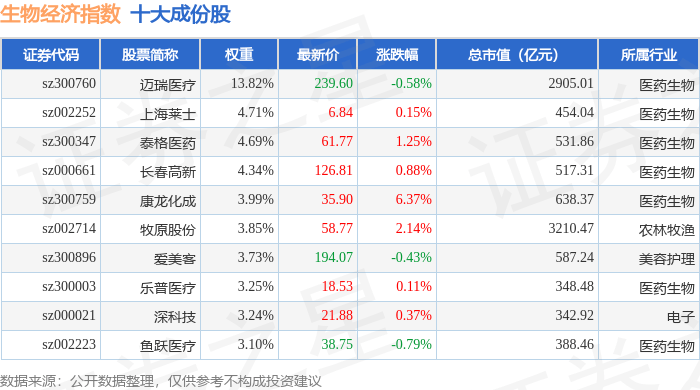
Core Points - The Bioeconomy Index (970038) closed at 2418.21 points on September 15, with a gain of 0.91% and a trading volume of 34.584 billion yuan, resulting in a turnover rate of 2.15% [1] - Among the index constituents, 21 stocks rose while 29 fell, with Furuide (福瑞股份) leading the gainers at 20.01% and BGI Genomics (华大基因) leading the decliners at 3.11% [1] Index Constituents Summary - The top ten constituents of the Bioeconomy Index include: - Mindray Medical (迈瑞医疗) with a weight of 13.82%, latest price at 239.60 yuan, and a market cap of 290.501 billion yuan [1] - Shijia History (十肖史上) with a weight of 4.71%, latest price at 6.84 yuan, and a market cap of 45.404 billion yuan [1] - Tigermed (泰格医药) with a weight of 4.69%, latest price at 61.77 yuan, and a market cap of 53.186 billion yuan [1] - Changchun High-tech (长春高新) with a weight of 4.34%, latest price at 126.81 yuan, and a market cap of 51.731 billion yuan [1] - Kanglong Chemical (康龙化成) with a weight of 3.99%, latest price at 35.90 yuan, and a market cap of 63.837 billion yuan [1] - Muyuan Foods (牧原股份) with a weight of 3.85%, latest price at 58.77 yuan, and a market cap of 321.047 billion yuan [1] - Aimeike (爱美客) with a weight of 3.73%, latest price at 194.07 yuan, and a market cap of 58.724 billion yuan [1] - Lepu Medical (乐普医疗) with a weight of 3.25%, latest price at 18.53 yuan, and a market cap of 34.848 billion yuan [1] - Shenzhen Technology (深科技) with a weight of 3.24%, latest price at 21.88 yuan, and a market cap of 34.292 billion yuan [1] - Jiao Yue Medical (角跃医疗) with a weight of 3.10%, latest price at 38.75 yuan, and a market cap of 38.846 billion yuan [1] Capital Flow Summary - The Bioeconomy Index constituents experienced a net inflow of 645 million yuan from main funds, while retail investors saw a net outflow of 5.51 billion yuan [3] - Notable capital flows include: - Furuide (福瑞股份) with a net inflow of 356 million yuan from main funds [3] - Wens Foodstuffs (温氏股份) with a net inflow of 209 million yuan from main funds [3] - Kanglong Chemical (康龙化成) with a net inflow of 184 million yuan from main funds [3] - Mindray Medical (迈瑞医疗) with a net inflow of 82 million yuan from main funds [3] - Changchun High-tech (长春高新) with a net inflow of 59 million yuan from main funds [3]





泰格医药涨2.02%,成交额2.38亿元,主力资金净流出698.06万元
Xin Lang Cai Jing· 2025-09-15 02:06
Company Overview - Tiger Med is a clinical research service provider based in Hangzhou, China, specializing in I-IV phase clinical trials, data management, and medical testing services [1][2] - The company was established on December 15, 2004, and went public on August 17, 2012 [1] Financial Performance - For the first half of 2025, Tiger Med reported a revenue of 3.25 billion yuan, a year-on-year decrease of 3.21%, and a net profit attributable to shareholders of 383 million yuan, down 22.22% year-on-year [2] - The company has distributed a total of 2.46 billion yuan in dividends since its A-share listing, with 1.15 billion yuan distributed over the last three years [3] Stock Performance - As of September 15, Tiger Med's stock price increased by 2.02% to 62.24 yuan per share, with a market capitalization of 53.59 billion yuan [1] - Year-to-date, the stock has risen by 14.58%, but it has seen a decline of 7.37% over the last five trading days and 10.45% over the last 20 days [1] Shareholder Structure - As of June 30, 2025, Tiger Med had 51,500 shareholders, a decrease of 4.14% from the previous period [2] - The top shareholders include various funds, with notable changes in holdings among major institutional investors [3]
泰格医药股价连续4天下跌累计跌幅9.2%,摩根基金旗下1只基金持1.81万股,浮亏损失11.19万元
Xin Lang Cai Jing· 2025-09-12 07:31
Group 1 - The core point of the news is that Tiger Med's stock has experienced a decline, with a cumulative drop of 9.2% over the last four days, closing at 61.01 yuan per share on September 12, with a total market capitalization of 52.531 billion yuan [1] - Tiger Med, established on December 15, 2004, and listed on August 17, 2012, specializes in providing professional clinical research services for pharmaceutical and health-related products, covering phases I to IV clinical trials, data management, and other related services [1] - The company's main revenue sources include clinical trial-related services and laboratory services (52.60%), clinical trial technical services (45.21%), and other services (2.19%) [1] Group 2 - Morgan Fund holds a position in Tiger Med through the Morgan CSI Innovative Drug Industry ETF (560900), which reduced its holdings by 3,000 shares in the second quarter, now holding 18,100 shares, accounting for 2.76% of the fund's net value [2] - The Morgan CSI Innovative Drug Industry ETF has a total scale of 34.9084 million, with a year-to-date return of 40.82% and a one-year return of 60.71% [2] - The fund manager, Mao Shichao, has been in position for 5 years and 128 days, with the fund's best return during this period being 56.22% and the worst being -24.75% [3]
医疗服务板块9月11日跌0.76%,诺思格领跌,主力资金净流出11.95亿元



Sou Hu Cai Jing· 2025-09-11 08:57
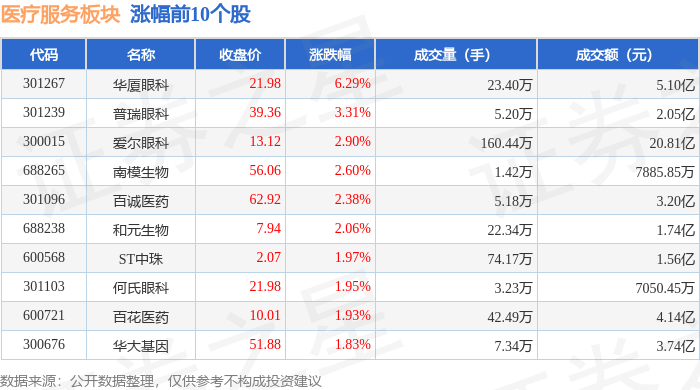
Core Viewpoint - The medical services sector experienced a decline of 0.77% on September 11, with notable losses from Nuo Si Ge, while the overall market indices, including the Shanghai Composite Index and Shenzhen Component Index, saw increases of 1.65% and 3.36% respectively [1]. Group 1: Market Performance - The Shanghai Composite Index closed at 3875.31, up 1.65% [1]. - The Shenzhen Component Index closed at 12979.89, up 3.36% [1]. - The medical services sector's performance was mixed, with individual stocks showing varying degrees of gains and losses [1]. Group 2: Individual Stock Performance - Notable gainers included: - Shengku Medical (301267) with a closing price of 21.98, up 6.29% on a trading volume of 234,000 shares and a turnover of 510 million yuan [1]. - Yinrui Eye Care (301239) closed at 39.36, up 3.31% with a turnover of 205 million yuan [1]. - Yuaner Eye Care (300015) closed at 13.12, up 2.90% with a turnover of 2.081 billion yuan [1]. - Major decliners included: - Nuo Si Ge (301333) closed at 56.45, down 5.93% with a turnover of 379 million yuan [2]. - Pu Ren Si (301257) closed at 48.35, down 5.29% with a turnover of 301 million yuan [2]. - Tai Ge Medical (300347) closed at 61.22, down 4.67% with a turnover of 2.135 billion yuan [2]. Group 3: Capital Flow Analysis - The medical services sector saw a net outflow of 1.195 billion yuan from institutional investors, while retail investors contributed a net inflow of 1.159 billion yuan [2][3]. - Specific stock capital flows indicated: - Yuaner Eye Care (300015) had a net inflow of 128 million yuan from institutional investors [3]. - Tai Ge Medical (300347) experienced a net outflow of 93.72 million yuan from institutional investors [3]. - International Medical (000516) had a net inflow of 12.97 million yuan from retail investors [3].
港股收盘|三大指数集体回调 泰格医药领跌相关个股
Sou Hu Cai Jing· 2025-09-11 08:45
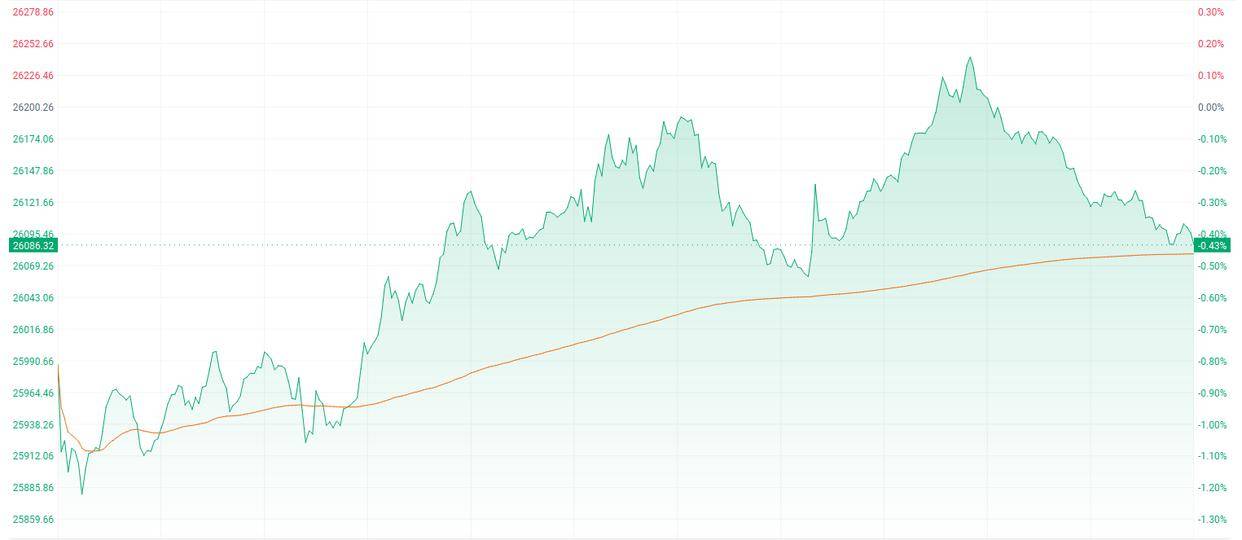
Market Overview - The Hong Kong stock market experienced a collective pullback, with the Hang Seng Index down 0.43% to 26,086.32 points, the Tech Index down 0.24% to 5,888.77 points, and the National Enterprises Index down 0.73% to 9,260.25 points [1][2]. Semiconductor Sector - The semiconductor sector led the market with notable gains, including InnoCare (02577.HK) up 9.25%, SMIC (00981.HK) up 4.97%, and Shanghai Fudan (01385.HK) up 5.37% [4][5]. - TSMC reported a revenue of NT$335.77 billion for August 2025, marking a year-on-year increase of 33.8% and a quarter-on-quarter increase of 3.9%, boosting market expectations for AI infrastructure development [6]. Telecommunications Equipment - Telecommunications equipment stocks also saw strong performance, with ZTE (00763.HK) up 7.50%, and China Tower (00788.HK) up 3.19% [8]. Nonferrous Metals - Nonferrous metal stocks were buoyed by interest rate cut expectations, with Jinli Permanent Magnet (06680.HK) up 6.04% and Luoyang Molybdenum (03993.HK) up 4.79% [9][10]. - Minsheng Securities noted that industrial metal supply remains constrained while domestic demand remains resilient, suggesting a potential upward trend in metal prices [11]. Cement Sector - The cement sector benefited from price increases, with Huaxin Cement (06655.HK) up 4.94% and China National Building Material (03323.HK) up 3.38% [12][13]. - Research indicated that cement prices in the Pearl River Delta region are expected to rebound due to seasonal demand and reduced supply [14]. Pharmaceutical Sector - Pharmaceutical stocks faced downward pressure, with Tigermed (03347.HK) down 9.36% and Zai Lab (06160.HK) down 5.87% [15][16]. - Market rumors about potential restrictions on innovative drugs from China to the U.S. have not significantly altered long-term expectations for these companies [17][18]. New Consumption Sector - New consumption stocks showed weakness, with Maogeping (01318.HK) down 4.73% and Laopu Gold (06181.HK) down 3.51% [19][20]. - Despite the current underperformance, institutions remain optimistic about the growth potential of new consumption companies, driven by changing consumer behaviors among the Z generation [21]. Individual Stock Movements - China Gold International (02099.HK) rose 2.70% amid increasing expectations for U.S. interest rate cuts [22]. - Tenghong Precision (06088.HK) surged 12.79% following the announcement of new Apple products, including new iPhones and AirPods [23][24].

一纸行政令草案震动医药圈!港、A医药股齐挫
Ge Long Hui· 2025-09-11 04:21
Core Viewpoint - A proposed executive order from the Trump administration is causing significant turmoil in the biopharmaceutical market, with major declines in stock prices for several companies [1][6]. Market Reaction - In the A-share market, companies such as Nossger, Huyou Pharmaceutical, and Tigermed saw declines exceeding 5%, with others like Yaoshi Technology and WuXi AppTec also following suit [1][2]. - The Hong Kong market's innovative drug concept index initially dropped over 7%, later narrowing to a 4.39% decline by midday [2]. Proposed Policy Impact - The New York Times reported that the proposed policy would require the FDA to conduct stricter reviews of clinical trial data from China, with companies submitting such data facing higher regulatory fees [3]. - If implemented, these restrictions could disrupt the U.S. pharmaceutical industry and affect the supply of all types of drugs, from generics to advanced therapies [6]. Industry Concerns - Analysts express that this "black swan" event could lead to a global supply chain restructuring, similar to the trade war during Trump's first term [7]. - The potential for drug shortages and rising prices in the U.S. market is a significant concern, particularly for generic drugs [7]. Investment Sentiment - Investor sentiment is divided, with some viewing the situation as a short-term emotional shock, while others worry that the end of the U.S. market could signal the end of the Chinese innovative drug bull market [9]. - Historical data suggests that after similar events, the pharmaceutical sector typically experiences a rebound within 2-4 weeks, with potential gains of 15%-20% [9].


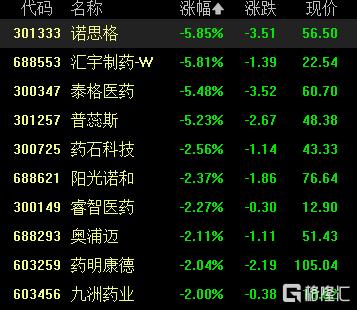
港股医药股跌幅扩大 泰格医药跌超14%
Mei Ri Jing Ji Xin Wen· 2025-09-11 01:53
Core Viewpoint - The Hong Kong pharmaceutical sector experienced significant declines, with major companies facing substantial stock price drops on September 11. Company Performance - Tigermed (03347.HK) saw a decline of 14.06% - Viva Biotech (01873.HK) dropped by 11.85% - Kanglong Chemical (03759.HK) fell by 10% - Zai Lab (06172.HK) decreased by 8.26% [1]
创新药概念股大幅低开
Di Yi Cai Jing Zi Xun· 2025-09-11 01:49
Market Overview - The A-share market opened with mixed results, with the Shanghai Composite Index down by 0.16%, the Shenzhen Component Index up by 0.11%, and the ChiNext Index up by 0.46% [3][4] - The Hang Seng Index opened down by 0.81%, and the Hang Seng Tech Index fell by 0.97% [6][7] Pharmaceutical Sector Performance - The innovative drug concept stocks experienced significant declines, with BeiGene falling over 10%, WuXi AppTec and Tigermed down over 7%, and several other companies like Hengrui Medicine, Junshi Biosciences, and Kelun Pharmaceutical dropping over 5% [2][6] - The pharmaceutical sector as a whole saw a downturn, with various sub-sectors such as medical services, weight loss drugs, and CRO concepts all reporting negative performance, with declines ranging from -1.13% to -1.99% [5] Notable Stock Movements - Specific stocks such as Hansoh Pharmaceutical and WuXi Biologics dropped over 10%, while Jiangsu Hengrui Medicine and Junshi Biosciences also faced significant losses [6] - Conversely, some stocks like Jiujiuwang Pharmaceutical saw a rise of 5% despite the overall market trend [6]



创新药,大跌
中国基金报· 2025-09-11 01:49
Market Overview - On September 11, the Shanghai Composite Index opened down 0.16%, while the ChiNext Index rose by 0.46% [1] - Pharmaceutical stocks experienced significant declines, with companies like BeiGene, WuXi AppTec, and Tigermed opening down over 7% [1] - Over 4,400 stocks were down, with innovative drug concept stocks like BeiGene and Tigermed seeing declines exceeding 10% [1] Index Performance - The Sci-Tech 50 Index stood at 1247.69, down 0.91% [3] - The ChiNext Index was at 2907.80, up 0.12% [3] - The CSI 300 Index was at 4432.68, down 0.29% [3] - The total number of stocks that declined in the Wande All A Index was 4456, while 870 stocks rose [3] Pharmaceutical Sector Performance - The innovative drug index fell by 4.08%, with a net outflow of 17.83 billion [4] - Major pharmaceutical companies like BeiGene and Tigermed saw declines of 10.57% and 10.68%, respectively [5][6] - Other pharmaceutical indices, such as monoclonal antibody and generic drug indices, also reported declines of 4.05% and 3.71% [4] Notable Stock Movements - BeiGene (688235) traded at 283.50, down 10.57% with a market cap of 12.604 billion [5] - Tigermed (300347) traded at 57.36, down 10.68% with a market cap of 147.2 billion [6] - Kanglong Chemical (300759) traded at 30.36, down 7.72% with a market cap of 50%Z [7] Additional Pharmaceutical Stocks - Other notable declines included companies like Aopumai, Bidu Pharmaceutical, and Kailai Ying, with declines ranging from 5.91% to 6.30% [9]


A股早评:创业板指高开0.46%,算力硬件概念股活跃!青山纸业8天5板,东山精密、中际旭创涨超4%,新诺威、泰格医药跌超10%
Ge Long Hui· 2025-09-11 01:47
Market Overview - The A-share market opened with mixed performance among the three major indices, with the Shanghai Composite Index down by 0.16%, the Shenzhen Component Index up by 0.11%, and the ChiNext Index up by 0.46% [1] Sector Performance - The computing power hardware sector, including CPO and liquid-cooled servers, showed significant activity, with companies like Qingshan Paper (600103) achieving five consecutive trading limits in eight days, and Dongshan Precision (002384) and Zhongji Xuchuang (300308) rising over 4% [1] - OpenAI and Oracle signed a substantial computing power deal worth $300 billion, indicating strong demand in the sector [1] Pharmaceutical Sector - The pharmaceutical sector opened lower, with companies such as XinNuoWei (300765) and Tigermed (300347) experiencing declines of over 10% [1] Film and Entertainment Sector - The film and cinema sector also opened lower, with companies like Happiness Blue Sea (300528) and Huanrui Century (000892) dropping over 10% and 4% respectively [1]