
TFC(300394)

Search documents
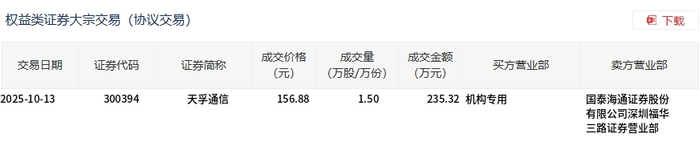
天孚通信今日大宗交易平价成交1.5万股,成交额235.32万元
Xin Lang Cai Jing· 2025-10-13 09:05
Group 1 - On October 13, Tianfu Communication executed a block trade of 15,000 shares, with a transaction amount of 2.3532 million yuan, accounting for 0.07% of the total transaction volume for the day [1][2] - The transaction price was 156.88 yuan, which remained unchanged compared to the market closing price of 156.88 yuan [1][2]


中国网络通信:2025 年第三季度展望-800G 持续强劲,1.6T 订单提前;买入中际旭创、新易盛-China Networking_ 3Q25 Preview_ Ongoing 800G Strength With 1.6T Order Pull-In; Buy Innolight_Eoptolink
2025-10-13 01:00
Summary of Conference Call Notes Industry Overview - The report focuses on the **optical networking industry** in China, specifically companies **Innolight**, **Eoptolink**, and **TFC Optical**. - The industry is expected to experience significant growth driven by **800G technology** and the **pull-in of 1.6T orders**. Key Financial Expectations - **Revenue Growth**: Anticipated revenue growth of approximately **25%-30%** for 3Q25, primarily due to strong demand for **800G** products and increased orders for **1.6T** technology [1][2]. - **Innolight**: Expected to report **Rmb10.5 billion** in revenue and **Rmb3.3 billion** in net profit for 3Q25, reflecting **29%** revenue growth and **37%** net profit growth quarter-over-quarter [1]. - **Eoptolink**: Projected to achieve **Rmb8.3 billion** in revenue and **Rmb3.1 billion** in net profit, indicating **30%** revenue growth and **31%** net profit growth quarter-over-quarter [1]. - **TFC Optical**: Expected to report revenue of **Rmb700 million**, with performance likely in line with expectations due to constraints in **200G EML** despite strong demand for **1.6T** orders [1]. Long-Term Industry Outlook - The long-term outlook for the optical transceiver market remains positive, with improved demand visibility for **FY26-27**. The industry demand is projected to grow by approximately **43% YoY** in FY27, driven by robust demand from **Cloud Service Providers (CSPs)** and advancements in **ASIC technology** [1][2]. Valuation and Target Prices - **Eoptolink**: Target price set at **Rmb472**, based on a **24.0x FY26E** forward PE, reflecting the strong cycle of **800G/1.6T** products [7]. - **Innolight**: Target price established at **Rmb569**, based on a **25x FY26E** forward PE, factoring in margin improvements from higher **SiPh transceiver** sales [9]. - **TFC Optical**: Target price of **Rmb196**, based on a **36.0x FY26E** PE, considering the strength of **1.6T** products and new customer contributions [11]. Risks to Consider - **General Risks**: - Slower-than-expected investments in data centers [8][10][12]. - Lower-than-expected capital expenditures on optical networks by telecommunications companies and government entities in China [8][10][12]. - Margin pressures due to price competition [8][10][12]. - Potential impacts from escalating **China-US tech disputes** [8][10][12]. Conclusion - The optical networking industry in China is poised for significant growth in the upcoming quarters, with key players like Innolight and Eoptolink expected to outperform market expectations. The long-term outlook remains constructive, supported by technological advancements and increasing demand from CSPs. However, investors should remain cautious of potential risks that could impact growth trajectories.
光模块狂飙之下 新易盛董事长高位套现37亿
Zhong Guo Jing Ying Bao· 2025-10-12 15:19
Core Viewpoint - The recent share transfer by the actual controller of Xinyi Sheng, a leading optical module company, has raised concerns about the high valuation of the optical module industry, despite the absence of clear signs of a bubble in the market [1][9]. Group 1: Company Performance - Xinyi Sheng reported a revenue of 8.647 billion yuan in 2024, a year-on-year increase of 179.15%, and a net profit of 2.838 billion yuan, up 312.26% [3]. - In the first half of 2025, the company achieved a revenue of 10.4 billion yuan, a year-on-year growth of 282.64%, with a net profit of 3.942 billion yuan, reflecting a growth of 355.68% [3]. - The stock price of Xinyi Sheng surged from a low of 46.56 yuan per share in April 2023 to a peak of 401.1 yuan per share in September 2023, marking a maximum increase of 761% [3]. Group 2: Market Reaction - Following the announcement of the share transfer, Xinyi Sheng's stock price fell by 4% on October 9, 2023, and by an additional 1.41% on October 10, resulting in a market value loss of over 8.9 billion yuan in just two trading days [4]. - The share transfer was conducted through a pricing inquiry method, attracting 29 institutional investors, with a subscription multiple of 2.6 times, indicating strong interest from the market [4][5]. Group 3: Industry Outlook - The optical module industry is experiencing significant growth driven by advancements in AI and cloud computing, which increase the demand for high-speed data transmission [2][5]. - Experts believe that the optical module sector has a vast development potential, with continuous market demand growth expected due to the rapid evolution of technologies like 5G and AI [5][9]. - Despite concerns about high valuations, the industry is not currently exhibiting clear signs of a bubble, as the growth in demand and technological advancements support long-term development [9][10].
光模块需求喷涌,大牛股4个月狂飙317%
2 1 Shi Ji Jing Ji Bao Dao· 2025-10-12 13:41
Core Insights - The global demand for computing power is expected to surge dramatically, with a forecasted increase of 100,000 times by 2035, driven by AI storage needs growing 500 times [5][6] - Chinese manufacturers are leading the midstream market globally, with companies like Zhongji Xuchuang and Xinyi Sheng achieving significant growth through technological advancements and strategic positioning [6][10] Industry Overview - Huawei's report highlights a shift from 9 billion people to 900 billion smart entities, marking a transition from mobile internet to smart entity internet [5] - The AI computing market is projected to reach $1.2 trillion by 2025, with China accounting for 38% of this market, primarily driven by smart driving, industrial AI, and medical imaging [6][10] Company Performance - Zhongji Xuchuang reported a revenue of 14.789 billion yuan in the first half of 2025, a year-on-year increase of 36.95%, with a net profit of 3.995 billion yuan, up 69.4% [7] - Xinyi Sheng experienced explosive growth, with a revenue of 10.437 billion yuan, a 282.64% increase, and a net profit of 3.942 billion yuan, up 355.68% [10] - Tianfu Communication achieved a revenue of 2.456 billion yuan, a 57.8% increase, with a 91% growth in active optical device business [10] Technological Advancements - The light module technology is evolving rapidly, with a focus on rate iteration, material innovation, and packaging breakthroughs [12] - The transition from 800G to 1.6T modules is becoming mainstream, with significant commercial advancements expected in the coming years [12][13] - Innovations such as CPO and LPO are set to address power consumption challenges while enhancing bandwidth density [13][14] Market Dynamics - The competitive landscape shows that Chinese companies dominate the global midstream market, with Zhongji Xuchuang and Xinyi Sheng ranking among the top three globally [10] - The strategic value of light modules as a core component of AI infrastructure is increasingly recognized, positioning Chinese firms favorably in the global competition [14]

光模块需求喷涌,大牛股4个月狂飙317%
21世纪经济报道· 2025-10-12 13:37
Core Insights - The global demand for computing power is expected to increase dramatically, with a forecasted growth of 100,000 times by 2035, leading to a 500-fold increase in AI storage needs [4][5] - Chinese manufacturers have established a leading position in the global midstream market for optical modules, driven by advancements in technology and production capacity [5][9] Industry Overview - The transition from mobile internet to the Internet of Intelligent Things will expand the number of connected devices from 9 billion to 900 billion by 2035, significantly impacting social life and productivity [4] - The AI computing market is projected to reach $1.2 trillion by 2025, with China accounting for 38% of this market, primarily driven by sectors such as smart driving, industrial AI, and medical imaging [5] Company Performance - Zhongji Xuchuang (中际旭创) reported a revenue of 14.789 billion yuan in the first half of 2025, a year-on-year increase of 36.95%, with a net profit of 3.995 billion yuan, up 69.4% [6] - New Yisheng (新易盛) experienced explosive growth, with a revenue of 10.437 billion yuan, a 282.64% increase year-on-year, and a net profit of 3.942 billion yuan, up 355.68% [8] - Tianfu Communication (天孚通信) achieved a revenue of 2.456 billion yuan, a 57.8% increase year-on-year, benefiting from its unique position as a supplier for NVIDIA's CPO optical engine [8] Technological Advancements - The optical module technology is rapidly evolving, with a focus on rate iteration, material innovation, and packaging breakthroughs [11] - The transition from 800G to 1.6T optical modules is becoming a mainstream trend, with significant commercial advancements expected in the near future [11][12] - Innovations such as CPO (Co-Packaged Optics) and LPO (Linear Drive) are set to reduce power consumption significantly while enhancing bandwidth density [12][13] Competitive Landscape - Chinese companies like Zhongji Xuchuang and New Yisheng are among the top three global players in the optical module market, showcasing strong technical capabilities and financial resilience [9]

盈利提速,算力板块表现亮眼





Haitong Securities International· 2025-10-12 10:32
Investment Rating - The report suggests to continue focusing on investment opportunities within the communication industry [2] Core Insights - The communication industry showed steady revenue growth and accelerated profitability in H1 2025, with total revenue reaching 1785.003 billion yuan, a year-on-year increase of 10.07%, and net profit attributable to shareholders at 160.432 billion yuan, up 11.26% year-on-year [4][7] - The AI computing industry chain is expected to continue accelerating its development in 2025, benefiting the communication industry [17][19] Summary by Sections H1 2025 Performance Overview - The communication industry achieved a total revenue of 1785.003 billion yuan in H1 2025, with a year-on-year growth of 10.07%, and a net profit of 160.432 billion yuan, reflecting an 11.26% increase [4][7] Segment Performance Changes - In H1 2025, the optical module and device segment reported revenue of 47.988 billion yuan, a year-on-year increase of 64.88%, and net profit of 10.876 billion yuan, up 111.99% [25] - The communication PCB segment achieved revenue of 57.249 billion yuan, a year-on-year increase of 37.66%, and net profit of 8.058 billion yuan, up 80.79% [31] - The network equipment segment generated revenue of 507.111 billion yuan, a year-on-year increase of 28.86%, with net profit of 19.184 billion yuan, up 19.57% [37] AI Industry Chain Investment - Major overseas cloud companies are expected to maintain optimistic growth in capital expenditures, with a total of 95 billion USD in Q2 2025, reflecting an 82.96% year-on-year increase [17] - Companies like Oracle and Nvidia are showing strong growth prospects in their AI-related businesses, with Oracle's unfulfilled revenue reaching 455 billion USD, a year-on-year increase of 359% [22][19]
净利增3倍,硅光需求强势攀升
3 6 Ke· 2025-10-11 11:16
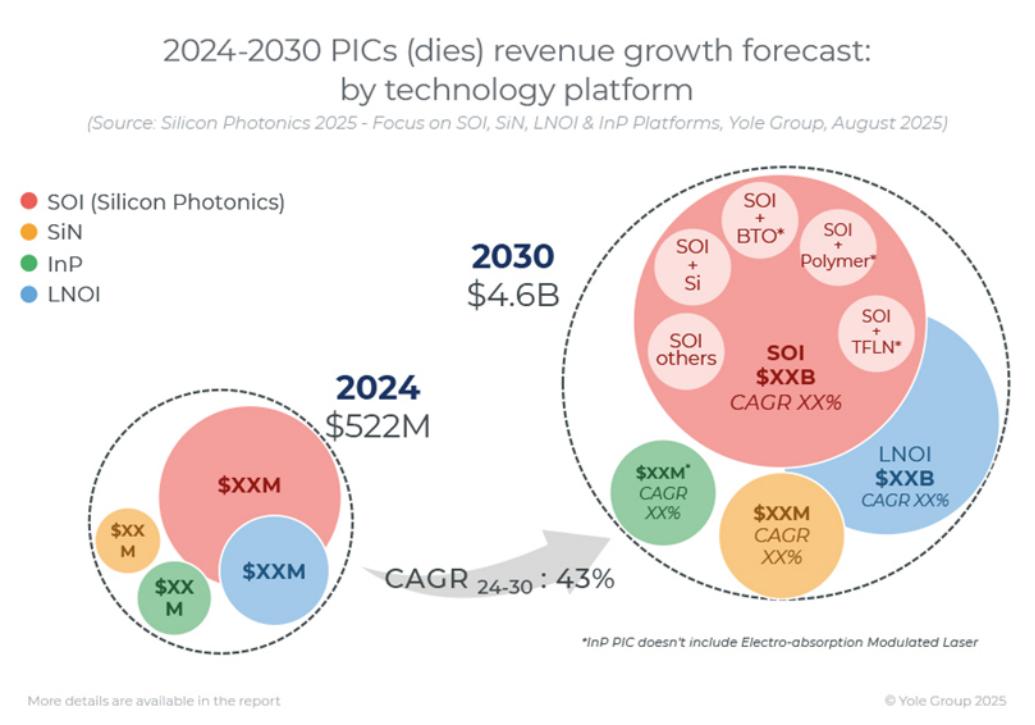
Core Insights - Silicon photonics technology is transitioning from laboratory research to market applications, integrating traditional photonic devices with mature silicon semiconductor processes to achieve high-speed, low-power, and highly integrated optical signal processing and transmission [1][2] - The demand for silicon photonics is shifting from incremental to explosive growth, driven by the exponential increase in bandwidth requirements from artificial intelligence, with 200G/channel links expected to become mainstream by 2026-2027 [1][2] Industry Overview - The silicon photonics industry has established a complete value chain consisting of upstream support, midstream manufacturing, and downstream application expansion [3] - Key components in the upstream include high-quality silicon-based materials, advanced lithography equipment, and specialized electronic design automation (EDA) software, which are essential for silicon photonics chip development [3] Market Participants - Major players in the silicon photonics industry include vertical integrators like Cisco and Marvell, startups such as Xphor and Lightmatter, and research institutions like Stanford and MIT [4] Milestones - On September 11, a national innovation center in China released a fully domestic 12-inch silicon photonics process design kit (PDK), marking a significant step towards standardized mass production of silicon photonics chips in the country [5] Domestic Market Dynamics - Domestic companies are forming a competitive landscape in the silicon photonics market, leveraging technological advancements and product positioning to capture market share [6] Company Performance - NewEase achieved a revenue of 10.437 billion yuan in the first half of 2025, a year-on-year increase of 282.96%, driven by the demand for high-speed optical modules [8][9] - Zhongji Xuchuang reported a revenue of 14.789 billion yuan in the first half of 2025, a 36.95% increase year-on-year, benefiting from its early entry into the 800G optical module market [10] - Tianfu Communication generated 2.456 billion yuan in revenue in the first half of 2025, reflecting a 57.84% year-on-year growth, supported by the AI industry's development [11][12] - Hengtong Optic-Electric reported a revenue of 32.049 billion yuan in the first half of 2025, a 20.42% increase year-on-year, maintaining its competitive edge through a full industry chain layout [13][14] - Shijia Photonics achieved a revenue of 999.3 million yuan in the first half of 2025, a 121.12% increase year-on-year, with significant growth in overseas markets [17][18] Challenges Ahead - The silicon photonics industry faces challenges such as technological diversity and the lack of standardization, which complicate the industrialization process and increase resource investment for customized development [19] - Reliability and lifespan testing are critical, as silicon photonics devices must meet stringent performance requirements in complex environments like data centers [20]


通信行业2025年三季报业绩前瞻:算力景气,红利稳健,战力将起
ZHESHANG SECURITIES· 2025-10-11 07:44
Investment Rating - The industry investment rating is "Positive" [4][19] Core Views - The telecommunications industry is benefiting from the ongoing Digital China strategy, leading to stable growth in overall business for operators, with innovative services experiencing higher growth rates and increasing proportions [2] - The AI computing power sector continues to thrive globally, with significant investments from major companies, indicating a rapid growth period for domestic computing power targets [4] - New growth drivers such as satellite internet are injecting new momentum into the industry, providing additional performance elasticity [4] Summary by Relevant Sections Telecom Operators - China Mobile is expected to report Q3 revenue of CNY 245.1 billion to CNY 246 billion, a year-on-year growth of 0.2% to 0.5%, with net profit of CNY 32.1 billion to CNY 32.4 billion, a growth of 4.6% to 5.6% [2][16] - China Telecom is projected to achieve Q3 revenue of CNY 127.2 billion to CNY 128.5 billion, a growth of 1% to 2%, with net profit of CNY 7.75 billion to CNY 8.05 billion, a growth of 3.5% to 7.5% [2][16] - China Unicom's Q3 revenue is expected to be CNY 93.7 billion to CNY 94.6 billion, with a growth of 1% to 2%, and net profit of CNY 2.41 billion to CNY 2.49 billion, a growth of 4.8% to 8.3% [3][16] - China Tower is anticipated to report Q3 revenue of CNY 24.9 billion to CNY 25.2 billion, a growth of 2.9% to 4.1%, with net profit of CNY 2.97 billion to CNY 3.05 billion, a growth of 5.2% to 8% [3][16] AI and Network Connectivity - The AI optical module sector is experiencing significant growth, with companies like Zhongji Xuchuang expected to report Q3 revenue of CNY 8.9 billion to CNY 9.6 billion, a growth of 37% to 47%, and net profit of CNY 2.9 billion to CNY 3.2 billion, a growth of 108% to 130% [4][16] - Tianfu Communication is projected to achieve Q3 revenue of CNY 1.8 billion to CNY 2.1 billion, a growth of 115% to 150%, with net profit of CNY 650 million to CNY 750 million, a growth of 102% to 133% [5][16] AI Applications and Data Centers - AI server demand is rapidly increasing, with ZTE expected to report Q3 revenue of CNY 31 billion to CNY 32 billion, a growth of 12% to 16%, and net profit of CNY 1.95 billion to CNY 2.1 billion, a decrease of 3% to 10% [7][16] - The AIDC sector is also growing, with Keda Data expected to report Q3 revenue of CNY 24 billion to CNY 27 billion, a growth of 44% to 62%, and net profit of CNY 180 million to CNY 230 million, a growth of 1347% to 1748% [8][16] Satellite Internet and Military Communication - The military communication sector is expected to see increased investment due to regional tensions, with companies like Zhenlei Technology projected to report Q3 revenue of CNY 150 million to CNY 160 million, a growth of 125% to 141%, and net profit of CNY 45 million to CNY 50 million, a growth of 409% to 466% [10][16]




前三季度险资调研A股公司累计1.4万次 关注电子元件等行业
Zheng Quan Ri Bao· 2025-10-10 16:08
Group 1 - Insurance institutions conducted a total of 14,128 investigations into A-share listed companies in the first three quarters of this year, with a significant focus on technology sectors such as electronic components and medical devices [1] - The total balance of insurance funds exceeded 36 trillion yuan by the end of the second quarter, with stock investments amounting to approximately 3.07 trillion yuan, reflecting a net increase of 640.6 billion yuan since the end of last year [2] - The most active insurance companies in terms of investigations included Ping An Pension Insurance with 494 investigations and Taikang Asset Management with 853 investigations, indicating a strong interest in market opportunities [2][3] Group 2 - The technology sector was the most investigated area by insurance institutions, with companies like Huichuan Technology and Lixun Precision receiving the highest attention, reflecting a market trend towards technology investments [4] - The rise in stock prices for technology companies, with the CSI 300 index increasing by approximately 18% and the robotics and AI indices rising by about 41% and 38% respectively, has driven insurance institutions to focus on this sector [4][5] - The shift towards technology investments is influenced by government support for technological innovation and the need for insurance institutions to diversify their portfolios in a low-interest-rate environment [5]




光模块需求喷涌 中国企业领跑“新光年”
2 1 Shi Ji Jing Ji Bao Dao· 2025-10-10 10:03
Core Insights - The global computing power is expected to increase by 100,000 times by 2035, with data becoming the "new fuel" for AI, leading to a 500-fold increase in AI storage demand [1][2] - Chinese companies are dominating the midstream market of the optical module industry, with key players like Zhongji Xuchuang and Xinyi Sheng ranking among the top three globally [5] Industry Overview - The optical module industry is experiencing explosive growth due to the surge in global computing power demand, driven by applications in smart driving and industrial AI [1] - Huawei's report indicates that the number of connected devices will expand from 9 billion to 900 billion by 2035, marking a significant shift from mobile internet to intelligent agent internet [2] Company Performance - Zhongji Xuchuang reported a revenue of 14.789 billion yuan in the first half of 2025, a year-on-year increase of 36.95%, with a net profit of 3.995 billion yuan, up 69.4% [3] - Xinyi Sheng demonstrated explosive growth with a revenue of 10.437 billion yuan, a 282.64% increase year-on-year, and a net profit of 3.942 billion yuan, up 355.68% [4] - Tianfu Communication achieved a revenue of 2.456 billion yuan, a 57.8% increase year-on-year, with a 91% growth in active optical device business [4] Technological Advancements - The optical module technology is rapidly evolving along the paths of rate iteration, material innovation, and packaging breakthroughs [6] - The transition from 800G to 1.6T optical modules is becoming a mainstream trend, with significant increases in shipment volumes expected [6][7] - Innovations in silicon photonics are driving the commercialization of high-speed optical modules, with cost advantages over traditional solutions [8] Market Dynamics - The CPO (Co-Packaged Optics) technology is anticipated to be commercially available by 2026, significantly reducing energy consumption while enhancing bandwidth density [9] - The competitive landscape shows that Chinese manufacturers have established a strong foothold in the global midstream market, leveraging technological breakthroughs and financial resilience [3][5]