EOPTOLINK(300502)

Search documents
新易盛股价涨5.31%,恒越基金旗下1只基金重仓,持有14.73万股浮盈赚取332.56万元
Xin Lang Cai Jing· 2025-12-19 02:46
12月19日,新易盛涨5.31%,截至发稿,报448.08元/股,成交86.44亿元,换手率2.24%,总市值4453.79 亿元。 资料显示,成都新易盛通信技术股份有限公司位于四川省成都市双流区黄甲街道物联大道510号,成立 日期2008年4月15日,上市日期2016年3月3日,公司主营业务涉及光模块的研发、生产和销售。主营业 务收入构成为:25G以上98.86%,25G以下0.87%,其他0.26%,PON0.00%。 从基金十大重仓股角度 恒越成长精选混合A(010622)成立日期2021年2月9日,最新规模4.73亿。今年以来收益71.93%,同类 排名274/8098;近一年收益62.68%,同类排名389/8067;成立以来亏损15%。 恒越成长精选混合A(010622)基金经理为廖明兵。 截至发稿,廖明兵累计任职时间5年161天,现任基金资产总规模9.55亿元,任职期间最佳基金回报 63.86%, 任职期间最差基金回报-41.96%。 风险提示:市场有风险,投资需谨慎。本文为AI大模型自动发布,任何在本文出现的信息(包括但不 限于个股、评论、预测、图表、指标、理论、任何形式的表述等)均只作为参考 ...

新易盛涨2.04%,成交额23.86亿元,主力资金净流入1.26亿元
Xin Lang Cai Jing· 2025-12-19 01:52
新易盛所属申万行业为:通信-通信设备-通信网络设备及器件。所属概念板块包括:激光雷达、CPO概 念、光通信、出海概念、5G等。 截至9月30日,新易盛股东户数15.53万,较上期增加58.46%;人均流通股5700股,较上期减少36.78%。 2025年1月-9月,新易盛实现营业收入165.05亿元,同比增长221.70%;归母净利润63.27亿元,同比增长 284.37%。 分红方面,新易盛A股上市后累计派现7.75亿元。近三年,累计派现4.93亿元。 机构持仓方面,截止2025年9月30日,新易盛十大流通股东中,香港中央结算有限公司位居第一大流通 股东,持股3584.72万股,相比上期减少1472.75万股。易方达创业板ETF(159915)位居第四大流通股 东,持股1875.44万股,相比上期减少311.09万股。华泰柏瑞沪深300ETF(510300)位居第七大流通股 东,持股1690.16万股,相比上期减少72.09万股。易方达沪深300ETF(510310)位居第八大流通股东, 持股1221.39万股,相比上期减少38.07万股。华夏沪深300ETF(510330)位居第九大流通股东,持股 911 ...
两融余额较上一日减少34.80亿元 电子行业获融资净买入额居首
Sou Hu Cai Jing· 2025-12-19 01:48
| 序号 | | | | | --- | --- | --- | --- | | | 证券代码 ◆ | 证券简称 ◆ | 交易日期 ◆ | | 1 | 300502.SZ | 新易盛 | 2025-12-18 | | 2 | 601318.SH | 中国平安 | 2025-12-18 | | 3 | 600118.SH | 中国卫星 | 2025-12-18 | | ব | 600343.SH | 航天动力 | 2025-12-18 | | 5 | 600879.SH | 航天电子 | 2025-12-18 | | 6 | 002600.SZ | 领益智造 | 2025-12-18 | | 7 | 603986.SH | 兆易创新 | 2025-12-18 | | 8 | 002837.SZ | 英维克 | 2025-12-18 | | 9 | 300274.SZ | 阳光电源 | 2025-12-18 | | 10 | 002536.SZ | 飞龙股份 | 2025-12-18 | 资金流向方面,申万31个一级行业中有14个行业获融资净买入,其中,电子行业获融资净买入额居首,当日净买入17.28亿元;获融资 ...



资金风向标|两融余额较上一日减少34.80亿元 电子行业获融资净买入额居首
Sou Hu Cai Jing· 2025-12-19 01:42
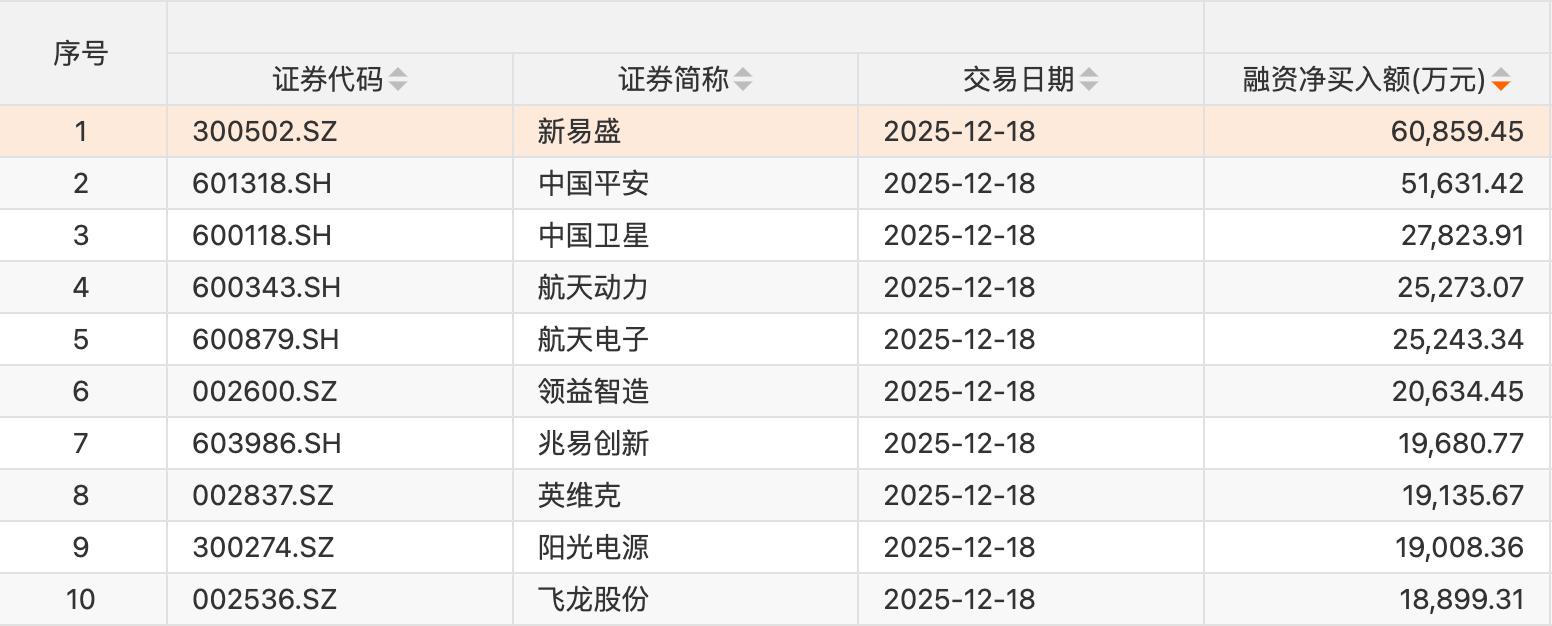
截至12月18日,A股两融余额为24993.66亿元,较上一交易日减少34.80亿元,占A股流通市值比例为2.61%。当日两融交易额为1718.86亿元,较上一交易日 减少134.06亿元,占A股成交额的10.23%。 上证报中国证券网讯(刘禹希 记者 徐蔚)截至12月18日,A股两融余额为24993.66亿元,较上一交易日减少34.80亿元,占A股流通市值比例为2.61%。当日 两融交易额为1718.86亿元,较上一交易日减少134.06亿元,占A股成交额的10.23%。 资金流向方面,申万31个一级行业中有14个行业获融资净买入,其中,电子行业获融资净买入额居首,当日净买入17.28亿元;获融资净买入居前的行业还 有国防军工、机械设备、通信、电力设备、非银金融等。 个股方面,29只个股获融资净买入额超1亿元。新易盛获融资净买入额居首,净买入6.09亿元;融资净买入金额居前的还有中国平安、中国卫星、航天动 力、航天电子、领益智造、兆易创新、英维克、阳光电源、飞龙股份等。 | 序号 | 证券代码 ◆ | 证券简称 ◆ | 交易日期 ◆ | | --- | --- | --- | --- | | 1 | 300 ...




331股获融资买入超亿元,新易盛获买入32.66亿元居首
Mei Ri Jing Ji Xin Wen· 2025-12-19 01:28
每经AI快讯,A股12月18日共有3744只个股获融资资金买入,有331股买入金额超亿元。其中,新易 盛、中际旭创、航天电子融资买入金额排名前三,分别获买入32.66亿元、22.16亿元和17.28亿元。 ...

新易盛市值4200亿元,中专生如何逆袭为百亿富豪?
Xin Lang Cai Jing· 2025-12-18 09:31
登录新浪财经APP 搜索【信披】查看更多考评等级 来源:尺度商业 2004年,高光荣与合伙人一起创立"光盛通信",公司业务与一家名为"易杰龙"的公司重叠,两家公司打 得热火朝天,互相抢单、挖人,甚至员工都玩起了现实版"无间道",潜伏在对方公司做兼职。 斗了几年,不分胜负,双方决定握手言和。2008年,"光盛通信"和"易杰龙"整合成一家新公司,新公司 取两家字号各一字,新易盛就此诞生。 后来的故事堪称魔幻,这个诞生于"休战协议"的企业,在2016年成功在创业板上市,如今更跻身北美云 厂商巨头的核心供应链,与中际旭创、天孚通信被戏称为"易中天",成为A股人气正旺的万亿市值天 团。 12月18日收盘,新易盛总市值4229亿元,年内涨幅417%,2023年以来累计涨幅超3500%。伴随着公司 的起飞,高光荣也完成了华丽转身,从乐山无线电厂的中专生技术员,蜕变为身家百亿的行业大佬。 如此逆袭背后,发生了什么? 中专生逆袭,技术员变身百亿大佬 高光荣的起点,平凡得几乎看不见光环。1969年出生于四川省乐山市,他没有名校背景,也没有显赫家 世。1980年代末,他从成都无线电机械学校工业电气自动化专业毕业,手握一张中专文凭, ...

通信设备板块12月18日跌1.48%,新易盛领跌,主力资金净流出32.44亿元
Zheng Xing Xing Ye Ri Bao· 2025-12-18 09:13
证券之星消息,12月18日通信设备板块较上一交易日下跌1.48%,新易盛领跌。当日上证指数报收于 3876.37,上涨0.16%。深证成指报收于13053.98,下跌1.29%。通信设备板块个股涨跌见下表: 从资金流向上来看,当日通信设备板块主力资金净流出32.44亿元,游资资金净流入7.38亿元,散户资金 净流入25.07亿元。通信设备板块个股资金流向见下表: 以上内容为证券之星据公开信息整理,由AI算法生成(网信算备310104345710301240019号),不构成投资建议。 fund ...

沪深两市今日成交额合计1.66万亿元,新易盛成交额居首
Xin Lang Cai Jing· 2025-12-18 07:18
Summary of Key Points Core Viewpoint - The total trading volume of the Shanghai and Shenzhen stock markets on December 18 reached 1.66 trillion yuan, reflecting a decrease of approximately 155.66 billion yuan compared to the previous trading day [1] Trading Volume Details - The trading volume in the Shanghai market was 704.90 billion yuan, while the Shenzhen market recorded 950.59 billion yuan [1] - New Yisheng topped the trading volume with 17.33 billion yuan, followed by Zhongji Xuchuang at 13.81 billion yuan, CATL at 11.08 billion yuan, Aerospace Electronics at 10.68 billion yuan, and Invec at 10.39 billion yuan [1]

低费率创业板人工智能ETF华夏(159381)近20日获得超6亿元资金净申购!光模块CPO含量超57%
Mei Ri Jing Ji Xin Wen· 2025-12-18 06:10
Core Viewpoint - The A-share AI computing power sector is experiencing a consolidation phase after a violent rebound, with notable stocks like New Yisheng, Zhongji Xuchuang, and Taicheng Guang showing pullbacks. The Huaxia AI ETF (159381) has seen significant capital inflow recently, indicating strong investor interest in this sector [1]. Group 1: ETF Performance - As of 13:52, the Huaxia AI ETF (159381) on the ChiNext board fell by 1.37%, with trading volume quickly surpassing 200 million yuan [1]. - Over the past 20 days, the ETF has attracted over 600 million yuan in capital, reflecting a concentrated investment strategy [1]. - The ETF tracks the ChiNext AI Index (970070.CNI), with over 57% weight in optical modules, and includes domestic software and AI application companies, providing high elasticity [1]. Group 2: Key Holdings - The top three weighted stocks in the ETF are Zhongji Xuchuang (28%), New Yisheng (20%), and Tianfu Communication (4%) [1]. - The ETF has a low comprehensive fee rate of only 0.20%, the lowest among its peers [1]. Group 3: Industry Outlook - According to Industrial Securities, AI computing power investments are expected to drive the communication sector to significantly outperform the market by 2025 [1]. - By 2026, overseas computing power is anticipated to enter a "mid-air refueling" phase, particularly in the optical module and supporting industry chain [1]. - The Blackwell initiative is expected to accelerate data center developments, with Rubin's progress indicating that 1.6T optical modules may become the main demand driver next year, leading to sustained high growth for leading companies [1].



2023年全球光模块现状及趋势分析 中国光模块厂商在全球市场崛起【组图】
Qian Zhan Wang· 2025-12-18 04:11
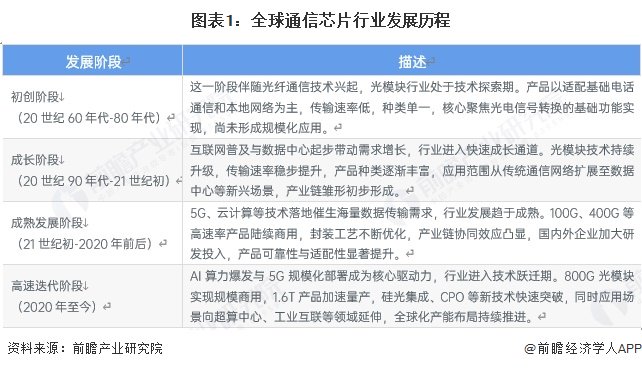
Core Insights - The global optical module industry is experiencing significant growth driven by advancements in technology and increasing demand from applications such as 5G, AI, and data centers [1][4][6]. Industry Development Stages - **Initial Stage**: The optical module industry began in the 1960s, focusing on basic functionalities for telephone communication with low transmission rates and limited product variety [2]. - **Growth Stage**: The 1990s to early 2000s saw rapid growth due to the rise of the internet and data centers, leading to improved transmission rates and a broader range of products [2]. - **Mature Development Stage**: From the early 2000s to around 2020, the industry matured with the commercialization of high-speed products like 100G and 400G, alongside enhanced reliability and compatibility [2]. - **High-Speed Iteration Stage**: Since 2020, the industry has entered a phase of rapid technological advancement, with the commercialization of 800G modules and accelerated production of 1.6T products, driven by AI and 5G deployments [2]. Market Demand and Growth - The deployment of 5G networks is significantly increasing the demand for high-speed optical modules, which are essential for supporting new business models and applications such as industrial IoT and high-definition video [4]. - The global optical transceiver market is projected to reach $14.4 billion in 2024, marking a 52% increase from $9.5 billion in 2023, driven by the rising demand for AI computing power [6]. Competitive Landscape - Chinese companies are increasingly dominating the global optical module market, with firms like Zhongji Xuchuang and NewEase achieving substantial revenue growth and entering the top ten global suppliers [10]. - In 2024, Zhongji Xuchuang's revenue is expected to grow by 114% to exceed $3.3 billion, while NewEase anticipates a 175% increase to $1.2 billion, reflecting their strong market positions [10]. Technological Advancements - Major optical module manufacturers are focusing on silicon photonics, with Chinese companies like Zhongji Xuchuang achieving mass production of 400G/800G silicon photonics modules and gaining significant market share [9]. - The integration of new technologies such as silicon photonics and CPO is expected to enhance product offerings and meet the growing demands of cloud service providers and AI ecosystems [9].