
EOPTOLINK(300502)

Search documents
AI 光模块:增长主导行业颠覆-AI Transceivers Growth Dominates Disruption
2026-03-01 17:22
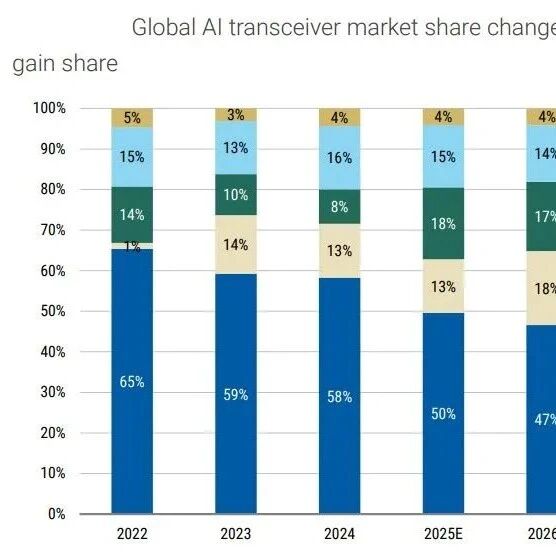
Summary of Key Points from the Conference Call Industry Overview - The focus is on the **AI transceiver market**, which is projected to experience significant growth, with the total addressable market (TAM) expected to triple from approximately **US$18 billion in 2025 to US$50 billion by 2028** driven by advancements in AI data center architectures [1][29]. Core Insights - **Transceiver Demand Growth**: - AI transceiver demand is anticipated to rise from **41 million units in 2025 to 95 million units by 2028**. High-end transceivers (800G and 1.6T) are expected to be the primary growth drivers, with unit volumes increasing from **20 million in 2025 to 80 million in 2028** [19][28]. - The growth is attributed to three main factors: 1. Expansion of AI data centers requiring advanced optical transceivers for connectivity. 2. Increased capital expenditure (capex) from major cloud players, with projected spending of **US$735-795 billion in 2026**, representing a **60% year-over-year growth** [28]. 3. Continuous innovation in product offerings, particularly in 800G and 1.6T transceivers [28]. - **CPO (Co-Packaged Optics) Impact**: - CPO is recognized as a legitimate long-term risk to traditional pluggable transceivers, but its impact is expected to be limited in the medium term, with projected demand dilution of **3% in 2026, 11% in 2027, and 16% in 2028** [17][26]. - Large-scale adoption of CPO is unlikely before **2027-2028**, with initial relevance expected at **3.2T** and beyond [90]. Company-Specific Insights - **Eoptolink**: - Upgraded to **Overweight** with a price target raised to **Rmb460** due to expected above-industry growth in the 800G and 1.6T segments [49]. - **Suzhou TFC**: - Price target increased to **Rmb371**, maintaining an **Equal Weight** rating, reflecting the recent share price rally and potential benefits from the AI transceiver industry's growth [50]. - **Coherent and Lumentum**: - Both companies are expected to gain market share, with Coherent positioned for better opportunities compared to Lumentum, which has seen significant stock price increases but may face volatility due to CPO developments [51][52]. Market Dynamics - **CPO Development**: - CPO is seen as a strategic challenge to traditional transceiver companies due to its potential to displace existing products and disrupt business models. However, technical challenges such as manufacturing yields, thermal management, and cost premiums pose significant barriers to its widespread adoption [80][89]. - **Competitive Landscape**: - The competitive landscape is shifting, with CPO competing against both traditional pluggable transceivers and copper solutions. The transition to CPO is expected to create additional pressure on traditional optical transceivers [85]. Additional Considerations - **Stock Recommendations**: - A range of companies are highlighted as potential beneficiaries of the AI transceiver market and CPO developments, including **LandMark**, **VPEC**, **TSMC**, and **ASE**, among others [23][75]. - **Long-Term Outlook**: - The overall sentiment remains positive for the AI transceiver market, with expectations of strong earnings growth in 2026, driven by the rapid expansion of AI infrastructure investments [22]. This summary encapsulates the key insights and projections regarding the AI transceiver market and the implications of CPO technology on traditional transceiver companies, highlighting both opportunities and risks within the industry.




光模块市场大爆发,CPO威胁被高估了吗?
傅里叶的猫· 2026-03-01 15:30
Core Viewpoint - The AI optical module market is experiencing unprecedented growth, with the total addressable market (TAM) expected to surge from $18 billion in 2025 to $50 billion by 2028, representing a threefold increase in three years [3][4]. Market Growth - The demand for high-end optical modules (800G and 1.6T) is projected to increase from 20 million units in 2025 to 80 million units by 2028, quadrupling in four years [4]. - Major cloud computing companies are expected to invest between $735 billion and $795 billion in capital expenditures this year, a 60% year-on-year increase, significantly contributing to data center construction and optical module demand [4]. CPO Technology - Co-Packaged Optics (CPO) integrates optical engines directly into switch chip packaging, offering benefits like faster transmission speeds and lower power consumption, but faces significant technical challenges [6][7]. - CPO's five major technical bottlenecks include low manufacturing yield, heat dissipation issues, high costs, an immature supply chain, and maintenance challenges [7][8]. Scenarios for CPO Impact - Morgan Stanley outlines three scenarios for CPO's impact on traditional optical modules: - **Base Case**: CPO achieves manufacturing breakthroughs by 2027, with minimal demand dilution for traditional modules (3% in 2026, 11% in 2027, 16% in 2028) [9][10]. - **Optimistic Case**: CPO's large-scale application is delayed beyond 2028, allowing traditional modules to maintain over 70% market share [10]. - **Pessimistic Case**: CPO achieves breakthroughs in late 2026, with demand dilution of 21% in 2026, 32% in 2027, and 38% in 2028, yet traditional modules still retain 79% market share [11]. NPO as a Response - Near Packaged Optics (NPO) serves as a middle ground for traditional optical module manufacturers, allowing them to enhance performance without the complexities of CPO [15][16]. Data Center Trends - Three major trends are reshaping data center architecture: Scale-out, Scale-up, and Scale-across, driving the demand for optical modules [17][18][19]. - Scale-out involves connecting multiple GPU racks, with high-end optical module demand expected to rise from 20 million units in 2025 to 53 million in 2026, a 166% increase [18]. - Scale-up focuses on GPU interconnects within racks, with significant opportunities arising as copper cables approach their physical limits [19]. - Scale-across addresses the need for interconnectivity between data centers, with traffic share increasing from 5% to 20%, necessitating high-speed optical modules [21]. OCS as a Growth Engine - Optical Circuit Switching (OCS) is creating new demand for optical modules, with a projected market size of $2 billion by 2030, complementing AI optical modules rather than competing with them [24][25]. Company Analysis - In the traditional optical module sector, Eoptolink and Coherent are expected to be the biggest winners, with significant price target increases reflecting their growth potential [27][28]. - Lumentum's stock has surged over 900% in the past year, but its valuation may be overly optimistic given the expected earnings growth [28]. - The CPO supply chain is beginning to take shape, with companies like TSMC and ASE positioning themselves to benefit from future CPO applications [31][32]. PCB and Connector Impacts - The rise of CPO presents a mixed bag for the PCB industry, with some companies facing structural headwinds while others, like Bizlink, stand to benefit from the transition to Active Electrical Cables (AEC) [37][38]. Cloud Vendor Attitudes - Major cloud vendors are actively pursuing CPO technology, indicating a serious commitment to its development, although large-scale applications remain in the pilot phase [41][43].


AI与无人机驱动光纤新周期
GOLDEN SUN SECURITIES· 2026-03-01 08:17
Investment Rating - The report maintains a "Buy" rating for key companies in the optical fiber and cable industry, including Zhongji Xuchuang, Xinyi Sheng, and Tianfu Communication, among others [11]. Core Insights - The optical fiber and cable industry is entering a new cycle driven by AI data centers and drone applications, with fiber prices having more than doubled since 2025, indicating a significant upturn in market conditions [1][20]. - The demand for optical fibers is shifting from traditional telecommunications to AI data centers, which require 5 to 10 times more fiber infrastructure than conventional cloud facilities. The share of AI fiber in global demand is expected to surge from 5% in 2024 to 30% by 2027 [3][25]. - Supply constraints are evident due to the long production cycle of optical fiber preform rods, which can take 18-24 months to expand capacity. This has led to a structural supply-demand mismatch, particularly affecting the G.652D fiber segment [4][23]. Summary by Sections Price Dynamics - Since late 2025, retail prices for optical fibers have been on the rise, with G.652.D bare fiber prices exceeding 30 yuan/km, and actual transaction prices often between 40-50 yuan/km, reflecting a cumulative increase of 94%-144% [2][21]. - The rising fiber prices have caused a disconnect between cable costs and operator bidding limits, leading to the suspension of collective procurement projects by operators like Guangdong Telecom [2][21]. Demand Drivers - The primary demand driver for this cycle is the construction of AI data centers, which significantly increases the demand for optical fibers. The consumption of fiber infrastructure by AI data centers is projected to be 5 to 10 times greater than that of traditional cloud facilities [3][25]. - The drone sector is also emerging as a new market for optical fibers, with current demand estimated at 50 million core kilometers per year, significantly increasing Russia's fiber consumption [3][25]. Supply Constraints - The production of optical fiber is constrained by the lengthy and technically challenging process of expanding preform rod capacity, which directly limits overall industry supply. New capacity from expansions initiated now will not be available until after 2027 [4][23]. - The focus on producing specialty fibers for AI applications is squeezing the capacity for standard G.652D fibers, leading to a supply gap in the general fiber market [4][23]. Investment Opportunities - The report highlights several companies as key investment opportunities within the optical fiber and cable sector, including Zhongji Xuchuang, Xinyi Sheng, and Tianfu Communication, as well as companies involved in the broader computing and cooling sectors [8][26].


A股CPO概念集体下挫,新易盛跌7%
Jin Rong Jie· 2026-02-27 04:49
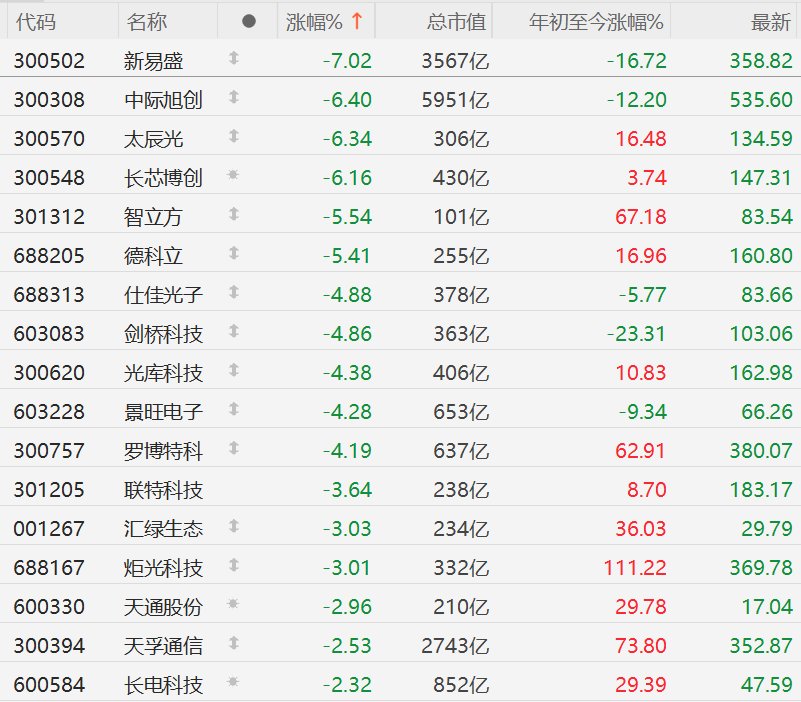
Group 1 - The A-share market saw a collective decline in CPO concept stocks, with New Yisheng dropping by 7% [1] - Zhongji Xuchuang, Taicheng Guang, and Changxin Bochuang experienced declines exceeding 6% [1] - Zhili Fang and Dekeli fell by more than 5%, while Shijia Guangzi, Cambridge Technology, Guangku Technology, Jingwang Electronics, and Robotech dropped over 4% [1] - Lian Te Technology, Huilv Ecology, and Juguang Technology saw declines of more than 3% [1]

半日主力资金加仓计算机板块,抛售电子板块
3 6 Ke· 2026-02-27 04:07
Group 1 - Main capital inflow observed in the computer and non-ferrous metal sectors, while electronic and building materials sectors experienced net outflows [1] - Specific stocks with significant net inflows include Huasheng Tiancai with 4.709 billion, Baogang Co. with 2.599 billion, and Tuowei Information with 2.241 billion [1] - Stocks facing notable net outflows include Xinyi Sheng with 3.027 billion, Zhongji Xuchuang with 1.779 billion, and Shenghong Technology with 1.631 billion [1]


CPO概念集体下挫,新易盛跌7%
Ge Long Hui· 2026-02-27 04:06
Core Viewpoint - The CPO concept stocks in the A-share market experienced a collective decline, with significant drops in several key stocks on February 27, indicating a bearish trend in this sector [1]. Group 1: Stock Performance - Xinyisheng (新易盛) fell by 7.02%, with a total market capitalization of 35.67 billion and a year-to-date decline of 16.72% [2]. - Zhongji Xuchuang (中际旭创) decreased by 6.40%, having a market cap of 59.51 billion and a year-to-date drop of 12.20% [2]. - Taichengguang (太辰光) saw a decline of 6.34%, with a market value of 30.6 billion and a year-to-date increase of 16.48% [2]. - Changxin Bochuang (长芯博创) dropped by 6.16%, with a market cap of 43 billion and a year-to-date increase of 3.74% [2]. - Zhili Fang (智立方) decreased by 5.54%, with a market capitalization of 10.1 billion and a year-to-date increase of 67.18% [2]. - Dekeli (德科立) fell by 5.41%, with a market cap of 25.5 billion and a year-to-date increase of 16.96% [2]. - Shijia Guangzi (仕佳光子) declined by 4.88%, with a market value of 37.8 billion and a year-to-date drop of 5.77% [2]. - Cambridge Technology (剑桥科技) decreased by 4.86%, with a market cap of 36.3 billion and a year-to-date drop of 23.31% [2]. - Guangku Technology (光库科技) fell by 4.38%, with a market value of 40.6 billion and a year-to-date increase of 10.83% [2]. - Jingwang Electronics (景旺电子) saw a decline of 4.28%, with a market cap of 65.3 billion and a year-to-date drop of 9.34% [2]. - Robot Technology (罗博特) decreased by 4.19%, with a market value of 63.7 billion and a year-to-date increase of 62.91% [2]. - Liante Technology (联特科技) fell by 3.64%, with a market cap of 23.8 billion and a year-to-date increase of 8.70% [2]. - Huilv Ecology (汇绿生态) decreased by 3.03%, with a market value of 23.4 billion and a year-to-date increase of 36.03% [2]. - Juguang Technology (炬光科技) fell by 3.01%, with a market cap of 33.2 billion and a year-to-date increase of 111.22% [2]. - Tiantong Co. (天通股份) decreased by 2.96%, with a market value of 21 billion and a year-to-date increase of 29.78% [2]. - Tianfu Communication (天孚通信) fell by 2.53%, with a market cap of 274.3 billion and a year-to-date increase of 73.80% [2]. - Changjia Technology (长甲科技) decreased by 2.32%, with a market value of 85.2 billion and a year-to-date increase of 29.39% [2].
拓维信息涨停!DeepSeek V4引爆国产算力行情,云计算ETF(159890)盘中净流入超6600万
Sou Hu Cai Jing· 2026-02-27 02:53
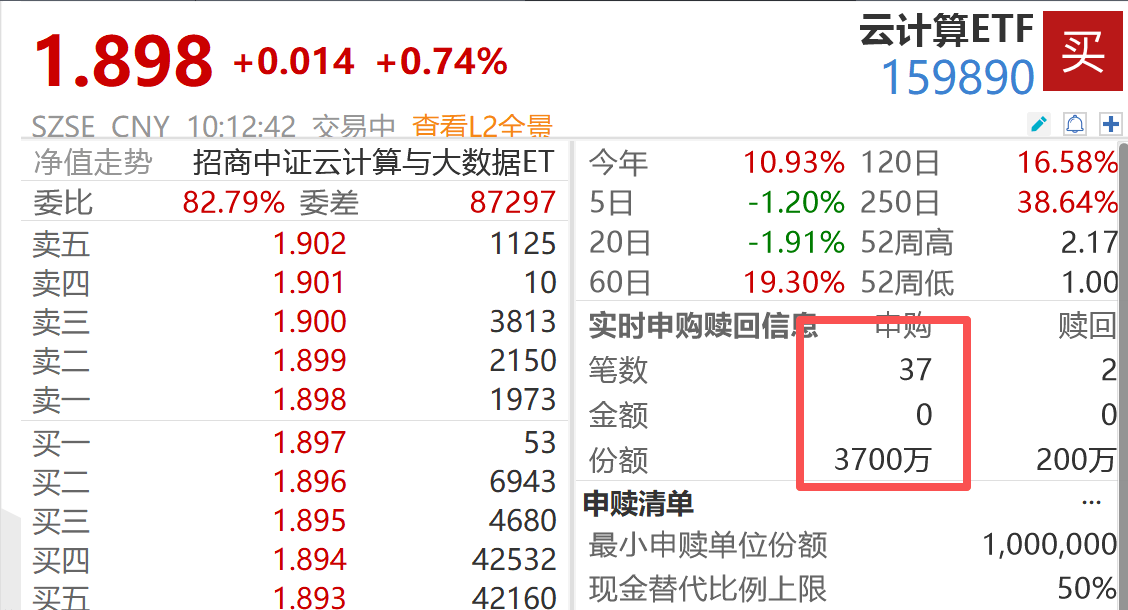
Core Viewpoint - The rise of domestic computing power chains is significantly impacting the cloud computing sector, with the cloud computing ETF (159890) experiencing notable gains and increased investor interest [1]. Group 1: Market Performance - The cloud computing ETF (159890) opened with a rise of over 1% and is currently up by 0.74%, indicating strong performance among its constituent stocks [1]. - Notable stocks include Tuowei Information, which hit the daily limit, and Yuntian Lifeng, which surged by 13%, while several others like Wangsu Science and Technology and Runhe Software rose by over 6% [1]. - The fund has seen a net inflow of over 66 million yuan in a single day, with a cumulative net subscription of approximately 58.9 million yuan over the past five days, breaking previous records [1]. Group 2: Industry Developments - DeepSeek is set to release its V4 "Sea Lion Lite" version, which supports 1 million tokens and features native multimodal processing capabilities, prioritizing domestic chip suppliers for optimization [3]. - This shift marks a significant transition for the domestic computing power industry from being merely "usable" to achieving "scale commercialization," reinforcing the logic of domestic computing power [3]. Group 3: Demand Insights - According to a report from CITIC Securities, the token usage of domestic large models has surged, with the top three models being domestic, reflecting an exponential growth in AI inference demand [4]. - The report indicates that the domestic computing power sector, benefiting from cost advantages and an improving ecosystem, is poised to dominate the infrastructure layer [4]. - China International Bank also noted significant changes in the large model industry around the Spring Festival, suggesting a new wave of growth potential for the computing power supply chain [4]. Group 4: ETF Composition - The cloud computing ETF (159890) tracks the CSI Cloud Computing and Big Data Theme Index, with holdings that balance AI computing power (41%) and AI applications (32%) [5]. - The top ten holdings include leading software and hardware companies such as iFlytek, Kingsoft Office, and Inspur Information, which are expected to benefit from the AI infrastructure wave [5][6]. - The current trend led by DeepSeek in reshaping the domestic computing power ecosystem is likely to drive the industry from "passive adaptation" to "active definition," presenting collaborative development opportunities in computing power and AI applications [6].


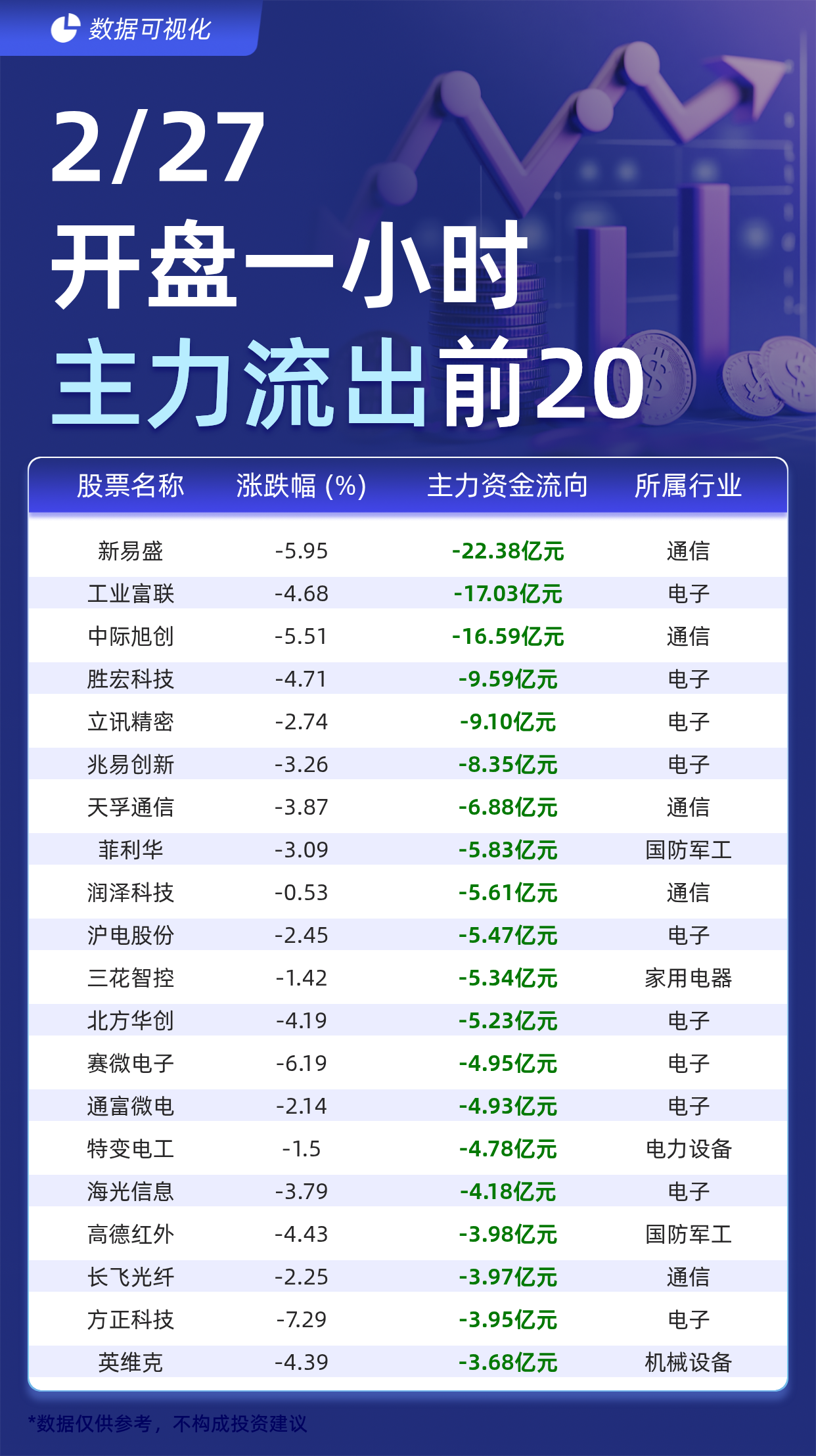
主力个股资金流出前20:新易盛流出22.38亿元、工业富联流出17.03亿元



Jin Rong Jie· 2026-02-27 02:49
Core Insights - The main focus of the news is the significant outflow of capital from various stocks, indicating a bearish sentiment in the market as of February 27, with notable declines in stock prices and substantial amounts of money withdrawn from these companies [1][2][3] Group 1: Stock Performance - Xinyiseng experienced a decline of 5.95% with a capital outflow of 2.238 billion [2] - Industrial Fulian saw a drop of 4.68% and a capital outflow of 1.703 billion [2] - Zhongji Xuchuang's stock fell by 5.51% with 1.659 billion flowing out [2] - Shenghong Technology decreased by 4.71% with an outflow of 0.959 billion [2] - Lixun Precision's stock dropped by 2.74% with a capital outflow of 0.910 billion [2] - Zhaoyi Innovation saw a decline of 3.26% with 0.835 billion outflow [2] - Tianfu Communication's stock fell by 3.87% with an outflow of 0.688 billion [2] - Feilihua experienced a decrease of 3.09% with 0.583 billion flowing out [2] - Runze Technology's stock declined by 0.53% with an outflow of 0.561 billion [2] - Hudian Co. saw a drop of 2.45% with a capital outflow of 0.547 billion [2] - Sanhua Intelligent Control decreased by 1.42% with an outflow of 0.534 billion [3] Group 2: Industry Breakdown - The communication sector faced significant outflows, with Xinyiseng, Zhongji Xuchuang, Tianfu Communication, and Runze Technology all showing negative trends [2][3] - The electronics industry also experienced notable capital outflows, including Industrial Fulian, Shenghong Technology, Lixun Precision, Zhaoyi Innovation, Hudian Co., and Sanhua Intelligent Control [2][3] - The defense and military sector, represented by Feilihua and Gaode Hongwai, also saw declines in stock prices and capital outflows [2][3] - The power equipment sector, represented by Tebian Electric, experienced a smaller outflow of 0.478 billion with a decline of 1.5% [3]
行业研究|行业周报|通信设备III:通信周观点:算力硬件满载扩产,AI模型SOTA投资升温-20260226
Changjiang Securities· 2026-02-26 11:02
Investment Rating - The industry investment rating is "Positive" and maintained [12] Core Insights - The communication sector saw a 2.35% increase in the 6th-7th week of 2026, ranking 6th among primary industries in the Yangtze River region; since the beginning of 2026, it has risen by 0.44%, ranking 27th [2][6] - Tower's silicon photonics revenue doubled, with a high demand for 1.6T, and capacity expansion plans have been adjusted with prepayments secured; silicon photonics modules continue to penetrate the market [2][10] - Vertiv's orders and backlog reached new highs, with a shipment-to-order ratio rising to 2.9 times [2][10] - ByteDance's Seedance 2.0 has industry-leading generation availability, while Google's Gemini 3.1 Pro tops the charts, and Anthropic's annual revenue is growing rapidly at $14 billion [2][10] - OpenAI's cumulative computing expenditure is expected to exceed $600 billion by 2030, with an upward revision of revenue forecasts [2][10] Summary by Sections Market Performance - In the 6th-7th week of 2026, the communication sector increased by 2.35%, ranking 6th among primary industries; since the start of 2026, it has risen by 0.44%, ranking 27th [2][6] - Among companies with a market capitalization above 8 billion, the top three gainers this week were Dawei Technology (+39.4%), Shengke Communication (+31.7%), and Shenling Environment (+29.6%); the top three decliners were Tongyu Communication (-11.7%), Dingtong Technology (-9.7%), and Xinke Mobile (-9.3%) [6] Company Highlights - **Tower**: In Q4 2025, revenue reached $440 million, a year-on-year increase of 13.7%, with GAAP net profit of $80 million, up 45.3%. The company expects silicon photonics revenue to reach $228 million in 2025, doubling from 2024, and has raised its capacity target from 3 times to over 5 times the Q4 2025 shipment [7] - **Vertiv**: In Q4 2025, revenue was $2.88 billion, a year-on-year increase of 22.7%, with GAAP net profit of $450 million, up 203.1%. The company reported a significant increase in organic orders, with a year-on-year growth of 252% [7] AI Model Developments - On February 12, ByteDance launched Seedance 2.0, achieving industry-leading performance in complex scenarios with a high generation availability rate [8] - Anthropic completed a $30 billion Series G financing round with a post-money valuation of $380 billion, reporting an annual revenue of approximately $14 billion [8] - On February 19, Google released Gemini 3.1 Pro, which ranked first in AI analysis, showing significant improvements in reasoning capabilities [8] Future Projections - OpenAI updated its financial outlook, projecting cumulative computing-related expenditures to exceed $600 billion by 2030, with training costs expected to rise significantly in 2025 and 2026 [9]



英伟达算力架构持续迭代升级,行业高景气度不断夯实,高速光模块需求确定性极强,CPO步入实质落地阶段
Xin Lang Cai Jing· 2026-02-26 10:27
Group 1 - Zhongji Xuchuang (300308) is a leading global player in the high-speed optical module sector, deeply tied to major North American cloud providers like Nvidia, Microsoft, and Google, making it a core beneficiary during the AI computing power explosion [1][24] - The company maintains a strong position in the global market for 800G and 1.6T high-speed optical module shipments, with a continuous upgrade in product structure towards high-end offerings, leading to steady improvements in gross margin and profitability [1][24] - With the large-scale rollout of Nvidia's GB300 and Rubin next-generation computing platforms, the demand for optical modules per machine has significantly increased, driving a sustained high growth in orders for the company [1][24] Group 2 - Xinyi Technology (300502) focuses on the research, production, and sales of high-speed optical modules, ranking among the few domestic companies with global competitiveness, particularly in the 400G and 800G high-end module sectors [2][25] - The company has a high proportion of overseas revenue and is closely tied to major global cloud providers and equipment manufacturers, resulting in high order visibility and outstanding delivery capabilities [2][25] - Benefiting from the accelerated construction of AI data centers and the explosive demand for high-speed interconnects, the company is seeing a continuous increase in the proportion of high-end products and an ongoing optimization of profitability [2][25] Group 3 - Luxshare Precision (002475) has rapidly entered the high-speed optical module market, becoming an important partner for leading international companies like Nvidia, leveraging its advanced manufacturing and supply chain integration capabilities [3][26] - The company has significant advantages in optical module structural components, packaging processes, and thermal solutions, allowing it to quickly respond to large-volume orders from major clients [3][26] - As AI computing demand continues to surge, the optical module business is emerging as a new growth curve for the company, supported by stable cash flow and technological synergies from its experience in consumer and automotive electronics [3][26] Group 4 - Shengyi Technology (600183) is a global leader in the field of copper-clad laminates and high-frequency materials, serving as a core upstream supplier for optical modules, servers, and data center hardware [4][27] - The demand for high-frequency and high-speed copper-clad laminates is continuously increasing due to the growth of high-speed optical modules, with the company maintaining a leading position in related materials technology and comprehensive customer coverage [4][27] - The company benefits from the accelerated construction of AI computing infrastructure and the rapid iteration of data center hardware, leading to a steady improvement in profitability [4][27] Group 5 - Pengding Holdings (002938) is a global leader in high-end printed circuit board (PCB) research, production, and sales, holding a significant position in the PCB market for high-speed communication, servers, and optical modules [5][28] - The requirements for PCB layers, precision, and signal integrity have significantly increased due to 800G and 1.6T high-speed optical modules, with the company demonstrating industry-leading technical strength and process levels [5][28] - The company is experiencing rapid growth in high-speed PCB demand as AI data center construction accelerates, leading to improvements in revenue and gross margin [5][28] Group 6 - Hengtong Optic-Electric (600487) has become a domestic industry leader by leveraging its advantages across the entire optical communication industry chain, with core competitiveness in optical modules, optical fibers, and marine communications [6][29] - The company’s high-speed optical module products cover 400G and 800G high-speed rates, achieving bulk shipments in data centers and computing interconnect scenarios [6][29] - With significant investments in silicon photonics and CPO co-packaging optical technology, the company is well-positioned to benefit from the increased global investment in computing infrastructure and the explosive demand for optical modules [6][29]


