Petpal Tech.(300673)

Search documents
佩蒂股份:公司将及时、准确地履行信息披露义务
Zheng Quan Ri Bao Wang· 2026-01-30 06:46
证券日报网讯1月30日,佩蒂股份(300673)在互动平台回答投资者提问时表示,关于业绩预告,公司 将严格遵循《深圳证券交易所创业板股票上市规则》等法律法规的要求,及时、准确地履行信息披露义 务。 ...

佩蒂股份20260128
2026-01-29 02:43
Summary of Petty Co. Conference Call Company Overview - **Company**: Petty Co. (佩蒂股份) - **Industry**: Pet Food Industry Key Points Impact of Tariffs and Market Performance - In 2025, U.S. tariffs affected Petty Co.'s overseas revenue, but price adjustments and cost optimization led to an increase in gross margin [2][3] - Fourth-quarter overseas orders rebounded, with expectations for reduced tariff impacts in 2026 and successful market expansion in Europe and Canada [2][3] Domestic Market Strategy - The domestic brand "Jueyan" performed exceptionally well, expanding into new product lines such as air-dried, baked, and freeze-dried foods, with high growth expected in 2026 [2][5] - Plans to launch a cost-effective brand "Haoshijia" to increase production of products suitable for the domestic market, enhancing capacity utilization and profitability [2][5] Production Adjustments - Jiangsu and Wenzhou factories, originally focused on the U.S. market, are adjusting production lines to meet domestic demand, with multiple production lines for air-dried, wet, freeze-dried, and baked foods now operational [2][6] - New brands are planned to differentiate from "Jueyan" and "Haoshijia," aiming to expand domestic market share and ensure profitability growth [6] Sales Channels and Distribution - Online sales for "Jueyan" and "Haoshijia" account for nearly 70% of total sales, with efforts to expand offline channels, particularly in mid-to-high-end supermarkets [2][7] - Collaboration with Sam's Club to launch exclusive products, with plans to gradually introduce successful online products to offline channels [7] Product Success and Market Trends - "Jueyan" duck jerky, a core product, has exceeded sales of 100 million yuan since its launch in 2012, maintaining strong growth and successfully entering offline markets [4][9] - The domestic pet snack market shows significant growth potential, especially among younger consumers who value emotional connections with pet snacks [10] Competitive Landscape - The high-end pet snack market in China is diverse, with a growing number of small brands achieving success through refined operations, while the U.S. market is dominated by a few large brands [11][12] - Petty Co. holds a significant market share in the U.S. and is enhancing product functionality through technological iterations [12] Future Development Strategy - Petty Co. plans to leverage cost advantages in Southeast Asia for production while utilizing the New Zealand factory for high-end meat products [13] - The company aims to consolidate its technological advantages in the U.S. and expand innovative products like plant-based gums [13] Inventory and Order Trends - Overseas market inventory levels are indirectly assessed through order lead times, with cautious ordering observed in 2025 due to tariff pressures [14] - Expectations for modest growth in the U.S. market in 2026 as tariff burdens decrease and policy stability improves [14] Product Outlook - The outlook for "Jueyan" air-dried and baked foods is positive, with air-dried products achieving significant growth and expected to reach 100 million yuan in sales [15][16] - New processing techniques for high-end baked foods are anticipated to attract quality-conscious consumers, positioning Petty Co. favorably in the high-end pet food market [16]
股市必读:佩蒂股份(300673)1月28日董秘有最新回复
Sou Hu Cai Jing· 2026-01-28 18:02
截至2026年1月28日收盘,佩蒂股份(300673)报收于17.89元,下跌2.51%,换手率3.94%,成交量6.39万 手,成交额1.15亿元。 当日关注点 来自交易信息汇总:1月28日主力资金净流出1088.81万元,显示主力短期减持动向。 交易信息汇总资金流向 1月28日主力资金净流出1088.81万元;游资资金净流入427.47万元;散户资金净流入661.33万元。 以上内容为证券之星据公开信息整理,由AI算法生成(网信算备310104345710301240019号),不构成 投资建议。 投资者: 公司新西兰品牌目前还没上市销售的原因是什么?是有什么问题吗? 董秘: 尊敬的投资者您好,新西兰主粮产品及品牌进入国内市场除了需遵守中新两国的法律法规之 外,还需完成销售平台搭建等工作,公司正积极推进相关工作,将努力尽快实现市场期待,并及时发布 相关信息,敬请关注,谢谢! 投资者: 公司怎么应对当前汇率问题,当前汇率对公司的影响有多大? 董秘: 尊敬的投资者,您好!公司出口业务主要以美元作为结算货币,因此汇率波动可能对相关业务 的盈利水平带来一定不确定性。为有效应对此类风险,公司已采取多项措施以降低汇率 ...
佩蒂股份:新西兰主粮产品及品牌进入国内市场除了需遵守中新两国的法律法规之外,还需完成销售平台搭建等工作
Zheng Quan Ri Bao Wang· 2026-01-28 13:14
证券日报网讯 1月28日,佩蒂股份(300673)在互动平台回答投资者提问时表示,新西兰主粮产品及品 牌进入国内市场除了需遵守中新两国的法律法规之外,还需完成销售平台搭建等工作,公司正积极推进 相关工作,将努力尽快实现市场期待,并及时发布相关信息。 ...
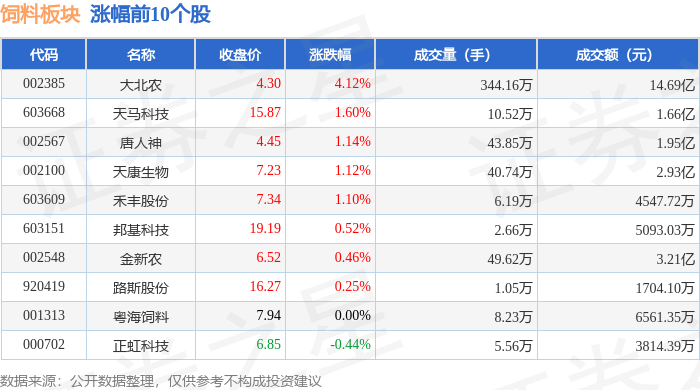
饲料板块1月28日跌0.3%,百洋股份领跌,主力资金净流入1.13亿元
Zheng Xing Xing Ye Ri Bao· 2026-01-28 08:56
Market Overview - The feed sector experienced a decline of 0.3% on January 28, with Baiyang Co., Ltd. leading the drop [1] - The Shanghai Composite Index closed at 4151.24, up 0.27%, while the Shenzhen Component Index closed at 14342.9, up 0.09% [1] Individual Stock Performance - Major gainers in the feed sector included: - Dabeinong (002385) with a closing price of 4.30, up 4.12% on a trading volume of 3.44 million shares and a transaction value of 146.9 million yuan [1] - Tianma Technology (603668) closed at 15.87, up 1.60% with a transaction value of 166 million yuan [1] - Tangrenshen (002567) closed at 4.45, up 1.14% with a transaction value of 19.5 million yuan [1] - Conversely, Baiyang Co., Ltd. (002696) led the decline with a closing price of 7.57, down 3.32% on a trading volume of 131,200 shares and a transaction value of 101 million yuan [2] - Other notable decliners included: - Aonong Biological (603363) down 2.64% [2] - Petty Holdings (300673) down 2.51% [2] Capital Flow Analysis - The feed sector saw a net inflow of 113 million yuan from institutional investors, while retail investors experienced a net outflow of 69.45 million yuan [2] - The capital flow for key stocks included: - Dabeinong had a net inflow of 16.416 million yuan from institutional investors, while retail investors saw a net outflow of 13.4 million yuan [3] - Tiankang Biological (002100) had a net inflow of 26.242 million yuan from institutional investors [3] - Baiyang Co., Ltd. experienced a net outflow of 30.7375 million yuan from retail investors [3]


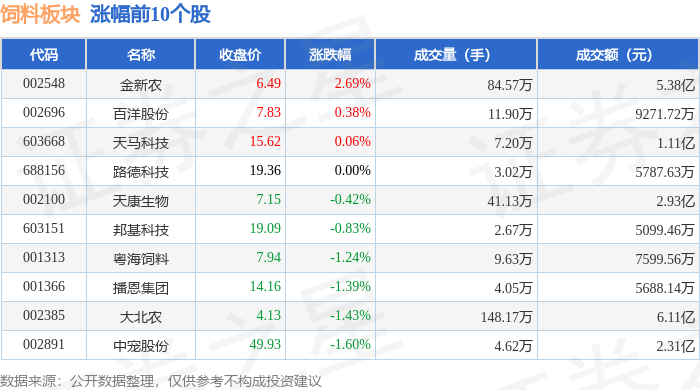
饲料板块1月27日跌1.85%,佩蒂股份领跌,主力资金净流出1.84亿元
Zheng Xing Xing Ye Ri Bao· 2026-01-27 08:49
证券之星消息,1月27日饲料板块较上一交易日下跌1.85%,佩蒂股份领跌。当日上证指数报收于 4139.9,上涨0.18%。深证成指报收于14329.91,上涨0.09%。饲料板块个股涨跌见下表: | 代码 | 名称 | 收盘价 | 涨跌幅 | 成交量(手) | 成交额(元) | | | --- | --- | --- | --- | --- | --- | --- | | 002548 | 金新农 | 6.49 | 2.69% | 84.57万 | | 5.38 Z | | 002696 | 自洋股份 | 7.83 | 0.38% | 11.90万 | | 9271.72万 | | 603668 | 天马科技 | 15.62 | 0.06% | 7.20万 | | 1.11亿 | | 688156 | 路德科技 | 19.36 | 0.00% | - 3.02万 | | 5787.63万 | | 002100 | 天康生物 | 7.15 | -0.42% | 41.13万 | | 2.93亿 | | 603151 | 邦基科技 | 19.09 | -0.83% | 2.67万 | | 5099.46万 | ...

中国消费行业:2026 年 GCC 会议要点 -估值仍具吸引力,消费复苏迹象显现-China Consumer Sector_ 2026 GCC takeaways_ Sector valuation remains attractive with signs of consumption recovery
2026-01-26 02:50
Summary of Key Points from the Conference Call Industry Overview - **Sector**: China Consumer Sector - **Key Insights**: The sector shows signs of consumption recovery despite a near-term property market downturn. Valuation remains attractive, approximately 1 standard deviation below 10-year averages, indicating that a consumption recovery is not yet priced in [2][21]. Consumer Staples - **Baijiu**: Anticipated demand support for mid-end baijiu due to easing alcohol bans and private consumption growth. Companies are expected to accelerate channel transformations for sustainable EPS growth [3][8]. - **Beer**: Premiumization continues through product diversification and in-home channel expansion, despite on-trade softness. CR Beer expects low-single-digit volume growth in 2025, with Heineken volumes projected to grow by 20% YoY [3][8]. - **Dairy**: Liquid milk sales are expected to recover modestly in 2026, driven by marketing and innovation, despite a weak 2025. Fresh milk shows resilience with double-digit growth [3][8]. - **Freshly-Made Beverages (FMB)**: Guming is expected to maintain steady SSSG in 2026 through category expansion and dine-in growth, despite the phase-out of delivery subsidies [3][8][19]. - **Condiments**: Sequentially improving demand is expected, with Haitian focusing on multi-product categories and Jonjee anticipating a cleaner 2026 after a weak 4Q25 [3][8]. Consumer Discretionary - **Home Appliances**: Companies like Midea and Haier expect higher overseas growth compared to domestic markets in 2026. Strategies include price hikes and operational efficiencies [4][10]. - **Jewelry**: Brands with unique designs may consolidate post-VAT reform. Laopu is expected to achieve strong sales growth due to increased focus on value-added services [4][10]. - **Restaurants**: Intense competition leads to divergent strategies, with some companies lowering prices while others upgrade offerings. DPC Dash is on track for expansion despite market uncertainties [4][10]. Stock Implications - **Most Preferred Stocks**: CR Beer, Guming, MIXUE, China Foods, YUM China, among others, are highlighted as preferred investments due to their growth potential [5]. - **Least Preferred Stocks**: Companies like Swellfun, Nongfu, and Gree are noted as less favorable due to various challenges [5]. Key Risks - Risks include demand recovery uncertainties, cost inflation or deflation, and changes in the competitive landscape. These factors could significantly impact the consumer sector's performance [21]. Additional Insights - **Pet Food**: The industry is shifting towards online sales, with over 85% of sales occurring digitally. Competition is intensifying, pushing brands towards innovation and product differentiation [13]. - **Snack Sector**: Rapid category diversification and channel restructuring are creating growth opportunities, particularly through snack discounters [9][12]. This summary encapsulates the essential insights and projections from the conference call, providing a comprehensive overview of the current state and future outlook of the China consumer sector.





玉米价格持续上涨,关注种植景气修复
GUOTAI HAITONG SECURITIES· 2026-01-26 02:20
Investment Rating - The report maintains an "Overweight" rating for the agricultural sector [6] Core Insights - Corn prices continue to rise, with a current spot price of 2,375 CNY/ton as of January 23, 2026, reflecting a weekly increase of 0.46%. The report is optimistic about the recovery of planting sentiment in the agricultural sector [4][10] - The report highlights a trend of increasing investment in the agricultural sector, with institutional investors increasing their holdings in companies like Wens Foodstuffs and Zhongxing Junye, while reducing positions in others like Noposion and New Hope [3] - The pet industry is also highlighted, with significant trends noted in pet fashion and pet-human cohabitation, indicating a growing investment in this sector. Major pet exhibitions are scheduled for March 2026, which are expected to catalyze new product launches [5] Summary by Sections Agricultural Sector - The agricultural sector's fund holdings are valued at 46.896 billion CNY, which is 0.14 percentage points below the standard industry allocation ratio, marking five consecutive quarters of underperformance [3] - The report anticipates stable to rising prices for corn and other grains, which is expected to benefit seed companies that adhere to a "quality for price" strategy [4] Livestock and Poultry - The report notes fluctuations in pig prices, with a current price of 13.1 CNY/kg, reflecting a 2.92% weekly increase. However, the annual comparison shows a decrease of 15.19% [10] - The average self-breeding and self-raising profit in the industry is reported at 43.4 CNY per head, showing a significant increase of 486.6% week-on-week [10] Pet Industry - The report emphasizes the increasing consumer investment in pets, with major exhibitions in South and North China expected to draw significant attention and new product launches from leading brands [5] - Recommended stocks in the pet sector include Guibao Pet, Zhongchong Co., and Ruipubio, all of which are expected to benefit from the growing market [6] Key Company Forecasts - The report provides earnings forecasts and valuations for key companies, with several companies rated as "Overweight," including Muyuan Foods, Wens Foodstuffs, and others, indicating a positive outlook for their performance [39]


农林牧渔行业月报:猪价偏弱震荡,2025年宠物食品出口表现向好-20260123
Zhongyuan Securities· 2026-01-23 09:14
Investment Rating - The report maintains an investment rating of "Outperform" for the agriculture, forestry, animal husbandry, and fishery industry [1]. Core Insights - The report highlights a weak fluctuation in pig prices, with the average price in December 2025 at 11.58 yuan/kg, down 0.09% month-on-month and down 26.76% year-on-year. However, a supply gap for heavy pigs is expected to lead to a price rebound [9][19]. - The white feather chicken prices showed an upward trend in December, with an average price of 3.67 yuan/jin, up 5.16% month-on-month, supported by tight supply and demand [9][25]. - Pet food exports maintained a year-on-year growth, with December 2025 exports at 37,700 tons, up 15.49% year-on-year, although the export value in USD decreased by 1.68% [9][32]. Summary by Sections Market Review - In December 2025, the agriculture, forestry, animal husbandry, and fishery index rose by 0.24%, ranking 22nd among 30 sectors, while the Shanghai and Shenzhen 300 index increased by 2.28%, indicating a 2.04 percentage point underperformance [9][12]. Livestock Industry Data Tracking - **Pig Farming**: The average price of pigs in December was 11.58 yuan/kg, with a month-on-month decrease of 0.09% and a year-on-year decrease of 26.76%. The supply-demand dynamics are expected to stabilize, with a potential increase in prices due to supply gaps [19][24]. - **White Feather Chicken**: The average price for white feather chicken in December was 3.67 yuan/jin, reflecting a month-on-month increase of 5.16% due to tight supply and demand support [25][29]. Pet Food - Pet food exports in December reached 37,700 tons, a year-on-year increase of 15.49%, while the total export value for the year was 1.412 billion USD, down 4.62% year-on-year [32][34]. Investment Recommendations - The report suggests focusing on companies such as Muyuan Foods, Pulaike, and Guobao Pet, all rated as "Buy" based on their earnings forecasts and relative valuation [1][9].

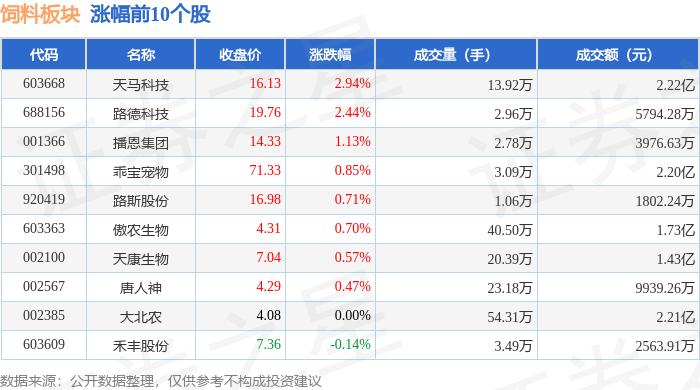
饲料板块1月23日跌0.29%,中宠股份领跌,主力资金净流出7063.74万元
Zheng Xing Xing Ye Ri Bao· 2026-01-23 09:04
Group 1 - The feed sector experienced a decline of 0.29% on January 23, with Zhongchong Co., Ltd. leading the drop [1] - The Shanghai Composite Index closed at 4136.16, up 0.33%, while the Shenzhen Component Index closed at 14439.66, up 0.79% [1] - Key stocks in the feed sector showed varied performance, with Tianma Technology rising by 2.94% to a closing price of 16.13, while Zhongchong Co., Ltd. fell by 1.55% to 49.52 [2] Group 2 - The feed sector saw a net outflow of 70.64 million yuan from institutional investors, while retail investors had a net inflow of 90.51 million yuan [2] - The trading volume and turnover for major stocks in the feed sector varied, with major stocks like Tianma Technology and Haida Group showing significant trading activity [3] - The net inflow and outflow of funds for specific stocks indicated a mixed sentiment among investors, with some stocks like Haida Group experiencing a net inflow of 13.67 million yuan from institutional investors [3]