Petpal Tech.(300673)

Search documents
饲料板块1月21日跌0.69%,傲农生物领跌,主力资金净流出9594.33万元
Zheng Xing Xing Ye Ri Bao· 2026-01-21 08:48
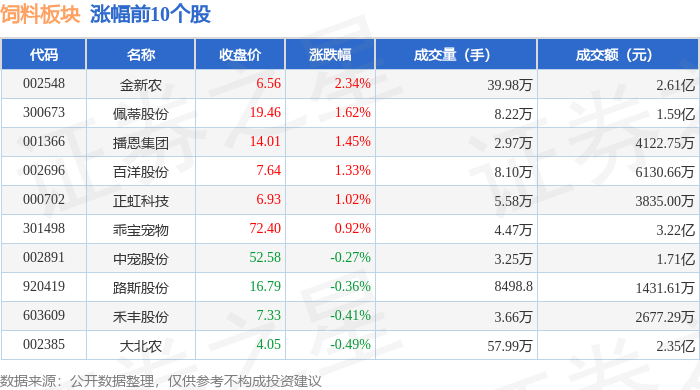
Market Overview - The feed sector experienced a decline of 0.69% on January 21, with Aonong Biological leading the drop [1] - The Shanghai Composite Index closed at 4116.94, up 0.08%, while the Shenzhen Component Index closed at 14255.12, up 0.7% [1] Individual Stock Performance - Jin Xin Nong (002548) closed at 6.56, up 2.34% with a trading volume of 399,800 shares and a transaction value of 261 million [1] - Petty Holdings (300673) closed at 19.46, up 1.62% with a trading volume of 82,200 shares and a transaction value of 159 million [1] - Aonong Biological (603363) closed at 4.27, down 1.84% with a trading volume of 430,600 shares and a transaction value of 184 million [2] - Other notable declines include Tian Kang Biological (002100) down 1.26% and Hai Da Group (002311) down 1.17% [2] Capital Flow Analysis - The feed sector saw a net outflow of 95.94 million from institutional investors, while retail investors had a net inflow of 63.31 million [2] - The capital flow for individual stocks shows Jin Xin Nong with a net inflow of 21.61 million from institutional investors, while Aonong Biological had a net outflow of 1.32 million [3] - Petty Holdings experienced a net outflow of 1.99 million from institutional investors but a net inflow of 6.27 million from retail investors [3]


猪价继续上涨,关注寒潮和腊月对价格影响
GUOTAI HAITONG SECURITIES· 2026-01-18 13:44
Investment Rating - The report provides an "Increase" rating for the industry, indicating a positive outlook compared to the Shanghai and Shenzhen 300 Index [46]. Core Insights - The report highlights the strengthening of pig prices, with a current price of 12.69 CNY/Kg, reflecting a week-on-week increase of 0.20 CNY/Kg. Factors contributing to this trend include a decrease in sales plans for January and the anticipated impact of a nationwide cold wave starting January 19, which may further boost prices [5][10]. - In the planting sector, corn and soybean prices have shown stability, with corn prices at 2364 CNY/ton (up 0.5% week-on-week) and soybean prices at 4072 CNY/ton (up 0.6% week-on-week). The report expresses optimism for the recovery of planting sector profitability [3][10]. - The pet industry is experiencing increased attention due to major exhibitions, with significant events scheduled in March 2026, which are expected to catalyze new product launches from leading domestic brands [4]. Summary by Sections Livestock - The report notes that pig prices are on the rise, with a current price of 12.69 CNY/Kg, up 1.60% week-on-week and 10.06% month-on-month, although down 19.33% year-on-year. The report suggests that the cold wave and increased demand during the lunar month will be key factors influencing future price movements [5][10]. - Recommended stocks in the livestock sector include Muyuan Foods, Wens Foodstuffs, and others, with a focus on companies that are expected to benefit from the recovery in pig prices [5][40]. Planting - The report indicates that corn and soybean prices are stable, with corn at 2364 CNY/ton and soybeans at 4072 CNY/ton. The planting sector is expected to see a recovery in profitability, particularly benefiting seed companies that focus on high-quality products [3][10]. Pet Industry - Major pet exhibitions are set to take place in March 2026, which are expected to enhance market interest and lead to new product launches from top brands. The report emphasizes the potential for growth in the pet sector due to these events [4][10]. Key Company Coverage - The report includes earnings forecasts and valuations for key companies in the industry, with all covered companies receiving an "Increase" rating. Notable companies include Muyuan Foods, Wens Foodstuffs, and various firms in the pet and agricultural sectors [40].




新消费&轻工周报:AI+消费迈入物理世界,新型烟草出口格局生变利好龙头-20260118
SINOLINK SECURITIES· 2026-01-18 12:12
Investment Rating - The report does not explicitly state an investment rating for the industry Core Insights - The report highlights various sectors including trendy toys, new tobacco, home furnishings, paper packaging, personal care, AI glasses, Xiaomi Group, pet food, and AI+3D printing, indicating a mixed outlook across these industries with some showing growth potential while others face challenges Trendy Toys - The collaboration between Honor and Pop Mart to launch the first trendy toy smartphone is expected to differentiate products in a competitive market, targeting younger consumers [8] - Despite a decline in overall online GMV for trendy toys, leading companies like Miniso and Bluku are experiencing significant growth, with Miniso's blind box category growing by 315% [10] New Tobacco - The cancellation of VAT export rebates for e-cigarettes is expected to pressure profits in the short term, but may benefit companies like Smoore in the long run as they can capture market share from smaller competitors [11] - The HNB market is anticipated to expand significantly with the upcoming launch of IQOS in the US [12] Home Furnishings - The domestic real estate market remains weak, with significant declines in new and second-hand home transactions [13] - Export figures show a decline for Chinese furniture, while Vietnam's furniture exports are growing, indicating a shift in regional competitiveness [14] Paper Packaging - The report notes fluctuations in paper prices, with a general decline in prices for various paper types, but anticipates a recovery in demand as packaging needs stabilize [15] - The overall retail growth in food, beverages, and daily necessities is expected to support the packaging sector's recovery [16] Personal Care and AI Glasses - The personal care sector shows mixed performance, with some brands experiencing growth while others decline [17] - Meta's plans to significantly increase the production capacity of AI glasses signal a positive outlook for the sector, potentially boosting demand across the supply chain [18] Xiaomi Group - Xiaomi continues to lead in the smartphone market, with expectations to integrate self-developed chips and AI models into their products by 2026 [19] - The company aims to enhance its brand positioning and profitability through technological advancements and strategic product launches [20] Pet Food - The pet food market is projected to grow, with a focus on new product introductions and market expansion strategies [23] - Recent data indicates a decline in GMV for pet food on major e-commerce platforms, highlighting competitive pressures [24] AI+3D Printing - The consumer-grade 3D printing market is expected to grow, driven by new product launches and community engagement initiatives [33] - Companies are focusing on lowering entry barriers and enhancing user experience to penetrate the market further [36]



饲料板块1月16日跌0.52%,傲农生物领跌,主力资金净流出7100.75万元
Zheng Xing Xing Ye Ri Bao· 2026-01-16 08:49
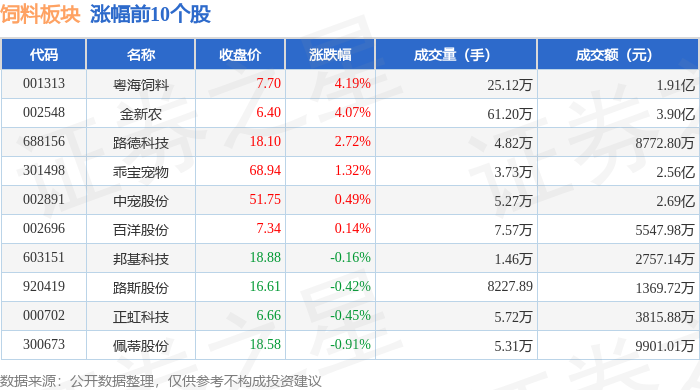
Market Overview - The feed sector experienced a decline of 0.52% on January 16, with Aonong Biological leading the drop [1] - The Shanghai Composite Index closed at 4101.91, down 0.26%, while the Shenzhen Component Index closed at 14281.08, down 0.18% [1] Individual Stock Performance - The top gainers in the feed sector included: - Jinxinnong (002548) with a closing price of 6.40, up 4.07% on a trading volume of 612,000 shares and a turnover of 1.76 million [1] - Just Update (001313) with a closing price of 7.70, up 4.19% on a trading volume of 251,200 shares and a turnover of 191 million [1] - The top decliners included: - Aonong Biological (603363) with a closing price of 4.16, down 1.65% on a trading volume of 623,800 shares and a turnover of 261 million [2] - Tiankang Biological (002100) with a closing price of 7.07, down 1.26% on a trading volume of 247,400 shares and a turnover of 176 million [2] Capital Flow Analysis - The feed sector saw a net outflow of 71.01 million from institutional investors, while retail investors contributed a net inflow of 31.24 million [2] - The capital flow for individual stocks showed: - Jinxinnong (002548) had a net inflow of 21.44 million from institutional investors, but a net outflow of 26.24 million from retail investors [3] - Just Update (001313) had a net inflow of 20.81 million from institutional investors, with a net outflow of 25.93 million from retail investors [3]


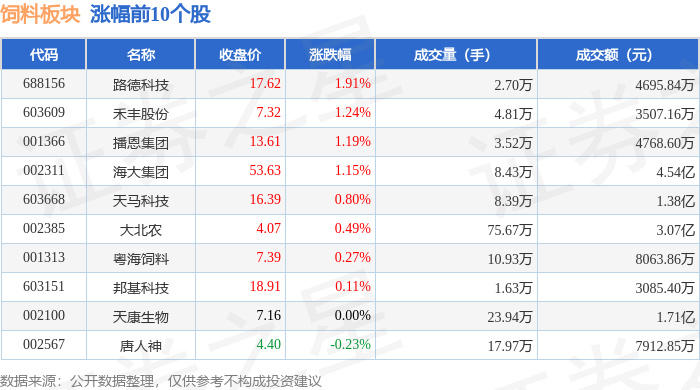
饲料板块1月15日涨0.13%,路德科技领涨,主力资金净流出1.16亿元
Zheng Xing Xing Ye Ri Bao· 2026-01-15 08:53
Group 1 - The feed sector experienced a slight increase of 0.13% on January 15, with Lude Technology leading the gains [1] - The Shanghai Composite Index closed at 4112.6, down 0.33%, while the Shenzhen Component Index closed at 14306.73, up 0.41% [1] - Key stocks in the feed sector showed varied performance, with Lude Technology closing at 17.62, up 1.91%, and Tangrenshen closing at 4.40, down 0.23% [1] Group 2 - The feed sector saw a net outflow of 116 million yuan from institutional investors, while retail investors contributed a net inflow of 116 million yuan [2] - The trading volume for Lude Technology was 27,000 hands, with a transaction amount of 46.9584 million yuan [1] - The stock performance of major companies included Hada Group with a closing price of 53.63, up 1.15%, and Petty Co. with a closing price of 18.75, down 2.09% [2][3] Group 3 - The net inflow from retail investors for TianKang Biological was 17.1 million yuan, while the net outflow from institutional investors was 18.4821 million yuan [3] - The net inflow for GuaiBao Pet was 6.3998 million yuan from institutional investors, while it faced a net outflow of 10.7891 million yuan from retail investors [3] - The overall sentiment in the feed sector indicates mixed investor behavior, with some stocks attracting retail interest while others faced institutional selling pressure [2][3]

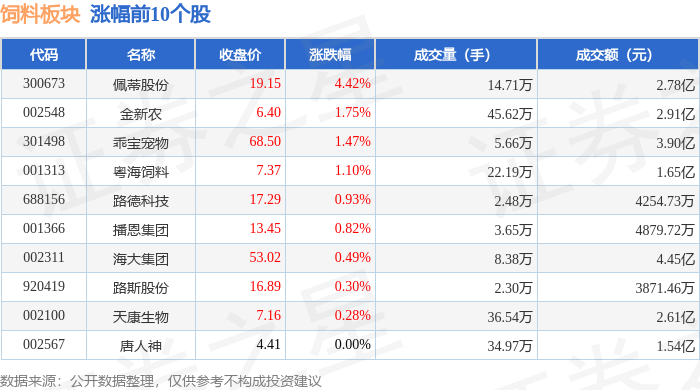
饲料板块1月14日涨0.22%,佩蒂股份领涨,主力资金净流出8966.45万元
Zheng Xing Xing Ye Ri Bao· 2026-01-14 08:44
Market Overview - The feed sector increased by 0.22% on January 14, with Petty Co. leading the gains [1] - The Shanghai Composite Index closed at 4126.09, down 0.31%, while the Shenzhen Component Index closed at 14248.6, up 0.56% [1] Key Performers in the Feed Sector - Petty Co. (300673) closed at 19.15, up 4.42%, with a trading volume of 147,100 shares and a transaction value of 278 million [1] - Jin Xin Nong (002548) closed at 6.40, up 1.75%, with a trading volume of 456,200 shares and a transaction value of 291 million [1] - Guai Bao Pet (301498) closed at 68.50, up 1.47%, with a trading volume of 56,600 shares and a transaction value of 390 million [1] Capital Flow Analysis - The feed sector experienced a net outflow of 89.6645 million from institutional investors, while retail investors saw a net inflow of 66.2951 million [2] - The overall capital flow indicates a mixed sentiment, with institutional investors withdrawing funds while retail investors are actively buying [2] Individual Stock Capital Flow - Guai Bao Pet (301498) had a net inflow of 19.8055 million from institutional investors, but a net outflow of 1.66916 million from retail investors [3] - Hai Da Group (002311) saw a net inflow of 12.0345 million from institutional investors, while retail investors had a net inflow of 470.27 thousand [3] - Petty Co. (300673) had a net inflow of 10.0145 million from institutional investors, but retail investors experienced a net outflow of 746.07 thousand [3]
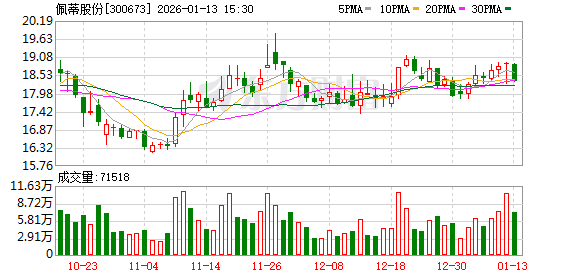
佩蒂股份:目前公司生产经营正常
Zheng Quan Ri Bao· 2026-01-13 13:44
Group 1 - The core viewpoint of the article is that Petty Holdings is currently operating normally and is actively working to meet its business objectives [2] Group 2 - The company has stated that all factories are conducting business in an orderly manner according to their respective positioning and operational plans [2] - Petty Holdings is making efforts to complete all tasks assigned by the company [2]
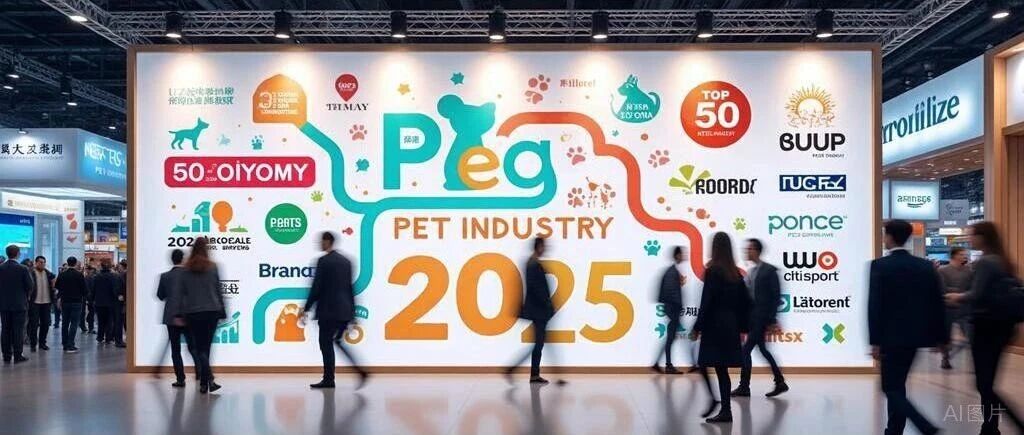
【2025榜单】驱动3000亿宠物市场的真内核是什么?| 2025宠物产业50条隐秘洞察与TOP50创新品牌发布
新消费智库· 2026-01-12 16:23
Core Insights - The pet industry in China is projected to exceed 500 billion yuan by 2025, marking a significant transformation from a purely economic sector to a social ecosystem [2] - The main consumer group is shifting from the "90s generation" to the "00s generation," which is growing at a rate 21 percentage points higher, while the "silver-haired" demographic will also play a crucial role in the next decade [2] - The emotional connection between pets and owners is becoming a driving force in the industry, moving from pets as mere property to being considered family members [2] - Government policies are increasingly integrating the pet economy into urban development plans, indicating a shift from spontaneous market growth to a more structured and policy-driven approach [2] Section 1: Sharp Insights into the Pet Industry - The illusion of a market ceiling at 811.4 billion yuan creates a false sense of prosperity, as the real challenge lies in transitioning from "new pet ownership" to "refined care" [6] - The "Z generation" is seen as the fastest-growing consumer group, but their actual purchasing power is limited, making them more of future influencers than current spenders [6] - The "silver-haired gold mine" is expected to be the most significant source of growth in the pet industry over the next 5-10 years, as this demographic has both the financial means and emotional needs for pet companionship [6] - The concept of "emotional tax" is emerging, where spending on pets is viewed as fulfilling emotional needs rather than mere expenses [7] - The shift from impulsive pet ownership to responsible consumption is driven by rising abandonment rates, leading to a more thoughtful approach to pet care [9] - The "it economy" is showing resilience during economic downturns, but non-essential pet products may face cuts first [9] - "Pet-friendly" policies are becoming essential for businesses, with a focus on creating harmonious environments for pets and their owners [9] - The trend of "personalization" in pet products is evolving, moving towards unique offerings based on individual pet characteristics [9] Section 2: Product Innovation and Supply Chain Dynamics - The competition in functional pet food is intensifying, with many players in the market, making it crucial to base claims on verifiable clinical data [11] - The "fresh meat" segment is entering a critical phase where supply chain efficiency will determine market success [11] - The rise of "baked food" is creating a competitive landscape focused on ingredient quality and scientific formulation [11] - Freeze-dried snacks are transitioning from luxury items to staple foods, reshaping consumer perceptions of pet food value [13] - The "clean label" movement is facing trust issues due to the lack of standardized definitions for terms like "natural" and "no additives" [12] - Pet snacks are becoming a significant part of the diet, with specific functional benefits [15] - The demand for smart pet products is growing, but they must address real pain points to move beyond novelty [16] - Design is becoming a critical factor in pet product success, with aesthetically pleasing items gaining popularity [17] Section 3: Market Trends and Consumer Behavior - The trend of celebrating pets' birthdays and purchasing themed products is becoming a new norm, with significant growth in related consumer behavior [21] - Multi-pet households are becoming the norm, driving demand for specialized products [42] - Pet health management is shifting towards proactive prevention, with a growing number of pet owners regularly providing supplements [43] - The "humanization" of pets is deepening, with owners increasingly investing in their pets' fashion and social presence [44] - Exotic pet ownership is rising among younger generations, reflecting a desire for unique social expressions [45] Section 4: Best Innovative Brands in the Pet Industry - The report will highlight 50 brands excelling in product breakthroughs, innovative business models, technological applications, design aesthetics, and social responsibility [23][24] - Each brand will be evaluated based on its core innovations, representative products, and industry impact [24]
农林牧渔周观点(2026.01.05-2026.01.11):猪价反弹后趋稳延续强势,关注宠物行业白皮书发布-20260112
Shenwan Hongyuan Securities· 2026-01-12 11:03
Investment Rating - The industry investment rating is "Overweight," indicating that the industry is expected to outperform the overall market [4]. Core Insights - The report highlights a rebound in pig prices, which are stabilizing and maintaining strength. The focus is also on the pet industry following the release of a white paper on the sector [1][3]. - The report suggests that the supply of pigs remains ample in the first half of 2026, with a prolonged bottoming period expected for the industry cycle. The logic for a rebound in 2026 remains intact, presenting potential investment opportunities [3][4]. Summary by Sections Pig Farming - As of January 11, the national average price for external three yuan pigs is 12.70 yuan/kg, reflecting a week-on-week increase of 2.1%. The supply of large pigs is tight, and the enthusiasm for secondary fattening has increased, leading to a temporary tightening of the market [3]. - The price of weaned piglets has also risen, reaching 251 yuan/head, nearing industry cost levels. The report notes that the production capacity reduction has slowed down, with a slight increase in the number of breeding sows [3][4]. Pet Industry - The 2026 China Pet Industry White Paper indicates that the urban pet consumption market reached 312.6 billion yuan in 2025, growing by 4.1% year-on-year. The dog market accounted for 160.6 billion yuan, while the cat market reached 152.0 billion yuan [3]. - The average annual spending per pet owner has shown a slight increase, with dog owners spending an average of 3,006 yuan and cat owners spending 2,085 yuan [3]. Chicken Farming - The average price for white feather broiler chicks has decreased to 3.15 yuan/chick, a week-on-week decline of 6.5%. Despite this, the supply of broilers remains tight, with the average price for broiler chickens at 3.79 yuan/kg [3]. - The report emphasizes that the theme of abundant supply in the white feather chicken market will continue into 2025-2026, and it suggests focusing on leading companies in the sector [3].
饲料板块1月12日跌0.25%,金新农领跌,主力资金净流出1.84亿元
Zheng Xing Xing Ye Ri Bao· 2026-01-12 09:00
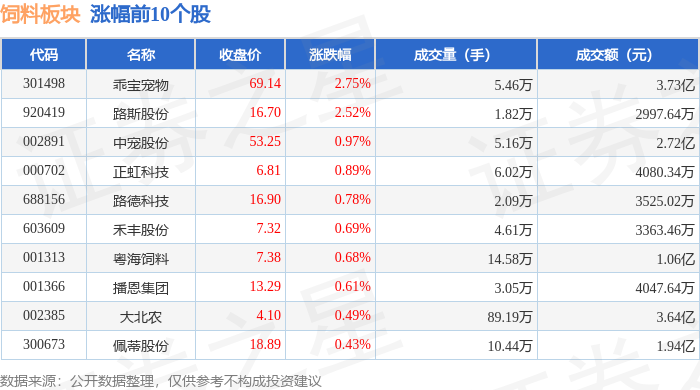
Group 1 - The feed sector experienced a decline of 0.25% on January 12, with Jin Xin Nong leading the drop [1] - The Shanghai Composite Index closed at 4165.29, up 1.09%, while the Shenzhen Component Index closed at 14366.91, up 1.75% [1] - Major stocks in the feed sector showed varied performance, with notable gainers including Guai Bao Pet Food, which rose by 2.75% to a closing price of 69.14 [1] Group 2 - Jin Xin Nong's stock price fell by 2.37% to 6.18, with a trading volume of 488,700 shares and a turnover of 303 million yuan [2] - The feed sector saw a net outflow of 184 million yuan from main funds, while retail investors contributed a net inflow of 141 million yuan [2] - The stock performance of various companies indicated mixed trends, with some stocks like Petty Co. showing a slight increase of 0.43% [2][3] Group 3 - The main fund inflow for Da Bei Nong was 29.46 million yuan, while it experienced a net outflow from retail investors of 10.16 million yuan [3] - Lu Si Co. had a net inflow of 1.44 million yuan from main funds, with retail investors also contributing positively [3] - The overall sentiment in the feed sector appears cautious, with significant movements in fund flows indicating varying investor confidence [3]