
CATL(300750)

Search documents
2025胡润中国500强榜单发布,有101家企业将主要研发基地设在上海
Xin Lang Cai Jing· 2026-02-05 03:43
Core Insights - The "2025 Hurun China 500" list highlights the top non-state-owned enterprises in China ranked by their value, marking the seventh consecutive release of this report by Hurun Research Institute [1] Group 1: Company Rankings and Values - TSMC retains its position as the highest-valued private enterprise in China with a value of 1.05 trillion RMB, an increase of 350 billion RMB [1][2] - Tencent ranks second with a value of 530 billion RMB, up by 190 billion RMB [1][2] - ByteDance holds the third position with a value of 340 billion RMB, increasing by 180 billion RMB [1][2] - Alibaba, CATL, Pinduoduo, Ping An Insurance, Xiaomi, BYD, and Huawei complete the top ten list, with notable value increases ranging from 10% to 109% [2][3] Group 2: Overall Market Trends - The threshold for entering the top 500 has risen by 7.5 billion RMB to 34 billion RMB, reflecting a 28% increase [3] - The total value of the top 500 companies has grown by 21 trillion RMB, a 38% increase, reaching 77 trillion RMB [3] - Among the listed companies, 386 experienced value growth, including 95 new entrants, while 102 saw a decline [3] Group 3: Industry Insights - 75% of the top 500 companies provide physical products, while 25% offer software or services [3] - The semiconductor, media and entertainment, industrial products, and consumer goods sectors account for half of the total value of the Hurun China 500 [3] Group 4: Geographic Distribution - Beijing, Shanghai, and Shenzhen are the top three cities with the most companies in the Hurun China 500, with 59, 57, and 49 companies respectively [5] - Shanghai has the highest number of R&D bases with 101 companies, followed by Beijing and Shenzhen with 66 and 61 respectively [6][5] - The Yangtze River Delta region has 161 companies in the top 500, representing 32% of the total, while the Guangdong-Hong Kong-Macau Greater Bay Area has 108 companies, accounting for 22% [7]






沪深300ESGETF南方(560180)跌0.59%,半日成交额126.90万元
Xin Lang Cai Jing· 2026-02-05 03:37
Group 1 - The core point of the article highlights the performance of the HuShen 300 ESG ETF managed by Southern Fund Management, which has seen a return of 19.34% since its inception on April 13, 2023, and a return of 1.57% over the past month [1] - As of the midday close on February 5, the HuShen 300 ESG ETF (560180) fell by 0.59%, trading at 1.184 yuan with a transaction volume of 1.269 million yuan [1] - The top holdings of the ETF include Kweichow Moutai, which rose by 1.41%, and Zijin Mining, which fell by 5.29%, indicating mixed performance among its key stocks [1] Group 2 - The ETF's performance benchmark is the HuShen 300 ESG Index return rate, indicating its focus on sustainable investment [1] - The fund manager is Southern Fund Management Co., Ltd., with Li Jialiang serving as the fund manager [1]





新规锁定车企责任,动力电池回收进入强约束时代
Di Yi Cai Jing· 2026-02-05 03:27
Core Viewpoint - The new interim measures for the recycling and comprehensive utilization of used power batteries from electric vehicles emphasize the responsibility of automotive companies to create favorable recycling conditions for consumers and lower the barriers for compliant recycling behavior [1][5][6]. Group 1: Regulatory Framework - The Ministry of Industry and Information Technology and five other ministries have jointly issued the "Interim Measures for the Recycling and Comprehensive Utilization of Used Power Batteries from New Energy Vehicles," signaling a significant policy enhancement in the battery recycling sector [1]. - The measures require automotive companies to directly engage with consumers during the scrapping phase of electric vehicles, ensuring that retired batteries are funneled into formal recycling channels [1][5]. Group 2: Environmental and Safety Concerns - Improper handling of retired batteries can lead to environmental hazards, including the release of toxic gases and contamination of soil and water due to the leakage of critical metal ions like nickel, cobalt, and lithium [2]. - The industry faces structural overcapacity and inefficient competition due to the diversion of retired batteries to non-compliant channels, which hampers the effective recovery of valuable metals [2]. Group 3: Consumer Engagement and Responsibilities - The interim measures highlight that companies must not shift the responsibility of battery recycling onto consumers, as individuals lack the capacity to manage the disposal of retired batteries [5]. - Companies are required to establish recycling points that align with the sales regions and volumes of new energy vehicles, addressing the imbalance in recycling infrastructure across different cities [5][6]. Group 4: Compliance and Market Impact - The new regulations are expected to enhance the recycling efficiency of batteries by integrating recycling considerations into the design phase, thereby reducing costs associated with the use of recycled materials [7]. - The measures encourage collaboration between battery manufacturers and automotive companies, promoting a more sustainable development path for both sectors [8].

2025胡润中国500强:最具价值国企前三名为农业银行、工商银行、国家电网
Xin Lang Cai Jing· 2026-02-05 03:06
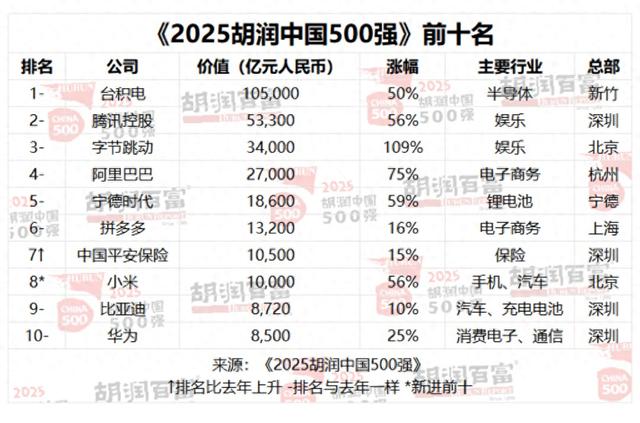
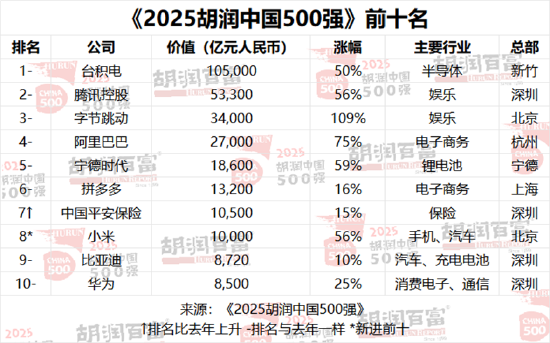
Core Insights - The "2025 Hurun China 500" report highlights TSMC as the highest-valued private enterprise in China, with a valuation increase of 3.5 trillion RMB, reaching 10.5 trillion RMB [1][4] - Tencent follows as the second highest, with a valuation growth of 1.9 trillion RMB, totaling 5.3 trillion RMB [1][4] - ByteDance ranks third, increasing its value by 1.8 trillion RMB to 3.4 trillion RMB [1][4] - Xiaomi enters the top ten for the first time, with a valuation increase of 357 billion RMB, reaching 1 trillion RMB [1][4] Top Ten Private Enterprises - TSMC: Valuation of 105,000 million RMB, growth of 50% [2][5] - Tencent: Valuation of 53,300 million RMB, growth of 56% [2][5] - ByteDance: Valuation of 34,000 million RMB, growth of 109% [2][5] - Alibaba: Valuation of 27,000 million RMB, growth of 75% [2][5] - CATL: Valuation of 18,600 million RMB, growth of 59% [2][5] - Pinduoduo: Valuation of 13,200 million RMB, growth of 16% [2][5] - Ping An Insurance: Valuation of 10,500 million RMB, decline of 15% [2][5] - Xiaomi: Valuation of 10,000 million RMB, growth of 56% [2][5] - BYD: Valuation of 8,720 million RMB, growth of 10% [2][5] - Huawei: Valuation of 8,500 million RMB, growth of 25% [2][5] Top Ten State-Owned Enterprises - Agricultural Bank: Valuation of 202,000 million RMB [3][6] - Industrial and Commercial Bank: Valuation of 274,000 million RMB [3][6] - State Grid: Valuation of 266,000 million RMB [3][6] - China National Railway Group: Valuation of 224,000 million RMB [3][6] - China Construction Bank: Valuation of 203,000 million RMB [3][6] - Kweichow Moutai: Valuation of 182,000 million RMB [3][6] - China Petroleum: Valuation of 176,000 million RMB [3][6] - Bank of China: Valuation of 170,000 million RMB [3][6] - China Mobile: Valuation of 175,000 million RMB [3][6] - CITIC Group: Valuation of 156,000 million RMB [3][6]


2025胡润中国500强发布:寒武纪价值增长3700亿元,位列第16
Xin Lang Cai Jing· 2026-02-05 03:04
来源:5D调查 胡润研究院发布2月5日发布《2025胡润中国500强》,台积电价值增长3.5万亿元,以10.5万亿元再度蝉 联中国价值最高的民营企业。腾讯价值增长1.9万亿元,以5.3万亿元稳居第二。字节跳动价值增长1.8万 亿元,以3.4万亿元保持第三。小米新进前十,价值增长3570亿元,以1万亿元位列第八。 | | | | 《2025胡润中国500强》 前十名 | | | | | --- | --- | --- | --- | --- | --- | --- | | 排名 | 公司 | 价值(亿元人民币) | | 涨幅 | 三是得行业 | SHI | | | 合肥皂 | alle Par 200 - 100, 000 | | 50% | | | | 2- | 腾讯控股 | 53,300 | | 56%500 | 娱乐 | 深圳 | | 3- | 字节跳动 | 34,000 | | 109% | 娱乐 | 北京 | | 4- | 阿里巴巴 | 27,000 | | 75% | 电子商务 | 杭州 | | | 宁德时代 | 18,600 | 1981-1991 | 59% | 一理申池 | 宁德 | | | ...

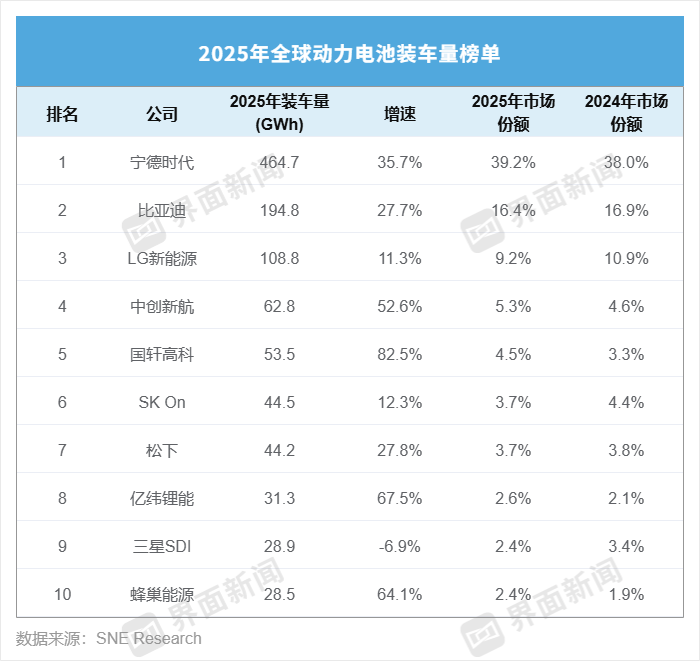
历史首次,中企狂揽全球动力电池超七成市场 | 动力电池排名②
Xin Lang Cai Jing· 2026-02-05 02:57
智通财经记者 | 高菁 2025年,中国企业贡献了全球超七成的动力电池装车量,以及超八成的储能电池出货量。 2月4日,韩国研究机构SNE Research(下称SNE)发布最新统计数据,去年全球动力电池装车总量达1187 GWh,同比增长31.7%。这一增速较2024年全年有所回升。 同期,共有六家中国企业的动力电池装车量闯进全球前十,分别为宁德时代(300750.SZ)、比亚迪 (002594.SZ)、中创新航(03931.HK)、国轩高科(002074.SZ)、亿纬锂能(300014.SZ)和蜂巢能源。 六家中企的总市场份额达70.4%,较去年全年的提高了3.3个百分点,也是有统计以来中企年度全球动力 电池市占率首次超70%。 | | | | 2025年全球动力电池装车量榜单 | | | | --- | --- | --- | --- | --- | --- | | 排名 | 公司 | 2025年装车量 (GWh) | 増速 | 2025年市场 保题 | 2024年市场 保频 | | 1 | 宁德时代 | 464.7 | 35.7% | 39.2% | 38.0% | | 2 | 比亚迪 | 194.8 ...


2025胡润中国500强发布:美团退出前十,位列第17位
Xin Lang Cai Jing· 2026-02-05 02:56
胡润研究院发布2月5日发布《2025胡润中国500强》,台积电价值增长3.5万亿元,以10.5万亿元再度蝉 联中国价值最高的民营企业。腾讯价值增长1.9万亿元,以5.3万亿元稳居第二。字节跳动价值增长1.8万 亿元,以3.4万亿元保持第三。小米新进前十,价值增长3570亿元,以1万亿元位列第八。美团退出前 十,位列第17位。 从价值上涨的绝对数额来看,过去一年中增长最多的是台积电,其价值增长了3.5万亿元,主要原因是 人工智能需求的强劲拉动、先进的制程技术以及稳固的市场地位。其次是腾讯,价值增长了1.9万亿 元,主要是由于其在游戏、广告、金融科技三大主业的出色表现,推动了公司整体业绩的提升。位列第 三的是字节跳动,价值增长了1.8万亿元,得益于AI业务的进展推动公司估值持续走高。 阿里巴巴价值增长1.2万亿元,主要因为阿里巴巴在人工智能和云计算领域的战略投入取得了高速增 长,以及传统电商基本盘企稳回升。 宁德时代价值增长6900亿元,主要得益于新能源汽车市场需求的持续增长。2025年5月,宁德时代在港 交所二次上市,募资超325亿元人民币,成为2025年港股最大IPO。 有着"中国的英伟达"之称的寒武纪,价值 ...


2025胡润中国500强发布:台积电、腾讯、字节跳动位列前三
Xin Lang Cai Jing· 2026-02-05 02:27
Core Insights - The 2025 Hurun China 500 list shows significant growth in company valuations, with TSMC leading as the highest valued private enterprise in China at 10.5 trillion RMB, followed by Tencent and ByteDance [1][9]. Company Performance - TSMC's value increased by 3.5 trillion RMB, driven by strong demand for artificial intelligence, advanced process technology, and a solid market position [3][11]. - Tencent's valuation rose by 1.9 trillion RMB, attributed to strong performance in gaming, advertising, and fintech [3][11]. - ByteDance's value grew by 1.8 trillion RMB, benefiting from advancements in AI [3][11]. - Alibaba's value increased by 1.2 trillion RMB, due to strategic investments in AI and cloud computing, alongside a recovery in traditional e-commerce [4][12]. - CATL's valuation rose by 690 billion RMB, supported by sustained demand in the electric vehicle market [4][12]. - Xiaomi entered the top ten with a valuation increase of 357 billion RMB, driven by growth in its automotive business and premium smartphone sales [4][12]. - Other notable companies include Cambricon, which saw a valuation increase of 370 billion RMB, and NetEase, which grew by 238 billion RMB due to strong gaming performance [4][12]. Industry Trends - The total value of the Hurun China 500 companies increased by 21 trillion RMB (38%) to reach 77 trillion RMB [2][10]. - The semiconductor industry experienced the most significant growth, surpassing the life sciences sector to become the second-largest industry in the list, while industrial products remained the largest [2][10]. - The real estate sector faced the largest decline, followed by retail [2][10]. - The average age of the top 500 companies is 29 years, indicating a relatively young corporate landscape [11]. Geographic Insights - Beijing, Shanghai, and Shenzhen are the top three cities with the most companies on the list, housing 59, 57, and 49 companies respectively [2][10]. - Suzhou emerged as the preferred manufacturing base with 68 companies, while Shanghai was the leading research and development hub with 101 companies [2][10]. New Entrants and Market Dynamics - A total of 95 companies (19%) made it to the list for the first time, with seven companies valued over 100 billion RMB [2][10]. - The threshold for entry into the 2025 Hurun China 500 increased by 7.5 billion RMB to 34 billion RMB, reflecting a 28% rise [2][10].


富临精工:龙头合作、一体化布局助推盈利释放-20260205
HTSC· 2026-02-05 02:25
Investment Rating - The report maintains a "Buy" rating for the company with a target price of RMB 29.38 [9]. Core Views - The company is expected to benefit from strategic collaboration with leading customers and an integrated layout that reduces production costs, enhancing its competitiveness in the lithium battery materials business [3][4]. - The company plans to jointly increase capital in its subsidiary Jiangxi Shenghua with CATL, which will strengthen their collaboration in lithium battery materials and other fields [4]. - The establishment of a joint venture to produce 500,000 tons of ferrous oxalate annually is a significant step in controlling raw material costs and achieving a vertical supply chain [5]. - The automotive parts business is transitioning towards smart electric control and mechatronics, with a focus on new energy vehicle components and humanoid robot parts [6]. Summary by Sections Investment Rating - The company is rated as "Buy" with a target price of RMB 29.38, reflecting a positive outlook based on expected growth in earnings and market position [9]. Strategic Collaborations - The company announced a capital increase with CATL, which will raise CATL's stake in Jiangxi Shenghua from 19% to 33% [4]. - This collaboration is expected to enhance order resilience and scalability for the company [4]. Production and Cost Management - The joint venture for ferrous oxalate production will help in reducing the cost of lithium iron phosphate production, with expectations of profit per ton increasing to RMB 2,000-3,000 by 2026 [5]. - The integrated supply chain strategy aims to solidify the company's position in high-end lithium iron phosphate materials [5]. Financial Projections - The company has adjusted its profit forecasts, lowering the 2025 net profit estimate by 31% to RMB 568 million, while increasing the 2026 and 2027 estimates by 35% and 46% respectively [7]. - Revenue projections for 2026 are set at RMB 37.57 billion, with a significant increase in earnings per share (EPS) expected [7][13]. Automotive Parts Business - The automotive parts segment is expanding into smart electric control systems and humanoid robot components, indicating a diversification of product offerings [6]. - The company aims to become a leading supplier in the domestic humanoid robot market through partnerships and customized solutions [6].

富临精工(300432):龙头合作、一体化布局助推盈利释放
HTSC· 2026-02-05 01:46
Investment Rating - The report maintains a "Buy" rating for the company with a target price of RMB 29.38 [9][7]. Core Views - The company is expected to benefit from strategic collaboration with leading customers and an integrated layout that reduces production costs, enhancing its competitiveness in the lithium battery materials business [3][4]. - The company plans to jointly increase capital in its subsidiary Jiangxi Shenghua with CATL, which will strengthen its production capacity for lithium iron phosphate cathode materials [4]. - The establishment of a joint venture to produce 500,000 tons of ferrous oxalate annually is a significant step in controlling raw material costs and achieving a vertical supply chain [5]. - The automotive parts business is transitioning towards smart electric control and mechatronics, with a focus on components for new energy vehicles and humanoid robots [6]. Summary by Sections Investment Rating - The report maintains a "Buy" rating for the company, with a target price of RMB 29.38, up from a previous value of RMB 20.48 [9][7]. Financial Forecasts - The company’s net profit for 2025 is revised down by 31% to RMB 568 million, while profits for 2026 and 2027 are increased by 35% and 46% to RMB 1.897 billion and RMB 2.762 billion, respectively [7][15]. - The expected earnings per share (EPS) for 2025, 2026, and 2027 are RMB 0.33, RMB 1.11, and RMB 1.62, respectively [7][15]. - Revenue projections for 2026 are significantly increased to RMB 37.567 billion, reflecting a growth of 165.25% compared to the previous year [15][17]. Business Developments - The company is expanding its upstream raw material production capacity, which is expected to lower the cost of lithium iron phosphate per ton and enhance profit margins [5][6]. - The automotive parts segment is evolving to include smart thermal management systems and components for electric drive systems, indicating a strategic shift towards high-tech applications [6][16]. - The collaboration with leading firms in the humanoid robotics sector positions the company as a potential key supplier in this emerging market [6].