
Maxscend Microelectronics Company Limited(300782)

Search documents
国信证券晨会纪要-20250828
Guoxin Securities· 2025-08-28 02:57
Group 1: Automotive Industry Insights - The automotive industry is experiencing a significant shift towards intelligent driving technologies, with companies like HUAWEI and Horizon leading the way in advanced driver assistance systems [13][14]. - The penetration rate of L2 and above autonomous driving features in passenger vehicles reached 29.7% as of June 2025, reflecting a year-on-year increase of 13 percentage points [14]. - Investment recommendations include companies such as Xpeng Motors, Leap Motor, and Geely for complete vehicles, and suppliers like Suoteng Technology and Hesai Technology for components [15]. Group 2: Pharmaceutical Sector Developments - The pharmaceutical sector showed weaker performance compared to the overall market, with the biopharmaceutical segment rising only 1.05% [16]. - The World Lung Cancer Conference (WCLC) in September 2025 will showcase innovative research from Chinese pharmaceutical companies, highlighting the growing competitiveness of domestic products [16][17]. - Investment focus is recommended on companies presenting at major conferences like ESMO and WCLC, particularly those with promising clinical data [17]. Group 3: Mining and Metals Performance - Luoyang Molybdenum's net profit for H1 2025 increased by 60% to CNY 8.67 billion, driven by rising copper and cobalt prices alongside increased production [18][19]. - Zijin Mining reported a 54.41% year-on-year increase in net profit for H1 2025, attributed to a significant rise in gold production and prices [22][23]. - Cloud Aluminum's net profit for H1 2025 grew by 10%, with a strong performance in aluminum production and a proposed cash dividend of CNY 3.2 per share [20][21]. Group 4: Real Estate and Property Management - Poly Property's revenue for H1 2025 reached CNY 8.4 billion, with a net profit increase of 5%, indicating steady growth in property management services [31][32]. - Greentown China reported a significant decline in net profit by 89.7% for H1 2025, primarily due to uneven revenue recognition and asset impairment provisions [33][34]. - The company maintained a strong sales performance, with total sales area down only 10% compared to the industry average, reflecting resilience in a challenging market [34].



卓胜微(300782):短期盈利能力承压 L-PAMID产品进入量产交付阶段
Xin Lang Cai Jing· 2025-08-28 00:42
Core Viewpoint - The company experienced a significant decline in revenue and profitability in the first half of 2025, with expectations for a recovery in gross margin due to cost reduction efforts and improved production efficiency in the latter half of 2024 [1][2][3]. Financial Performance - In the first half of 2025, the company reported revenue of 1.704 billion yuan, a year-over-year decrease of 25.42%, and a net loss attributable to shareholders of 147 million yuan, down 141.59% year-over-year [1]. - The second quarter of 2025 saw revenue of 948 million yuan, a year-over-year decline of 13.43% but a quarter-over-quarter increase of 25.43% [1]. - Gross margin decreased by 13.4 percentage points to 28.75% in the first half of 2025, with a gross margin of 26.95% in Q2 2025, reflecting a year-over-year decline of 14.4 percentage points [1]. Product Line Performance - Revenue from the RF discrete devices segment was 899 million yuan, a year-over-year decrease of 29.01%, accounting for 53% of total revenue, with a gross margin decline of 15.0 percentage points to 28.25% [1]. - Revenue from the RF module segment was 756 million yuan, down 21.79% year-over-year, representing 44% of total revenue, with a gross margin decrease of 12.0 percentage points to 28.74% [1]. Future Outlook - The company anticipates a stabilization and recovery of gross margins as production efficiency improves and cost reduction milestones are achieved [2]. - The L-PAMiD product line has entered mass production, and the WiFi7 module products are being shipped at scale, indicating a positive trend in product development and market readiness [2]. - The company is focusing on expanding its product matrix in high-value segments and aims to leverage its technology in various applications, including IoT and smart home devices [2]. Investment Recommendation - The company is positioned as a platform enterprise for RF front-end products, maintaining an "outperform the market" rating despite downward adjustments in profit forecasts for 2025-2027 due to weak downstream demand and high initial production costs [3].
卓胜微(300782):短期盈利能力承压,L-PAMiD产品进入量产交付阶段
Guoxin Securities· 2025-08-27 14:45
Investment Rating - The investment rating for the company is "Outperform the Market" [6] Core Views - The company's short-term profitability is under pressure, with a significant decline in revenue and net profit in the first half of 2025. Revenue reached 1.704 billion yuan, down 25.42% year-on-year, and the net profit attributable to shareholders was -147 million yuan, down 141.59% year-on-year [1][2] - The company has entered the mass production and delivery phase for its L-PAMiD product series, which is the first in the industry to achieve a fully domestic supply chain. The WiFi7 module products have also achieved large-scale production and stable shipments [3][6] - The company is expected to see a stabilization and recovery in gross margins as cost reduction points emerge, with production capacity ramping up and operational efficiency improving [2][3] Financial Performance Summary - In the first half of 2025, the company's revenue from RF discrete devices was 899 million yuan (down 29.01% year-on-year), accounting for 53% of total revenue, while RF module revenue was 756 million yuan (down 21.79% year-on-year), accounting for 44% [2] - The company's gross margin decreased to 28.75%, down 13.4 percentage points year-on-year, with R&D expenses reduced by 17.5% to 407 million yuan [1][2] - The financial forecast for 2025-2027 has been adjusted, with net profit estimates revised down to 444 million yuan, 749 million yuan, and 955 million yuan for 2025, 2026, and 2027 respectively [3][5] Key Financial Metrics - The company is projected to achieve revenues of 4.494 billion yuan in 2025, with a slight increase of 0.1% year-on-year. The net profit for 2025 is expected to be 444 million yuan, reflecting a 10.4% increase from 2024 [5][25] - The earnings per share (EPS) for 2025 is estimated at 0.83 yuan, with a PE ratio of 101.6 [5][25] - The company's EBIT margin is projected to be 11.2% in 2025, with a return on equity (ROE) of 4.2% [5][25]
搭乘AI东风,A股近八成消费电子公司上半年营收飘红,哪些陷利润下滑窘境?
Hua Xia Shi Bao· 2025-08-27 08:29
Core Insights - The consumer electronics industry is showing signs of recovery, with 80 out of 101 companies reporting revenue growth year-on-year, and 35 companies achieving over 20% growth [1] - Industrial Fulian leads the sector with significant revenue and profit growth, achieving 360.76 billion yuan in revenue and 12.11 billion yuan in net profit for the first half of 2025, marking a year-on-year increase of 35.58% and 38.61% respectively [2] - The emergence of "dark horse" companies is notable, with several firms reporting revenue growth exceeding 50%, particularly those focused on AI applications [4] Industry Performance - The consumer electronics sector has 22 companies with revenues exceeding 10 billion yuan, with notable performances from companies like Luxshare Precision and Hikvision, which reported revenues of 124.50 billion yuan and 41.82 billion yuan respectively [3] - A total of 14 companies reported net profit growth exceeding 100%, with Qianfang Technology and Silan Micro achieving remarkable increases of 1287.12% and 1162.42% in net profit [5] AI Impact - AI technology is driving new growth points in the consumer electronics industry, with products like AI smartphones and smart home devices gaining traction [6] - The short-term effects of AI-related investments are evident, particularly for companies that have early adopted AI technologies [6] Market Disparities - Despite the overall recovery, there is a clear divergence within the industry, with 16 companies reporting a decline in net profit exceeding 30% [7] - Companies like AOC Technology and OFILM have reported losses, with AOC's net profit dropping to -0.49 billion yuan from a profit of 0.05 billion yuan in the previous year [7] Competitive Landscape - The competitive environment is intense, with leading companies capturing a significant market share, making it challenging for smaller firms to compete effectively [8]




卓胜微涨2.07%,成交额5.85亿元,主力资金净流入2918.32万元
Xin Lang Cai Jing· 2025-08-27 03:50
Core Viewpoint - The stock of Zhaosheng Microelectronics has shown a mixed performance in 2023, with a year-to-date decline of 4.06% but a recent recovery in the last five, twenty, and sixty trading days, indicating potential investor interest and market volatility [2]. Group 1: Stock Performance - As of August 27, Zhaosheng Microelectronics' stock price increased by 2.07% to 85.96 CNY per share, with a trading volume of 5.85 billion CNY and a turnover rate of 1.54%, resulting in a total market capitalization of 459.84 billion CNY [1]. - The stock has experienced a 5.89% increase over the last five trading days, a 13.70% increase over the last twenty days, and a 21.00% increase over the last sixty days [2]. Group 2: Financial Performance - For the first half of 2025, Zhaosheng Microelectronics reported a revenue of 1.704 billion CNY, representing a year-on-year decrease of 25.42%, while the net profit attributable to shareholders was -147 million CNY, a significant decline of 141.59% [2]. - The company has distributed a total of 884 million CNY in dividends since its A-share listing, with 265 million CNY distributed over the past three years [3]. Group 3: Shareholder and Institutional Holdings - As of June 30, 2025, the number of shareholders for Zhaosheng Microelectronics was 85,200, a decrease of 0.67% from the previous period, with an average of 5,263 circulating shares per person, which increased by 0.67% [2]. - Among the top ten circulating shareholders, Hong Kong Central Clearing Limited held 9.1102 million shares, a decrease of 278,400 shares, while E Fund's ChiNext ETF and Huatai-PB's CSI 300 ETF also showed changes in their holdings [3].
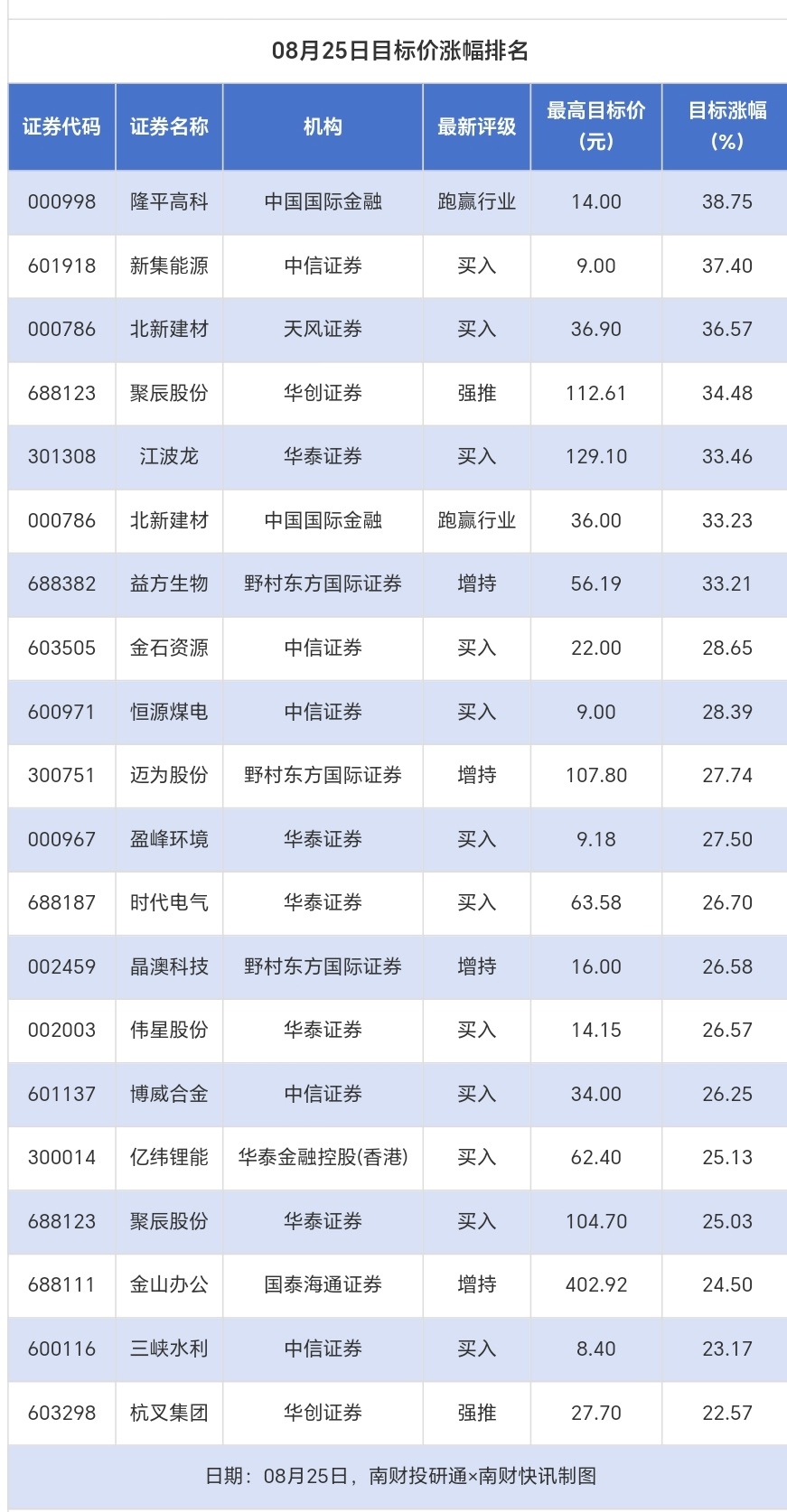
舍得酒业获4家券商推荐,赤峰黄金评级被调低丨券商评级观察
2 1 Shi Ji Jing Ji Bao Dao· 2025-08-26 01:25
Core Viewpoint - On August 25, 2023, brokerage firms provided target prices for listed companies, with notable increases in target prices for companies in the agriculture, coal mining, and construction materials sectors, indicating potential investment opportunities in these industries [1][2]. Target Price Increases - The companies with the highest target price increases were: - Longping High-Tech (隆平高科) with a target price increase of 38.75% to 14.00 CNY [2] - Xinji Energy (新集能源) with a target price increase of 37.40% to 9.00 CNY [2] - Beixin Building Materials (北新建材) with a target price increase of 36.57% to 36.90 CNY [2] Brokerage Recommendations - A total of 163 listed companies received brokerage recommendations on August 25, with notable mentions: - Shede Liquor (舍得酒业) received 4 recommendations [4] - Shuiyang Co. (水羊股份) and Marubi Biotechnology (丸美生物) each received 3 recommendations [4] Rating Adjustments - One company had its rating upgraded: - Guodian Power (国电电力) was upgraded from "Hold" to "Buy" by Huayuan Securities [5] - Three companies had their ratings downgraded: - Minhe Livestock (民和股份) from "Buy" to "Hold" [6] - Chifeng Gold (赤峰黄金) from "Buy" to "Hold" [6] - Silan Microelectronics (士兰微) from "Buy" to "Hold" [6] First-Time Coverage - Seven companies received first-time coverage with positive ratings: - Ganhua Science and Technology (甘化科工) received a "Buy" rating from Dongwu Securities [7] - Wangneng Environment (旺能环境) received a "Buy" rating from Xinda Securities [7] - Yingliu Co. (应流股份) received an "Increase" rating from Shanxi Securities [7] - New Clean Energy (新洁能) received an "Increase" rating from Industrial Securities [7] - Weijian Medical (稳健医疗) received a "Buy" rating from Northeast Securities [7]





卓胜微(300782):2Q2025营收环比改善 芯卓产线建设顺利推进
Xin Lang Cai Jing· 2025-08-26 00:44
Group 1: Financial Performance - In 1H2025, the company achieved operating revenue of 1.704 billion yuan, a year-on-year decrease of 25.42% [1] - The net profit attributable to the parent company was -147 million yuan, a year-on-year decline of 141.59% [1] - The non-recurring net profit attributable to the parent company was -151 million yuan, a year-on-year decrease of 142.77% [1] - In 2Q2025, the company reported operating revenue of 948 million yuan, a year-on-year decrease of 13.43% but a quarter-on-quarter increase of 25.43% [1] - The net profit attributable to the parent company in 2Q2025 was -101 million yuan, with the loss margin expanding quarter-on-quarter [1] - The gross profit margin for 1H2025 declined to 28.75% due to high wafer costs and increased depreciation [1] Group 2: Business Model and Product Development - The company is deepening its Fab-Lite operating model, with the revenue share of RF front-end modules increasing from 36.34% in the previous year to 44.35% [2] - The company has successfully validated its first domestically supplied L-PAMiD product and has entered the mass production and delivery phase [2] - The WiFi 7 module has achieved large-scale production and stable shipments, while automotive-grade UWB chips have entered mass production [2] - The 6-inch filter production line has achieved mass production of duplexers and quadplexers, with integrated self-produced filters being successfully introduced to multiple brand customers [2] - The 12-inch production line has rapidly increased capacity to 5,000 wafers per month and has entered a stable production phase with high product yield [2] - As production volume increases and operational efficiency improves, the high-cost issues due to low capacity utilization are expected to gradually ease, leading to a stabilization and recovery of product gross margins [2] Group 3: Future Projections - The company projects revenues of 4.22 billion yuan, 5.21 billion yuan, and 5.86 billion yuan for the years 2025, 2026, and 2027, respectively [3] - The net profits attributable to the parent company are expected to be -58 million yuan, 405 million yuan, and 743 million yuan for the years 2025, 2026, and 2027, respectively [3] - Corresponding PE ratios for 2026 and 2027 are projected to be 111.92 and 61.03 times, respectively [3]
卓胜微(300782):Q2营收环比+25%,6、12英寸产线产能利用率提升,毛利率有望企稳回升
Great Wall Securities· 2025-08-25 11:49
Investment Rating - The report maintains a rating of "Accumulate" for the company [5] Core Views - The company has shown a quarter-on-quarter revenue increase of 25% in Q2, with improved capacity utilization on the 6/12 inch production lines, indicating a potential stabilization and recovery in gross margin [1][4] - The company is positioned as a leading player in the domestic semiconductor RF chip market, having completed the transition to a Fab-Lite operating model, which is expected to unlock a high-end RF front-end market worth hundreds of billions [4] Financial Summary - For 2023, the projected revenue is 4,378 million yuan, with a year-on-year growth rate of 19.1%. The net profit attributable to shareholders is expected to be 1,122 million yuan, reflecting a growth rate of 5.0% [15] - The revenue for H1 2025 is reported at 1,704 million yuan, a year-on-year decrease of 25.42%, with a net loss attributable to shareholders of 147 million yuan [11][12] - The gross margin for Q2 2025 is reported at 26.95%, down 4.06 percentage points from the previous quarter, primarily due to increased competition and depreciation costs [9][10] Production Capacity and Product Development - The 6-inch production line has successfully ramped up production of various RF components, including duplexers and integrated filters, with the L-PAMiD product entering mass production [3][4] - The 12-inch production line has achieved a monthly production capacity of 5,000 chips, with efficient utilization rates, and is gradually moving towards mass production of second-generation technology platforms [4] Market Position and Future Outlook - The company is expected to achieve net profits of 425 million yuan, 766 million yuan, and 1,103 million yuan for the years 2025, 2026, and 2027 respectively, with corresponding P/E ratios of 100.6, 55.9, and 38.8 [4][15] - The report emphasizes the potential for the company to capture significant market share in the high-end RF front-end market, driven by its technological advancements and production capabilities [4]
卓胜微8月25日现1笔大宗交易 总成交金额200.15万元 其中机构买入200.15万元 溢价率为0.00%
Xin Lang Cai Jing· 2025-08-25 09:25
Group 1 - The stock of Zhuosheng Microelectronics (卓胜微) closed at 84.45 yuan on August 25, with a slight decline of 0.33% [1] - A block trade occurred, involving a total of 23,700 shares and a transaction amount of 2.0015 million yuan, with a premium rate of 0.00% [1] - Over the past three months, the stock has seen a total of three block trades, amounting to 46.4095 million yuan [1] Group 2 - In the last five trading days, the stock has increased by 5.31%, with a net inflow of 8.7552 million yuan from main funds [1]
交银国际每日晨报-20250825
BOCOM International· 2025-08-25 04:47
Group 1: 卓胜微 (300782 CH) - The company has shifted from profit to loss in 1H25, with revenue in 2Q25 at RMB 948 million, down 13% year-on-year, and losses of RMB 101 million and RMB 147 million for 2Q25 and 1H25 respectively [1] - Management expects cost pressure to approach its peak as production capacity increases, with signs of cost reduction and improved efficiency emerging [1] - Revenue forecasts for 2025 and 2026 have been lowered to RMB 4.17 billion and RMB 5.17 billion respectively, with EPS estimates adjusted to RMB 0.05 and RMB 1.15 [1] Group 2: 哔哩哔哩 (BILI US) - The company reported 2Q25 revenue of RMB 7.3 billion, a 20% year-on-year increase, with adjusted net profit of RMB 560 million, slightly above expectations [2] - Game revenue surged 60% year-on-year driven by the success of "三谋", while advertising revenue also grew by 20% due to increased traffic and AI technology applications [2] - The target price has been raised to USD 32, reflecting a potential upside of 34.7% [3] Group 3: 途虎 (9690 HK) - The company’s performance in the first half of 2025 met expectations, with revenue growth driven by improved market share and profit margins [6] - The target price has been adjusted to HKD 25, indicating a potential upside of 31.2% [6] - The company is expected to maintain double-digit revenue growth and stable profit margins despite industry uncertainties [6] Group 4: 先声药业 (2096 HK) - The company achieved a 15% revenue growth and a 21% increase in adjusted net profit in 1H25, driven by a 26% growth in innovative drug revenue [7][8] - Management has updated guidance for 2025-2027, expecting over 15% growth in revenue and adjusted net profit [8] - The target price has been raised to HKD 16.40, reflecting a positive outlook on the company’s growth trajectory [8] Group 5: 恒瑞医药 (1276 HK) - The company reported a 16% revenue growth in 1H25, with innovative drug sales growing over 25% [9][10] - The company plans to repurchase shares worth approximately RMB 10-20 billion, contingent on achieving specific sales growth targets [9] - The target price has been set at HKD 70.40, indicating a potential downside of 9.4% [10] Group 6: 速腾聚创 (2498 HK) - The company’s laser radar sales increased over sixfold year-on-year in 2Q25, with expectations for peak deliveries in the second half of the year [11][12] - The gross margin for the robot business reached 41.5%, contributing to an overall gross margin increase to 27.7% [12] - The target price is maintained at HKD 41.89, reflecting confidence in the company’s growth potential [12] Group 7: 亿纬锂能 (300014 CH) - The company’s battery shipments reached 50 GWh in the first half of 2025, a 46% year-on-year increase, with revenue growing 30% to RMB 28.2 billion [13][14] - Focus is on improving profitability in the energy storage segment, with expectations for recovery in margins [13] - The target price is set at RMB 56.51, indicating a potential upside of 16.5% [14] Group 8: 名创优品 (9896 HK) - The company’s revenue grew 21.1% year-on-year in the first half of 2025, with a 23.1% increase in 2Q25, exceeding previous guidance [15][16] - The management has raised the full-year revenue growth guidance to over 25% [16] - The target price has been increased to HKD 48.70, indicating a potential upside of 24.7% [16] Group 9: 李宁 (2331 HK) - The company reported a 3.3% revenue growth in the first half of 2025, with net profit declining 11% year-on-year [17][18] - Management maintains a cautious outlook for the third quarter, citing challenges in the operating environment [17] - The target price is set at HKD 16.28, reflecting a potential downside of 10.1% [18] Group 10: 友邦保险 (1299 HK) - The new business value grew 14% year-on-year, primarily driven by contributions from Hong Kong and Thailand [19][20] - The company aims for a compound annual growth rate of 40% in new business value from new regions between 2025 and 2030 [19] - The target price is maintained at HKD 84, indicating a potential upside of 14.4% [20] Group 11: 恒基地产 (12 HK) - The company’s revenue fell 18.8% year-on-year in the first half of 2025, with core net profit down 44.4% [21][22] - The target price has been adjusted to HKD 25.90, reflecting a cautious outlook on the company’s performance [22] - The rental income remained stable, with a slight decline of 2.8% [22] Group 12: 越秀服务 (6626 HK) - The company’s revenue remained stable with a 0.1% year-on-year increase, while net profit decreased by 13.7% [23][24] - The company maintains a high dividend payout ratio of 50% [23] - The target price has been slightly adjusted to HKD 4.20, indicating a potential upside of 38.2% [24] Group 13: 中国电力 (2380 HK) - The company’s profit increased by 0.7% year-on-year, outperforming market expectations [25][26] - The company plans to adjust its installation targets for wind and solar power due to new policies [25] - The target price has been slightly lowered to HKD 3.75, maintaining a buy rating [26]
