
Sublime China Information (301299)

Search documents
卓创资讯:纸浆节后情绪向好,现货市场报价上涨
Cai Jing Wang· 2026-02-25 07:05
近期阔叶浆外盘价格再度提涨,叠加节后纸浆主力合约价格反弹,贸易商情绪向好,进口木浆现货报价 上涨。截至2月24日,国内进口针叶浆现货均价5310.96元/吨,较节前涨幅0.87%;进口阔叶浆现货均价 4602.63元/吨,较节前涨幅1.60%。"3.8"促销节即将到来,下游部分生活用纸企业发函促涨,纸浆需求 存在快速复苏预期,且贸易商现货成本偏高,纸浆重心或窄幅上行,重点关注港口去库速度及下游复产 节奏。(卓创资讯) ...

卓创资讯:光伏玻璃节后成交回暖,涨价动力不足
Cai Jing Wang· 2026-02-25 06:58
近期国内光伏玻璃市场成交略有好转,库存整体平稳。2.0mm、3.2mm镀膜玻璃主流价格环比持稳。供 应端窑炉开工正常,货源充足;节后下游组件企业刚需补货带动成交回暖,但节前库存累积较多,价格 缺乏上行动力。短期组件企业开工恢复尚需时间,以按需采购为主,暂无集中备货计划,库存仍处高 位。下游盈利偏弱压价意愿较强,市场博弈僵持。预计短期内光伏玻璃价格以稳为主,成交逐步温和修 复。(卓创资讯) ...
卓创资讯:国际原油上涨 成品油零售价格预计开启上调窗口
Ge Long Hui· 2026-02-24 03:21
格隆汇2月24日|据卓创资讯数据监测模型显示,截至2月23日收盘,国内第10个工作日参考原油的变化 率为3.98%,预计汽、柴油零售限价每吨分别上调175和170元,折合升价92#汽油、95#汽油、0#柴油分 别上调0.14、0.15、0.14元,调价窗口为2026年2月24日24时。 ...
卓创资讯推进H股上市进程,已获证监会备案接收
Jing Ji Guan Cha Wang· 2026-02-13 05:51
Group 1 - The company is advancing its plan to list on the main board of the Hong Kong Stock Exchange [1] - The company submitted its listing application to the Hong Kong Stock Exchange on November 28, 2025 [1] - The company received acknowledgment from the China Securities Regulatory Commission for its H-share issuance application materials on January 12, 2026 [1] Group 2 - The market will focus on the review progress by the Hong Kong Stock Exchange and the potential listing timeline [1]
卓创资讯跌1.03%,成交额8465.92万元,近5日主力净流入-1124.94万
Xin Lang Cai Jing· 2026-02-11 08:17
Core Viewpoint - The company, Zhaochuang Information, is leveraging AI technology to enhance its data analysis and information services in the bulk commodity market, aiming to improve operational efficiency and customer experience. Group 1: Company Overview - Zhaochuang Information is a leading provider of bulk commodity information services in China, focusing on data monitoring, price assessment, and industry analysis [7] - The company's main revenue sources include information services (57.19%), digital services (20.98%), exhibition services (12.08%), consulting services (9.74%), and others (0.01%) [7] Group 2: Financial Performance - For the period from January to September 2025, Zhaochuang Information achieved operating revenue of 263 million, representing a year-on-year growth of 19.91%, while net profit attributable to shareholders decreased by 5.93% to 49.52 million [8] - Since its A-share listing, the company has distributed a total of 325 million in dividends [9] Group 3: Technological Advancements - The company has launched an AI platform and automation tools to enhance the production of annual and monthly analysis reports, significantly improving analyst efficiency and customer experience [2] - Zhaochuang Information has developed a commodity price prediction system using advanced machine learning models to assist enterprises in making informed decisions [2] Group 4: Market Activity - As of February 11, the company's stock price decreased by 1.03%, with a trading volume of approximately 84.66 million and a market capitalization of 3.695 billion [1] - The stock has seen a net outflow of 3.45 million from major investors, indicating a lack of strong buying interest [4][5] Group 5: Shareholder Information - As of September 30, the number of shareholders for Zhaochuang Information was 11,800, a decrease of 15.79% from the previous period, while the average number of shares held per shareholder increased by 18.76% to 3,025 shares [8]
高瞻远“猪”:历年春节生猪屠宰量盘点 一季度后期行情如何波动
Xin Lang Cai Jing· 2026-02-11 03:21
Core Viewpoint - The pig market is experiencing weak price trends in early February 2026 due to abundant supply and lower-than-usual pre-Spring Festival stocking levels, with expectations of a price decline post-Festival [3][13]. Group 1: Historical Analysis of Pig Slaughter Volume - Historical data shows that pig slaughter volumes typically increase before the Spring Festival, with significant growth observed in most years from 2019 to 2025, except for 2019. The highest increase was recorded in 2024 at 131.46% [3][4]. - The peak slaughter volume usually occurs between the 24th and 26th day of the lunar month, with expectations for 2026 to follow this trend [3][4]. Group 2: Current Market Conditions - In January 2026, pig slaughter volumes showed a month-on-month decline, but began to increase again towards the end of the month, with a cumulative increase of 35.29% by February 9 [4][15]. - The pre-Festival stocking period is limited this year, which may restrict the support for pig prices [15]. Group 3: Supply and Demand Forecast for February and March - February is expected to see an increase in both daily slaughter and outflow volumes, with a projected month-on-month increase of 1.07% in slaughter volume, but overall supply is anticipated to exceed demand, leading to a potential decline in average prices [8][17]. - March is likely to continue the trend of increased supply, with a forecasted 3.86% rise in daily outflow, while demand remains low, suggesting a continued oversupply situation [9][17]. Group 4: Price Trends and Market Reactions - The market may experience a brief price increase before the end of February, but a downward trend is expected as the stocking period concludes, with average prices projected between 11.0 and 11.4 yuan per kilogram [11][20]. - Low prices may stimulate demand from slaughterhouses for storage and lead to increased restocking activities, potentially resulting in a rebound in prices towards the end of March, with estimates of 11.6 to 12.0 yuan per kilogram [20].


春节临近牛肉价格小幅上扬 行业周期上行通道渐启
Zheng Quan Ri Bao Wang· 2026-02-10 12:27
Group 1 - The core viewpoint of the article indicates that the beef market is entering a new upward cycle driven by policies, capacity adjustments, and demand recovery, particularly as the Spring Festival approaches, leading to a seasonal price increase [1][2] - The average price of beef in China's wholesale markets was reported at 66.13 yuan per kilogram on February 10, showing a slight increase from 65.94 yuan per kilogram on January 4 and 65.95 yuan per kilogram on February 2, reflecting a stable upward trend [1] - Analysts suggest that the beef industry is transitioning from a long-term downward trend, with the market expected to face a "high rebound, weak seasonality, and a weak market finish" in 2025 due to the interplay between ample supply and weak demand [1][2] Group 2 - The implementation of new import policies starting January 1, 2026, which will impose additional tariffs of 55% on beef imports beyond a specified quota, is expected to reduce import volumes and increase costs, thereby alleviating domestic supply pressure and supporting domestic beef prices [1][2] - Analysts from Guoxin Securities predict that the tightening of import policies will lead to a decrease in beef imports and an increase in domestic beef prices, creating a favorable environment for domestic beef producers [2] - The collaboration between Shandong Delisi Food Co., Ltd. and the internet platform Feixiong Lingxian represents a strategic move towards resource integration and upgrading within the industry, aiming to enhance the quality and cost-effectiveness of beef sourcing [3] Group 3 - The Chinese beef industry is at a critical juncture as it transitions between old and new cycles, with domestic production capacity expected to shrink and tightening import policies reducing the supply of low-cost beef [4] - As the macroeconomic environment stabilizes and restaurant consumption gradually recovers, demand for beef is anticipated to strengthen, benefiting various segments of the industry, including breeding, slaughtering, processing, and branding [4] - The optimization of industry structure and price recovery is likely to create new development opportunities for the beef sector [4]

卓创资讯:2025年中国饲料总产量再创新高,年增长8.6%
Cai Jing Wang· 2026-02-05 09:15
Core Insights - The total industrial feed production in China is projected to reach 34,225.3 million tons by 2025, with an annual growth rate of 8.6% [1] - The increase in domestic livestock and poultry production capacity is expected to drive a more than 8% year-on-year increase in compound feed demand, providing strong support for corn prices [1] - Due to reduced profits and potential losses in livestock farming, it is anticipated that the production capacity of pigs and the inventory of laying hens may decline in 2026, leading to total feed demand in 2026 being lower than in 2025 but higher than in 2024, maintaining a relatively high level [1] - The usage of corn in feed is expected to slightly decrease year-on-year, which may weaken its supporting role for corn prices [1]
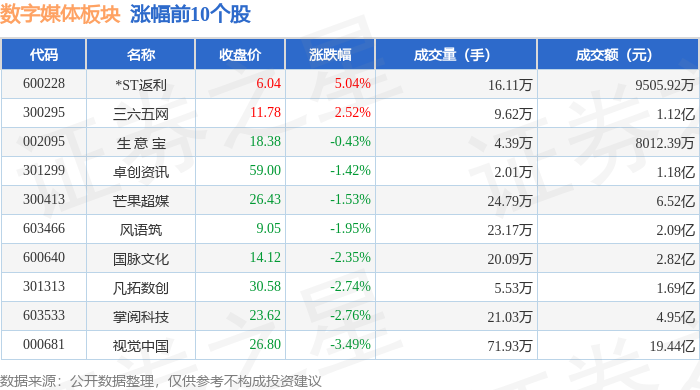
数字媒体板块2月4日跌3.85%,值得买领跌,主力资金净流出10.39亿元
Zheng Xing Xing Ye Ri Bao· 2026-02-04 08:56
Market Overview - The digital media sector experienced a decline of 3.85% on February 4, with ZhiDeMai leading the drop [1] - The Shanghai Composite Index closed at 4102.2, up 0.85%, while the Shenzhen Component Index closed at 14156.27, up 0.21% [1] Individual Stock Performance - *ST Fanli (600228) closed at 6.04, up 5.04% with a trading volume of 161,100 shares and a transaction value of 95.06 million [1] - Sanliu Wu Wang (300295) closed at 11.78, up 2.52% with a trading volume of 96,200 shares and a transaction value of 112 million [1] - Other notable declines include ZhiDeMai (300785) down 11.55% to 67.65, and XinHua Net (603888) down 6.29% to 24.29 [2] Capital Flow Analysis - The digital media sector saw a net outflow of 1.039 billion from institutional investors, while retail investors contributed a net inflow of 919 million [2] - The table of capital flow indicates that major stocks like *ST Fanli and Shengyi Bao experienced mixed capital movements, with significant outflows from institutional investors [3] Detailed Stock Capital Flow - *ST Fanli had a net inflow of 15.74 million from major investors, but a net outflow of 9.61 million from speculative investors [3] - Shengyi Bao saw a net inflow of 3.15 million from major investors, but also faced outflows from both speculative and retail investors [3] - The largest net outflow was observed in Mango Super Media (300413) with 40.88 million from major investors, while retail investors contributed a net inflow of 10.68 million [3]



油价迎来年内“二连涨”!
Zheng Quan Ri Bao Zhi Sheng· 2026-02-03 10:16
Core Viewpoint - Domestic refined oil prices have experienced consecutive increases in 2026, with gasoline and diesel prices rising by 205 yuan and 195 yuan per ton respectively, leading to higher consumer fuel costs [1][2]. Group 1: Price Changes - The National Development and Reform Commission announced that from February 3, 2026, gasoline and diesel prices will increase by 0.16 yuan, 0.17 yuan, and 0.17 yuan per liter respectively [1]. - Consumers filling a 50-liter tank will incur an additional cost of approximately 8 yuan [1]. Group 2: Market Influences - The rise in oil prices is attributed to geopolitical tensions and adverse weather conditions in the U.S. affecting production, with Brent crude oil prices initially exceeding $70 per barrel before dropping to around $66 [2]. - The International Monetary Fund has raised its global economic growth forecast for 2026 by 0.2 percentage points to 3.3%, while the International Energy Agency has increased its oil demand growth forecast by 70,000 barrels per day to 930,000 barrels per day [2]. Group 3: Future Outlook - Analysts predict that after the recent price adjustments, the price change rate may turn negative, with significant variability in future crude oil prices [3]. - Increased gasoline demand is expected due to the Spring Festival travel season, while diesel demand remains subdued due to reduced construction activities [3]. - Domestic supply of refined oil is expected to be relatively ample, with increased operational capacity in refineries, leading to potential downward pressure on gasoline and diesel prices in the short term [3].