Amazon(AMZN)

Search documents
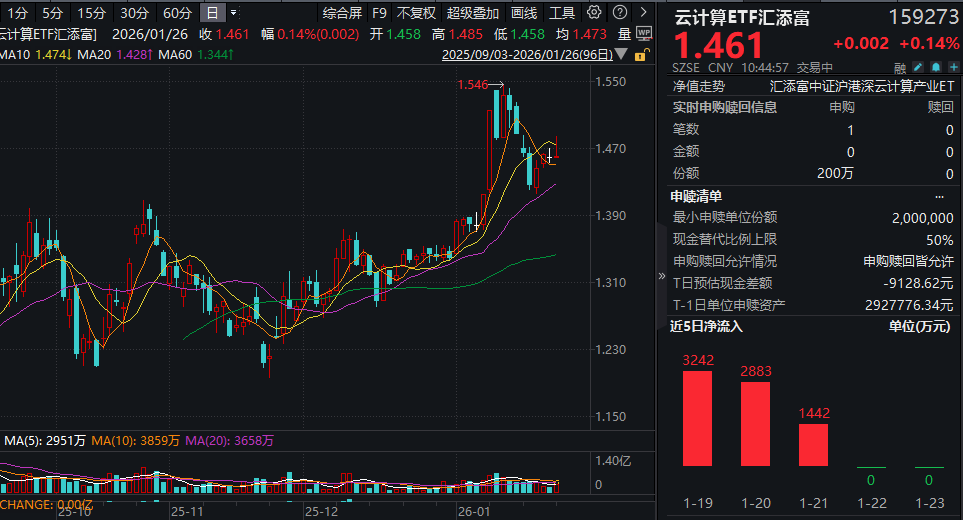
“易中天”再度飘红!云计算ETF汇添富(159273)震荡微涨再度吸金!机构:聚焦AI,算力降本向光而行!
Xin Lang Cai Jing· 2026-01-26 03:09
Core Viewpoint - The AI computing power sector is experiencing fluctuations, with significant capital inflow and positive performance from key stocks in the cloud computing ETF Huatai (159273) [1][3] Group 1: Market Performance - The cloud computing ETF Huatai (159273) saw a slight increase of 0.14%, with a trading volume of 30 million yuan, surpassing the total from the previous Friday [1] - In the past 10 days, the sector has attracted over 120 million yuan in capital [1] - Notable stock performances include NetEase Technology rising over 13%, Yuke Technology-W increasing over 7%, and Runze Technology up over 3% [3] Group 2: Analyst Insights - CITIC Securities predicts that the computing power sector will continue to grow in 2025 due to ongoing capital expenditures (Capex) from major cloud service providers (CSPs), increasing token demand, and enhanced product capabilities [3][4] - The outlook for 2026 suggests sustained growth in computing power and a pivotal opportunity for AI applications [4] Group 3: AI Industry Trends - The AI industry is evolving, with continuous model optimization and a shift towards practical business models [5] - From 2024 Q1, major cloud service providers like Google, Microsoft, and Amazon have maintained over 20% year-on-year revenue growth for seven consecutive quarters, indicating robust profitability in data centers [7] - The total Capex for the four major CSPs in North America reached $112.43 billion in Q3 2025, reflecting a year-on-year increase of 76.9% and a quarter-on-quarter increase of 18.3% [7] Group 4: Light Counting Projections - Light Counting forecasts that sales of optical modules (including AOC) will exceed $23 billion in 2025, a 50% increase from 2024, with Ethernet optical modules expected to reach $17 billion, a 60% increase year-on-year [9] - The demand for 1.6T optical modules is projected to accelerate in 2026-2027, while the growth rate for 800G modules is expected to slow down [9]





1月26日国际晨讯丨现货黄金首次突破5000美元/盎司 美联储即将举行2026年首次议息会议
Sou Hu Cai Jing· 2026-01-26 00:47
Market Review - The Nikkei 225 index opened at 53023.28 points, down 1.53% [1] - The Korean Composite Index opened at 4997.54 points, up 0.1% [1] - Spot gold surpassed $5000 per ounce for the first time, increasing by approximately 1% [1] - Spot silver also reached a new high, rising over 2% to a maximum of $106.541 per ounce [1] - On January 23, the US major stock indices closed mixed, with the Dow Jones down 0.58% at 49098.71 points, the S&P 500 up 0.03% at 6915.61 points, and the Nasdaq up 0.28% at 23501.24 points [1] - For the week, the Dow Jones fell 0.52%, the S&P 500 dropped 0.35%, and the Nasdaq decreased by 0.06% [1] - In Europe, major stock indices closed mixed, with the DAX up 0.18% at 24900.71 points, the CAC40 down 0.07% at 8143.05 points, and the FTSE 100 down 0.07% at 10143.44 points [1] - For the week, the DAX fell 1.57%, the CAC40 dropped 1.4%, and the FTSE 100 decreased by 0.9% [1] Upcoming Events - The Federal Reserve is set to hold its first monetary policy meeting of 2026 on January 29, with expectations that it will maintain current rates [2] - Market focus for Tesla's earnings report has shifted from financial data to advancements in Full Self-Driving (FSD) systems, humanoid robots, and Robotaxi technology [2] - Microsoft and Meta will address whether companies are beginning to benefit from AI investments [2] Institutional Insights - Goldman Sachs has raised its 2026 gold price forecast to $5400 per ounce from a previous estimate of $4900 per ounce, citing diversification in private investment as a key factor for gold's upward movement [3] Company News - Nvidia's founder Jensen Huang visited the company's new office in Shanghai, engaging with employees and addressing their concerns [4] - Tesla CEO Elon Musk announced that the FSD system requiring driver supervision is expected to be approved in China as early as next month, aligning closely with its approval timeline in Europe [4] - Amazon plans a second round of layoffs as part of a larger plan to cut approximately 30,000 jobs, with the latest round expected to be similar in scale to the 14,000 white-collar positions cut in October 2025 [4]





High Tide Inc. (HITI): Among High Growth Canadian Stocks to Buy
Insider Monkey· 2026-01-26 00:39
Core Insights - Generative AI is viewed as a transformative technology by Amazon's CEO Andy Jassy, indicating its potential to significantly enhance customer experiences across the company [1] - Elon Musk predicts that by 2040, humanoid robots could create a market worth $250 trillion, representing a major shift in the global economy driven by AI innovation [2][3] - Major firms like PwC and McKinsey acknowledge the multi-trillion-dollar potential of AI, suggesting a broad consensus on its economic impact [3] Company and Industry Analysis - A breakthrough in AI technology is redefining work, learning, and creativity, leading to increased interest from hedge funds and top investors [4] - There is speculation about an under-owned company that may play a crucial role in the AI revolution, with its technology posing a threat to competitors [4][6] - Prominent figures in technology and investment, including Bill Gates and Warren Buffett, recognize AI as a significant advancement with the potential for substantial social benefits [8]

“七巨头“财报本周亮剑:AI万亿豪赌迎生死大考,华尔街已举“惩罚之锤”
智通财经网· 2026-01-26 00:00
Core Viewpoint - Investors are focusing on niche stocks in the artificial intelligence sector, with upcoming earnings reports from major tech companies serving as a critical indicator for the continuation of this strategy into 2026 [1] Group 1: Performance of Major Tech Companies - The "Tech Seven" companies, including Google, Amazon, Apple, Meta Platforms, Microsoft, Nvidia, and Tesla, have significantly influenced the stock market over the past three years, but this trend reversed by the end of 2025, leading to skepticism about the returns on their substantial investments in AI [1] - Following the peak of the Tech Seven index on October 29, 2025, five of the seven companies saw their stock prices decline, underperforming the S&P 500 index, with only Google and Amazon recording gains [1] Group 2: Shift in Investor Focus - Traders have shifted their attention to companies benefiting from substantial funding from large tech firms, with stocks like Sandisk, Micron Technology, and Western Digital seeing significant price increases of over 130%, 76%, and 67% respectively since the Tech Seven index's peak [2] - The performance of tech stocks is now expected to be driven by earnings, with major firms needing to demonstrate satisfactory results to attract capital back into the sector [2] Group 3: Upcoming Earnings Reports - Microsoft, Meta Platforms, and Tesla are set to release their earnings reports on Wednesday, followed by Apple on Thursday, with Alphabet and Nvidia's reports scheduled for early February [2] - The Tech Seven group is projected to see a 20% profit growth in the fourth quarter, marking the slowest growth rate since early 2023, indicating pressure on these companies to show returns on their capital expenditures [2][4] Group 4: Capital Expenditure and Growth Expectations - Major tech companies are expected to increase their capital expenditures significantly, with projections of around $475 billion in 2026, up from $230 billion in 2024, necessitating visible returns on these investments [4] - If these companies fail to meet growth targets, they risk substantial stock price declines, as seen with Meta Platforms, which experienced an 11% drop following its capital expenditure announcement without clear profitability guidance [5] Group 5: Market Dynamics and Valuation - Despite the challenges, the Tech Seven stocks are not considered expensive historically, with an expected price-to-earnings ratio of 28, aligning with the average over the past decade [8] - The S&P 500 index's performance is heavily influenced by the Tech Seven, which accounts for over one-third of the index's weight, making it difficult for investors to completely avoid these stocks [5]

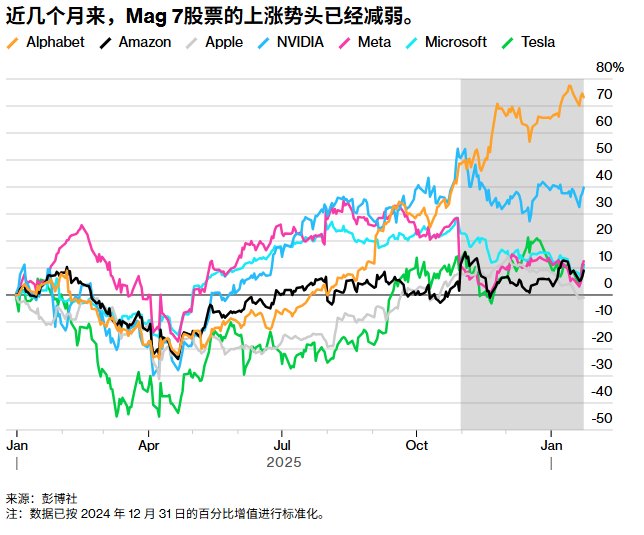
七巨头“财报本周亮剑:AI万亿豪赌迎生死大考,华尔街已举“惩罚之锤
Zhi Tong Cai Jing· 2026-01-25 23:59
Core Viewpoint - Investors are focusing on niche stocks in the artificial intelligence sector, with upcoming earnings reports from major tech companies serving as a critical indicator for the continuation of this strategy into 2026 [1] Group 1: Performance of Major Tech Companies - The "Tech Seven" companies, including Google, Amazon, Apple, Meta Platforms, Microsoft, Nvidia, and Tesla, have significantly influenced the stock market over the past three years, but skepticism is growing regarding their AI investments and returns [1] - As of October 29, 2025, five of the seven companies saw their stock prices decline, underperforming the S&P 500 index, with only Google and Amazon showing gains [1] - The group is expected to report a 20% profit growth for Q4, marking the slowest growth since early 2023, indicating pressure to demonstrate returns on substantial capital expenditures [3][6] Group 2: Shift in Investor Focus - Following the decline of the Tech Seven index, traders have shifted their attention to companies benefiting from funding from these tech giants, with stocks like Sandisk, Micron Technology, and Western Digital seeing significant price increases [2] - The performance of these smaller companies is attributed to expectations of economic growth and attractive valuations, suggesting a broader market shift towards performance-driven investments [2] Group 3: Earnings Reports and Expectations - Major companies like Microsoft, Meta Platforms, and Tesla are set to release earnings reports soon, with Alphabet and Nvidia following later, which will provide insights into various sectors including cloud computing and digital advertising [2][3] - Microsoft’s Azure business has shown remarkable growth, with a 39% revenue increase in Q1, driven by demand for AI model training, and expectations for continued growth in the upcoming quarter [5] Group 4: Capital Expenditure and Investor Sentiment - Major tech companies are projected to increase capital expenditures to approximately $475 billion by 2026, up from $230 billion in 2024, raising investor expectations for returns [6] - The market is cautious, as companies that fail to meet growth targets may face significant stock price declines, as evidenced by Meta Platforms' 11% drop following its capital expenditure announcement [6] Group 5: Market Dynamics and Valuation - The Tech Seven companies dominate the S&P 500 index, accounting for over one-third of its total weight, making it challenging for investors to avoid these stocks [7] - Despite the recent performance issues, the expected price-to-earnings ratio for the Tech Seven is 28, aligning with historical averages, indicating that these stocks are not overly expensive [10]
数年来首次,云计算巨头开始“逆市”涨价,或带来全行业重估
Xuan Gu Bao· 2026-01-25 23:31
Group 1 - Amazon Web Services (AWS) has raised the price of its EC2 machine learning capacity blocks by approximately 15%, with the p5e.48xlarge instance hourly cost increasing from $34.61 to $39.80 [1] - This price increase marks a significant shift in the cloud services industry, breaking a two-decade trend of declining prices, indicating that if cloud service providers successfully implement price hikes without significant customer loss, subsequent increases may become easier [1] - The rising demand for artificial intelligence tokens is expected to drive a price increase trend from upstream to CPUs and cloud services, with AWS leading the way in breaking industry norms, potentially leading to a valuation restructuring for cloud computing and related service providers [1] Group 2 - Companies that may benefit from the cloud computing price increase trend include UCloud, Deepin Technology, Hongjing Technology, Capital Online, Shunwang Technology, Wangsu Science and Technology, and Qingyun Technology [2] - In the database sector, companies such as Star Ring Technology, Dameng Data, Haima Data, Taiji Co., SuperMap Software, and Torus Technology are also highlighted as potential beneficiaries [2]
AI应用端持续回暖
Yang Zi Wan Bao Wang· 2026-01-25 23:01
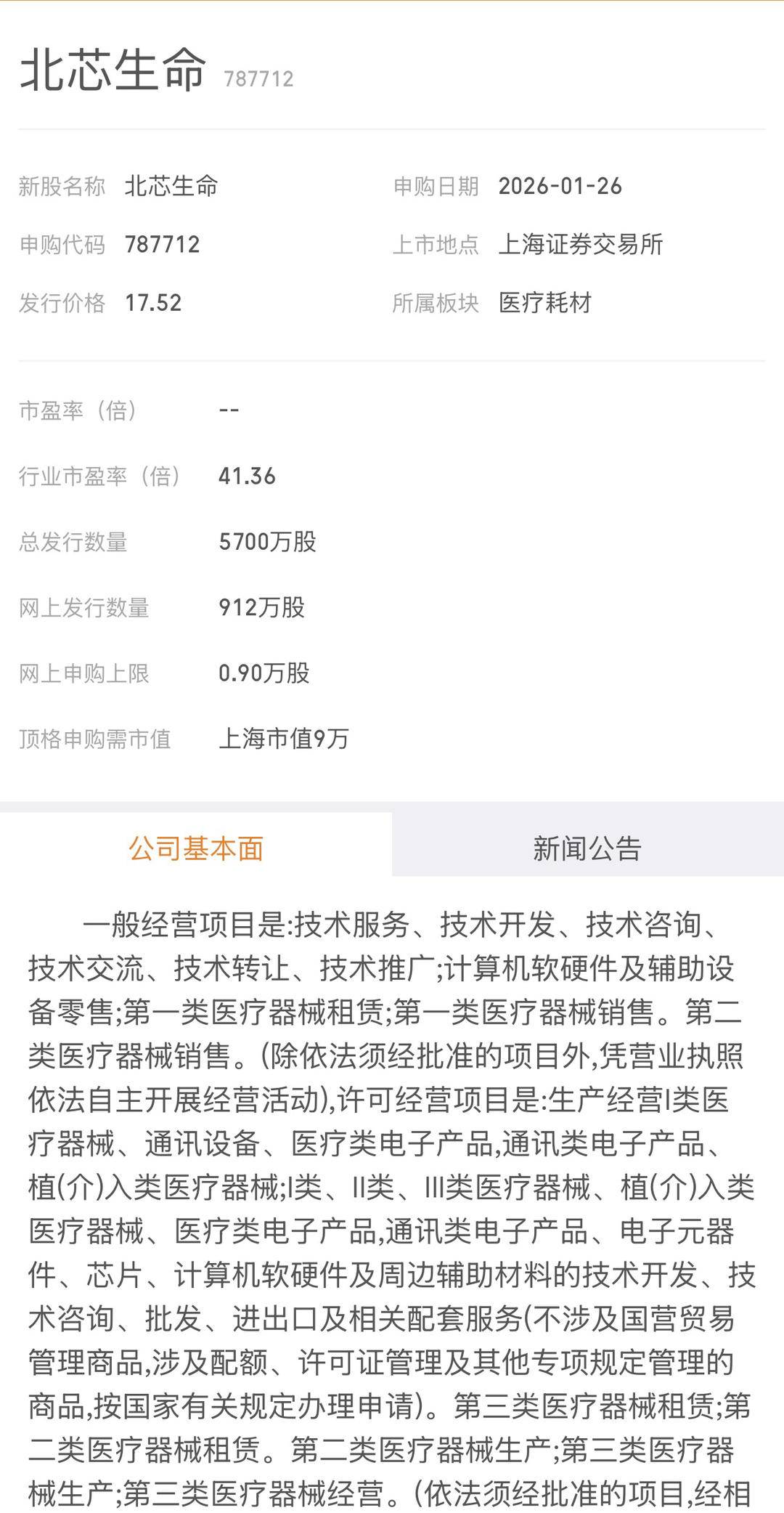
Group 1: Market Overview - The market experienced significant activity with over 3,900 stocks rising, and the North Stock 50 Index surged over 3% [1] - The total trading volume in the Shanghai and Shenzhen markets reached 3.09 trillion, an increase of 393.5 billion compared to the previous trading day [1] - Key sectors leading the market included photovoltaic, commercial aerospace, gold, and AI applications [1] Group 2: Company Highlights - Fenglong Co., Ltd. (002931) achieved an 18-day consecutive limit-up, with a price increase of 405.74% from December 25, 2025, to January 23, 2026, and is now under trading suspension for risk assessment [2] - Xian Dao Intelligent (300450) projected a net profit of 1.5 billion to 1.8 billion for 2025, representing a year-on-year growth of 424.29% to 529.15%, driven by a recovery in the global power battery market and strong demand in the energy storage sector [3] - The company is enhancing its cash flow management and improving its operational resilience through accelerated equipment acceptance and payment collection [3] Group 3: New Stock Offering - A new stock, Beixin Life, is available for subscription on January 26, 2026, with an issue price of 17.52, listed on the Shanghai Stock Exchange, and belongs to the medical consumables sector [5] Group 4: External Market Influence - The Nasdaq Composite Index rose by 0.28%, while the Dow Jones Industrial Average fell by 0.58%, indicating mixed performance in the U.S. stock market [7] - The precious metals sector led the gains, with Pan American Silver rising over 4% [7]



全球大公司要闻 | 苹果降价促销,AI巨头春节“撒钱”
Wind万得· 2026-01-25 22:43
Group 1 - Tencent and Baidu are distributing significant cash rewards during the Spring Festival, with Tencent offering 1 billion yuan in cash red envelopes and Baidu providing 500 million yuan in cash rewards through its app [2] - Apple has initiated a major discount on the iPhone Air 256GB model, reducing the price from 7999 yuan to 5499 yuan, marking the largest price drop for this model in history [2] - Nvidia's CEO Jensen Huang is visiting China to deepen cooperation in AI technology, while the company faces production halts for certain components [3] Group 2 - Xiaomi's CEO Lei Jun announced that the new generation of Xiaomi SU7 is expected to have sample cars available before the Spring Festival [5] - NIO's subsidiary has achieved 91.36% progress in its battery doubling plan, with over 7309 new batteries invested as of January 24 [5] - Hunan Gold plans to acquire 100% equity of two companies to enhance its competitiveness in the precious metals refining and processing sector [5] Group 3 - Microsoft is addressing issues with Windows 11 that have affected basic applications, while also expanding its gaming strategy to include Xbox games on PS5 and Switch [8] - Amazon's low Earth orbit satellites are facing criticism for their brightness affecting astronomical observations, and the company is experiencing a decline in order volume [8] - The U.S. government plans to invest 1.6 billion USD in a rare earth company to secure critical mineral supplies, acquiring a 10% stake [8] Group 4 - Samsung Electronics plans to increase NAND flash supply prices by 100% in Q1 2026, reflecting ongoing tensions in the semiconductor market [10] - Toyota maintains its leading position in the Thai automotive market while facing challenges in electric vehicle transitions in China [10] - SK Hynix aims to launch high bandwidth memory samples by 2026 to meet the demands of AI and data center high-performance computing [10] Group 5 - Volkswagen's CEO stated that plans to build an Audi factory in the U.S. are contingent on tariff reductions, while its joint venture plans to launch 13 new models by 2026 [12] - BMW is implementing a second official price adjustment in 2026, with some models seeing price reductions exceeding 60,000 yuan [12] - LVMH is increasing investments in the beauty sector to strengthen its position in the high-end beauty market [12]




The Trump Market Rollercoaster: A Trader’s Guide to Geopolitical Whiplash
Stock Market News· 2026-01-25 18:00
Market Reactions - The stock market experienced significant volatility due to geopolitical tensions, particularly following President Trump's tariff threats against European nations over Greenland, leading to a drop in major indices [2][3]. - On January 20, 2026, the Dow Jones Industrial Average fell by 877 points (1.8%), the S&P 500 dropped by 2.1%, and the Nasdaq Composite decreased by 2.4% [3]. - Following a "framework deal" announcement on January 21-22, 2026, the S&P 500 rebounded by 0.5%, the Dow Jones increased by 0.6% to 0.7%, and the Nasdaq rose by 0.9% [5]. Company Performance - Major tech companies faced declines, with Nvidia dropping between 3.6% and 4.4%, Amazon's shares falling by 2.9% to 3.7%, and Tesla decreasing by over 3% [4]. - Investors shifted towards safe-haven assets, resulting in a surge in gold prices amid market uncertainty [4]. Tariff Threats and Trade Relations - President Trump issued a new round of tariff threats against Canada on January 24, 2026, in response to Canada's trade agreement with China, which included a lowered tariff rate on Chinese electric vehicles [7][8]. - The proposed 100% tariff on Canadian goods entering the U.S. was met with pushback from Canadian officials, emphasizing that Canada had no intention of pursuing a free trade deal with China [9]. Economic Policy Insights - Treasury Secretary Scott Bessent downplayed market concerns regarding the Greenland tariff threats, suggesting that the initial panic was exaggerated and advocating for a more measured approach to international trade [11]. - Bessent's views sometimes diverged from President Trump's, particularly regarding the strength of the dollar, indicating internal dynamics within the administration that could influence economic policy [12]. Market Sentiment and Investor Behavior - The market's reaction to presidential announcements has led to the emergence of the acronym "TACO," reflecting the expectation that aggressive threats may precede strategic retreats [6]. - Investors have adapted to the unpredictable nature of the market, finding opportunities amidst the volatility created by geopolitical events and presidential rhetoric [13].

解读2025年全球裁员潮:AI还不是关键因素
Jing Ji Guan Cha Wang· 2026-01-25 17:56
Group 1 - The core point of the article is that the global wave of layoffs in 2025 is driven by multiple factors, including economic slowdown, cost pressures, strategic restructuring, and the impact of AI, rather than solely by AI replacing jobs [2][6][8] - In the United States, 2025 saw a significant increase in layoffs, with approximately 1.17 million layoffs reported by the end of November, marking the highest level since the COVID-19 pandemic [2][3] - AI has been cited as a factor in about 54,000 to 55,000 layoffs, accounting for only 4% to 5% of total layoffs, indicating that while AI is changing workforce structures, it is not the primary driver of the layoffs [3][8] Group 2 - In Europe, companies are announcing layoffs primarily for cost control, profit pressure, and business restructuring, with the automotive and manufacturing sectors being particularly affected [3][6] - In China, layoffs are largely attributed to macroeconomic and structural adjustments, with youth unemployment rates remaining high, particularly among those aged 16-24 [4][6] - Major Chinese companies like Alibaba and Baidu are undergoing workforce reductions not solely due to layoffs but also due to strategic focus and asset divestitures [5][6] Group 3 - AI is reshaping job structures, particularly in roles such as customer service and administrative support, but the overall impact on employment is more complex, with economic conditions being a more significant factor [7][8] - The introduction of AI and automation often leads to job restructuring rather than outright layoffs, with a focus on efficiency and productivity improvements [11][12] - The long-term effects of AI on employment will depend on the adaptability of the workforce and the diversity of local industry structures [9][10] Group 4 - Companies are increasingly recognizing the need for reskilling and upskilling their workforce rather than relying solely on layoffs, as this approach can enhance long-term productivity and employee trust [22][24] - Leading firms are investing in employee training programs to adapt to technological changes, with examples including Amazon's "2025 Skills Enhancement Program" [24][25] - The future workforce will require a combination of technical skills and soft skills, with a growing emphasis on the ability to integrate AI into business processes [18][19]