
Broadcom(AVGO)

Search documents
New Wi-Fi 8 Expands AVGO's Connectivity Portfolio: What's Ahead?
ZACKS· 2026-01-07 17:35
Core Insights - Broadcom (AVGO) is expanding its Wireless Device Connectivity solutions with the launch of the BCM4918 accelerated processing unit (APU) and two new dual-band Wi-Fi 8 devices, BCM6714 and BCM6719, which enhance throughput and enable secure, power-efficient applications for residential users [1][9] Product Development - The new platform integrates compute acceleration, advanced networking, and robust security, catering to the demands of an AI-driven connected ecosystem [2] - The BCM4918 APU is a highly integrated system-on-chip that combines high-performance CPU computing, on-device AI/ML inference, advanced networking offload, and cryptographic acceleration [2] Financial Performance - Broadcom's Semiconductor Solutions segment, which includes the Wireless Device Connectivity business, accounted for 58% of fiscal 2025 revenues [3] - The company anticipates first-quarter fiscal 2026 AI revenues to double year over year to $8.2 billion, with total Semiconductor revenues expected to reach $12.3 billion, indicating a 50% year-over-year growth [4] - The current order backlog for AI switches exceeds $10 billion, driven by the popularity of the 102-terabit per second Tomahawk 6 switch [4] Competitive Landscape - Broadcom faces significant competition in the semiconductor market from NVIDIA and Marvell Technology, both of which are experiencing strong growth driven by AI and high-performance computing demands [5][6][7] Stock Performance and Valuation - Broadcom shares have appreciated 50.7% over the past year, outperforming the broader Zacks Computer and Technology sector's return of 25.7% [8] - The stock is trading at a forward 12-month price/earnings ratio of 32.33X, compared to the sector's 27.84X, indicating a premium valuation [12] - The Zacks Consensus Estimate for fiscal 2026 earnings is $9.86 per share, reflecting a 44.6% growth from fiscal 2025 [15]



CoWoS产能支撑,摩根大通再次上调TPU预期:今明两年出货量有望达370、500万颗
美股IPO· 2026-01-07 16:20
Core Viewpoint - Morgan Stanley has raised its CoWoS capacity forecasts for 2026 and 2027 by 8% and 13% respectively, driven by TSMC's capacity expansion and strong demand for TPUs [1][2]. Group 1: CoWoS Capacity Forecasts - TSMC's CoWoS capacity is expected to reach 115,000 wafers per month by the end of 2026, with additional capacity from external suppliers (mainly ASE and Amkor) contributing 12,000 to 15,000 wafers per month [2]. - The capacity increase is primarily due to rising demand from the ASIC supply chain, with TSMC focusing on CoWoS-L technology while CoWoS-S supply remains stable [2]. Group 2: TPU Demand and Shipments - Morgan Stanley has raised its TPU shipment forecasts for 2026 and 2027 to 3.7 million and 5 million units respectively, reflecting strong market demand and TSMC's ongoing capacity expansion [3][4]. - To meet TPU demand, Broadcom's CoWoS wafer allocation has been increased to 230,000 wafers in 2026 and 350,000 wafers in 2027, while MediaTek is expected to receive 18,000 and 55,000 wafers in the same years [5]. Group 3: Key Players and Projects - NVIDIA's CoWoS allocation for 2026 remains at 700,000 wafers, with slight adjustments in product mix due to HBM4 readiness issues [6]. - AMD's CoWoS forecasts remain unchanged at 90,000 and 120,000 wafers for 2026 and 2027, with potential delays in the MI450 project [6]. - AWS's Trainium project has seen a slight reduction in 2026 shipment expectations to 2.1 million units, with lifecycle totals unchanged [7]. Group 4: Outsourcing and Equipment Suppliers - Due to TSMC's capacity constraints, smaller projects are being outsourced to packaging factories, with ASE expected to benefit from various CPU and TPU projects [8]. - Equipment suppliers are projected to see a 20% to 30% increase in equipment shipments in 2026, driven by strong demand for CoWoS, WMCM, and FOCoS technologies [9].





Standard Chartered: Not Cheap But Still Attractive After Its Run
Seeking Alpha· 2026-01-07 15:30
Group 1 - The article emphasizes the importance of diversifying investment portfolios, particularly by including a mix of dividend and growth stocks, as European banks have reached their fair values [1] - The focus is on European small-cap stocks with a 5-7 year investment horizon, highlighting the potential for capital gains and dividend income [1] - The investment group European Small Cap Ideas provides exclusive research on European investment opportunities, featuring two model portfolios: the European Small Cap Ideas portfolio and the European REIT Portfolio [1]

Broadcom (AVGO) Rose on Record Earnings and Higher Demand
Yahoo Finance· 2026-01-07 14:29
Core Insights - Impax US Sustainable Economy Fund underperformed the Russell 1000 in Q3 2025, returning 7.33% compared to the index's 7.99% due to a focus on lower-risk, high-quality factors [1] - The fund's top holdings include Broadcom Inc. (NASDAQ:AVGO), which has shown significant performance fluctuations [2][3] Fund Performance - The portfolio's performance was impacted by a risk-on market environment favoring high-risk and high-momentum stocks [1] - The fund's Institutional Class returned 7.33% in Q3 2025, lagging behind the Russell 1000's return of 7.99% [1] Broadcom Inc. (NASDAQ:AVGO) Insights - Broadcom Inc. experienced a one-month return of -16.76% but gained 49.91% over the last 52 weeks, closing at $343.77 per share with a market capitalization of $1.63 trillion on January 6, 2026 [2] - The company performed well due to record earnings and high demand for AI semiconductor solutions, bolstered by investor confidence in its leadership in custom AI accelerators and successful VMware integration [3] - Broadcom is primarily held for its exposure to themes such as Resource Efficiency, Digital Infrastructure, and Meeting Basic Needs, as semiconductors are essential for various everyday activities [3] Hedge Fund Interest - Broadcom Inc. ranks 12th among the 30 Most Popular Stocks Among Hedge Funds, with 183 hedge fund portfolios holding its stock at the end of Q3, up from 156 in the previous quarter [4] - While Broadcom is recognized for its potential, some analysts suggest that certain AI stocks may offer greater upside potential with less downside risk [4]
美股风向突变!投资者撤离“七巨头”,标普493迎翻身良机?
Jin Shi Shu Ju· 2026-01-07 12:57
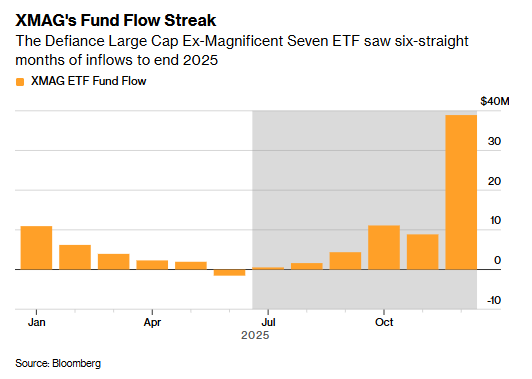
Core Viewpoint - The dominance of AI companies in the U.S. stock market, which has driven a 78% increase over the past three years, is facing skepticism as investors question the long-term profitability and transformative potential of AI technology [2] Group 1: Market Dynamics - Investors are shifting their focus from the "Magnificent Seven" tech giants to the remaining 493 companies in the S&P 500, particularly those that could benefit from an economic recovery [2] - The "Magnificent Seven" index has seen a decline of 2% since October 29 of the previous year, while the remaining S&P 493 index has increased by 1.8% during the same period [2] - The Defiance Large Cap Ex-Magnificent Seven ETF, which excludes the "Magnificent Seven," has experienced significant net inflows, with December's inflow being four times that of November [3] Group 2: Future Outlook - Ed Yardeni predicts impressive performance for the S&P 493 index in 2025, despite challenges such as government inefficiencies and a weak labor market [3] - If the economy improves, cyclical and growth-oriented sectors are expected to benefit, providing opportunities for investors looking to diversify away from large tech stocks [3] - Goldman Sachs forecasts that the contribution of the "Magnificent Seven" to S&P 500 earnings growth will decrease from 50% in 2025 to 46% in 2026, while S&P 493's earnings growth is expected to accelerate to 9% in 2026 [6] Group 3: Investment Sentiment - There is a growing sentiment of "AI fatigue," with investors becoming more selective about AI-related investments, as evidenced by Michael Burry's bearish bets on Nvidia and Palantir [5] - Concerns about the sustainability of capital expenditures and high valuations are leading to a more cautious approach among AI investors [4] - Analysts suggest that the healthcare sector, along with materials and non-essential consumer goods, may present attractive investment opportunities due to undervaluation relative to historical levels [6]



连华尔街都看腻了AI!美股资金正悄悄流向标普500其余493家公司
智通财经网· 2026-01-07 12:57
Core Viewpoint - The AI concept stocks have dominated the U.S. stock market over the past three years, leading to a cumulative increase of 78%, but investor enthusiasm is waning as concerns grow about the sustainability of this growth and the potential for a market shift away from the "Magnificent Seven" stocks [1] Group 1: Market Trends - A market style shift has begun, with the "Magnificent Seven" index down 2% since October 29, while the remaining 493 stocks in the S&P 500 have risen by 1.8% [2] - Funds are moving from high-growth stocks to more defensive and reasonably valued sectors, as evidenced by the Defiance Large Cap Ex Magnificent Seven ETF, which saw a threefold increase in net inflows in December compared to November [2] Group 2: Future Outlook - The performance of the remaining 493 S&P 500 stocks is expected to be "remarkable" in 2025, with high profit margins maintained despite economic challenges [5] - If economic conditions improve, cyclical and growth-oriented sectors may also benefit, providing opportunities for investors looking to move away from tech giants [5] - Historical examples suggest that once the dominance of the "Magnificent Seven" ends, the overall market may experience volatility [6] Group 3: Investment Sentiment - There is a growing sentiment of "AI fatigue," with warnings from various analysts about the potential end of the tech giants' dominance [7] - Goldman Sachs predicts that the contribution of the "Magnificent Seven" to S&P 500 earnings growth will decline from 50% in 2025 to 46% in 2026, while the growth rate for the remaining stocks is expected to rise from 7% to 9% [7] - Value investors are finding the remaining 493 stocks attractive due to significant valuation disparities and favorable macroeconomic conditions [7]

Should You Buy the Invesco QQQ ETF With the Nasdaq at an All-Time High? Here's What History Says
The Motley Fool· 2026-01-07 10:03
Core Insights - The Nasdaq-100 has consistently outperformed other indexes like the S&P 500 due to its high concentration of technology stocks [1] - The index features 100 of the largest nonfinancial companies listed on the Nasdaq, with over 60% of its weighting in the technology sector [2] - The Invesco QQQ Trust, which tracks the Nasdaq-100, is currently trading near an all-time high after a 20% gain in 2025 [3] Technology Sector Dominance - The Nasdaq-100's performance is heavily influenced by larger companies, with a cap ensuring no single company exceeds 24% of the index [4] - The top 10 holdings in the Invesco QQQ ETF account for 51.7% of the total weighting, indicating a top-heavy structure [5] - Key companies in the top 10 include Nvidia (9.04%), Apple (8.01%), and Microsoft (7.17%), which are involved in rapidly growing tech segments [6][7] Performance and Returns - The average return of the top 10 stocks over the last five years is 346%, contributing to the Nasdaq-100's outperformance compared to the S&P 500 [7] - Advanced Micro Devices and Micron Technology had significant share price increases of 77% and 239% respectively in 2025, positioning them as important players in the AI semiconductor space [9] - The Invesco QQQ ETF has produced an average annual return of 10.5% since its inception in 1999, with accelerated returns of 19.3% over the last decade [11] Diversification and Volatility - While the Nasdaq-100 is primarily tech-focused, it includes non-technology holdings like Costco, Linde, PepsiCo, and Starbucks, which can help mitigate some volatility [10] - Historical performance accounts for various market downturns, including five bear markets since 1999, demonstrating the index's resilience [13] - Despite current high trading levels, historical trends suggest it may still be a favorable time to invest in the Invesco QQQ ETF for long-term gains [15]



AI热潮力压地缘风险,道指、标普500指数创新高
2 1 Shi Ji Jing Ji Bao Dao· 2026-01-07 05:53
Group 1: Market Performance - The three major U.S. stock indices closed higher, with the Dow Jones and S&P 500 reaching all-time highs, closing at 49,462.08 and 6,944.82 points respectively, while the Nasdaq rose to 23,547.17 points [1] - The S&P 500's expected price-to-earnings ratio is approximately 22 times, slightly down from 23 times in November but still above the five-year average of 19 times [1] Group 2: Sector Movements - Energy stocks initially surged due to speculation about U.S. companies gaining access to Venezuelan oil resources, but major companies like ExxonMobil and Chevron saw declines of 3.4% and 4.5% respectively, indicating uncertainty in the sector [1] - At CES 2026, Nvidia's CEO highlighted the importance of memory and storage demand, leading to a strong performance in semiconductor stocks, with Micron Technology rising by 10% and SanDisk soaring by 27% [2] - Data center cooling stocks fell, with Johnson Controls down over 6% and Trane Technologies down 2.5% following Nvidia's announcement about new server technology [2] Group 3: Future Outlook - Morgan Stanley's chief U.S. equity strategist predicts continued stock market growth driven by multiple catalysts, including earnings, regulatory easing, and AI applications, with a projected earnings growth rate of nearly 14% for 2026 [3] - Concerns remain regarding high valuations and capital intensity among large tech companies, prompting some analysts to adopt a more cautious stance [3] - The expansion in the AI sector is heavily reliant on "circular investment," with significant capital expenditures expected from major tech firms, totaling around $440 billion [4][5]

90% of Investors Plan to Own AI Stocks in 2026: Here Are 2 That Should Be in Your Portfolio
The Motley Fool· 2026-01-07 04:00
Core Insights - Nvidia and Broadcom are identified as top AI stocks to consider for investment in 2026 and beyond, with a significant majority of investors planning to buy or hold AI stocks [1][2]. Nvidia - Nvidia's market capitalization stands at $4.6 trillion, with a current stock price of $187.47 and a gross margin of 70.05% [3][4]. - The company has experienced remarkable growth, with revenue increasing from $5.9 billion in fiscal Q3 2023 to $57 billion in fiscal Q3 2026 [3][4]. - Nvidia's GPUs are the primary drivers of AI workloads, and its data center networking revenue surged by 162% to $8.2 billion [4]. - The CUDA software platform has been pivotal in establishing Nvidia's dominance, as it has trained a generation of developers to optimize AI applications on its chips [5][6]. Broadcom - Broadcom has a market capitalization of $1.6 trillion, with a current stock price of $343.77 and a gross margin of 64.71% [7][8]. - The company specializes in data center networking and ASIC design, providing essential products for managing data flow in AI clusters [8][9]. - Broadcom is positioned to benefit from the growing demand for custom AI chips, with analysts predicting its AI revenue will increase from $20 billion in fiscal 2025 to over $50 billion in fiscal 2026, and $100 billion in fiscal 2027 [11]. - ASICs, while having high upfront costs and less flexibility than GPUs, are becoming a viable option for data center operators as inference workloads grow [10][12].

AI 供应链:CES 展会影响、ASIC 芯片生产、中国 AI 芯片-Asia-Pacific Technology-AI Supply Chain CES implications, ASIC production, China AI chips
2026-01-07 03:05
Summary of Key Points from the Conference Call Industry Overview - The focus is on the **AI semiconductor industry**, particularly the dynamics surrounding **AI GPUs** and **AI ASICs**. The demand for these components is expected to be strong in 2026, driven by supply factors such as memory availability and TSMC's 3nm technology [1][4][42]. Core Insights - **Nvidia's Production**: Nvidia's management reported that the **Rubin** compute board is in "full production," with assembly time significantly reduced from approximately **2 hours** for Blackwell to about **5 minutes** for Rubin. The launch is anticipated in the **second half of 2026** [2][54]. - **China's AI Chip Demand**: There is a forecast of around **2 million units** of H200 chips demanded by Chinese customers, with ongoing licensing processes. Companies like **ByteDance** are actively developing AI server racks compatible with both Nvidia and local chips [4][84]. - **Market Size Projections**: The total AI chip market is projected to reach **US$550 billion** by **2029**, which includes both AI GPUs and ASICs. This reflects a significant growth trajectory for the sector [5][42]. Capacity and Production Dynamics - **TSMC's CoWoS Capacity**: TSMC is expected to expand its CoWoS capacity by **20-30%** in 2026, with a revised forecast of **125kwpm** by the end of the year, marking a **79% increase** from previous estimates [12][43]. - **ASE/SPIL and Amkor**: Both ASE/SPIL and Amkor are also expanding their CoWoS capacities to meet rising demand from key customers like Nvidia, AMD, and AWS [13][14]. - **Google TPU Production**: Google is accelerating the production of its next-generation **TPU** chips, moving the timeline from **4Q26** to **3Q26**. Broadcom has also booked **30k** of CoWoS-S capacity to meet TPU demand [26][28]. Financial Outlook - **Revenue Growth**: TSMC is projected to generate **US$107 billion** from AI chip foundry services by 2029, which would account for about **43%** of its total revenue [44]. - **Cloud Capex Spending**: Estimated cloud capital expenditure for 2026 is projected to reach **US$632 billion**, indicating robust investment in AI infrastructure [45]. Risks and Considerations - **Supply Chain Risks**: The primary concerns for 2026 are expected to be shortages in memory, T-Glass, and TSMC's 3nm wafers, rather than CoWoS capacity itself [43][42]. - **China's Localization Efforts**: China is expected to increase its local chip production to support AI development, which may create additional demand for both local and foreign chips [81][82]. Additional Insights - **ByteDance's AI Server Racks**: At a recent conference, ByteDance showcased its **256-node AI server racks**, which are designed to work with both Nvidia and local AI chips, highlighting the competitive landscape in China's AI market [84]. - **Market Dynamics**: The AI semiconductor market is characterized by rapid growth and evolving dynamics, with significant implications for companies involved in chip production and supply chain management [42][43]. This summary encapsulates the key points discussed in the conference call, providing insights into the current state and future outlook of the AI semiconductor industry.