Broadcom(AVGO)

Search documents
“惊魂暴跌”后迎反击?瑞银力挺博通(AVGO.US):2026财年AI收入或超600亿,回调属过度反应
智通财经网· 2025-12-16 08:37
Core Viewpoint - Broadcom (AVGO.US) and Oracle (ORCL.US) experienced significant stock price fluctuations following their earnings reports, with Broadcom's stock dropping 17% over two days. UBS believes the market reaction was an overreaction and has raised its revenue expectations for Broadcom's AI semiconductor business, projecting revenues to exceed $60 billion in fiscal year 2026, nearly tripling year-over-year. The target price has been adjusted from $472 to $475 [1]. Group 1 - The company disclosed an AI business order backlog of $73 billion, covering an 18-month period, but management indicated that the actual delivery timeline would be closer to 12 months [2]. - In Q4, the total order backlog increased by 50% quarter-over-quarter, with AI semiconductor orders doubling. Excluding a new $11 billion order from Anthropic, the remaining backlog still increased by $20-25 billion, primarily from Google and Meta, not including OpenAI orders [2]. - Broadcom expects the delivery of a $21 billion rack order to Anthropic may extend into fiscal year 2027 due to the preparation progress of power components, emphasizing that Anthropic is the only rack customer in the backlog [2]. Group 2 - The company reaffirmed that the gross margin for its XPU business is approximately 55%, and for its AI networking business, it is around 80%. However, the overall gross margin for the $21 billion revenue from rack products is expected to fall to the 45%-50% range due to the inclusion of resale components [3]. - Broadcom's management expressed confidence that AI business revenues for fiscal year 2026 will exceed current market expectations, raising the revenue forecast for fiscal year 2027 to $135 billion, which is 2% above market consensus [3]. - UBS noted that the $21 billion order from Anthropic may be delivered by the end of fiscal year 2026 and continue into the first half of fiscal year 2027, with a projected delivery of $15 billion in fiscal year 2026 and the remaining $6 billion in fiscal year 2027 [4]. Group 3 - Broadcom's enterprise order backlog increased from $110 billion to $162 billion, with AI-related orders doubling quarter-over-quarter [5]. - The company addressed concerns regarding Google directly interfacing with foundries, stating that such a scenario is unlikely in the next five years, while emphasizing a long-term strategy to diversify its customer base to mitigate concentration risks [5]. - There is a trend of AI labs capturing more market share that was originally expected to be enterprise-level AI markets, as companies increasingly opt for services from providers like OpenAI and Anthropic rather than fine-tuning large models themselves [5]. Group 4 - Broadcom is open to monetizing custom chips through a licensing model if customer demand arises, which may reduce the portion of the average selling price (ASP) related to Broadcom's IP but could result in higher overall gross and operating margins [6]. - The company has achieved control over complete XPU solutions in its HBM business and is willing to adjust based on customer needs [6].

Broadcom: Momentum Breaks After Extended Rally
Investing· 2025-12-16 08:28
Market Analysis by covering: Broadcom Inc. Read 's Market Analysis on Investing.com ...


外企头条丨又一芯片巨头股价暴跌,对“AI泡沫”担忧加剧
Xin Lang Cai Jing· 2025-12-16 08:24
近期博通备受市场关注,很大程度上源于其与多家头部人工智能模型提供商的合作。例如,OpenAI已 与博通签订协议,采用其定制的人工智能芯片设计方案。博通也是谷歌TPU项目的重要合作伙伴,负责 TPU芯片的工程实现。受益于大规模数据中心建设带来的定制芯片需求,博通在人工智能芯片市场中所 占份额正持续扩大。博通公司首席执行官陈福阳预计,公司2026财年一季度人工智能半导体业务营收将 同比翻倍,达到82亿美元。但是,与不断增长的营 收预期形成对比的是公司的利润率下降。陈福阳表 示,由于"人工智能业务占比提高",其2026年一季度毛利率将低于前三个季度水平。毛利较低的定制化 AI处理器销售占比持续攀升,挤压整体获利能力,引发市场对博通业务盈利性可能下滑的担忧。投资 者对大型科技公司在AI投资回报方面的担忧正在加剧。(经济日报记者 周明阳) 受博通与甲骨文业绩引发的人工智能泡沫担忧,加之美联储降息后市场对政策的谨慎情绪,以及美国国 债收益率的上扬,当地时间12月12日,美股主要指数全线下跌。芯片巨头博通股价收盘下跌11.4%,市 值蒸发约2200亿美元。 (来源:经济日报) 转自:经济日报 ...
Possible Stock Splits in 2026: 2 Unstoppable Stocks Up 337% and 1,780% in 2 Years to Buy Now, According to Wall Street
The Motley Fool· 2025-12-16 08:02
Core Viewpoint - The resurgence of stock splits and the impact of artificial intelligence (AI) on the stock market have created significant investment opportunities, particularly in companies like Broadcom and AppLovin, which have shown remarkable stock performance and growth potential [1][2][3]. Group 1: Stock Market Trends - Stock splits are becoming more common again as a strategy to keep high-value stocks accessible to investors [1] - The bull market driven by AI advancements and strong corporate earnings has led major indices like the Dow Jones, S&P 500, and Nasdaq to reach record highs [2] - Historical data indicates that bull markets lasting over three years tend to continue for an average of eight years, suggesting further growth potential [3] Group 2: Broadcom - Broadcom's stock has increased by 337%, driven by the demand for application-specific integrated circuits (ASICs) as alternatives to energy-intensive GPUs [5][6] - The company has secured a multibillion-dollar deal with OpenAI to supply 10 gigawatts of ASICs over the next four years, with expectations of AI-related revenue growth to reach between $60 billion and $90 billion by 2027 [7] - Broadcom's current market cap is $1.6 trillion, with a gross margin of 64.71% and a PEG ratio of 0.43, indicating it may be undervalued despite a high price-to-earnings ratio [9][11] Group 3: AppLovin - AppLovin's stock has surged by 1,780%, attributed to its innovative advertising technology that aids app developers in marketing and monetization [12][13] - The company reported a 68% year-over-year revenue growth of $1.4 billion in the third quarter, with a diluted EPS increase of 96% [15] - AppLovin's market cap stands at $228 billion, with a PEG ratio of 0.63, suggesting it is attractively priced given its rapid growth [15][17]


计算机行业周报:MistraiAI发布Devstral2系列,GPT-5.2定义专家级智能-20251216
Huaxin Securities· 2025-12-16 07:36
Investment Rating - The report maintains a "Buy" rating for the companies mentioned, indicating a positive outlook for their performance in the market [10]. Core Insights - The release of MistralAI's Devstral2 series marks a significant advancement in AI programming tools, enhancing the capabilities of open-source programming agents and providing a dual solution for enterprise and localized needs [3][23]. - OpenAI's launch of the GPT-5.2 model series represents a major milestone in general artificial intelligence, showcasing superior performance in various benchmark tests, particularly in complex knowledge-based tasks [4][35]. - The AI infrastructure sector is experiencing robust growth, as evidenced by Broadcom's substantial orders for Google's TPU products, which are expected to address the industry's efficiency challenges [7][61]. Summary by Sections 1. Computing Power Dynamics - The computing power rental prices remain stable, with specific configurations priced at 28.64 CNY/hour for Tencent Cloud and 31.58 CNY/hour for Alibaba Cloud [21]. - MistralAI's Devstral2 series, featuring a flagship model with 123 billion parameters, is designed for code generation and complex codebase exploration, significantly pushing the boundaries of AI programming capabilities [3][23]. 2. AI Application Dynamics - Perplexity's weekly usage increased by 10.58%, indicating growing engagement with AI applications [32]. - The GPT-5.2 series, launched by OpenAI, includes various models tailored for different tasks, achieving remarkable results in benchmark tests and demonstrating enhanced capabilities in handling complex tasks [4][35]. 3. AI Financing Trends - Fal.ai completed a $140 million Series D funding round, raising its valuation to $4.5 billion, solidifying its position in the AI content generation infrastructure [48][49]. 4. Investment Recommendations - Broadcom's CEO disclosed that Anthropic has placed orders totaling $21 billion for Google's TPU products, reflecting strong demand in the AI chip market [7][61]. - The report suggests focusing on companies like Weike Technology and Nengke Technology, which are positioned to benefit from the expanding AI infrastructure and applications [8][62].


两日失血17%,博通(AVGO.US)的暴跌是陷阱还是馅饼?
智通财经网· 2025-12-16 07:16
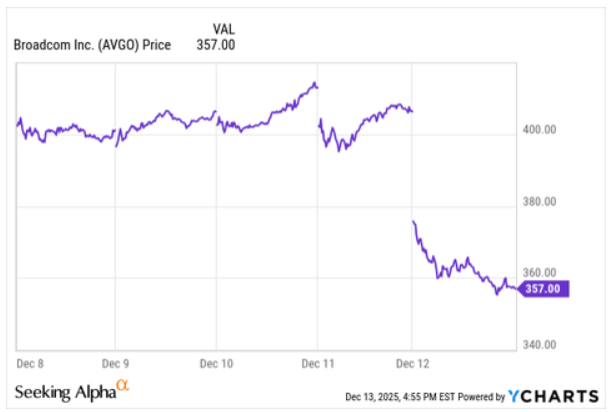
Core Viewpoint - Broadcom's stock experienced a significant decline, with a drop of 11.43% on Friday and an additional 6% on Monday, raising questions about the reasonableness of the sell-off despite strong financial performance [1][4]. Financial Performance - For Q4 of FY 2025, Broadcom reported revenues of $18 billion, a year-over-year increase of 28%, and a diluted earnings per share (EPS) of $1.74, up 93% from the previous year [4][5]. - Semiconductor solutions generated $11.07 billion in revenue, accounting for 61% of total revenue and growing 35% year-over-year, while infrastructure software contributed $6.94 billion, representing 39% of total revenue with a 19% increase [5][7]. - Free cash flow for the quarter reached $7.5 billion, representing 41.4% of revenue and a 36% increase compared to the previous year [7][8]. Cash Flow and Shareholder Returns - For FY 2025, Broadcom's total free cash flow was $26.91 billion, a 39% increase from FY 2024, with a free cash flow margin of 42.1% [8][9]. - The company announced a 10% increase in dividends for Q1 FY 2026, reducing long-term debt by $4.3 billion, and extending its stock buyback program with a remaining balance of $7.5 billion [9][10]. AI Orders and Market Position - Broadcom secured a $11 billion order from Anthropic, expected to be delivered by the end of 2026, and reported a backlog of over $73 billion in AI-related orders, which is anticipated to be fulfilled within the next 18 months [10][11]. - The CEO emphasized that the $73 billion backlog represents the minimum expected revenue from AI over the next six quarters, with additional orders likely to increase this figure [11][12]. Analyst Misinterpretations - Analysts misread the significance of the $73 billion backlog, failing to understand the CEO's conservative guidance style and comparing Broadcom unfavorably to Oracle, which is deemed inappropriate given Broadcom's strong cash flow and debt reduction [12][15]. - The market's reaction to the backlog was seen as overly emotional, with the CEO indicating that the order flow is expected to accelerate, contradicting the negative sentiment [12][23]. Valuation and Market Outlook - Despite the recent stock decline, Broadcom's valuation remains high, with a trailing P/E ratio of 30.8, reflecting the market's willingness to pay a premium for high-quality growth companies [17][20]. - Analysts have raised Broadcom's fair value estimate from $365 to $480, highlighting the company's strong revenue growth and potential for continued performance in the AI sector [21][20].
Broadcom’s Post-Earnings Selloff Wiped Out Nearly the Entire Market Value of AMD
Investing· 2025-12-16 06:08
Market Analysis by covering: Broadcom Inc. Read 's Market Analysis on Investing.com ...

异动盘点1216 |沪上阿姨涨近6%,拨康视云-B跌超11%;加密货币概念股走低,ServiceNow跌11.54%
贝塔投资智库· 2025-12-16 04:02
Group 1: Market Movements - Baoji Pharmaceutical-B (02659) surged over 3.2% amid its debut on the Hong Kong Stock Exchange, closing up 138.82% on its first day, with a market capitalization exceeding HKD 20 billion [1] - New Energy (01799) and Xinyi Solar (00968) saw declines of 3.01% and 3.67% respectively, as the photovoltaic sector faced weakness, with rumors of a 30 billion yuan investment for capacity storage by major companies [1] - Xpeng Motors-W (09868) and Li Auto-W (02015) dropped 4.88% and 2.67% respectively, following data from the China Association of Automobile Manufacturers indicating a month-on-month increase in production and sales [1] Group 2: Company-Specific News - Bolek Vision Cloud-B (02592) experienced a significant drop of nearly 15%, having previously doubled in price over 10 trading days, as it announced a new drug trial application to the FDA [2] - Hu Shang Ayi (02589) rose nearly 6% as Nayuki Tea expanded into the U.S. market, enhancing the international presence of Chinese tea brands [2] - Gold stocks fell sharply, with Zijin Mining (02899) and Shandong Gold (01787) declining by 4.29% and 4.94% respectively, following a report on the Bloomberg Commodity Index's upcoming rebalancing [2] Group 3: Cryptocurrency and Technology - Cryptocurrency ETFs faced significant declines, with notable drops in Bitcoin and Ethereum-related funds, as Bitcoin fell 3.3% from its record high, reflecting market pressures amid weak liquidity [3] - Oracle (ORCL.US) continued its downward trend, dropping 2.66% due to delays in delivering AI data centers for OpenAI, attributed to labor and material shortages [6] - Nvidia (NVDA.US) saw a slight increase of 0.73% after announcing the release of its third-generation language model, aimed at writing and programming tasks [6]


博通三天重挫17.7%,“谷歌链”核心遭遇2020年来最惨暴击
美股IPO· 2025-12-16 03:52
博通股价连续三个交易日下跌,累计跌幅达17.7%,并创下自2020年3月以来最差的三日表现。此次暴跌导致其市值蒸发超过 3000亿美元,规模约等于一个AMD的市值。市值缩水后,博通在美国上市公司市值排行榜上的位置被Meta超越,跌出前六。 而这场抛售由两记重拳引燃。首先,"谷歌链"核心标的——博通在上周公布了财报,尽管销售额创下历史新高,但其对AI业务 的收入预测未能满足华尔街的极高期望。 其次,"OpenAI链"核心公司——甲骨文刚公布完不及预期的财报后,其为ChatGPT所有者OpenAI建设的部分数据中心,又被 曝完工日期可能从2027年推迟至2028年,这直接引发了市场对AI基础设施建设速度的质疑。 此次股价重挫对投资者的直接影响是巨大的财富蒸发。在短短三个交易日内,博通的市值抹去了超过3000亿美元,这一损失 的规模约等于其竞争对手AMD的总市值。 市值的急剧缩水也改变了美国科技巨头的市值排名。由于博通股价的持续承压,Meta的市值已重新超越博通,使这家社交媒 体巨头重返美国市值第六大公司的位置。 这一变化虽然部分源于Meta股价的温和上涨,但主要还是由博通自身的急剧下跌所驱动。对于市场来说,这种排 ...
“AI基建”遭重创,博通,甲骨文三天跌超17%,英伟达亲儿子CoreWeave3个月几近“腰斩”
美股IPO· 2025-12-16 03:52
博通和甲骨文在短短三个交易日内跌幅均超过17%,其中博通创下自2020年3月以来最差表现,市值蒸发超3000亿美元,市值排名被Meta反超。同时, CoreWeave股价自6月高点已暴跌超60%。尽管AI需求依然旺盛,但市场担忧情绪蔓延,甲骨文高达500%的债务权益比更是引发了投资者的警惕。 在人工智能市场的至少一个细分领域,市场情绪已经明显转向悲观。市场风暴正在席卷整个AI基础设施板块。 与AI基础设施建设密切相关的三家公司——博通(Broadcom)、CoreWeave和甲骨文(Oracle)——在经历了上周大幅下跌后,本周一再度下挫: 博通股价周一再跌5.6%,此前周五已暴跌11%,目前较上周三创下的历史高点已回落18%。博通连续三个交易日下跌,累计跌幅达到18%, 创2020年3月份以来最 差同期表现。此次暴跌导致其市值蒸发超过3000亿美元,损失的规模约等于其竞争对手AMD的总市值。 甲骨文周一下跌2.7%,过去三个交易日累计下跌17%。自9月10日以来,公司市值已蒸发46%。 当日甲骨文股价曾创下自1992年以来的最佳单日表现,原因是披 露了庞大的AI订单积压规模。 CoreWeave股价周一再跌 ...