BIDU(BIDU)

Search documents
纳指连续三天跌超1%,亚马逊盘后跳水超10%,中概股逆势走强
Feng Huang Wang· 2026-02-05 23:04
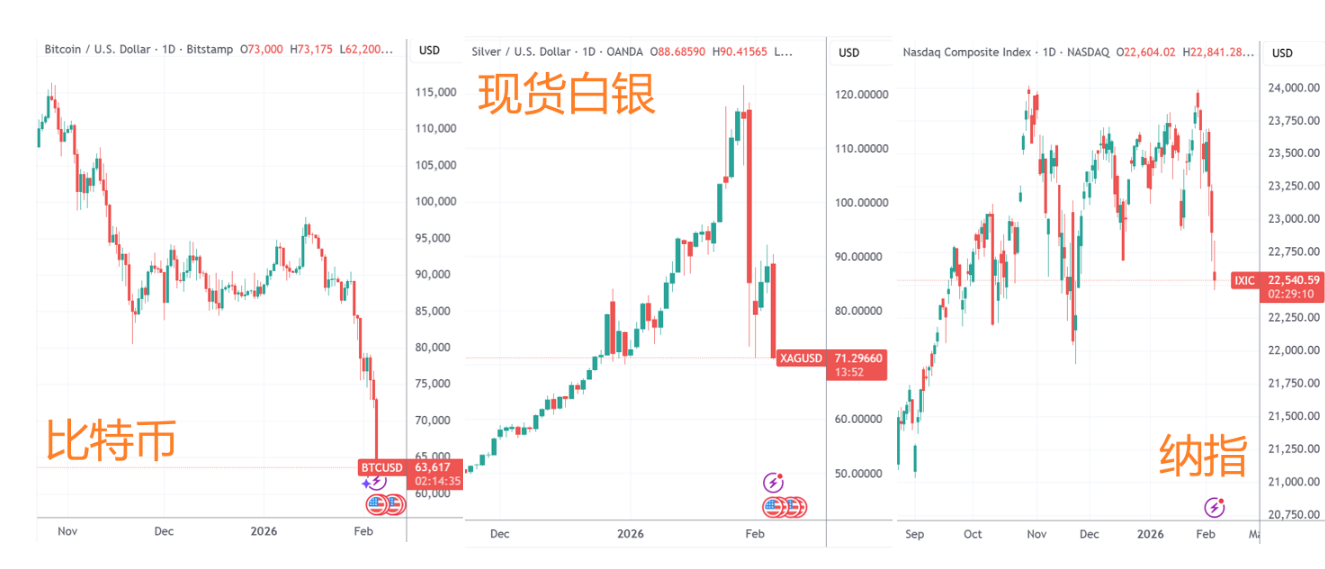
Market Overview - The software sector and cryptocurrency experienced a significant downturn, with the S&P 500 index falling by 1.23% to 6798.4 points, the Nasdaq Composite down 1.59% to 22540.59 points, and the Dow Jones Industrial Average decreasing by 1.2% to 48908.72 points, marking the worst three-day sell-off since April of the previous year [1][3] - Bitcoin dropped below $64,000, losing nearly half its value over the past six months, while spot silver saw a single-day decline of nearly 20% [1] Employment Data Impact - The recent weak U.S. employment data has halted the recent sector rotation, with 318 stocks in the S&P 500 declining. December job openings unexpectedly fell to the lowest level since 2020, and the number of layoffs reached the highest January level since the severe recession in 2009 [3] - Allianz's Chief Economic Advisor, Mohamed El-Erian, noted that layoffs are occurring despite GDP growth of approximately 4%, indicating a decoupling of employment from economic growth, which could have profound economic, political, and social implications [3] Company-Specific Developments - Amazon's stock plummeted over 10% after announcing a capital expenditure forecast of $200 billion for the year, significantly higher than the previous year's $130 billion and analyst expectations of $150 billion, which negatively impacted its profit guidance [3] - Nvidia's stock fell by 1.33%, while other major tech companies like Apple, Google, and Microsoft also saw declines, with Microsoft down 4.95% and Amazon down 4.42% [6] AI and Software Sector - The software sector faced pressure following the release of a new flagship model by AI company Anthropic, contributing to a broader sell-off in AI-related stocks. FaceSet dropped 7.21%, reaching its lowest point since March 2020, while Thomson Reuters fell over 5%, hitting a new low since 2021 [6] - Amid concerns over AI capital expenditures, some supply chain stocks performed well, such as Tianhong Technology, which rose 6.9% due to Google's $185 billion capital expenditure guidance [6] Chinese Stocks Performance - Chinese stocks showed resilience, with the Nasdaq Golden Dragon China Index rising by 0.9%. Notable performances included NIO up 5.86% and Baidu up 0.73%, while Alibaba and JD.com saw slight declines [7] Other Industry News - Pandora, the world's largest jewelry company, surged 16.83% after announcing plans to reduce reliance on pure silver by introducing platinum-plated jewelry in response to rising silver prices [8] - The proposed merger between Rio Tinto and Glencore to form the world's largest mining group collapsed, with Glencore citing undervaluation of its contribution to the merger [9] - Nvidia announced delays in the release of its RTX 50 series graphics cards due to memory shortages, prioritizing AI chip production instead [10] - Hims & Hers Health plans to launch a cheaper generic version of the oral weight loss drug semaglutide, causing a significant drop in the stock price of Novo Nordisk, which had just received approval for its brand product [11]


红包“四国杀”,打响AI入口争夺战
Shen Zhen Shang Bao· 2026-02-05 22:54
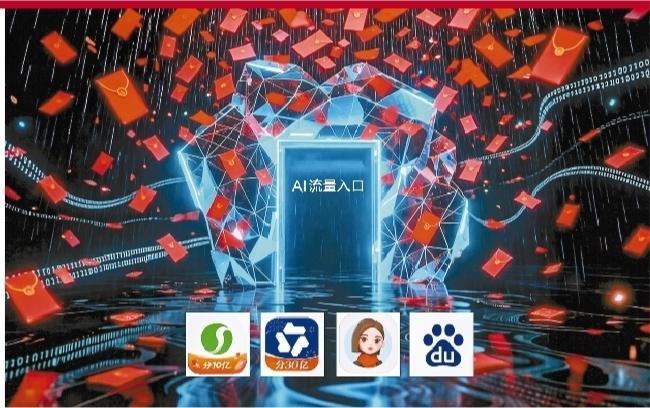
Core Viewpoint - The major internet companies Tencent, Alibaba, Baidu, and ByteDance are engaged in a "red envelope war" as they prepare for the 2026 Spring Festival, with significant cash giveaways aimed at gaining user engagement and establishing dominance in the AI sector [2][6]. Group 1: Cash Red Envelope Initiatives - Tencent announced a 10 billion yuan cash red envelope campaign starting February 1, 2026, while Baidu launched a 5 billion yuan initiative on the same day [2][4]. - Alibaba's Qianwen APP revealed a massive 30 billion yuan "Spring Festival Treat Plan" on February 2, 2026, marking its largest investment in a Spring Festival campaign [4]. - Users can participate in Tencent's red envelope activities by logging in daily, completing tasks, and sharing links, with the potential to win significant cash prizes [3][4]. Group 2: AI Integration and User Engagement - The red envelope campaigns are seen as a strategy to test user engagement with AI applications, marking a shift from previous marketing tactics that focused solely on cash giveaways [6][9]. - Industry experts suggest that the effectiveness of these campaigns will depend on the quality and usability of the AI products offered, rather than just the cash incentives [9][10]. - The competition is characterized by each company's focus on integrating their core business strengths, with Tencent leveraging social features, Alibaba focusing on a comprehensive ecosystem, and Baidu enhancing search functionalities [5][6]. Group 3: Long-term Implications for AI Market - The ongoing "red envelope war" is viewed as a significant event in the AI landscape, potentially accelerating the adoption and application of AI technologies across various sectors [8]. - Analysts predict that the competition will lead to a more profound integration of AI into everyday life, with companies needing to address real user needs to ensure long-term retention [10]. - The AI market in China is expected to grow significantly, with projections indicating a core industry scale surpassing 900 billion yuan by 2024, reflecting a 24% year-on-year increase [10].

红包大战,意在超级流量入口
Shen Zhen Shang Bao· 2026-02-05 22:54
Core Viewpoint - The current "red envelope war" among internet giants has shifted from mobile payments to artificial intelligence, with significant financial investments aimed at establishing the next generation of "super traffic entrances" that will shape the competitive landscape for the next decade [1][2]. Group 1: Company Strategies - Tencent has launched the "Shangyuanbao" initiative with a budget of 1 billion yuan, following its previous 500 million yuan investment during the 2015 Spring Festival [1]. - Alibaba's "Qianwen" has announced a 3 billion yuan investment for its "Spring Festival Treat Plan," integrating various services within its ecosystem [1]. - Baidu and ByteDance are also participating, with Baidu embedding its AI assistant into its app and offering 500 million yuan in cash rewards, while ByteDance collaborates with the Spring Festival Gala as the exclusive AI cloud partner [1]. Group 2: Market Dynamics - The competition for AI as a new traffic entrance is driven by the maturity of large models capable of handling complex tasks, and a substantial user base that supports AI's market foundation [3]. - By June 2025, the user base for generative AI in China is projected to reach 515 million, with a penetration rate of 36.5% [3]. - The saturation of mobile internet traffic and stagnant user engagement has prompted internet giants to seek new avenues for traffic [3]. Group 3: Competitive Landscape - The current battle for AI traffic entrances is reminiscent of past browser and mobile app wars, with AI agents capable of aggregating traffic, data, and transactions, potentially leading to a "winner-takes-all" scenario [3][4]. - The development of a super entrance requires advanced model capabilities, vast computational power, data, ecosystem integration, and scenario refinement, favoring major internet players [4]. Group 4: Opportunities for Smaller Players - Smaller players can still find opportunities by integrating with major models and creating plugins or skills that can be frequently utilized by mainstream AI agents [5]. - The emergence of the AI agent economy is expected to create a trillion-dollar software and service market by 2030, with significant online consumption growth [5]. Group 5: Impact on Businesses - The shift in traffic entrances poses both challenges and opportunities for ordinary businesses, as AI agents may favor recommending self-operated or leading brands, potentially marginalizing smaller businesses [6]. - Businesses that adapt to become "AI-friendly" and utilize free AI tools may gain a competitive edge in the new market landscape [6].
阿里字节领跑,百度腾讯掉队?智能体之争谁能笑到最后
Sou Hu Cai Jing· 2026-02-05 21:02
Core Insights - The year 2026 is anticipated to be a pivotal moment for the AI agent industry, with significant policy developments, accelerated actions from tech giants, and increased capital market investments [1][3] - There are differing opinions on the current state of competition in the AI agent space, with some believing that leading players like ByteDance and Alibaba have initiated a peak competition, while others argue that the market is still in its infancy due to technological limitations and ecosystem challenges [1][5] Investment Trends - The popularity of AI agents is reflected in capital movements, with five out of the top ten investment sectors in 2025 being directly related to AI agents [3] - Approximately 20% of new unicorns are centered around AI technology, indicating a crowded and competitive landscape with over 120 domestic AI agent platforms [3][4] AI Agent Maturity Levels - AI agents can be categorized into three levels: "basic" agents for simple tasks, "upgraded" agents capable of more complex operations, and future "complete" agents that may operate autonomously like humans [3][4] - Currently, most domestic AI agents are still at the "basic" level, performing tasks such as PPT creation and translation, with only a few, like Doubao and Qianwen, reaching the "upgraded" level [4][5] Competitive Landscape - The competitive hierarchy is emerging, with ByteDance and Alibaba leading as "seed players" capable of providing comprehensive solutions, followed by specialized players and those offering technical tools [7] - The Chinese AI agent market is expected to be dominated by large enterprises, which will hold about 80% market share due to their clear business needs and data foundations [7] Advantages of Leading Players - ByteDance and Alibaba's competitive edge stems from their self-developed large models, extensive ecosystems, and profitable products that can be scaled [8][11] - Alibaba's ecosystem is seen as a "super entrance" for activating its vast commercial network, while ByteDance leverages its traffic advantages through platforms like Douyin and TikTok [11][12] Challenges Faced by Leading Players - Despite their advantages, both companies face challenges: Alibaba's ecosystem is heavily reliant on its own platforms, limiting cross-platform collaboration, while ByteDance's late entry into the market has resulted in a lack of deep industry knowledge [12][14] - The competition is fierce, with predictions that 90% of AI agents may be overshadowed by large models, making it difficult for smaller players to compete [13] Market Dynamics - The AI agent market is characterized by a complex and broad landscape, suggesting that no single company can dominate entirely, leading to a multi-track, differentiated competition [18] - While ByteDance and Alibaba currently lead, there remains room for other players to carve out niches in vertical markets and through technological differentiation [18]
红包大战 意在超级流量入口
Shen Zhen Shang Bao· 2026-02-05 17:55
Core Insights - The competition among internet giants has shifted from mobile payments to artificial intelligence, with significant investments in AI-related initiatives and user engagement strategies [1][2] Group 1: Investment and Initiatives - Tencent launched the "Shangyuanbao, distributing 1 billion" campaign, marking a significant investment in user engagement during the Spring Festival, following a previous 500 million yuan investment in 2015 [1] - Alibaba's "Qianwen" announced a 3 billion yuan investment for its "Spring Festival Treat Plan," integrating various services within its ecosystem [1] - Baidu and ByteDance also participated, with Baidu embedding its AI assistant into its app and offering 500 million yuan in cash rewards, while ByteDance partnered with the Spring Festival Gala as the exclusive AI cloud partner [1] Group 2: Market Dynamics - The current AI competition is driven by the need for new traffic sources as mobile internet growth stagnates, with AI seen as the next major entry point for user engagement [2] - By 2025, the user base for generative AI in China is projected to reach 515 million, with a penetration rate of 36.5%, indicating a strong market foundation for AI applications [2] Group 3: Competitive Landscape - The battle for AI as a traffic entry point is reminiscent of past tech rivalries, with the potential for AI to aggregate traffic, data, and transactions, thus enhancing the competitive advantage for those who control these entry points [2][3] - The development of a super entry point requires advanced model capabilities, vast computational resources, and effective ecosystem integration, favoring major internet players over smaller competitors [3] Group 4: Opportunities for Smaller Players - Smaller players can still find opportunities by integrating with major AI models and creating plugins or skills that can be frequently utilized by mainstream AI agents [4] - The emergence of the AI agent economy is expected to create a trillion-dollar market by 2030, presenting new avenues for innovation and revenue generation [4] Group 5: Impact on Businesses - The shift in traffic entry points poses both challenges and opportunities for ordinary businesses, as AI agents may favor larger brands, potentially marginalizing smaller players [5][6] - Businesses that adapt to become "AI-friendly" and utilize available AI tools may gain a competitive edge in the evolving market landscape [6]
一边红包大战、一边高薪抢人!阿里、腾讯、字节……年薪最高开到了100多万元
Mei Ri Jing Ji Xin Wen· 2026-02-05 17:36
Core Insights - The AI red envelope competition during the Spring Festival has sparked widespread public participation, with companies like Baidu, Tencent, and Alibaba investing billions in cash to attract users and talent [1][2] Group 1: Company Strategies - Baidu initiated a 500 million yuan red envelope plan, allowing users to share in cash rewards while using its AI assistant, Wenxin, which attracted over 50 million participants within a week [1][2] - Tencent doubled its red envelope pool to 1 billion yuan and aims to recreate the success of WeChat red envelopes by directly returning saved marketing budgets to users [2] - Alibaba's Qianwen announced a 3 billion yuan "Spring Festival Treat" plan, offering not only cash but also services like movie tickets and meal bookings, integrating various Alibaba ecosystem services [2] Group 2: User Engagement and Market Potential - The user base for generative AI in China has reached 515 million, with a penetration rate of 36.5%, indicating a significant untapped market [2] - Major AI applications like Baidu's Wenxin, ByteDance's Doubao, Alibaba's Tongyi Qianwen, and Tencent's Yuanbao have all surpassed 100 million monthly active users, highlighting the competitive landscape [2] - Experts suggest that while cash incentives can attract initial users, long-term engagement requires multiple interactions to develop habitual usage, warning against the risk of creating "zombie users" [2][3] Group 3: User Experience and Retention Challenges - Baidu's approach of embedding Wenxin within its existing app, which has 700 million monthly active users, reduces barriers for user engagement [3] - The effectiveness of AI red envelopes depends on the perceived utility of the application; if users find the AI unhelpful, they may disengage after claiming rewards [3] - Retaining users post-promotion will depend on the quality and uniqueness of AI functionalities, as companies face the challenge of maintaining user loyalty beyond initial cash incentives [3]
一边红包大战,一边高薪抢人!阿里、腾讯、字节……年薪最高开到了100多万元
Mei Ri Jing Ji Xin Wen· 2026-02-05 17:03
每经记者|赵雯琪 每经编辑|陈柯名 记者|赵雯琪 AI的使用习惯,最终还是要靠大厂背后繁荣的生态、坚实的技术底座来实现,用户看的还是模型的智能程度、回答的准确率、功能的实用性以及能否融 入每天的生活和工作流等等。 几乎同步,腾讯迅速加码,将红包池翻倍至10亿元,并于2月1日起通过其AI应用"元宝"开启抽奖活动。腾讯创始人马化腾在内部年会上罕见发声,直言希 望"重现当年微信红包引爆社交的盛况"。他强调,元宝将把节省下来的营销预算直接回馈用户,让用户在互动中重拾"抢红包"的乐趣。 阿里千问则宣布的30亿"春节请客计划",折射出"下后手棋"的优势。从2月6日起,用户在千问APP里不仅能领现金,还能直接买电影票、订年夜饭、买年 货,甚至联动飞猪、盒马、大麦等阿里生态业务进行"全链路免单"。 据中国互联网络信息中心数据显示,我国生成式AI用户规模已达5.15亿,普及率为36.5%,意味着仍有近六成潜在市场尚未开发。目前,百度文心、字节 豆包、阿里通义千问和腾讯元宝的月活跃用户均已突破亿级。谁能率先撬动这片空白地带,或将决定谁能在AI浪潮中实现"鲤鱼跃龙门"。 红包只是引流的第一步。专家指出,仅靠一次性现金激励难以培养长 ...

百度宣布上限50亿美元股份回购计划
Zheng Quan Ri Bao Zhi Sheng· 2026-02-05 16:41
Group 1 - Baidu has announced a new share repurchase plan authorized by its board, allowing for the repurchase of up to $5 billion of its shares, effective until December 31, 2028 [1] - The company aims to enhance shareholder value through proactive measures, leveraging its substantial cash reserves and sound financial management [1] - Analysts believe the repurchase plan not only optimizes Baidu's capital structure but also signals confidence in the long-term value of its AI business, helping to stabilize stock prices and boost investor confidence [1] Group 2 - Baidu's board has approved a dividend policy for its common stock, with the first dividend expected to be announced in 2026, contingent on the company's financial performance and market conditions [2] - Future dividends will be supported by sustainable funding sources, primarily from operating profits and potentially supplemented by proceeds from the sale of non-core assets [2] - The initiation of dividends indicates that Baidu's core business has achieved stable and predictable cash flow, particularly with the early success of AI cloud and large model commercialization [2] Group 3 - The combination of share repurchase and dividend policy reflects Baidu's strategic shift from a "high growth narrative" to a "high-quality return" strategy, showcasing its responsibility as a mature tech company [3] - This approach emphasizes Baidu's capability to deliver long-term value to shareholders while maintaining a focus on sustainable growth [3]
中概指数涨1.2%,蔚来涨超7%,理想涨约3%
Xin Lang Cai Jing· 2026-02-05 15:06
Core Viewpoint - The Nasdaq Golden Dragon China Index saw an initial increase of 1.21%, indicating positive market sentiment towards Chinese stocks listed in the U.S. [1] Company Performance - NIO experienced a significant rise of 7.4% - Miniso increased by 5.4% - Yum China rose by 3.4% - Li Auto gained 2.8% - ZTO Express, Zai Lab, Bilibili, Baidu, and Kingsoft Cloud all saw increases of over 2% - Alibaba had a modest increase of 0.7% - Pony.ai declined by 1.2% - New Oriental fell by 2.8% [1] ETF Performance - KWEB ETF rose by 1.14% - CQQQ ETF increased by 0.7% - ASHR ETF decreased by 0.1% - ASHS ETF fell by 1.3% [1]


纳指低开1.31%,Alphabet绩后大跌超7%,高通跌超9%
Ge Long Hui· 2026-02-05 14:52
美国1月挑战者企业裁员人数升至10.8万,创2009年以来同期最高;上周初请失业金人数亦超预期上 升。美股开盘,三大指数集体下跌,纳指跌1.31%,标普500指数跌0.9%,道指跌0.6%。 Alphabet跌超7%,今年资本支出指引接近翻倍至1750亿-1850亿美元,远超预期。 高通跌9.3%,第二财季营收及调整后每股收益指引逊于预期,手机芯片业务受制于供应链瓶颈。 Arm跌3.2%,第三财季营收同比增长26%至12.4亿美元,本季营收指引不及最乐观预期。 百度涨2.5%,预计2026年首次派发股息,计划回购至多50亿美元的股票。 (格隆汇) ...