
BYD(BYDDY)

Search documents
华创证券:维持比亚迪电子(00285)“强推”评级 目标价56.4港元
智通财经网· 2025-11-03 06:19
Core Viewpoint - BYD Electronics is recognized as a leading platform manufacturing enterprise globally, benefiting from the expansion of product categories within its major customer system and upgrades in AI terminals, while its automotive electronics continue to accelerate product development [1][2]. Financial Performance - In the first three quarters of 2025, the company achieved revenue of 123.285 billion yuan (YoY +0.95%) and a net profit attributable to shareholders of 3.137 billion yuan (YoY +2.4%) [1]. - For the third quarter of 2025, the company reported revenue of 42.679 billion yuan (YoY -1.99%) and a net profit of 1.407 billion yuan (YoY -8.99%) [1]. Business Segments - The company operates in three main business lines: consumer electronics, automotive electronics, and new intelligent products. In H1 2025, the consumer electronics segment (assembly + components) generated revenue of 60.946 billion yuan (YoY -3.73%), while the new energy vehicle segment saw revenue of 12.454 billion yuan (YoY +60.57%), and the new intelligent products segment reported revenue of 7.206 billion yuan (YoY -4.18%) [2]. - The launch of the iPhone Air in October 2025 has delayed the revenue and profit performance in Q3 compared to the previous year [2]. Future Growth Potential - The automotive electronics segment is expected to maintain growth in product shipments, supported by the parent company's continuous expansion of product categories, including smart cockpits and intelligent driving assistance [3]. - In the AI business, the company has established a comprehensive layout covering general servers, storage servers, AI servers, and immersion cooling solutions, becoming a partner of NVIDIA in the data center field, which has led to strong growth in AI server shipments [3]. - The acquisition of Jabil's mobile manufacturing business is expected to deepen the company's engagement with major customers, with the integration of Jabil's operations marking a significant breakthrough in the largest product category for major clients [3].

比亚迪电子(0285.HK)2025年Q3业绩点评:25Q3净利润同比下降 北美大客户、汽车、AI构筑26年三大成长引擎
Ge Long Hui· 2025-11-03 05:17
Core Viewpoint - The company reported a decline in revenue and gross profit for Q3 2025, primarily due to changes in product mix, with expectations for growth driven by key business segments in 2026 [1][2][3] Group 1: Financial Performance - Q3 2025 revenue was 42.68 billion RMB, down 2.0% year-on-year, with gross profit at 2.946 billion RMB, a decrease of 20.0%, resulting in a gross margin of 6.9%, down 1.6 percentage points year-on-year [1] - Net profit fell 9.0% year-on-year to 1.407 billion RMB due to the decline in gross profit [1] Group 2: Business Growth Drivers - In 2026, the North American client’s components, new energy vehicles, and AI data center businesses are expected to be the three core growth engines, with a focus on business progress [1] - The North American client’s foldable screen new model is anticipated to drive an increase in metal middle frame shipments and average selling price (ASP), significantly boosting revenue [1] - The company plans to expand capacity by adding a large number of CNC machines in Q4 2025 to H1 2026, while enhancing automation and operational efficiency [1] Group 3: Sector-Specific Insights - The revenue forecast for the new energy vehicle business in 2025 has been lowered due to BYD's adjustment of its annual sales target from 5.5 million to 4.6 million vehicles, but high-level intelligent driving and suspension products are expected to drive up the unit value in 2026 [2] - AI data center liquid cooling and power product deliveries have been delayed, with the company focusing on expanding its product lines and system-level capabilities, while also increasing customer numbers [2] Group 4: Profit Forecast and Valuation - The net profit forecast for 2025 has been reduced by 11% to 4.319 billion RMB, with further reductions for 2026 and 2027 by 18% and 17% respectively, to 5.241 billion RMB and 6.203 billion RMB [3] - The current market valuation corresponds to P/E ratios of 17x, 14x, and 12x for 2025-2027, with a maintained "overweight" rating due to expected growth from key business segments [3]
比亚迪电子(00285.HK):3Q25业绩符合预期 关注数据中心业务发展
Ge Long Hui· 2025-11-03 05:17
Core Insights - The company's Q3 2025 performance met expectations, with total revenue of 123.3 billion yuan, a year-on-year increase of 0.95%, and a net profit attributable to shareholders of 3.14 billion yuan, up 2.4% year-on-year [1] - The company is focusing on AI data centers and AI robotics to expand its capabilities, with expectations for accelerated growth in these areas [2] Financial Performance - Q3 2025 revenue was 42.68 billion yuan, down 2% year-on-year and quarter-on-quarter; net profit for the quarter was 1.41 billion yuan, down 9% year-on-year but up 27% quarter-on-quarter [1] - The gross margin for Q3 2025 was 6.9%, a decrease of 1.6 percentage points year-on-year and 0.4 percentage points quarter-on-quarter, attributed to a decline in the proportion of high-margin component business [1] Business Trends - The mobile component business is expected to decline slightly, primarily due to delays in the shipment schedule of new devices from major clients; the assembly business remains stable [1] - The company is enhancing the per-vehicle value in the new energy vehicle sector, with ongoing development in cockpit, thermal management, suspension, and intelligent driving areas [1] - The AI data center business is anticipated to grow rapidly, supported by the launch of AI servers and the increasing demand for liquid cooling and power products [2] Profit Forecast and Valuation - The net profit forecasts for 2025 and 2026 have been revised down by 12% and 6% to 4.323 billion yuan and 5.798 billion yuan, respectively [2] - The current stock price corresponds to a P/E ratio of 17x for 2025 and 13x for 2026, with a target price of 50.0 yuan, implying a potential upside of 37% [2]
比亚迪的“刀片”和日本市场的“铠甲”
Jing Ji Guan Cha Wang· 2025-11-03 04:48
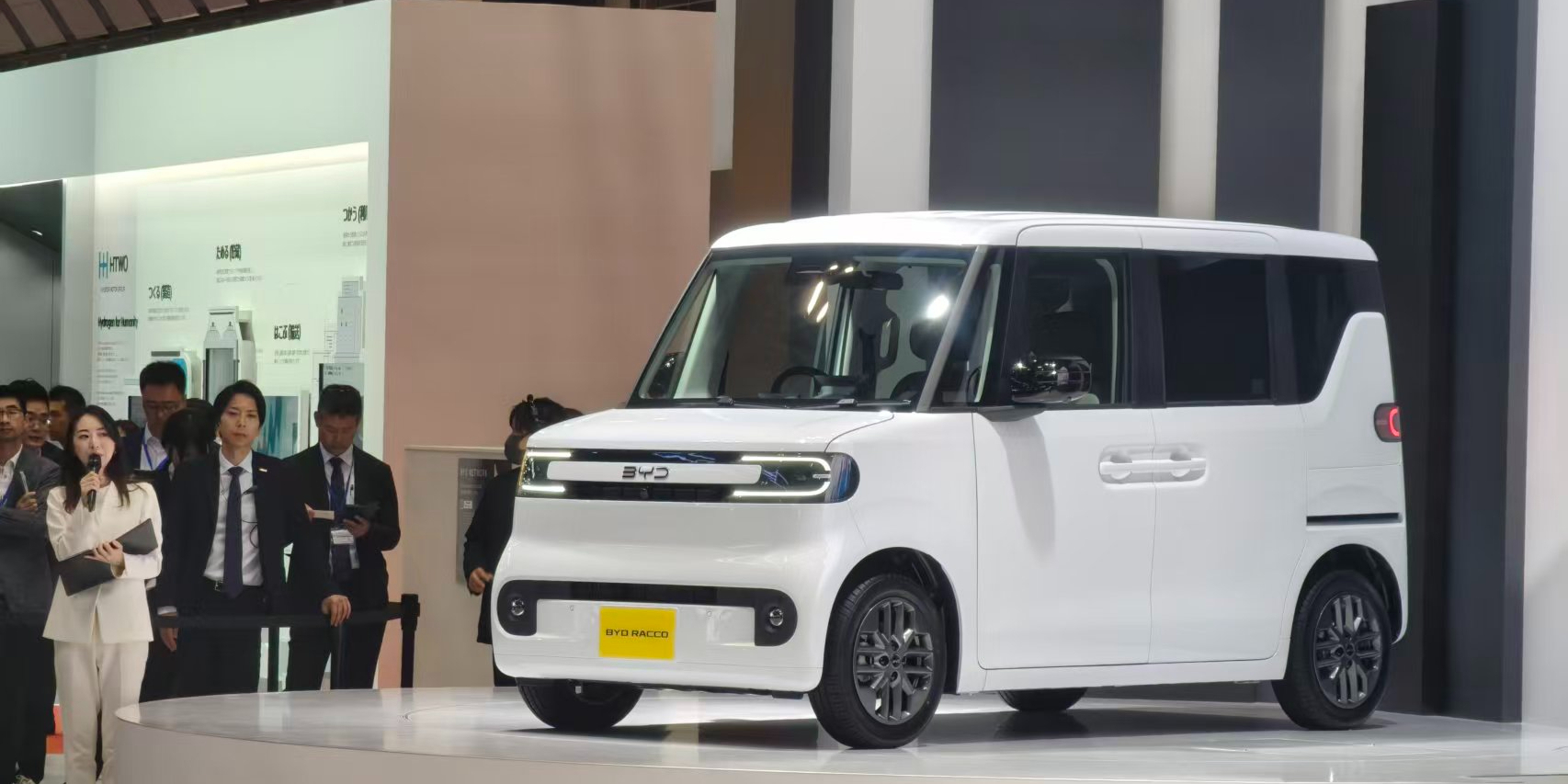
Core Viewpoint - The 2025 Japan Mobility Show highlights the contrasting approaches of Japanese automakers focusing on electrification and future mobility, while only BYD represents the advanced electrification level of Chinese automakers [2][3]. Group 1: Japanese Automakers' Initiatives - Japanese automakers showcased a diverse range of electric and future mobility products, including Toyota's Corolla concept car, Honda's "0 series" electric models, and Nissan's new LEAF [2]. - Other Japanese brands like Mazda, Subaru, Suzuki, and Mitsubishi also presented their electrification products, indicating a strong local commitment to electric mobility [2]. - The event reflects Japan's automotive industry contemplating and adjusting to the wave of electrification and automation, although the transformation is still in its early stages [3]. Group 2: BYD's Market Position - BYD has been in the Japanese market for over 20 years, initially focusing on battery and electronic businesses before introducing electric buses and commercial vehicles since 2015 [4]. - In the last three years, BYD has launched several passenger car models in Japan, including ATTO3, DOLPHIN, SEAL, and SEALION7 [5]. - BYD's sales in Japan have reached approximately 7,100 units, which is modest compared to its performance in other global markets, highlighting the challenges of penetrating the Japanese market [8]. Group 3: K-Car Strategy - BYD's introduction of the K-EV model, specifically designed for the Japanese market, aims to address local consumer preferences for K-Cars, which account for 35% to 40% of the market share [8][9]. - The K-EV offers a range of 180 kilometers and features like sliding doors, differentiating it from traditional small displacement fuel K-Cars [8]. - The success of BYD's K-Car in Japan will depend on the speed of changing consumer perceptions towards electric vehicles [9]. Group 4: Market Dynamics and Future Outlook - The Japanese automotive market is dominated by local brands, with over 90% market share, making it difficult for non-Japanese brands to compete [8]. - Despite the challenges, there is a growing acceptance of electric vehicles in Japan, with a 45.7% increase in registered imported electric vehicles from last year to the first half of this year [10]. - BYD plans to expand its product lineup in Japan, aiming to establish 7 to 8 models by 2027 and increase its sales points from 66 to 100 [7][10].

比亚迪(002594):2025Q3业绩环比提升,仍有一定压力
CMS· 2025-11-03 04:34
Investment Rating - The report maintains a strong buy recommendation for BYD [5] Core Views - BYD adheres to the development philosophy of "technology as king, innovation as fundamental," aiming to lead independent innovation of Chinese brands and reshape the global market landscape [1] - The company is expanding its global footprint, with plans to establish a CKD assembly plant in Malaysia by 2026 and has officially entered the Argentine market [2] - Despite a significant rebound in Q3 2025 performance, there remains pressure on profitability [10] Financial Data and Valuation - Total revenue for 2023 is projected at 602.315 billion, with a year-on-year growth of 42%, and expected to reach 969.358 billion by 2027 [4][14] - Operating profit for 2023 is estimated at 38.103 billion, with a projected decline in 2025 to 43.564 billion [4][11] - The net profit attributable to shareholders is expected to be 30.041 billion in 2023, with a forecasted decrease to 34.698 billion in 2025 [11][14] - The company’s total market capitalization is approximately 918.9 billion, with a current stock price of 100.79 yuan [5] Performance Metrics - The sales gross margin for Q3 2025 is reported at 17.61%, with a net profit margin of 4.20% [9] - The company plans to enhance collaboration across the supply chain to optimize management and create a win-win situation with suppliers and distributors [10] - The projected PE ratios for 2025, 2026, and 2027 are 26.5, 25.2, and 23.6 respectively [11][15]
BYD stock price has crashed as sales tumble: time to buy the dip?
Invezz· 2025-11-03 04:16
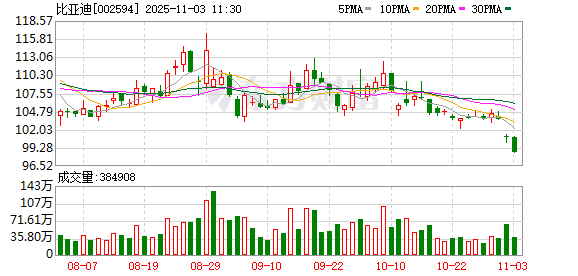
Core Viewpoint - BYD's stock price has experienced a significant decline, reaching its lowest level in over nine months due to weak delivery data, with a drop of 28% from its peak in May [1] Group 1: Stock Performance - The stock price fell to H$98.5, marking a notable decrease [1] - This decline represents a 28% drop from the highest point recorded in May of this year [1]
比亚迪:前10个月新能源汽车销量同比增长13.88%
Xin Jing Bao· 2025-11-03 04:01
Core Insights - BYD announced that its new energy vehicle sales reached 441,706 units in October 2025, with a cumulative total of 3,701,852 units for the year, representing a year-on-year growth of 13.88% [2] - The total installed capacity of new energy vehicle power batteries and energy storage batteries in October 2025 was approximately 27.362 GWh, with a cumulative total of about 230.613 GWh [2] - The total number of exported new energy vehicles in October 2025 was 83,904 units [2]
比亚迪10月销售汽车44.17万辆,去年同期为50.27万辆
Ju Chao Zi Xun· 2025-11-03 02:29
Core Insights - BYD's production in October 2025 reached 429,808 units, a decrease from 536,134 units in the same month last year, while cumulative production for the year reached 3,643,377 units, reflecting a year-on-year growth of 10.5% [3] - The total sales in October 2025 were 441,706 units, down from 502,657 units year-on-year, with cumulative sales of 3,701,852 units, marking a year-on-year increase of 13.88% [3] Passenger Vehicles - In October 2025, the production of passenger vehicles was 424,174 units, down from 534,003 units year-on-year, with cumulative production at 3,595,640 units, a year-on-year increase of 9.51% [3] - October sales for passenger vehicles were 436,856 units, compared to 500,526 units last year, with cumulative sales of 3,655,718 units, reflecting a year-on-year growth of 12.94% [3] Electric Vehicles - For pure electric passenger vehicles, October production was 219,382 units, up from 206,499 units year-on-year, with cumulative production at 1,797,558 units, showing a year-on-year increase of 30.32% [4] - October sales for pure electric vehicles reached 222,559 units, compared to 189,614 units last year, with cumulative sales of 1,828,462 units, indicating a year-on-year growth of 34.53% [4] Plug-in Hybrid Vehicles - Production of plug-in hybrid passenger vehicles in October was 204,792 units, down from 327,504 units year-on-year, with cumulative production at 1,798,082 units, reflecting a year-on-year decline of 5.57% [4] - October sales for plug-in hybrids were 214,297 units, compared to 310,912 units last year, with cumulative sales of 1,827,256 units, showing a slight year-on-year decrease of 2.69% [4] Commercial Vehicles - The commercial vehicle segment showed strong growth, with October production at 5,634 units, up from 2,131 units year-on-year, and cumulative production at 47,737 units, reflecting a year-on-year increase of 250.88% [4] - October sales for commercial vehicles were 4,850 units, compared to 2,131 units last year, with cumulative sales of 46,134 units, marking a year-on-year growth of 239.10% [4] Exports and Battery Installations - In October 2025, BYD exported a total of 83,904 new energy vehicles [5] - The total installed capacity of BYD's new energy vehicle power batteries and energy storage batteries reached approximately 27.362 GWh in October 2025, with a cumulative total of about 230.613 GWh for the year [5]
10月新能源车企销量普增,比亚迪、零跑等创新高
Cai Jing Wang· 2025-11-03 01:51
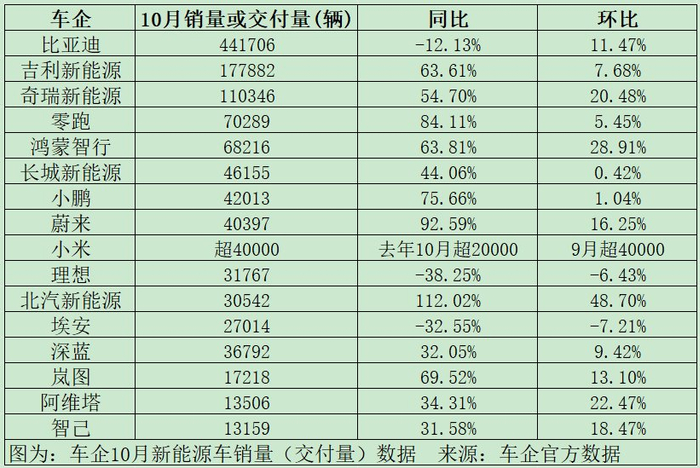
Core Insights - The overall delivery volume of new energy vehicle companies in October showed a month-on-month increase compared to September, with significant contributions from both traditional and new energy vehicle manufacturers [1] Group 1: Company Performance - BYD achieved a total sales volume of 441,706 units in October, marking an 11.47% increase month-on-month but a 12.13% decrease year-on-year [1] - Geely New Energy and Chery New Energy ranked second and third in sales, with year-on-year increases of 63.61% and 54.70%, respectively [1] - Leap Motor's monthly delivery volume reached a record high of 70,289 units, representing an 84.11% increase year-on-year [1] Group 2: State-Owned Enterprises - Among state-owned enterprises, Deep Blue, BAIC New Energy, and Lantu ranked highest in sales, with Lantu achieving nine consecutive months of growth since 2025 [1] - BAIC New Energy reported a remarkable year-on-year increase of 112.02% in sales, reaching 30,542 units in October [1] - Lantu's sales increased by 69.52% year-on-year, totaling 17,218 units [1] Group 3: Emerging Players - Companies like Xpeng and NIO also reported significant growth, with Xpeng achieving a year-on-year increase of 75.66% and NIO experiencing a decline of 38.25% [1] - The overall performance of new energy vehicle startups indicates a competitive landscape, with several companies breaking their previous monthly delivery records [1]


竞争大叠加高研发比亚迪步入业绩阵痛期
Xin Lang Cai Jing· 2025-11-03 00:07
Core Insights - BYD's Q3 2025 financial report shows a significant divergence in core data, with revenue declining for the first time since 2022 and net profit experiencing a substantial drop of 32.6% year-on-year [1] Revenue and Profit Performance - In Q3 2025, BYD reported a revenue of 194.985 billion yuan, a year-on-year decrease of 3.05%, marking its first quarterly revenue decline since 2022 [1] - The company's net profit for the same quarter was 7.823 billion yuan, reflecting a 32.6% year-on-year decline, continuing a trend of profit reduction over two consecutive quarters [1] - Despite a global sales increase of 18.64% year-on-year to 3.26 million units in the first three quarters, Q3 sales saw a decline of approximately 1.8%, primarily due to a 5.52% drop in September sales [1] R&D Investment and Financial Pressure - BYD's R&D expenses reached 43.75 billion yuan in the first three quarters, a 31.3% increase year-on-year, significantly exceeding its net profit [1] - The rising R&D expense ratio has negatively impacted short-term profits, with the cost per vehicle reaching 112,000 yuan in Q2, an increase of about 10,000 yuan from the previous quarter [1] - Experts suggest that high R&D investment is strategically necessary for long-term competitiveness in the transitioning automotive industry towards smart technology [1] Competitive Landscape and Market Strategy - The intensifying competition in the smart vehicle sector is a critical factor affecting BYD's performance, with competitors like Tesla and Huawei gaining market share [2] - To enhance user engagement, BYD is advised to create a smart ecosystem that integrates vehicle systems with mobile and home technologies, while also accelerating localized R&D for different markets [2] - The reduction of government subsidies for new energy vehicles and a previous surge in sales have led to a cooling of demand, impacting BYD's short-term sales outlook [2]