
Citi(C)

Search documents
花旗集团对潍柴动力的多头持仓比例降至5.35%
Xin Lang Cai Jing· 2026-02-02 09:15
Group 1 - The core point of the article is that Citigroup's long position in Weichai Power Co., Ltd. - H shares has decreased from 5.41% to 5.35% as of January 27, 2026 [1]


花旗集团对中兴通讯的多头持仓比例降至6.61%
Xin Lang Cai Jing· 2026-02-02 09:15
Group 1 - The core point of the article is that Citigroup's long position in ZTE Corporation's H-shares has decreased from 7.24% to 6.61% as of January 27, 2026 [1]

忘掉1月非农!年度就业或下修100万,美国就业正在被系统性高估
Hua Er Jie Jian Wen· 2026-02-02 08:40
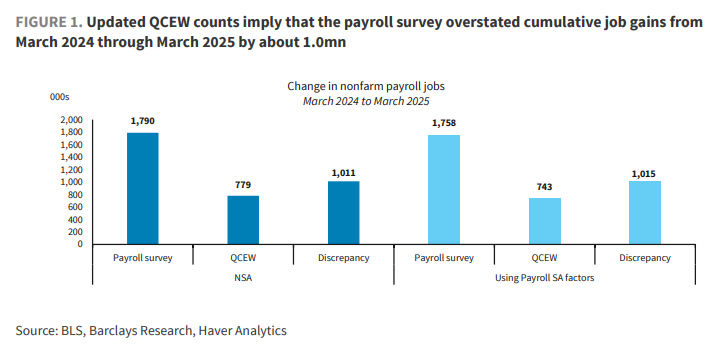
Core Viewpoint - There is a significant divergence in the January non-farm payroll (NFP) employment forecasts between Barclays and Citigroup, but both firms agree that the U.S. employment figures for 2025 are systematically overestimated, and the annual benchmark revision will reveal this discrepancy, indicating that the market is underpricing the risks of employment decline [1][5][20]. Group 1: Employment Predictions - Barclays predicts only 50,000 new jobs in January, with a similar increase in the private sector, while the unemployment rate is expected to slightly decrease to 4.3% [2]. - Citigroup, on the other hand, forecasts an increase of 135,000 jobs, with approximately 140,000 in the private sector, significantly above the market consensus of around 70,000, and maintains the unemployment rate at 4.4% [3]. Group 2: Data Quality Concerns - Both firms emphasize that the information content of the January employment data is low. Barclays notes that the employment data for Q4 2025 is significantly affected by government "delayed resignation plans," and short-term fluctuations do not represent trends [4]. - Citigroup points out that January is one of the most favorable months for seasonal adjustments, historically showing a pattern of "initial strength followed by a decline" [4]. Group 3: Systematic Overestimation of Employment - Despite differing views on January's data, both Barclays and Citigroup agree that the core issue lies in the overestimation of cumulative employment over the past year. Barclays cites QCEW data, indicating a discrepancy of nearly 1 million jobs between the non-farm survey and QCEW data from March 2024 to March 2025 [6][7]. - This suggests that the official non-farm payroll figures have systematically overestimated job growth by an average of 80,000 to 90,000 jobs per month [7]. Group 4: Market Mispricing of Employment Risks - The market is currently focused on whether the January NFP will "beat/miss" expectations and if the unemployment rate will hold at 4.5%, while neglecting critical signals indicating employment market pressures [12][13]. - Key indicators include a declining JOLTS hiring rate around 3.2%, worsening consumer sentiment regarding job availability, and significant distortions in employment data for the latter half of 2025 [17]. Group 5: Implications of Employment Revisions - A downward revision of employment figures by 700,000 to 1 million will alter the historical narrative, indicating that the past year's growth was not as robust as reported [18]. - This will necessitate a reevaluation of frameworks for wages, consumption, and GDP, and may challenge the perceived "employment safety net" by the Federal Reserve [18][19]. - The current labor demand intensity corresponding to the unemployment rate will be reassessed, suggesting that the employment market is closer to a "turning point" than the market anticipates [19].


花旗预计2月澳门赌收205亿澳门元 同比增长4%
Xin Lang Cai Jing· 2026-02-02 03:38
Group 1 - The core viewpoint of the report is that Macau's gaming revenue is projected to reach 22.633 billion MOP in January 2026, representing a year-on-year increase of 24%, and is expected to be approximately 91% of the revenue level in January 2019, exceeding market predictions by about 5% [1] - For February, the forecasted gaming revenue is 20.5 billion MOP, reflecting a year-on-year growth of 4%, with an average daily revenue of approximately 732 million MOP [1] - The report notes that February will experience seasonal weakness due to the Lunar New Year, with the off-peak season likely lasting from February 3 to February 18 [1] Group 2 - After adjusting for the differences in the Lunar New Year period, the combined gaming revenue for January and February is predicted to be 43.1 billion MOP, which indicates a year-on-year increase of 13.5% [1]
黄金估值已达极端水平!下半年避险情绪消退将成最大利空
Hua Er Jie Jian Wen· 2026-02-02 03:25
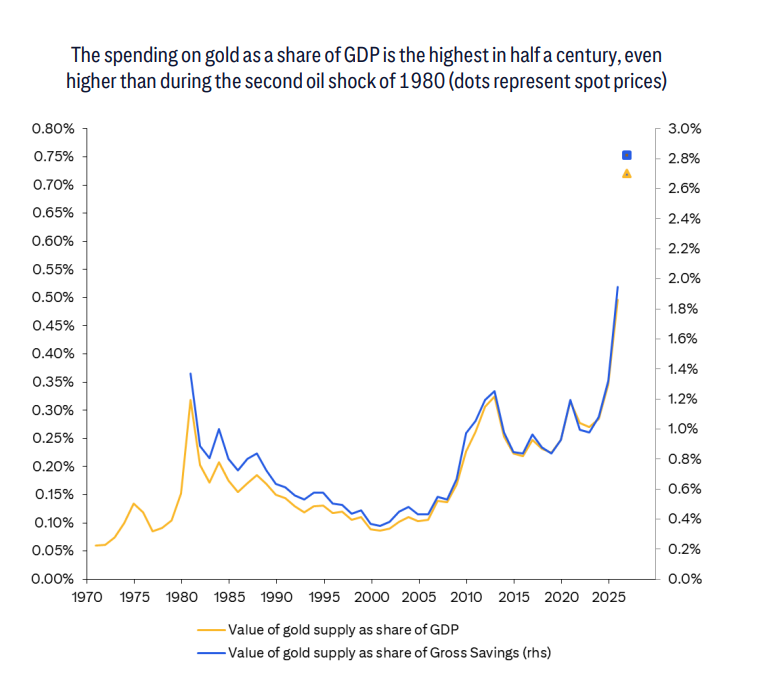
Core Viewpoint - The current valuation of gold is facing severe reassessment due to tightening global liquidity and declines in Bitcoin and commodities, with Citigroup's research indicating that gold prices have significantly overextended future uncertainties [1] Group 1: Valuation Concerns - Citigroup's report highlights that the annual expenditure on gold as a percentage of global GDP has surged to 0.7%, the highest level in 55 years, surpassing the peak during the 1980 oil crisis [2] - The current gold price is detached from the marginal production costs of the mining industry, with high-cost gold miners experiencing profit margins at a 50-year high [4] - If the allocation of gold returns to historical norms of GDP percentage (0.35%-0.4%), gold prices could plummet to between $2500 and $3000 per ounce, despite a baseline target of $4600 for 2026 [5] Group 2: Future Outlook - In the short term (0-3 months), Citigroup maintains a bullish outlook for gold prices, projecting a target of $5400-$5600 per ounce due to ongoing geopolitical and economic risks [6] - For the second half of 2026, Citigroup expresses caution, predicting that the factors supporting high gold prices will diminish, including a potential resolution to the Russia-Ukraine conflict and a cooling of tensions in Iran [8] - The expectation of a "Goldilocks" economy in the U.S. during the mid-term elections in 2026 could reduce the demand for gold as a hedge, alongside anticipated independence from political pressures for the Federal Reserve [8]
香港经济_2025 年四季度 GDP_复苏态势巩固-Hong_Kong_Economics_4Q25_GDP_Solidifying_Recovery
2026-02-02 02:42
Summary of Hong Kong Economic Conference Call Industry Overview - **Industry**: Hong Kong Economy - **Key Focus**: Economic recovery and GDP growth forecasts Core Insights and Arguments 1. **GDP Growth**: Hong Kong's economy showed a solid recovery in 4Q25 with a GDP growth of 3.8%, surpassing expectations driven by a surge in investments and improved consumption [1][3] 2. **Investment Surge**: Gross Fixed Capital Formation (GFCF) rose by 10.6% year-over-year, contributing significantly to the economic recovery [3] 3. **Consumption Improvement**: Consumption sentiment improved, supported by rising gold prices and equity market performance, with private consumption growing by 2.5% in 4Q25 [8] 4. **Net Trade Impact**: Net trade negatively impacted GDP growth due to higher imports outpacing exports, although service exports remained resilient [4][5] 5. **2026 GDP Forecast**: The real GDP forecast for 2026 has been raised to 3.2%, reflecting a more entrenched recovery across key sectors, including financial services and retail [1][5] 6. **Budget Support**: The upcoming FY2026/27 budget is expected to provide targeted support for lagging sectors, particularly SMEs and mass retailers, which are facing challenges [6][7] 7. **Weak Spots**: Identified weak spots include difficulties for SMEs in adapting to new trading behaviors, challenges for mass retailers due to competition, and risks associated with commercial real estate non-performing loans [7] Additional Important Content 1. **Fiscal Surplus**: The fiscal operating surplus for the first nine months of FY2025/26 was HK$43.9 billion, attributed to higher stamp duty revenues from equity transactions [6] 2. **Sectoral Outlook**: Positive outlooks for mass residential property prices and the Hang Seng Index, projected to reach 28,800 by mid-2026 and 30,000 by the end of 2026 [5] 3. **Consumer Behavior**: The report highlights the need for structural adjustments in sectors struggling with consumer behavior changes and digital transformation [7] This summary encapsulates the key points discussed in the conference call regarding the economic outlook for Hong Kong, emphasizing growth drivers, challenges, and future forecasts.
花旗警告铜市出现行情背离
Wen Hua Cai Jing· 2026-01-31 01:00
Core Viewpoint - Citi warns that risks in the commodity market are rising, with a notable disconnect between copper prices and physical demand despite recent price increases [1] Group 1: Copper Market - Citi's metal research head, Tom Mulqueen, indicates that copper prices may rise to $15,000-$16,000 per ton in the coming weeks, driven by inflows from precious metals and a weaker dollar [1] - Copper prices recently surpassed Citi's short-term target of $14,000, reaching $14,400 on the London Metal Exchange (LME) before experiencing a significant decline [1] - Mulqueen expresses a lack of confidence in the short-term copper price outlook, citing increased selling outside of China and weak physical market fundamentals as indicators of a likely price correction [1] - Citi forecasts an average copper price of $13,000 per ton for 2026 [1] Group 2: Energy Market - Maximilian Layton, global head of commodity research, states that oil prices remain sensitive to tensions in the Middle East, particularly around Iran [1] - The U.S. may take actions to weaken Iran's missile and nuclear capabilities, but the market anticipates that both sides will avoid a full-scale conflict [1]
花旗:经济和地缘政治风险将回落,为黄金市场降温
Jin Rong Jie· 2026-01-30 17:53
Group 1 - Citigroup predicts that by the second half of 2026, both economic and geopolitical risks will decrease from their currently high levels, which will cool down the gold market [1]
Citigroup India said to hire Khurana to head commercial banking
BusinessLine· 2026-01-30 08:25
Core Viewpoint - Citigroup Inc.'s India unit is enhancing its commercial banking operations by appointing Ankur Khurana as the head, aiming to capitalize on the growth of mid-sized companies in India [1][2]. Group 1: Appointment and Background - Ankur Khurana has over two decades of banking experience and previously worked at Standard Chartered Plc as co-head of coverage for India and South Asia [2]. - The position of head of commercial banking became available after the departure of veteran banker Bhanu Vohra in July [2]. Group 2: Market Context - Dealmaking activity in India is increasing, particularly in equity capital markets and mergers and acquisitions, indicating a robust market environment [3]. - The mid-market segment presents numerous opportunities as Indian companies expand operations and pursue acquisitions internationally [3].
Citigroup taps Ankur Khurana to lead India commercial banking business: Report
The Economic Times· 2026-01-30 07:11
Core Viewpoint - Citigroup has appointed Ankur Khurana as the head of commercial banking in India, aiming to enhance its focus on the rapidly growing mid-market corporate segment in the country [2]. Group 1: Appointment Details - Ankur Khurana joins Citigroup after working at Standard Chartered Plc, where she was co-head of coverage for India and South Asia [1][2]. - The position became available following the departure of Bhanu Vohra, a long-serving banker at Citi, who left in July to join BDO's Indian arm [2]. Group 2: Experience and Background - Khurana brings over 20 years of experience in corporate and commercial banking [2]. - She had been in discussions with multiple financial institutions after her exit from Standard Chartered [1].
