
Citi(C)

Search documents
Citi CFO Mark Mason has the CEO qualities for his next chapter, says former American Express chief
Yahoo Finance· 2025-11-25 12:31
Group 1 - Citigroup CFO Mark Mason will step down in early March 2026, transitioning to the role of executive vice chair and senior executive advisor to CEO Jane Fraser [1][2] - Gonzalo Luchetti, head of U.S. personal banking, will succeed Mason as CFO, with Mason expressing confidence in Luchetti and the team's ability to advance Citi's momentum [2][3] - Mason's long-term ambition is to become a CEO, reflecting a trend where CFOs are increasingly moving into CEO roles, with 7.5% of sitting CEOs in 2023 having previously served as CFOs [3][5] Group 2 - Citi will combine parts of its U.S. retail banking business with its wealth management operation, and Morningstar raised its fair value estimate for Citi to $90 per share from $82 due to a more optimistic outlook for net interest income growth [4] - Kenneth Chenault, a former CEO, highlighted Mason's qualifications as a potential CEO, noting his operational capabilities and strategic leadership during critical periods in Citi's history [6][7]

Citi CFO Mark Mason has CEO qualities, says ex-American Express chief
Fortune· 2025-11-25 12:31
Core Viewpoint - Citigroup CFO Mark Mason will step down in early March 2026, transitioning to an executive vice chair role, while Gonzalo Luchetti will succeed him as CFO, indicating a significant leadership change within the bank [1][2]. Leadership Transition - Mark Mason has been with Citigroup since 2001 and became CFO in 2019. He will take on the role of executive vice chair and senior executive advisor to CEO Jane Fraser after stepping down as CFO [2]. - Gonzalo Luchetti, currently the head of U.S. personal banking, will replace Mason as CFO [2]. Future Aspirations - Mason aims to pursue CEO opportunities outside of Citigroup by the end of 2026, reflecting his long-term ambition to lead a company [3][5]. - He expressed that the timing of this transition is beneficial for both his personal growth and the evolution of Citigroup's team [3]. Strategic Developments - The announcement coincides with Citigroup's plan to merge parts of its U.S. retail banking with its wealth management operations, which is expected to enhance net interest income growth [4]. - Morningstar raised its fair value estimate for Citigroup to $90 per share from $82, indicating a more optimistic outlook for the bank [4]. CFO to CEO Trends - The trend of CFOs moving into CEO roles is increasing, with 7.5% of sitting CEOs in the first half of the year coming from CFO positions, up from 6.5% in 2015 [5]. - Mason's career trajectory positions him well for a future CEO role, as noted by industry experts [5][6]. Leadership Qualities - Kenneth Chenault, a former CEO, highlighted that Mason possesses qualities that make him a strong candidate for a CEO position, including strategic ability and stakeholder trust [6][7]. - Mason's leadership during critical periods in Citigroup's history, such as the post-crisis restructuring, showcases his capability beyond traditional CFO responsibilities [7][9]. Career Background - Mason's career at Citigroup includes key roles in various complex businesses, emphasizing a consistent theme of breaking down silos and making decisions with a unified perspective [9]. - His experience spans significant events, including the 2009 joint venture between Citi's Smith Barney and Morgan Stanley [8].


华尔街开始布局下一轮AI投资热潮! 花旗押注最强主线将是EDA软件
智通财经网· 2025-11-25 07:40
Core Viewpoint - Citi Group has initiated coverage on two leading EDA giants, Synopsys (SNPS.US) and Cadence Design Systems (CDNS.US), with a "Buy" rating, predicting they will be key players in the upcoming AI investment wave [1][7] Group 1: Market Performance and Ratings - Both Synopsys and Cadence have underperformed in the past six months, with Synopsys down approximately 22% and Cadence down 5%, lagging behind the Philadelphia Semiconductor Index and the S&P 500 [2] - Citi has set a 12-month target price of $580 for Synopsys and $385 for Cadence, reflecting optimism about their recovery [7] - The EDA software market is dominated by Synopsys and Cadence, which together hold about 70% market share, with expected sustainable revenue growth of 15% to 20% [7][8] Group 2: AI and EDA Software Demand - The demand for EDA software is increasing due to the growing need for complex AI chip designs, driven by major tech companies like NVIDIA, AMD, and cloud giants [3][4] - EDA software is essential for chip design, and its role is becoming more critical as AI infrastructure demands exponential growth in computing power [3][4] - Both companies have integrated AI tools into their EDA software ecosystems, enhancing design efficiency and productivity [5][4] Group 3: Financial Resilience and Future Outlook - EDA software has shown strong fundamental resilience, consistently outperforming the semiconductor industry during downturns [8] - The share of EDA in overall chip industry R&D budgets is expected to rise from 13%-15% as AI tools enhance productivity [8] - Citi analysts favor Synopsys over Cadence due to its current valuation discount and potential for margin improvement [8]


Trafigura staff raised nickel concerns years before fraud claim
BusinessLine· 2025-11-25 04:34
Core Insights - Trafigura Group faced significant financial losses, approximately $600 million, due to questionable nickel-financing deals with firms run by Prateek Gupta, which have been described as resembling a Ponzi scheme [1][4] - Concerns regarding the relationship with Gupta were raised as early as September 2020, indicating that senior management was aware of potential risks long before the eventual collapse of the trading arrangement [2][3][5] Group 1: Financial Impact and Allegations - The trading house revealed in early 2023 that it had been defrauded, discovering that over $500 million worth of metal it purchased contained no nickel but rather stainless steel, aluminum, and worthless iron briquettes [4] - By 2021, the business dealings with Gupta had escalated to nearly 70,000 tons, equating to $1.2 billion in annual trading, despite earlier warnings from the trade finance department [5] - Gupta's firms engaged in "transit financing," where cargoes were sold and then bought back at a premium, raising questions about the legitimacy of the transactions [6] Group 2: Internal Concerns and Management Awareness - Emails from Trafigura's trade finance desk highlighted alarm over the business strategy with Gupta, noting long voyage times, high interest costs, and irregular sales, which led to concerns from major banks like Credit Suisse and Deutsche Bank about processing payments to Gupta's companies [8] - Senior figures within Trafigura, including the co-heads of metals, expressed disapproval of the dealings with Gupta, indicating a mixed reception among the company's leadership [9]

X @Bloomberg
Bloomberg· 2025-11-24 23:12
Citigroup’s India unit has more than doubled its asset-backed securities book to nearly $1 billion in the last two years, ahead of schedule for a goal it set for itself in February https://t.co/moUU1Nlp8y ...
Citi Wealth Chief: Equity Bull Market Has Room to Run
Wealth Management· 2025-11-24 20:02
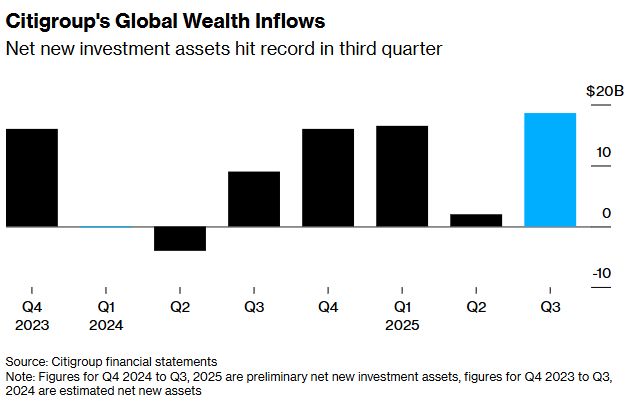
Core Viewpoint - Citigroup's wealth chief believes the equity bull market has potential for further growth, indicating that wealthy clients are still showing interest without excessive exuberance [1] Market Performance - The S&P 500 has declined approximately 2% in November, marking its worst month since March, amid increased volatility and a selloff in major technology companies [2] - Despite the downturn, Citigroup does not anticipate a market turning point, as earnings expectations remain robust [3] Wealth Management Strategy - Citigroup's wealth unit has shifted focus from a lending-heavy model to investment management, with client investment assets increasing by about 14% year-over-year in Q3 [4] - New inflows into the wealth unit reached $37.1 billion in the first nine months of the year, with a record inflow in Q3 [4] Regional Performance - Asia has shown particularly strong performance, with record inflows in Q3, leading to increased bonuses for private bankers in the region [5] - The bank's growth in Asia is primarily driven by clients from China, with significant contributions from non-resident Indians in markets like Singapore and Dubai [8] Organizational Changes - Citigroup is undergoing a significant revamp under CEO Jane Fraser, including job cuts and a focus on improving returns [6] - The bank plans to integrate its retail banking operations with its wealth management business, creating a unified group [7] Leadership and Culture - The wealth chief has faced challenges, including an investigation into workplace conduct, but maintains that the findings do not reflect his leadership style [10]
Citi Wealth Head Sees Upside to Bull Market on Record Inflows
Yahoo Finance· 2025-11-24 20:02
Core Viewpoint - Citigroup's wealth chief believes the equity bull market has potential for further growth, as the bank is experiencing record inflows from wealthy clients this year [1][4]. Group 1: Market Sentiment - There is no exuberance in the market, and investor behavior does not reflect the late stages of a bull market, where excessive capital is thrown at stocks [2]. - The S&P 500 has declined approximately 2% in November, indicating it may face its worst month since March, with increased volatility and a selloff in major technology companies [3]. Group 2: Client Behavior and Inflows - Wealthy clients are maintaining cash reserves and are looking to enter the market with downside protection through structured products [4]. - Citigroup's wealth unit has shifted focus from a lending-heavy model to investment management, with client investment assets increasing by about 14% year-over-year in Q3 [6]. Group 3: Performance and Strategy - New inflows into Citigroup's wealth unit reached $37.1 billion in the first nine months of the year, with a record inflow in Q3 [6]. - Asia has shown particularly strong performance, with record inflows in Q3, leading to increased bonuses for private bankers in the region [7]. Group 4: Organizational Changes - Citigroup is undergoing a significant revamp under CEO Jane Fraser, which includes job cuts and a strategic shift to improve its market position [8]. - The bank remains the only major financial institution trading below book value, indicating a perception of being undervalued by investors [8].
C's CFO Transition & U.S. Banking Revamp: A Move Toward Future Growth?
ZACKS· 2025-11-24 15:11
Core Insights - Citigroup, Inc. will transition its CFO role from Mark Mason to Gonzalo Luchetti in early March 2026, with Mason becoming executive vice chair and senior executive adviser to CEO Jane Fraser [1][10] - The leadership change is part of a strategic reset aimed at redefining Citigroup's long-term growth strategy and enhancing profitability [5] Leadership Transition - Mark Mason has been with Citigroup since 2001 and became CFO in 2019, initiating the transition to ensure a smooth handover for future growth [2] - Gonzalo Luchetti has a strong track record as head of U.S. Personal Banking, achieving 12 consecutive quarters of positive operating leverage and more than doubling the return on tangible common equity year to date [3] Business Reorganization - Citigroup will integrate its Retail Banking division into its Wealth business, creating a unified U.S. team to streamline operations and enhance customer experience [4] - U.S. Consumer Cards will be elevated as one of the company's five core businesses, reinforcing its position in a profitable segment [4] Financial Performance - Citigroup's shares have increased by 44.1% year to date, outperforming the industry growth of 27.1% [8] - The company trades at a forward price-to-earnings (P/E) ratio of 10.13X, below the industry average of 13.93X [14] Earnings Estimates - The Zacks Consensus Estimate for Citigroup's earnings implies a year-over-year rise of 27.6% for 2025 and 31.2% for 2026, with upward revisions in estimates over the past 30 days [15]

花旗财富主管:创纪录资金涌入!美股牛市仍有上行空间
Xin Lang Cai Jing· 2025-11-24 08:45
Group 1 - Citi's wealth management head, Andy Sieg, believes that the U.S. stock market still has "some upside" due to record inflows from wealthy clients, indicating that the market is not experiencing a euphoric phase typical of a bull market's end [1] - The S&P 500 index fell approximately 2% in November, potentially marking its worst month since March, amid increased market volatility and declining stock prices of major global tech companies [1] - Despite the market fluctuations, Citi maintains that strong earnings expectations suggest no "turning point" has been reached, with wealthy clients still holding cash on the sidelines and focusing on structured products for market entry [1] Group 2 - In the third quarter, Citi's wealth management division saw a 14% year-over-year increase in client investment assets, with new inflows reaching $37.1 billion in the first nine months of the year, including a record inflow in the third quarter [1] - Sieg emphasized that the net client fund inflow in Asia is the strongest globally, leading to anticipated increases in bonuses for private bankers in the region [4] - Citi's wealth management department is undergoing significant reforms under CEO Jane Fraser, including a reduction of 20,000 jobs, as the bank aims to improve its performance and address its valuation concerns [4] Group 3 - The bank has exited certain consumer banking markets in Asia, raising questions about potential further withdrawals, but Sieg affirmed the company's commitment to its wealth management business in Asia [5] - The integration of retail banking into wealth management is underway, with Kate Lufft appointed to lead the new combined department, reporting to Sieg [5] - Sieg noted a strong business growth driven by clients from China in major wealth centers like Hong Kong and Singapore, while also observing a lack of plans for expansion in the Indian market [5] Group 4 - Sieg expressed satisfaction with the bank's operations in China, highlighting a newfound "vitality" in economic development since the pandemic [5] - Despite facing challenges, including allegations of intimidating colleagues leading to an external investigation, Sieg defended his leadership style and the culture of the wealth management business [6]
花旗财管:市场尚未出现转折点 美股牛市仍有空间
Zhi Tong Cai Jing· 2025-11-24 06:39
Core Viewpoint - The U.S. stock market bull run still has room to grow, with no signs of excessive optimism or irrational exuberance among investors [1] Group 1: Market Sentiment - There is a strong earnings outlook, indicating that the market has not reached a turning point [1] - Wealthy clients are holding idle cash and focusing on structured products to maintain downside protection when entering the market [1] Group 2: Business Focus - The company is fully committed to its Citigold business in Asia, targeting clients with approximately $200,000 in assets, and has no plans to sell this business [1] Group 3: Growth Drivers - Clients from China are driving growth in the company's major Asian wealth centers, Hong Kong and Singapore [1] - The vitality of China's economic development observed during recent visits to Beijing and Shanghai is unprecedented compared to the pre-COVID era [1]