JP MORGAN CHASE(JPM)

Search documents
Gold and Silver Outlook for 2026: Why Hard Assets May Beat Stocks
FX Empire· 2025-12-31 14:59
Core Viewpoint - A significant divergence is emerging between financial assets and hard assets, with precious metals showing stronger conviction in future expectations compared to equities [3][4]. Precious Metals - Both gold and silver are trading near record highs, with gold testing $4,600 and silver touching $84, indicating a strong bullish sentiment in the precious metals market [2][5]. - Major institutions like JPMorgan and Bank of America have raised gold price targets to the $5,000 to $6,000 range over the next two years, driven by factors such as central bank diversification and currency debasement [4][8]. - Silver's market dynamics are particularly favorable due to persistent supply deficits and rising industrial demand, leading analysts to revise price forecasts upward [5]. Equities - The S&P 500 is projected to have a narrower margin for error, with targets clustering between 7,100 and 8,000, which implies limited upside that relies heavily on strong earnings growth and stable inflation [6]. - Current equity valuations are elevated, suggesting that even minor disappointments could negatively impact returns [6]. Future Outlook - Looking ahead to 2026, equities require near-perfect execution to achieve targets, while precious metals only need existing structural trends to continue [7]. - The consensus among analysts for gold prices is between $5,000 and $6,000, representing a potential upside of 10% to 30% from current levels [9].



Retail investors close out one of their best years ever. How they beat Wall Street at their own game
CNBC· 2025-12-31 11:35
Core Viewpoint - Retail investors have demonstrated significant growth and sophistication in their trading strategies, achieving strong returns in 2025 by effectively buying the dip during market downturns, challenging previous perceptions of their investing capabilities [2][3][12]. Retail Investor Performance - Retail investors capitalized on market dips, with 2025 being the second-best year for dip-buying since the early 1990s, according to Bespoke Investment Group [3]. - Individual traders purchased over $3 billion in equities on April 3, 2025, during a market decline, showcasing their willingness to invest amid volatility [7]. - Retail investors' portfolios outperformed institutional baskets tied to artificial intelligence and software, indicating a higher profit-to-loss ratio [5]. Shift in Investment Focus - From May 2025 onward, retail investors shifted their focus from single stocks to exchange-traded funds (ETFs), particularly the SPDR Gold Shares (GLD), which saw inflows surpassing the last five years combined [4]. - The gold-focused ETF experienced a record surge of over 65% in 2025, reflecting the growing interest in commodities amid market fluctuations [4]. Market Sentiment and Strategy - Retail investors have been more accurate in their market reactions compared to institutional investors, particularly during emotionally driven trades [9]. - The "TACO trade" strategy, which encourages buying stocks during market downturns caused by policy decisions, has gained traction among retail investors [10]. Evolution of Retail Investors - The participation of retail investors surged in 2025, with flows increasing over 50% from the previous year, reaching levels not seen since the meme stock craze of early 2021 [13]. - More than one-third of 25-year-olds moved significant sums to investment accounts since turning 22, indicating a growing trend of younger investors entering the market [12]. Changing Perceptions - The narrative surrounding retail investors has shifted from being viewed as "dumb money" to being recognized for their increasing sophistication and ability to make informed investment decisions [14][15]. - Retail investors are now seen as central to market dynamics, with their strategies aligning more closely with those of institutional investors [18].

Wall Street's most stressful hiring ritual may be about to restart
Yahoo Finance· 2025-12-30 18:58
Core Insights - Private equity firms are expected to resume their on-cycle recruiting practices soon, following a temporary halt due to Jamie Dimon's warnings to junior bankers [2][8] - The on-cycle recruiting process, which typically involves rapid interviews for positions starting two years later, has been delayed but is anticipated to kick off early in 2026 [3][4] - The shift in recruiting timelines has been influenced by the pandemic, with firms previously starting the process in January, now looking to resume earlier practices [7][8] Group 1: On-Cycle Recruiting Dynamics - Jamie Dimon, CEO of JPMorgan Chase, initiated a moratorium on on-cycle recruiting for the 2027 class, leading many top private equity firms to pause their hiring efforts [2][4] - Firms like Apollo, General Atlantic, and TPG have committed to not recruiting for the 2027 class until at least 2026, with some banks threatening to fire employees who accept future-dated offers [2][4] - As the new year approaches, there are indications that the on-cycle recruiting process will begin shortly after January 1, 2026, as firms prepare to engage with a new class of investment banking analysts [3][4][8] Group 2: Industry Perspectives - Recruiters and industry experts express optimism about the upcoming recruiting cycle, noting that many investment funds are eager to interview analysts with relevant training and deal experience [4][5] - The competitive nature of becoming a private equity analyst typically starts with a demanding investment banking career, where on-cycle recruiting requires immediate availability for interviews [6] - Historical data indicates that the recruiting timeline has shifted earlier since the pandemic, with firms now looking to resume practices that were common nearly a decade ago [7]
2026年全球另类投资展望报告:公私融合新纪元(第八版)(英文版)-摩根大通
Sou Hu Cai Jing· 2025-12-30 18:26
Core Insights - The global alternative investment landscape is evolving towards a "public-private convergence" era by 2026, characterized by the expansion of private markets, diversification of asset classes, and structural opportunities driven by technology and macro trends [1][9][12]. Private Market Growth - The private market asset size is nearing USD 20 trillion, with private credit growing from USD 250 billion in 2007 to USD 2.5 trillion today, highlighting its significance in the global financial system [1][11]. - Private credit is projected to reach USD 3.5 trillion by 2029, with deepening integration between public and private credit markets [3]. Real Estate Trends - A durable recovery in global commercial real estate (CRE) is anticipated for 2026, with equity yields expected to surpass debt yields, driven by lower interest rates and economic expansion [43][54]. - High-quality assets are predicted to outperform across all sectors, while the office sector is experiencing uneven recovery, with prime locations showing low vacancy rates and strong rental growth [43][44]. Infrastructure Investment - Infrastructure investment is at a structural growth inflection point, driven by energy demand, security, and transition factors, with capital expenditures expected to exceed depreciation for the first time [1][11]. - Energy utility companies are positioned to benefit from existing generation and transmission assets, combining defensive characteristics with growth potential [1]. Transportation Assets - Transportation assets are benefiting from a USD 3.5 trillion asset replacement cycle and evolving trade patterns, with strong demand for modern, efficient transport assets across maritime, aviation, and rail sectors [2]. Timberland and Hedge Funds - Timberland assets are gaining attention for their inflation resistance and stable cash flows, supported by improving housing affordability and the development of carbon credit markets [2]. - Hedge funds are entering a "renaissance period" for alpha generation, capitalizing on increased market volatility and the integration of AI into investment processes [2][34]. Private Equity Dynamics - The private equity market is returning to normalization, with improved fundraising environments and active transaction levels, particularly in the small and mid-market segments [2][34]. - AI and healthcare are emerging as core innovation sectors, with private markets becoming central to value creation [2][34].

中航畅宏:外资持续看好中国资产:盈利接棒估值,科技仍是主线
Sou Hu Cai Jing· 2025-12-30 14:05
Core Viewpoint - Major foreign financial institutions have expressed a positive outlook for China's stock market, driven by accelerating corporate earnings growth, macro policy coordination, and the appreciation of the RMB [1][3]. Group 1: Market Outlook - Foreign institutions believe that the driving force behind the rise of China's stock market is shifting from "valuation correction" in 2025 to "earnings growth" in 2026 [3][4]. - Goldman Sachs predicts a 38% increase in the Chinese stock market by the end of 2027, primarily driven by a 14% and 12% increase in corporate earnings in 2026 and 2027, respectively [4][5]. - UBS has set a target of 7100 points for the Hang Seng Tech Index and 100 points for the MSCI China Index by the end of 2026, indicating significant upside potential [5]. Group 2: Investment Trends - There has been a net inflow of $83.1 billion into Chinese assets through ETFs since the beginning of 2025, with the technology sector receiving the most inflow at $9.5 billion [10][11]. - Active foreign capital is expected to return more rapidly, with some foreign institutions increasing their positions in the Chinese stock market in preparation for 2026 [12][13]. - The investment opportunities are highly structured, with a focus on technology innovation, green energy transition, and high-quality brands benefiting from consumer recovery [7][9]. Group 3: Sector-Specific Insights - The technology sector is highlighted as having the greatest profit growth potential, with revenue less affected by trade policies [7]. - Traditional sectors are also attracting foreign interest, with improvements in state-owned enterprise earnings and dividend increases drawing long-term capital [8]. - Under the "anti-involution" framework, sectors like cement, solar energy, and chemicals are expected to receive policy support and have attractive valuations [9].



JPMorgan Chase Is Getting New Strategic Leadership, Courtesy of Berkshire Hathaway
Yahoo Finance· 2025-12-30 11:05
Executive Changes at Berkshire Hathaway - Warren Buffett will step down as CEO of Berkshire Hathaway in 2026, with Greg Abel set to take over the role [1] - Todd Combs, a prominent executive at Berkshire, is leaving to join JPMorgan Chase in a high-level position [2] Todd Combs' New Role at JPMorgan Chase - Combs will play a significant role in JPMorgan Chase's newly launched Security and Resiliency Initiative (SRI), which aims to invest $1.5 trillion over 10 years in enterprises critical to national interests [3][4] - The SRI plans to make $10 billion in direct equity and venture capital investments in U.S.-based companies that support infrastructure modernization, supply chain fortification, and growth policies [4] Focus Areas of the Security and Resiliency Initiative - The SRI will target four key economic segments: supply chain and advanced manufacturing (especially in healthcare), defense/aerospace, energy, and strategic technology [5] - Combs will lead the strategic investment group within the SRI, focusing on mid- and large-sized businesses in these sectors [5] Combs' Background and Experience - Combs has prior experience with JPMorgan Chase, having served on its board from September 2016 until his recent appointment [6] - He also has managerial experience as the CEO of Berkshire's insurance subsidiary GEICO from 2020 to 2025 [6]
【首席观察】2025年预测错了多少?2026年资本风口在哪里?
经济观察报· 2025-12-30 09:55
Core Viewpoint - The market is not afraid but transforms fear into pricing, which is crucial for investors to grasp the "capital wind" of 2026 [2][3] Group 1: Market Performance in 2025 - The year 2025 exhibited a significant disconnect between predictions and reality, with silver leading gains at 173.13%, followed by gold at 73.91% and copper at 32.92% [5] - Major indices like the S&P 500 and the Hang Seng Index saw increases of 17.26% and 28.61% respectively, while light crude oil dropped by 19.63% [5][6] - The S&P 500 index, despite conservative forecasts, achieved a year-to-date increase of over 17%, nearing historical highs [6] Group 2: Key Variables Influencing the Market - Five key variables explain the market dynamics of 2025: 1. The repricing of dollar credit and institutional risk premiums due to uncertainties in fiscal sustainability and central bank independence [10] 2. The rise of real assets' "non-sovereign premium," with gold reaching $4500 per ounce as a response to geopolitical and fiscal uncertainties [10] 3. The collision of demand and supply pricing in energy markets, reflecting concerns over inflation expectations [11] 4. Global liquidity mechanisms affecting financing costs and volatility, leading to a dual structure in market transactions [11] 5. The concentration of growth narratives around AI, with capital increasingly focused on profitability and productivity verification [11][12] Group 3: Outlook for 2026 - The asset pricing logic for 2026 shifts from "explaining the world" to "pricing the discount rate," emphasizing the importance of financial conditions and narrative realization [15] - The focus will be on "infrastructure 2.0," where the emphasis is on building sustainable computing power rather than merely acquiring GPUs [15][16] - Key factors determining the transition from thematic trading to trend markets include financial conditions, visibility of returns, supply-side engineering, and regulatory certainty [16] Group 4: Investment Strategies and Risks - The potential for gold to reflect "institutional premiums" remains, but the impact of the dollar and real interest rates may lead to sharper corrections [17] - The outlook for oil prices suggests prolonged low levels with potential spikes, while the yield curve may split between short-term central bank paths and long-term fiscal pressures [17] - The volatility of assets will be influenced by the overall market structure rather than directional trading, as investors adapt to frequent but manageable events [17]

无人看空!华尔街一致押注牛市之际风险暗藏
Jin Shi Shu Ju· 2025-12-30 03:05
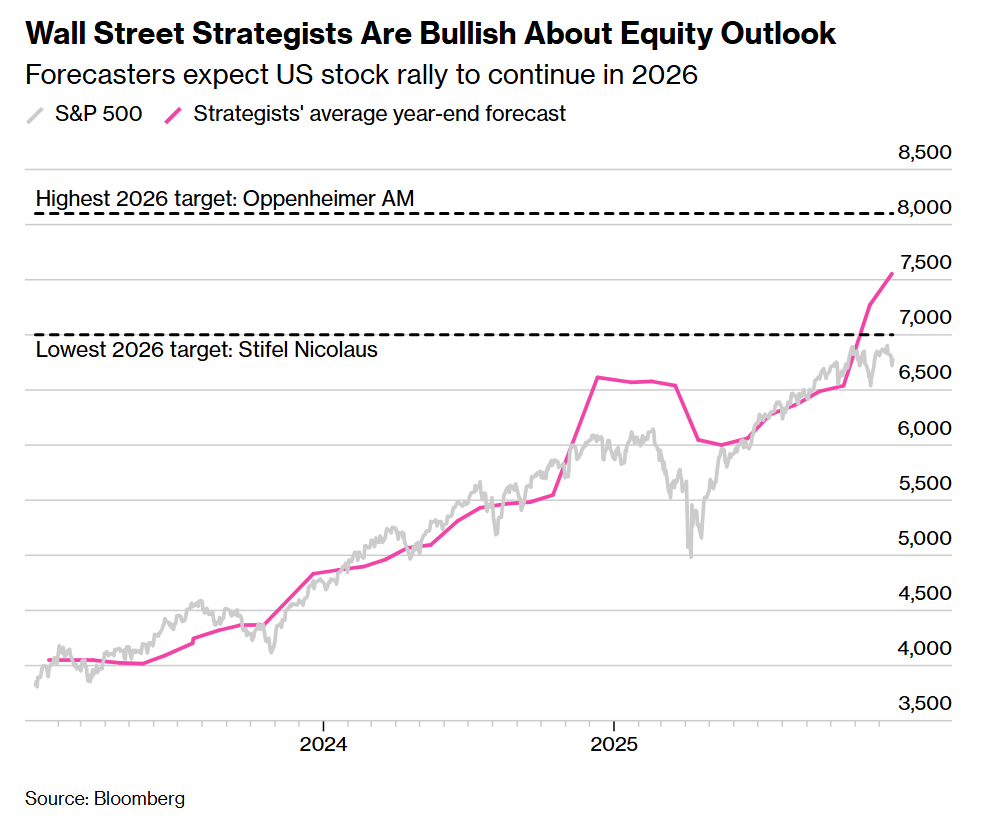
Core Viewpoint - A consensus among major banks and investment institutions suggests that the U.S. stock market will achieve its fourth consecutive year of gains by 2026, marking the longest streak in nearly two decades [2]. Group 1: Market Performance and Predictions - Since hitting a low in October 2022, the S&P 500 index has risen approximately 90%, despite ongoing concerns about potential risks such as an AI bubble, economic trends, and political instability under President Trump [2]. - Analysts predict an average year-end target for the S&P 500 in 2026 that implies a further increase of 9%, with no forecasters expecting a decline [2]. - Ed Yardeni, a senior market strategist, forecasts the S&P 500 to reach 7,700 points next year, an 11% increase from recent closing prices, but expresses concern over the prevailing optimism [5]. Group 2: Market Sentiment and Volatility - The optimistic sentiment among Wall Street analysts has been reinforced following a tumultuous 2025, where the S&P 500 index fell nearly 20% before experiencing a rapid rebound [5]. - Analysts have noted that the market's resilience is surprising, especially given the challenges posed by AI sector dynamics and trade wars initiated by Trump [8]. - Morgan Stanley's analysts shifted from a bearish to a bullish outlook, now predicting the S&P 500 to rise to 7,500 points, supported by economic growth, cooling inflation, and the belief that AI stock gains reflect a genuine economic transformation [9]. Group 3: Economic Indicators and Risks - The U.S. economy has shown remarkable resilience, with significant investments in AI and technology driving stock prices, contributing to nearly half of the S&P 500's gains this year [8]. - Analysts emphasize the importance of not underestimating the U.S. stock market's resilience, supported by strong corporate earnings growth and a stable macroeconomic environment [13]. - Some analysts, like Savita Subramanian from Bank of America, caution against over-optimism, suggesting that the S&P 500 could reach 7,100 points in 2026, with potential declines of 20% in a recession scenario [12].
Hideout in the Financial Sector as We Round out 2025?
ZACKS· 2025-12-30 02:21
Core Insights - The financial sector is positioned as a leading investment opportunity as the stock market approaches all-time highs, influenced by policy uncertainty, tariffs, and inflation pressures that maintain higher interest rates for an extended period [1][2] Financial Sector Performance - Big banks have significantly outperformed the broader indexes, with Citigroup achieving a year-to-date return of +68% and JPMorgan at +35% [3] - The Zacks Finance Market has a year-to-date performance of +18%, slightly trailing the S&P 500 and Nasdaq [4] Dividends and Valuations - The average annual dividend yield in the Zacks Finance Market is 2%, compared to 1% for the S&P 500, making finance stocks attractive for dividend-seeking investors [5] - The finance market's forward P/E multiple is 19X, which is lower than the tech sector's inflated valuations and below the benchmark's 26X [9] Industry Rankings - The Securities and Exchanges Industry is currently the top-rated industry within the Zacks Finance Market, ranking in the top 10% of over 240 Zacks industries [11] - Stocks in the Securities and Exchanges Industry, such as Nasdaq and S&P Global, are benefiting from positive EPS revisions and hold a Zacks Rank 2 (Buy) [12] Overall Sector Outlook - The Zacks Finance Market is rated as the second-best sector out of 16, with the Computer and Technology Market being the only sector with higher-rated sub-industries, making finance a preferred choice for investors seeking value and dividends [13]



彭博:无人看空!华尔街一致预期2026美股继续涨,资深策略师对共识感到担忧
美股IPO· 2025-12-29 23:26
Core Viewpoint - The article highlights a significant shift in market sentiment, with no strategists predicting a downturn for the S&P 500 index in 2026, projecting an average increase of 9%, marking the longest consecutive annual gains in nearly two decades [1][2][5]. Group 1: Market Sentiment and Predictions - A Bloomberg survey indicates that all 21 surveyed strategists are optimistic about the S&P 500 index, predicting it will rise to 7500 points by 2026, following a nearly 90% rebound since October 2022 [2][5]. - The consensus among Wall Street strategists suggests that if this optimistic outlook materializes, it would lead to the longest annual increase since the global financial crisis [2][5]. - Morgan Stanley's analysts have shifted from a previously bearish stance to a bullish outlook, now forecasting a rise to 7500 points, driven by strong corporate earnings and low interest rates [8][6]. Group 2: Risks and Cautions - Despite the overall optimism, some strategists express concerns about potential risks, including high valuations, Federal Reserve policies, and trade tariffs [1][6][14]. - Ed Yardeni, a seasoned strategist, warns that the lack of dissenting opinions among analysts could be a cause for concern, suggesting that extreme optimism may not be justified [6][14]. - CIBC Capital Markets' Christopher Harvey, while maintaining a bullish outlook with a target of 7450 points, cautions that macroeconomic risks could disrupt market stability [14][15].