Lilly(LLY)

Search documents
Should You Buy, Sell or Hold Lilly Stock Ahead of Q2 Earnings?
ZACKS· 2025-08-04 13:40
Core Viewpoint - Eli Lilly and Company (LLY) is set to report its second-quarter earnings on August 7, with sales and earnings estimates at $14.75 billion and $5.61 per share respectively. Earnings estimates for 2025 have increased slightly from $21.92 to $22.05 per share over the past month [1][6]. Group 1: Earnings Performance - LLY has had a mixed earnings surprise history, exceeding expectations in two of the last four quarters and missing in the other two, with an average surprise of 6.69% [3]. - The last reported quarter saw a negative earnings surprise of 5.11% [3][4]. Group 2: Factors Influencing Upcoming Results - The anticipated growth in LLY's second-quarter results is expected to be driven by strong demand for its GLP-1 drugs, particularly diabetes drug Mounjaro and weight loss medicine Zepbound [6][7]. - Sales of Mounjaro and Zepbound are projected at $4.58 billion and $3.1 billion respectively, with LLY's own estimates slightly lower at $4.46 billion and $3.09 billion [9]. - Increased demand for other key drugs like Emgality, Jardiance, Olumiant, Taltz, and Verzenio is also expected to support top-line growth, despite pricing pressures and competitive dynamics [10][12]. Group 3: Competitive Landscape and Market Dynamics - LLY faces significant competition in the GLP-1 market, particularly from Novo Nordisk's semaglutide products, which could impact Mounjaro and Zepbound's market share [25][26]. - The company is diversifying its pipeline beyond GLP-1 drugs, with recent acquisitions aimed at expanding into cardiovascular, oncology, and neuroscience areas [23][24]. Group 4: Stock Performance and Valuation - LLY's stock has decreased by 0.9% year-to-date, compared to a 3.3% decline in the industry [15]. - Despite a premium valuation, the company is recommended for retention due to its robust growth prospects and position as a leading drugmaker [27].



X @Bloomberg
Bloomberg· 2025-08-04 11:32
Company Performance - Eli Lilly was nearly a $1 trillion company [1] - The company is now facing missed targets [1] Market Dynamics & Risks - The company is facing tariff threats [1] - The company is facing investor doubts [1]
This Biotech Stock Could Soar on Upcoming Clinical Data
The Motley Fool· 2025-08-04 11:15
Core Viewpoint - Viking Therapeutics is currently undervalued at a market cap of $3.7 billion, presenting a compelling investment opportunity in the weight loss drug sector, particularly as the company approaches critical clinical data releases for its oral VK2735 candidate [2][3][5]. Company Overview - Viking Therapeutics is focused on developing a dual GLP-1/GIP mechanism for weight loss, which has shown promising results in previous trials, including a 14.7% body weight reduction over 13 weeks with 88% of patients achieving at least 10% weight loss [6][10]. - The company is expected to report Phase 2 data for VK2735 in the second half of 2025, with September being the most likely timeframe [5]. Competitive Landscape - The obesity drug market is evolving, with competitors like Pfizer and Roche facing setbacks, creating an opportunity for Viking to capitalize on its differentiated approach [9][10]. - The market for obesity drugs is projected to reach $100 billion in annual sales by 2030, yet few companies have successfully developed oral alternatives, which could enhance Viking's strategic positioning [11]. Value Creation Pathways - Viking offers multiple avenues for value creation, including potential strategic partnerships or acquisition interest from major pharmaceutical companies facing patent cliffs [12][13]. - The company could also explore independent commercialization through innovative partnership models, such as subscription-based treatment platforms [14]. Market Dynamics - The competitive landscape has created a scarcity of advanced oral GLP-1 assets, making Viking's differentiated platform particularly attractive to potential acquirers, including Novo Nordisk [15][11]. - Viking's clean intellectual property position and manageable valuation further enhance its appeal as a target for companies looking to fill gaps in their obesity drug portfolios [13]. Upcoming Catalysts - The upcoming readout of VK2735 oral data is critical, as success could lead to various value creation scenarios, including strategic acquisitions or licensing partnerships [20][21]. - The dual-pathway approach of Viking addresses validated market needs, positioning the company favorably in a landscape with limited competition [19].


8月4日早餐 | 全球股市走弱;AI应用催化不断
Xuan Gu Bao· 2025-08-04 00:12
Market Overview - US stock market experienced significant declines last Friday, with the Dow Jones falling by 1.23%, Nasdaq down by 2.24%, and S&P 500 decreasing by 1.6% [1] - Major tech stocks also saw losses, including Amazon down 8.27%, Meta Platforms down 3.03%, Apple down 2.50%, Nvidia down 2.33%, Tesla down 1.83%, Microsoft down 1.76%, and Google A down 1.44% [1] Employment Data - In July, the US non-farm payroll added only 73,000 jobs, significantly below expectations, with previous two months' data revised down by 258,000 [2] - The unemployment rate rose to 4.2% [2] AI Developments - Sam Altman announced that OpenAI's valuation has reached $300 billion, with plans to release numerous products in the coming months [2] - Anthropic has blocked OpenAI's API access ahead of the GPT-5 release [2] - Google released its IMO 2025 gold medal model, Gemini 2.5 Deep Think, potentially competing with GPT-5 [3] Clinical Trials - Elon Musk's brain-machine interface company is set to launch clinical trials for brain chips in the UK, aimed at helping paralyzed patients control devices with their thoughts [4] Military Contracts - The US Army is simplifying its collaboration model with Palantir, potentially leading to a contract worth $10 billion [5] Pharmaceutical Research - Eli Lilly announced long-term results from its TRAILBLAZER-ALZ 2 Phase III clinical study, confirming the long-term value of early intervention in Alzheimer's disease [6] Oil Production - OPEC+ has agreed to significantly increase oil production, raising daily output by 548,000 barrels in September [7] A-Share Market Strategy - Analysts suggest that the recent short-term index adjustments are not concerning, maintaining a "slow bull market" trend [9] - The market is supported by three core logic points: bottom-line thinking in macro and capital market policies, the emergence of new growth drivers, and the influx of incremental capital [9] - Concerns about the impact of US stock market adjustments on A-shares are mitigated by historical data indicating that A-shares are less affected during the early stages of a bull market [9] AI Coding Tools - Barclays reported that the AI website building tool Lovable achieved $100 million in annual recurring revenue within eight months, surpassing other well-known AI tools [11] - Lovable's platform allows users to input ideas in a chat interface, with AI generating backend code and completing integrations, termed "vibe coding" [11] Regulatory Developments - The National Development and Reform Commission of China is taking measures to address "involution" competition among private enterprises [12] - The People's Bank of China is establishing a macro-prudential and financial stability committee and promoting the digital yuan [12] Company Announcements - China Shenhua is considering issuing shares and cash to acquire assets from the State Energy Group, involving 13 company equities, leading to a stock suspension [16] - Jichuang Vision is planning a change in control, resulting in stock suspension [17] - Sanan Optoelectronics intends to acquire 100% of Lumileds Holding B.V. for $239 million to enhance its product line and profitability [18]


下周大事提醒
Ge Long Hui A P P· 2025-08-03 15:33
Group 1 - The United States will implement "reciprocal tariffs" starting August 7, which may impact trade dynamics [1] - Key financial reports are expected from companies such as AMD, Micron Technology, Novo Nordisk, and Eli Lilly [1] - The 2025 World Robot Expo will open in Beijing, highlighting advancements in robotics [1] Group 2 - On August 4, the Eurozone's Sentix Investor Confidence Index and the U.S. factory orders for June will be released [2] - On August 5, China will publish the July S&P Global China PMI, and the U.S. will release the July ISM Non-Manufacturing Index [2] - On August 6, financial results from AMD, McDonald's, and Novo Nordisk will be disclosed [2] - On August 7, the U.S. will begin implementing "reciprocal tariffs," and the Bank of England will announce its policy interest rate [2] - On August 8, the U.S. is requesting a resolution between Russia and Ukraine by August 8 [2] - On August 9, China will release July CPI and PPI data [2]




美股市场速览:市场突发回撤,大盘价值刚性较优
Guoxin Securities· 2025-08-03 07:04
Investment Rating - The report maintains a "Weaker than Market" rating for the U.S. stock market [1] Core Insights - The U.S. stock market experienced a sudden pullback influenced by non-farm employment data, with the S&P 500 declining by 2.4% and the Nasdaq by 2.2% [3] - Among sectors, large-cap value stocks outperformed large-cap growth and small-cap stocks, indicating a preference for stability in turbulent market conditions [3] - The report highlights that three sectors saw gains while 21 sectors faced declines, with utilities, food and staples retailing, and media and entertainment being the only sectors to rise [3] Summary by Sections Price Trends - The S&P 500 fell by 2.4% and the Nasdaq by 2.2% this week, with large-cap value stocks declining by 1.8% compared to a 3.1% drop in large-cap growth stocks [3] - Utilities (+1.6%), food and staples retailing (+0.9%), and media and entertainment (+0.2%) were the only sectors to increase, while transportation (-5.9%), materials (-5.1%), and retail (-4.8%) faced the largest declines [3] Fund Flows - The estimated fund flow for S&P 500 constituents was -$16.95 billion this week, a significant increase from the previous week's -$2.2 billion [4] - Media and entertainment (+$1.59 billion), utilities (+$0.27 billion), and food and staples retailing (+$0.042 billion) saw inflows, while healthcare equipment and services (-$3.47 billion) and financials (-$4.15 billion) experienced the largest outflows [4] Earnings Forecast - The report indicates a 0.6% upward adjustment in the 12-month EPS forecast for S&P 500 constituents, with 18 sectors seeing an increase and 5 sectors experiencing downgrades [5] - Retail (+3.3%), media and entertainment (+2.0%), and technology hardware (+1.5%) led the upward revisions, while healthcare equipment and services faced a significant downgrade of -3.6% [5]




特朗普逼跨国药企砍价:哪些中国企业获益?
Hu Xiu· 2025-08-03 05:34
Core Viewpoint - The article discusses the significant price disparity of prescription drugs in the U.S. compared to other developed countries, leading to new policies aimed at price control and the potential impact on multinational pharmaceutical companies and emerging markets [1][2]. Group 1: U.S. Drug Pricing Policies - U.S. prescription drug prices are 2-3 times higher than those in other developed countries, with some innovative drugs priced at 10 times higher than in China [1] - New policies require pharmaceutical companies to provide "most favored nation pricing" to U.S. Medicare, sign contracts for price locking, renegotiate overseas prices to "repatriate profits," and promote direct sales for price transparency [1][2] - The Pharmaceutical Research and Manufacturers of America (PhRMA) criticized these policies, claiming they would undermine U.S. innovation [1][2] Group 2: Multinational Pharmaceutical Companies' Strategies - Companies like Johnson & Johnson, Pfizer, and Merck are adopting multi-faceted strategies to balance profits and compliance, including adjusting global pricing strategies [3] - Some companies are lowering prices in the U.S. while increasing prices in other markets to maintain profit margins, with AstraZeneca already announcing price reductions for certain drugs in the U.S. [3][4] - To offset profit losses, companies may raise prices in emerging markets like China, where the annual treatment cost for PD-1 drugs is approximately 1.16 million yuan, ten times higher than in China [4] Group 3: Cost Optimization Strategies - Cost reduction is a core objective, leveraging China's low-cost advantages, where biopharmaceutical R&D costs are 1/5 to 1/10 of those in the U.S. [5] - Pfizer has signed over $1 billion in CDMO orders with Chinese companies to transfer some biopharmaceutical production to China, reducing production costs by 30% [5][6] - Companies are also transferring non-core technologies to China to avoid tariffs and lower costs, such as Pfizer's collaboration with Chinese firms to establish PD-1 production bases [6][7] Group 4: Legal and Policy Maneuvering - Industry associations and pharmaceutical companies are using legal and political avenues to resist new policies, with PhRMA planning to appeal to the WTO regarding the "most favored nation pricing" requirement [10] - They are lobbying Congress, arguing that foreign price controls could reduce U.S. R&D investment by $10 billion annually [10] Group 5: Opportunities and Challenges for Chinese Companies - Chinese companies are positioned to benefit from accelerated domestic substitution, with local biosimilars gaining price advantages [11] - CDMO businesses are expanding, with WuXi Biologics reporting a 144% year-on-year increase in CDMO revenue in the first half of 2025 [12] - Chinese pharmaceutical companies are also achieving breakthroughs in international markets through licensing agreements, with total upfront payments reaching $2.329 billion in the first half of 2025 [13] Group 6: Beneficiary Companies - Companies in the biosimilar sector, such as Innovent Biologics and Antengene, are expected to gain market share as multinational firms raise prices in China [16] - WuXi Biologics is recognized as a leading global CDMO, while other companies like Eastone and Hengrui are also expanding their CDMO projects [17] - Chinese firms that have established production facilities in India and Southeast Asia, like Huahai Pharmaceutical, are likely to benefit from reduced reliance on the U.S. market [19]


深度|丹麦百年制药巨头首次由外籍高管掌舵!他能改变司美格鲁肽的命运吗
Di Yi Cai Jing Zi Xun· 2025-08-03 03:44
发明了胰岛素的丹麦百年制药巨头诺和诺德,近年来因明星减重药司美格鲁肽的走红一度成为欧洲市值 最高的公司。但今年以来,该公司在资本市场上的"司美格鲁肽光环"褪色。上周,诺和诺德在宣布了新 CEO的任命后,公司一周股价暴跌三分之一,市值蒸发超过千亿美元。 "市场的恐慌主要由于对新任命高管的失望,加之公司下调了业绩预期,未来的发展前景不明朗。"一位 生物医药投资人对第一财经记者表示。 他是一位挑战者 在诺和诺德102年的历史上,这家胰岛素巨头只更换过5名CEO,而且全部是丹麦人。今年5月,诺和诺 德意外宣布Lars Fruergaard Jørgensen将不再担任CEO,并称将物色新人选。 Jørgensen曾一手主导了司美格鲁肽在全球的上市。在他的带领下,诺和诺德于去年6月创下接近7000亿 美元的市值新高。但由于过去一年以来,减重药全球市场环境的迅速变化,司美格鲁肽在美国市场面临 复杂的挑战,导致该公司股价从去年6月的高位已下跌超过三分之二。在这一背景下,诺和诺德做出更 替CEO的艰难决定,以安抚资本市场。 当地时间7月29日,诺和诺德公布了备受市场关注的CEO任命——一位从公司内部成长起来并不断受到 提拔的 ...

60天!特朗普挥“降价大棒”:辉瑞、诺和诺德等17家药企被下“最后通牒”
Hua Xia Shi Bao· 2025-08-03 00:25
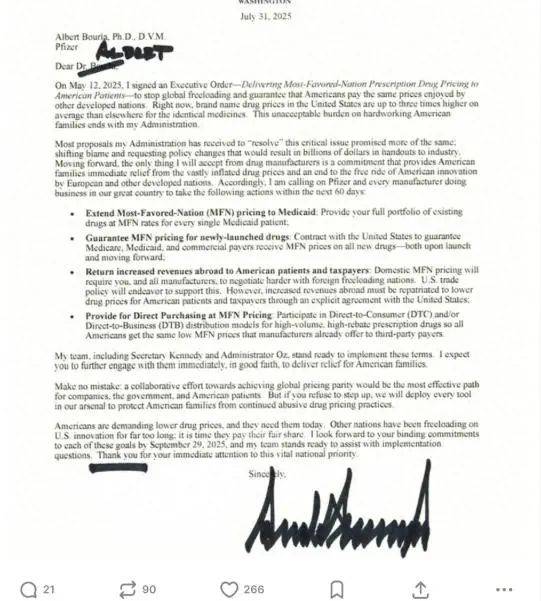
Group 1 - Trump issued a "last ultimatum" to 17 major pharmaceutical companies, demanding written commitments for price reductions within 60 days, or the government would take necessary actions to protect American families from high drug prices [1][2] - Pharmaceutical companies responded cautiously, with Pfizer emphasizing its patient assistance programs but not committing to broad price cuts, while Merck avoided discussing price reductions for established drugs [2][3] - The average price of prescription drugs in the U.S. is approximately 2.56 times higher than in other OECD countries, with some innovative drugs being up to 10 times more expensive [5] Group 2 - The U.S. pharmaceutical market is characterized by high drug prices, with median launch prices increasing from $2,115 in 2008 to $180,007 in 2021, a nearly 90-fold increase [4] - The complexity of the reimbursement system, including the roles of Pharmacy Benefit Managers (PBMs) and insurance companies, is cited as a significant factor driving up patient costs [5][6] - Trump's actions reflect ongoing tensions in the U.S. healthcare system, where the balance between incentivizing pharmaceutical innovation and ensuring patient access remains a critical challenge [6][7] Group 3 - The potential for a "drug price reduction wave" could significantly impact large multinational pharmaceutical companies, altering the pricing logic for innovative drugs and those under patent protection [3][8] - The pharmaceutical industry faces immense political and public pressure, which may lead to limited price reductions for specific drugs, but systemic reforms are necessary for lasting change [6][9] - A 10% decrease in drug prices could result in a 17% reduction in R&D spending by companies, indicating that price control measures may negatively affect future drug development [9][10]


特朗普态度大转弯!计划将司美格鲁肽等减重药纳入医保与医疗补助计划
GLP1减重宝典· 2025-08-02 08:33
Core Insights - The Trump administration is preparing a pilot program to allow Medicare and Medicaid to cover the costs of weight-loss drugs, specifically GLP-1 medications, to address the growing obesity crisis in the U.S. [2][5] - This initiative represents a significant policy shift, as it will enable the use of GLP-1 drugs for weight management without requiring the presence of obesity-related diseases [5][9] - If successful, the pilot program could pave the way for permanent inclusion of these medications in public healthcare systems [9] Group 1: Policy Changes - The pilot program is set to begin in April 2026 for Medicaid and January 2027 for Medicare, marking a notable change from earlier government positions that did not support coverage for weight-loss drugs [7] - The program will evaluate the effectiveness, economic burden, and long-term impacts of GLP-1 medications within the healthcare system [9] Group 2: Market Implications - Leading companies in the GLP-1 market, such as Novo Nordisk and Eli Lilly, are expected to benefit significantly from this policy change, with projections indicating that the sector could generate over $150 billion in global revenue by 2030 [7][9] - The high annual cost of GLP-1 medications, estimated between $5,000 to $7,000, has raised concerns about financial sustainability, especially as demand increases [5][9] Group 3: Public Health Context - The U.S. has the highest obesity rate among developed countries, with approximately 42% of adults classified as obese, prompting calls for expanded medical interventions to improve overall health and reduce preventable diseases [9] - Public health experts advocate for the integration of medical treatments like GLP-1 drugs to enhance obesity management strategies [9]