Nissan Motor(NSANY)

Search documents
日产出售总部大楼
日经中文网· 2025-11-07 08:00
Core Viewpoint - Nissan is facing significant financial challenges, reporting a loss of 670.8 billion yen for the fiscal year 2024, marking its first loss in three fiscal years, primarily due to poor sales in the U.S. market [4] Group 1: Financial Performance - Nissan's final loss for the fiscal year 2024 is 670.8 billion yen, a stark contrast to a profit of 426.6 billion yen in the previous fiscal year [4] - The company anticipates a further loss of 275 billion yen for the fiscal year 2025, following a profit of 69.7 billion yen in the prior year [4] Group 2: Asset Sale - Nissan announced the sale of its headquarters building in Yokohama for 97 billion yen, which will contribute 73.9 billion yen to its consolidated financial statements for the fiscal year ending March 2026 [4] - The buyer is a special purpose company (SPC) MJI, formed by KKR and Mizuho Real Estate Investment Advisory, primarily funded by Taiwanese auto parts manufacturer Minth Group [3] Group 3: Operational Strategy - The sale is part of Nissan's strategy to improve its financial structure and accelerate operational restructuring amid ongoing challenges [4] - Nissan has signed a "sale and leaseback" agreement, allowing it to continue using the facility for 20 years post-sale [4]


Nissan CEO: Nexperia chip restrictions are hitting production
Youtube· 2025-11-07 07:38
Core Insights - The company is on track to achieve its cost reduction targets, having reduced fixed costs by over 80 billion yen in the first half of the year and aiming for a total of 150 billion yen by the end of the fiscal year [1] - The company has generated over 4,500 cost reduction ideas, leading to a visibility of around 200 billion yen, up from 75 billion yen in May and 150 billion yen in July [2] - The company faces supply constraints, particularly with Nexperia chips and aluminum supply in the US, prompting a placeholder provision of 25 billion yen to absorb potential impacts [6][7] Cost Reduction Efforts - Fixed cost reductions are progressing well, with a target of 250 billion yen for the next fiscal year [1] - The variable cost reduction initiatives have shown consistent growth, indicating effective management and innovation within the company [2] Supply Chain Challenges - The company is currently navigating supply chain issues due to geopolitical tensions and specific supplier constraints, which could impact production [4][5] - The situation regarding chip supply is fluid, and the company is closely monitoring developments to adjust production as necessary [7] Geopolitical Implications - The company benefits from a global footprint, allowing it to maintain flexibility in response to geopolitical challenges affecting the automotive sector [9][10] - Ongoing restructuring efforts are aimed at preserving this flexibility, which is crucial for stability in a rapidly changing environment [10]

日产进出口(广州)有限公司成立 外资车企首次在华设立合资整车进出口公司
Zhong Guo Zhi Liang Xin Wen Wang· 2025-11-07 07:15
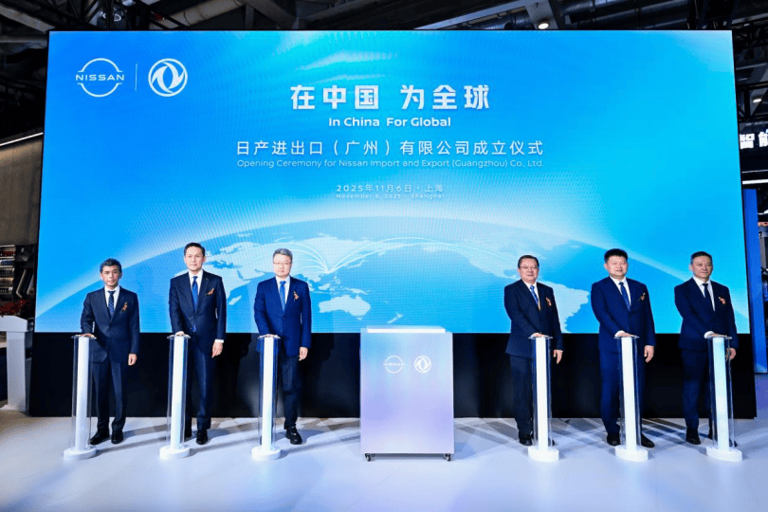
Core Insights - Nissan announced the establishment of Nissan Import and Export (Guangzhou) Co., Ltd., marking the first joint venture for a foreign automotive company in China to engage in complete vehicle import and export [1][3] Group 1: Company Formation - The newly established joint venture has a registered capital of 1 billion yuan, with Nissan China Investment Co. contributing 600 million yuan and Dongfeng Motor Group contributing 400 million yuan [3] - The joint venture aims to enhance business development through deep cooperation between Nissan and Dongfeng [3] Group 2: Strategic Importance - This joint venture is a key project in Nissan's "In China, For China, To the World" strategy, facilitating a closed-loop operation of research and development, production, and export [3] - The establishment of the joint venture will integrate the supply chain advantages of the Chinese market with a global sales network, creating a complete value chain of "local R&D - local production - global sales" [3] Group 3: Market Focus - The first batch of export models will be adapted to meet the regulatory standards and consumer preferences of different overseas markets, targeting regions such as Southeast Asia and the Middle East [3] - This strategic shift reflects Nissan's recognition of China's innovative capabilities and signifies a deeper focus of its global business towards Chinese manufacturing [3]
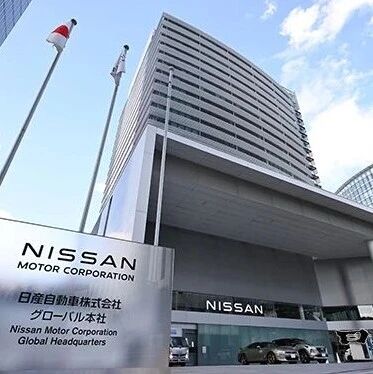
半年亏损2219亿日元 日产计划45亿元卖掉全球总部大楼 敏实集团接手
Xin Lang Cai Jing· 2025-11-07 05:46
Core Points - Nissan has agreed to sell its global headquarters building in Yokohama for 97 billion yen (approximately 4.5 billion yuan) to a consortium supported by the automotive parts manufacturer Minth Group, which is listed in Hong Kong [1] - The headquarters building, located near Yokohama Station, was moved from Tokyo in 2009 and includes office space as well as a showroom for Nissan vehicles [1] - Nissan reported a net loss of 221.92 billion yen for the first half of the fiscal year 2025 (April to September), compared to a profit of 19.22 billion yen in the same period last year [1]
日产总部大楼卖了,事儿还没完
Zhong Guo Qi Che Bao Wang· 2025-11-07 05:25
Core Viewpoint - Nissan has reported significant financial losses while finalizing the sale of its global headquarters building in Yokohama for 97 billion yen (approximately 4.5 billion RMB) to a consortium led by China's Minth Group and US private equity firm KKR [2][3] Financial Performance - For the first half of the 2025 fiscal year (April-September 2024), Nissan's revenue was 5,578.7 billion yen, a year-on-year decline of 6.8% [3] - The company reported an operating loss of 27.7 billion yen, compared to an operating profit of 32.9 billion yen in the same period last year [3] - Net loss reached 221.9 billion yen, contrasting with a net profit of 19.2 billion yen in the previous year [3] - The report indicated that U.S. tariffs reduced operating profit by 149.7 billion yen (approximately 6.9 billion RMB) [3] Sales and Market Performance - Global sales for the first half of 2025 were 1.48 million units, down 7.3% year-on-year [5] - Sales in major markets such as China, Japan, and Europe declined, with only North America showing slight growth [5] - In China, Nissan's sales fell to 696,000 units in 2024, a decrease of 12.2% compared to the previous year, and down by half from 1.381 million units in 2021 [3] Strategic Initiatives - The sale of the headquarters is part of Nissan's broader recovery strategy under new CEO Ivan Espinosa, who launched the "Re:Nissan" plan aimed at significant cost reduction [6] - The plan includes consolidating global manufacturing plants from 17 to 10 by the 2027 fiscal year and reducing annual production capacity from 3.5 million to 2.5 million vehicles [6] - Nissan plans to cut 20,000 jobs, representing 15% of its workforce, which is a more aggressive reduction compared to previous reforms [6] Challenges Ahead - The company faces strong opposition from domestic labor unions regarding the layoffs [6] - Nissan's market position is under pressure due to slow progress in electric vehicle technology and competition in key markets like China and the U.S. [6][7] - The company anticipates an operating loss of 275 billion yen for the 2025 fiscal year, with profit losses expected from currency fluctuations and tariffs [7]

日产汽车出售总部大楼,半年亏百亿元
2 1 Shi Ji Jing Ji Bao Dao· 2025-11-07 04:39
Group 1 - Nissan Motor Co. announced the sale of its global headquarters building in Yokohama, Kanagawa Prefecture for 97 billion yen (approximately 4.5 billion RMB) and will continue to use the building under a lease agreement after the sale [1] - For the first half of the fiscal year 2025 (April to September), Nissan reported a net loss of 221.92 billion yen (approximately 10.3 billion RMB), compared to a profit of 19.22 billion yen in the same period last year [1]
日产汽车45亿元出售全球总部大楼,中国零部件商敏实集团接手
Jing Ji Guan Cha Wang· 2025-11-07 03:42
Core Insights - Nissan Motor has agreed to sell its global headquarters building in Yokohama for 97 billion yen (approximately 4.5 billion yuan) to a consortium supported by Hong Kong-listed auto parts manufacturer Mindray Group [1][1][1] - The transaction will be led by KJR Management, a subsidiary of American private equity giant KKR & Co., with Mindray Group as a major investor [1][1][1] - This is not the first time Nissan has considered selling its headquarters; reports in May indicated that the company planned to sell the building to alleviate financial pressures from global restructuring [1][1][1] - After the sale, Nissan intends to continue operating in the building through a "sale and leaseback" arrangement, signing a lease with the buyer [1][1][1] - Nissan is currently undergoing significant cost-cutting measures, including layoffs and factory closures, to address its most severe financial situation in over two decades [1][1][1]
(第八届进博会)日产在华设立首个合资整车进出口公司
Zhong Guo Xin Wen Wang· 2025-11-07 03:38
Core Insights - Nissan Import and Export (Guangzhou) Co., Ltd. has been established as the first joint venture vehicle import and export company by a foreign automaker in China, with an investment of 1 billion RMB from Nissan (China) Investment Co., Ltd. and Dongfeng Motor Group Co., Ltd. [1][2] - The establishment of this new company signifies a new model of joint cooperation aimed at value co-creation, expanding the successful partnership that began 22 years ago with the founding of Dongfeng Nissan [1][2] - The N7, Nissan's first pure electric sedan under the Dongfeng Nissan new energy technology framework, and the Frontier Pro PHEV, the first pickup truck designed, developed, and produced in China for global export, will be among the first models to be exported [1][2] Company Strategy - The establishment of Nissan Import and Export (Guangzhou) Co., Ltd. is a strategic move to enhance high-level open cooperation and integrate into the global economic landscape [2] - Nissan aims to leverage China's position as the largest automotive market and an innovation engine for global automotive industry transformation, focusing on electric and intelligent vehicle development [2] - The collaboration between Nissan and Dongfeng will emphasize the integration of global standards with Chinese wisdom to accelerate the "made in China, for the world" strategy [2]

巨亏百亿元!日产汽车公司将出售总部大楼
Jing Ji Wang· 2025-11-07 02:58
Group 1 - Nissan Motor Co. will sell its global headquarters building in Yokohama for 97 billion yen (approximately 4.5 billion RMB) and will continue to use the building under a lease agreement after the sale [1] - The sale is part of Nissan's restructuring efforts to improve its operations [1] Group 2 - For the first half of the fiscal year 2025 (April to September), Nissan reported a net loss of 221.92 billion yen (approximately 10.3 billion RMB), compared to a profit of 19.22 billion yen in the same period last year [2] - The company's sales in Japan and the United States have been persistently weak, partly due to high tariff policies from the Trump administration [2]
日产汽车抛售日本总部大楼,中企敏实集团组团最高44.9亿元收购
Ju Chao Zi Xun· 2025-11-07 02:39
Group 1 - Nissan Motor Co. announced the sale of its global headquarters building in Yokohama for 90 to 97 billion yen (approximately $630 million) to a consortium led by China's Minth Group and KKR's KJR Management [2] - The 22-story office building is located in Yokohama's central business district, which is part of the Greater Tokyo Area [2] - The deal includes a 10-year leaseback agreement, allowing Nissan to continue using the headquarters after the sale [2] Group 2 - Honda and Nissan terminated their merger talks due to disagreements over merger conditions, with Honda seeking Nissan's profitability plan as a prerequisite for the merger [3] - Following the breakdown of negotiations, Renault, a major shareholder in Nissan, initiated a search for global investors to prevent a decline in share value, with potential investors including large tech companies like Apple [3] - Nissan expressed willingness to collaborate with Foxconn, with Foxconn's chairman stating that purchasing shares is not the goal, but rather focusing on cooperation [3] Group 3 - The sale of the headquarters is part of Nissan's strategy to address financial difficulties and strengthen its capital position amid increasing competition in the global electric vehicle market [5] - Nissan faces challenges such as aging models and insufficient market competitiveness, alongside a $5.6 billion debt due next year [5] - The company has initiated a turnaround plan that includes global layoffs of 20,000 employees and reducing production bases from 17 to 10 [5]