
Starbucks(SBUX)

Search documents
卖身后的星巴克,欲为“二流”而不可得?
3 6 Ke· 2025-11-27 09:35
Core Viewpoint - Starbucks has announced a strategic partnership with Boyu Capital to establish a joint venture for its retail operations in China, retaining 40% ownership while Boyu will hold 60% and manage major operational decisions. The plan includes expanding the current 8,000 stores to 20,000, indicating a shift towards lower-tier markets, which may lead to a decline in brand perception and customer base [1] Group 1: Market Position and Strategy - Starbucks aims to compete with lower-priced coffee brands like Luckin Coffee and Kudi, which have seen rapid growth and market share gains [3][4] - The partnership with Boyu Capital is seen as a move to penetrate deeper into the Chinese market, particularly targeting lower-tier cities [1][21] - Despite the expansion plans, Starbucks faces significant challenges in cost management compared to its competitors, making it difficult to compete on price [9][7] Group 2: Financial Performance - Starbucks China reported a 14% decline in net revenue for the fiscal year 2022, with same-store sales dropping 23% and transaction volume down 20% [6] - In Q4 of fiscal year 2023, same-store sales further declined by 16%, indicating ongoing struggles in the market [6] - The company has initiated a price reduction strategy for the first time in 25 years, but this has not significantly improved its competitive position against lower-cost rivals [6][22] Group 3: Product Innovation and Consumer Preferences - Starbucks has lagged behind competitors like Luckin in product innovation, launching only 78 new products in its most prolific year compared to Luckin's over 100 [10][12] - The lack of popular new offerings has contributed to a decline in consumer interest, as younger consumers prioritize social value and innovative products [13][14] - The traditional approach of Starbucks contrasts sharply with the data-driven, rapid iteration model employed by Luckin, which has successfully created popular products that resonate with consumers [12][19] Group 4: Operational Challenges - Starbucks' operational costs are significantly higher than those of its competitors, with raw material costs at 26% and total costs exceeding 26 yuan per cup, compared to competitors' costs around 9-10 yuan [8][7] - The company's attempt to introduce smaller, more cost-effective store formats has not yielded the expected results, as operational costs remain high and consumer engagement has declined [21][22] - The challenge lies in balancing the brand's premium image with the need to appeal to price-sensitive consumers in lower-tier markets [19][21]


一步一广告推送,地理围栏“追杀式营销”边界何在?
2 1 Shi Ji Jing Ji Bao Dao· 2025-11-27 09:02
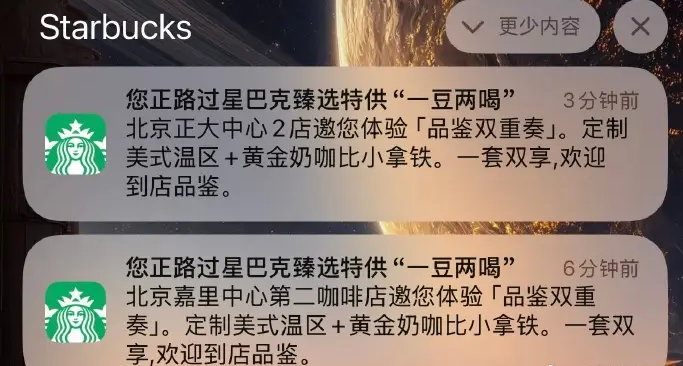
Core Viewpoint - The article discusses the growing concern over privacy issues related to location-based marketing strategies employed by coffee and tea brands, particularly Starbucks China, which has faced complaints regarding excessive personal data collection and marketing push notifications based on users' real-time locations [1][4][8]. Group 1: Privacy Concerns - Starbucks China is facing a privacy complaint due to its app sending location-based promotional notifications, raising concerns about being "tracked" by the app [4][8]. - The use of "geo-fencing" technology by Starbucks, which triggers notifications when users are near a store, has been criticized for not being clearly outlined in the app's privacy policy [5][6][8]. - The article highlights that many consumers have expressed dissatisfaction with the excessive collection of personal information by digital food and beverage services, indicating a broader trend in the industry [4][9]. Group 2: Regulatory Environment - Regulatory bodies have begun to scrutinize the practices of companies like Starbucks for frequently soliciting sensitive personal information, leading to multiple investigations and warnings [9][10]. - The article notes that in June 2023, Starbucks was among 64 mobile applications cited for improper collection and use of personal information [9]. Group 3: Industry Trends - The competitive landscape in the beverage industry is driving companies to rely heavily on data for digital operations, marketing, and customer retention strategies [9][10]. - Starbucks reported a 4% increase in store transaction volume for 2025, but a 5% decrease in average transaction value, prompting the company to enhance promotional efforts through its app [9][10]. - Other brands in the industry, such as Luckin Coffee and CoCo, have also faced similar complaints regarding data privacy, indicating a widespread issue across the sector [9][10].
一步一广告推送,地理围栏“追杀式营销“边界何在?
2 1 Shi Ji Jing Ji Bao Dao· 2025-11-27 09:00
Core Viewpoint - The article discusses the implications of location-based marketing in the food and beverage industry, particularly focusing on Starbucks China and the privacy concerns arising from its use of geofencing technology for targeted promotions. Group 1: Company-Specific Insights - Starbucks China has faced privacy complaints regarding its app's use of geolocation to send promotional notifications to users, raising concerns about being "tracked" [1][2] - The company confirmed that it has discontinued the geolocation-based promotional feature in response to user feedback and is committed to improving privacy protection [5] - Starbucks has previously been criticized for excessive data collection practices, including the solicitation of personal information such as phone numbers and location data [5][6] Group 2: Industry Trends and Challenges - The food and beverage industry is increasingly relying on digital tools and data collection for competitive advantage, with many brands, including Luckin Coffee and CoCo, also facing scrutiny for similar privacy issues [6][7] - The competitive landscape has intensified, with Starbucks reporting a 4% increase in store transaction volume but a 5% decrease in average transaction value, prompting the company to enhance promotional efforts [6][7] - The reliance on user data for personalized marketing raises significant privacy concerns, necessitating compliance with regulations that require clear user consent and purpose disclosure [4][7]
一步一广告推送,电子围栏“追杀式营销“边界何在?
2 1 Shi Ji Jing Ji Bao Dao· 2025-11-27 08:47
Core Viewpoint - The article discusses the privacy concerns surrounding Starbucks China's use of location-based marketing through its app, highlighting the tension between digital marketing strategies and compliance with personal information protection laws. Group 1: Privacy Concerns - Starbucks China faces a privacy complaint regarding its app's use of location-based push notifications, which some users perceive as intrusive tracking [1][3] - The app's privacy policy does not explicitly mention the use of location data for marketing purposes, raising compliance issues under China's personal information protection laws [3][4] - The company confirmed that the location-based marketing feature has been discontinued in response to user feedback [3] Group 2: Industry Practices - The use of location services for marketing is common in the beverage industry, with many brands collecting sensitive personal information such as phone numbers and location data [4][5] - Other companies in the industry, including Luckin Coffee and CoCo, have also faced scrutiny for similar practices of excessive data collection [4][5] - The competitive landscape in the beverage market drives companies to rely heavily on user data for personalized marketing and customer retention strategies [5] Group 3: Regulatory Environment - Regulatory bodies have begun to focus on the practices of beverage brands regarding personal information collection, with multiple companies being called out for violations [4][5] - The article notes that in June 2023, Starbucks and 64 other mobile applications were reported for improper collection and use of personal information [4]
10月茶饮上新25款,咖啡上新39款
Ge Long Hui· 2025-11-26 14:48
Core Insights - The beverage industry is experiencing a seasonal shift with the introduction of autumn and winter-themed drinks, leading to a total of 77 new products launched by the top ten tea and coffee brands in October, an increase of 11.59% compared to August [2][4]. Tea Beverage Trends - Among tea brands, Cha Bai Dao leads with six new products, followed by Gu Ming with five, and Yi He Tang and CoCo with four each [4]. - The tea segment has seen a significant rise in milk tea offerings, with 30 new milk tea products launched in October, accounting for 83.33% of all new tea products, while fruit tea introductions have decreased to only three [8]. - Classic ingredients like taro and brown sugar pearls are being emphasized, with brands like Mi Xue Bing Cheng and Hu Shang A Yi focusing on multiple new taro products [21]. Coffee Beverage Trends - In the coffee sector, Lucky Coffee is the most active, launching ten new products, while Ruixing follows with seven [4]. - The trend towards richer flavors is evident, with 22 new milk coffee products introduced, making up 52.38% of all new coffee products [11]. - Innovative flavor combinations are being explored, such as salty-sweet boundaries and regional specialties, with products like Ruixing's salty milk tea and Ken Yue's rose milk latte [21]. Cross-Category Innovations - The boundaries between tea and coffee categories are increasingly blurred, with brands like Hu Shang A Yi and Gu Ming introducing coffee products, while coffee brands like Ruixing and Starbucks are venturing into non-coffee beverages [14]. - Green tea is the most frequently used base in new drinks, appearing in 10 products, which is 28.6% of the total, followed by black tea and flower tea [14]. Seasonal Ingredients - Seasonal ingredients are prominently featured, with cheese and pumpkin appearing in new products from multiple brands, enhancing the seasonal and comforting attributes of the drinks [20].
Trade Tracker: Stephanie Link buys Dick's Sporting Goods and buys more Starbucks
CNBC Television· 2025-11-25 18:00
One of the names, Dick Sporting Goods, was on the ledger today. They beat on the top and the bottom line. Shares were down though because the company is closing some Foot Locker stores to protect profits.Um, the stock has come back. It's up 2%. Silence that.Thank you. As Stephanie Link buys this name. >> Yeah, first time ever, by the way.>> Yeah. What What was the big draw for you. >> Could I just go back on retail sales.I mean, I know it's September data, but it was up 5.7% year-over-year. So, it's still q ...

Worst CEOs Of The Year: Brian Niccol Of Starbucks
Yahoo Finance· 2025-11-25 12:55
Core Viewpoint - The article discusses the selection of the worst CEOs in America, highlighting major strategic failures and their impact on shareholders, customers, and employees [1]. Company Performance - Starbucks Corp. has seen a decline in its share price, down 16% over the last five years, while the S&P 500 has increased by 84% [2]. - The stock price peaked at $117 in March but has since fallen to $83, indicating a loss of investor confidence [4]. Leadership Changes - Starbucks has experienced multiple leadership changes, with Brian Niccol being the latest CEO after Kevin Johnson and Howard Schultz [3]. - Niccol was expected to revitalize the company based on his previous successes at Taco Bell and Chipotle, but has not delivered results [5]. Strategic Decisions - Niccol's strategy included a focus on returning to Starbucks' roots as a community coffeehouse, but has faced criticism for lack of tangible results [5]. - A significant decision made under Niccol's leadership was the sale of 40% of Starbucks' operations in China for $4 billion, a move seen as abandoning a key growth market [5].
外资品牌集体 “改姓中”:星巴克、汉堡王易主背后,中国资本手术刀如何改写全球规则
Sou Hu Cai Jing· 2025-11-25 11:19
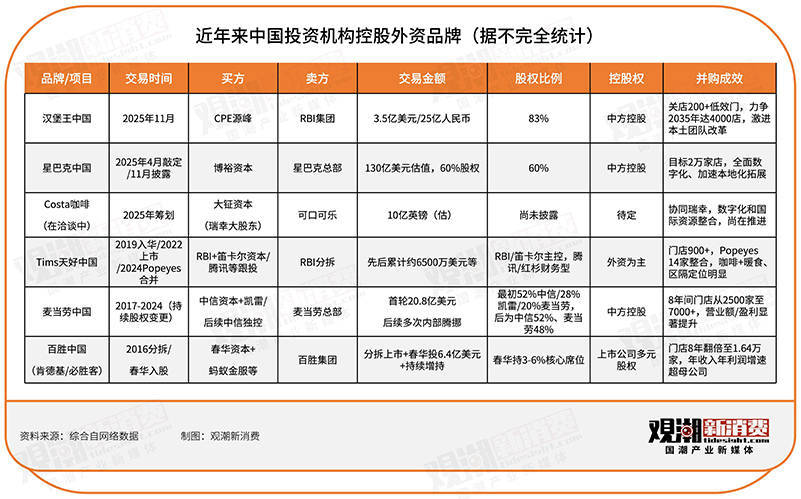
Core Insights - The ownership transfer of international brands in China, such as Starbucks and Burger King, signifies a critical shift in market dynamics, emphasizing the need for localization and adaptation to survive in a competitive landscape [1][3][17] - The decline of international brands in China is attributed to decision-making inefficiencies, digital lag, and a reversal of latecomer advantages, necessitating a reevaluation of their operational strategies [4][5][6][7] Ownership Changes - Starbucks China has transferred 60% of its equity to Boyu Capital, valuing the company at $13 billion, while Burger King China was acquired by CPE Yuanfeng for $350 million, gaining 83% control [2][4] - The trend of Chinese investment in foreign brands reflects a broader strategy to enhance competitiveness through local management and operational restructuring [1][3] Market Challenges - International brands are facing systemic failures in the Chinese market, with Starbucks' market share dropping to 14% in 2024, less than half of its peak [2][4] - The operational models of these brands, which were successful globally, are failing in China due to a lack of adaptability to local consumer preferences and market conditions [4][5][6] Strategic Solutions - The introduction of Chinese capital is seen as a solution to the operational challenges faced by international brands, focusing on local management, digital transformation, and supply chain localization [3][4][11] - Control restructuring is crucial, allowing local teams to make faster decisions and respond to market changes effectively [7][8][12] Digital Transformation - The digitalization of operations is a key strategy, with companies like McDonald's achieving over 90% of orders through digital channels after implementing localized systems [9][10][11] - This transformation is not merely a technological upgrade but a comprehensive overhaul of operational frameworks to enhance efficiency and customer engagement [10][11] Supply Chain Localization - Localizing supply chains is essential for improving cost competitiveness and operational agility, enabling brands to respond swiftly to market demands [11][12] - The establishment of long-term partnerships with local suppliers enhances the overall supply chain ecosystem, crucial for success in the Chinese market [11][12] Future Outlook - The next five years are expected to witness more international brands undergoing transformation under Chinese capital, with the potential for either revival or failure [17][18] - The ultimate success of these brands will depend on their ability to understand Chinese consumers, create genuine value, and balance brand identity with local adaptation [17][18]

X @Bloomberg
Bloomberg· 2025-11-25 03:46
The operator of Starbucks in Malaysia says business is gradually recovering after the Gaza conflict-triggered boycotts led to store closures and steep losses https://t.co/XmQOmK3drW ...
外资品牌集体 “改姓中”:星巴克、汉堡王易主背后,中国资本的本土化手术刀
Sou Hu Cai Jing· 2025-11-25 00:11
Core Insights - The ownership transfer of Starbucks China and Burger King China signifies a significant shift in market dynamics, where international brands are increasingly relying on local capital to regain competitiveness in the Chinese market [4][7][8] - The era of easy profitability through brand prestige is over, as international brands face systemic challenges and must adapt to local market conditions to survive [4][8][9] Ownership Changes - Starbucks China has transferred 60% of its equity to Hillhouse Capital, valuing the joint venture at $13 billion [6] - Burger King China was acquired by CPE Yuanfeng for $350 million, gaining 83% control [6] - McDonald's China has seen its stake increase to 52% under CITIC Capital, reflecting a trend of local capital taking control of international brands [6][8] Market Challenges - International brands are experiencing a decline in market share, with Starbucks' share dropping to 14% in 2024, less than half of its peak [6][8] - The competitive landscape has shifted, with local brands like Luckin Coffee surpassing international giants, highlighting the failure of traditional business models [8][9] Structural Issues - Decision-making inefficiencies in multinational corporations hinder their ability to respond quickly to market changes, leading to missed opportunities [11] - A digital capability gap exists, as international brands struggle to adapt their global IT systems to the unique Chinese market, resulting in operational inefficiencies [12] - Local teams possess a better understanding of the market and are more willing to innovate, reversing the advantages once held by international brands [13] Strategic Solutions - Local capital is restructuring control by acquiring stakes in international brands, allowing for more agile decision-making and operational autonomy [14][17] - Digital transformation is being prioritized, with companies like McDonald's leveraging partnerships to enhance their digital capabilities and customer engagement [14][16] - Supply chain localization is being implemented to improve cost efficiency and responsiveness, crucial for competing in the Chinese market [15] Case Studies - CITIC Capital's acquisition of McDonald's China exemplifies a successful model of value creation through phased control and operational restructuring, resulting in significant growth in store numbers and digital engagement [16][17] Strategic Implications - Investors should identify brands with strong potential for operational improvement despite current challenges, as these may offer significant upside [18] - Emphasizing local management teams and operational strategies is essential for navigating the complexities of the Chinese market [18][19]
