Starbucks(SBUX)

Search documents
当星巴克的空间“自救”野心,碰上小红书的流量赌局
Hu Xiu· 2025-09-28 02:23
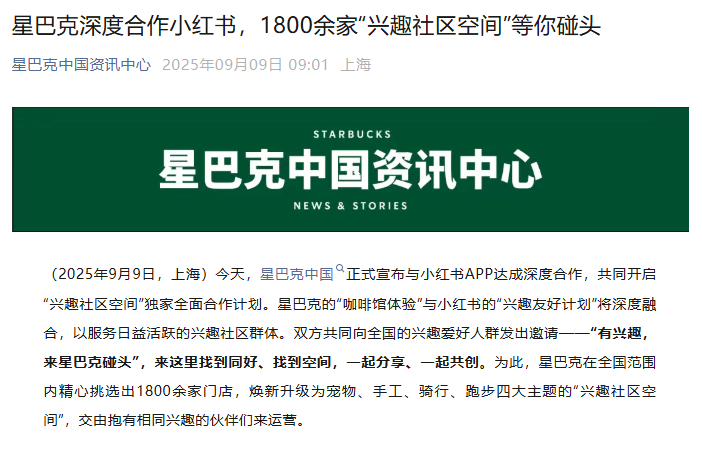
Core Insights - Starbucks China and Xiaohongshu have announced a deep collaboration to transform over 1,800 stores into themed "interest community spaces" focusing on pets, crafts, cycling, and running, indicating a strategic response to market competition pressures [1][4][19] Group 1: Collaboration Details - The partnership aims to create distinct offline social spaces catering to specific interest groups, with over 450 stores designated as pet-friendly, providing free "pawccino" treats and hosting events like pet parties [4][12] - More than 1,000 stores will offer craft-friendly spaces with experiences like unlocking craft blind boxes, while over 50 stores will provide running-friendly services such as free cup upgrades and hydration [4][12] - Cycling-friendly spaces will also be established in 50 stores, equipped with bike pumps and offering free water and limited-time cup upgrades [4][12] Group 2: Market Context - The collaboration comes as Starbucks faces declining market share in China, dropping from 42% in 2017 to 14% in 2024, largely due to competition from local brands like Luckin Coffee [19][23] - The shift in consumer behavior from a focus on the "third space" experience to a more functional, high-frequency consumption model has pressured Starbucks to redefine its market strategy [19][21] Group 3: Strategic Implications - The initiative reflects a broader trend where brands are increasingly leveraging community and interest-based marketing to build customer loyalty, as seen in other successful brands like Lululemon [25][26] - However, there are concerns that the collaboration may prioritize traffic generation over genuine community engagement, potentially leading to a perception of insincerity in the brand's efforts [38][44] - The effectiveness of this partnership will depend on Starbucks' ability to authentically connect with interest groups rather than merely using them as a marketing tool [44][52]


星巴克人事地震,传奇女CTO辞职,离职真相引猜测
3 6 Ke· 2025-09-28 02:04
Core Insights - Deb Hall Lefevre, Starbucks' Chief Technology Officer, has resigned, and Ningyu Chen has been appointed as the interim CTO [1] - Lefevre's departure comes during a critical period for Starbucks as it implements its "Back to Starbucks" strategy, which focuses on enhancing store experience and operational efficiency through technology [6][10] Group 1: Leadership Changes - Deb Hall Lefevre has a rich background in technology management, having worked with major companies like Motorola and McDonald's, where she led significant digital transformations [2][3] - Lefevre joined Starbucks in May 2022, recruited by CEO Howard Schultz, and was instrumental in integrating technology with the company's mission [5] - Ningyu Chen, the new interim CTO, previously served as Senior Vice President of Global Experience Technology at Starbucks [1] Group 2: Strategic Context - The "Back to Starbucks" strategy aims to improve customer interaction and operational efficiency through technology, which will continue despite the leadership change [6][10] - Lefevre's resignation may be linked to organizational changes, including a shift in reporting structure that requires her to report to the new CFO, Cathy Smith [6][10] - The company is facing various challenges, including layoffs, cost-cutting measures, and declining performance, which may have contributed to the pressures on the CTO role [10][12] Group 3: Future Implications - Lefevre's exit leaves Starbucks with unfinished digital transformation goals, entering a phase of uncertainty regarding its technological direction [12] - There are suggestions that Starbucks may need a new technology leader to navigate emerging technologies and revitalize its strategy [11]

星巴克首席技术官辞职,公司强调科技重点不会改变
Ge Long Hui A P P· 2025-09-28 01:58
格隆汇9月28日|据路透,内部备忘录显示,星巴克首席技术官(CTO)Deb Hall Lefevre已辞职,暂时由 全球体验科技资深副总裁Ningyu Chen代理,尚未任命正式继任人选。该备忘录由星巴克首席财务官 (CFO)Cathy Smith发出,提到Lefevre计划退休,并强调公司的科技重点不会改变,仍聚焦于推动"重返 星巴克"(Back to Starbucks)转型计划所需的数位化工作。Lefevre过去曾任职麦当劳,2022年5月加入星巴 克,负责优化得来速、行动点餐等技术系统。 ...
星巴克“断臂求生”,欧美裁员近千人
Hu Xiu· 2025-09-28 01:19
Core Viewpoint - Starbucks is undergoing a significant restructuring aimed at optimizing efficiency in mature markets, which includes closing hundreds of stores in North America and Europe and laying off approximately 900 non-retail employees [1][2]. Group 1: Restructuring Details - The restructuring plan will cost $1 billion, which includes $150 million for severance and $850 million for store closures [2]. - Starbucks will reduce its North American store count from 18,743 to 18,300 by the end of September, marking an unprecedented contraction [1]. - The closures will affect underperforming stores, including the Reserve Roastery in Seattle, which is the first of its kind globally [1]. Group 2: Market Challenges - The coffee market is shifting from a focus on expansion to efficiency, with competition now centered on single-store performance, digital experiences, and supply chain resilience [3]. - Starbucks has seen a decline in same-store sales in North America for six consecutive quarters, with a 2% drop reported in the third quarter of fiscal 2025 [3][4]. - The tolerance for high-priced coffee is decreasing among consumers, leading to intensified competition from brands offering lower price points [4][5]. Group 3: Strategic Implications - The restructuring reflects deeper strategic challenges, including rising operational costs and the need to close inefficient stores to enhance profitability [6][7]. - The departure of the CTO suggests potential internal conflicts regarding the strategic direction of the company [8]. - Starbucks is also considering selling its China operations, with negotiations ongoing with several investment firms, which could reshape its market presence [9].
178亿赞助缺口大,洛杉矶奥运要靠星巴克“续命”
3 6 Ke· 2025-09-27 23:48
Group 1 - The Los Angeles 2028 Olympics has secured 24 partners, including Honda, Nike, and Omega, with sponsorship revenue exceeding $1.448 billion, surpassing the 2024 Paris Olympics, but still short of the $2.5 billion target [1] - Starbucks has announced its partnership as the official coffee partner for the Los Angeles Olympics and Paralympics, planning to set up a specially designed café in the Olympic and Paralympic villages [1][6] - The partnership aims to enhance Starbucks' brand visibility and influence, leveraging the global reach of the Olympics to deepen brand recognition [1][10] Group 2 - Starbucks has a historical connection to sports, with founder Howard Schultz's background in athletics influencing the brand's strategic decisions [2] - The company has been gradually entering the sports marketing arena, with significant initiatives planned for 2024, including collaborations with sports brands like YONEX [2][4] - The partnership with the Olympics is seen as a strategic move to address performance pressures and market expansion needs, especially as same-store sales in North America have declined [6][8] Group 3 - The Los Angeles Olympics is innovating its commercial partnership model by independently categorizing coffee as an official partnership category, breaking the traditional dominance of beverage giants like Coca-Cola [8][10] - This shift allows coffee brands to participate directly in the Olympics, potentially leading to increased visibility for brands like Starbucks [8][10] - The collaboration is expected to extend Starbucks' consumer engagement beyond traditional settings, integrating coffee into dynamic environments like sports venues [10] Group 4 - The competitive landscape in the coffee industry is intensifying, with brands like Luckin Coffee and others actively engaging in sports marketing to enhance brand exposure [11][15] - Luckin Coffee has successfully leveraged sports events, such as the Beijing Winter Olympics, to boost brand awareness and has established partnerships across various sports [11][15] - Other brands, including Kudi and Migu, are also exploring sports sponsorships, indicating a broader trend of coffee brands recognizing the value of sports marketing [11][15]
X @The Wall Street Journal
The Wall Street Journal· 2025-09-27 18:14
Market Expansion - A coffee chain, rivaling Starbucks, is expanding into the American market [1]
别再“卷”价格了,中餐出海真正的护城河是合规
Hu Xiu· 2025-09-27 12:16
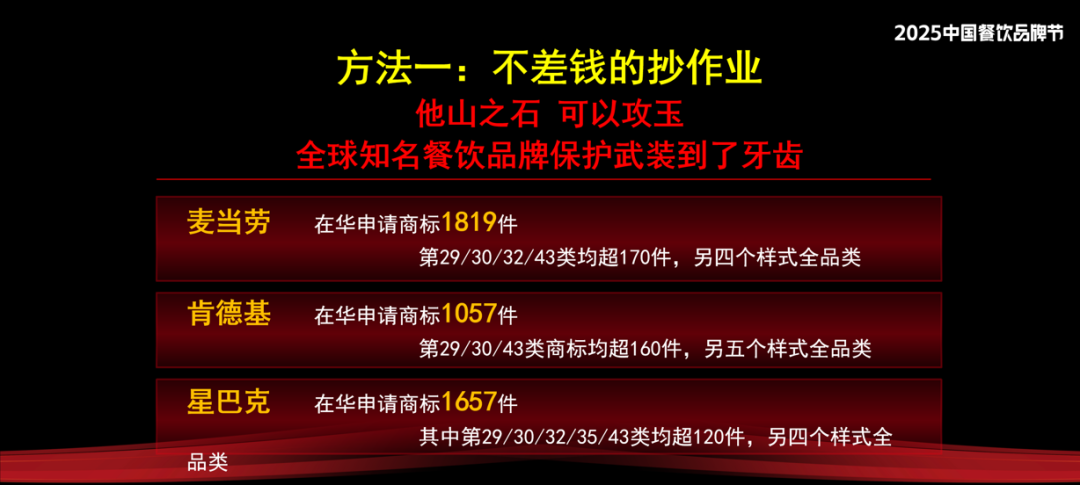
Core Viewpoint - The article discusses the current state and future potential of Chinese cuisine brands going global, emphasizing the importance of legal compliance and strategic planning in the process of international expansion [1][2]. Group 1: Legal Compliance - Legal compliance has become a critical factor for Chinese restaurants expanding overseas, with various legal challenges identified, including intellectual property, overseas investment, taxation, supply chain, labor, store qualifications, data security, and marketing [3][4]. - The first step for Chinese restaurants going abroad is to secure their intellectual property rights, as many brands face issues due to lack of prior planning and registration [5][6]. - Each country has its own trademark registration process, which can take from a few months to several years, necessitating early planning for trademark protection [6][7]. Group 2: Franchise Model - Currently, 80% of Chinese restaurant brands expanding internationally are using the franchise model, which is recommended due to its low cost, high efficiency, and minimal political risk [16][17]. - The franchise model serves as a cultural export vehicle, allowing for the dissemination of Chinese culinary culture without the complexities associated with technology or national security [18][19]. - Legal barriers for franchising are relatively low, as many countries have harmonized their commercial laws, making it easier for brands to operate internationally [20][21]. Group 3: Compliance Risks - Common compliance risks for Chinese brands in international franchising include non-compliance with franchise qualifications and contracts, often due to inadequate legal preparation [27][28]. - Non-compliance can lead to severe consequences, including civil liabilities, administrative penalties, and potential criminal charges in some jurisdictions [34][35]. - Countries like Malaysia and the U.S. have specific legal requirements for franchising that must be adhered to, including trademark registration and disclosure obligations [36][37]. Group 4: Strategic Recommendations - Companies are advised to conduct thorough legal risk assessments and compliance research before entering foreign markets, focusing on intellectual property, franchising, and overseas investment [47]. - The article emphasizes the need for a proactive approach to compliance, suggesting that brands should not rely on last-minute preparations [48][52]. - It is crucial for brands to maintain a cooperative spirit in international markets, avoiding competitive sabotage that could harm the overall image of Chinese cuisine abroad [54][56].




Starbucks is closing over 100 North American stores — here are the locations we know so far
Business Insider· 2025-09-27 11:24
Core Insights - Starbucks announced the closure of over 100 coffeehouse locations across North America, but did not specify which stores would close [1] - Business Insider is compiling a list of affected locations based on reports from in-store staff and verification through the Starbucks store locator [1] - The closures are expected to impact various neighborhoods and states significantly [1] Company Response - Starbucks expressed its understanding of the emotional connection customers have with their stores, emphasizing the importance of these locations in their daily lives and community [2] Affected Locations - The closures will affect multiple states including California, Virginia, Maryland, Massachusetts, New Jersey, New Mexico, Oregon, and Washington, with specific addresses listed for each state [6][10]
Starbucks Is Closing Stores and Cutting Jobs. Will It Save the Stock?
The Motley Fool· 2025-09-27 09:55
Core Insights - Brian Niccol's tenure as CEO of Starbucks has not met investor expectations despite initial optimism following his appointment [1][2] - The company is implementing a turnaround strategy called "Back to Starbucks," which focuses on enhancing customer service and store environments [4][8] Company Actions - Starbucks plans to close approximately 200 stores this year, resulting in a total of around 18,300 locations in North America by the end of the fiscal year [7] - The company will refurbish over 1,000 locations to improve their design and atmosphere [8] - Starbucks is eliminating 900 non-retail jobs and closing many open positions as part of its restructuring efforts [8] Historical Context - The current store-closing strategy is reminiscent of Howard Schultz's actions in 2008, where he closed 600 stores to refocus the brand [9][10] - Schultz's previous strategy successfully reset the brand and improved customer experience, but it remains uncertain if Niccol's approach will yield similar results given the company's larger scale and increased competition [10] Market Challenges - Same-store sales are still declining, and the company faces challenges from weak discretionary spending and a slowing job market in the U.S. [11] - Investors may need to exercise patience as the turnaround strategy unfolds, especially with the stock's high price-to-earnings ratio exceeding 30 [12][13]
Corporate Shifts and Economic Indicators: Amgen’s Tariff Response, Starbucks’ Restructuring, China’s Profit Rebound, and JPMorgan’s Alibaba Bet
Stock Market News· 2025-09-27 04:38
Amgen - Amgen plans to invest $650 million to expand its U.S. manufacturing operations in Puerto Rico, creating approximately 750 jobs [2][9] - This investment is a direct response to President Trump's announcement of a 100% tariff on pharmaceutical products not manufactured domestically, effective October 1 [2][9] - Since late 2017, Amgen has invested over $40 billion in U.S. manufacturing and R&D, including a $900 million expansion in Ohio and a $1 billion investment in North Carolina earlier this year [3][9] Starbucks - Starbucks is closing 434 North American stores by the end of September, reducing its store count from 18,734 to 18,300 [4][9] - The closures are part of a restructuring plan aimed at improving financial stability and customer experience, with 900 non-retail employees being laid off [5][9] - Despite the closures, Starbucks plans to increase its North American store count in the next fiscal year and redesign over 1,000 locations [5][9] China's Industrial Sector - China's industrial profits surged by 20.4% year-over-year in August, a significant recovery from a -1.5% decline in July [6][9] - The cumulative industrial profit for January-August increased by 0.9% to ¥4.69 trillion, indicating potential stabilization in the manufacturing sector [6][7][9] JPMorgan and Alibaba - JPMorgan Chase increased its stake in Alibaba from 6.81% to 12.29% on September 22, signaling bullish sentiment towards the tech sector [8][10] - This move reflects growing confidence in Alibaba and the broader tech sector, driven by global AI developments and increasing domestic computing power demands [11]