
TME(TME)

Search documents
盈利下调何时休?小摩:可以抄底港股消费互联网了吗
Zhi Tong Cai Jing· 2025-08-08 10:58
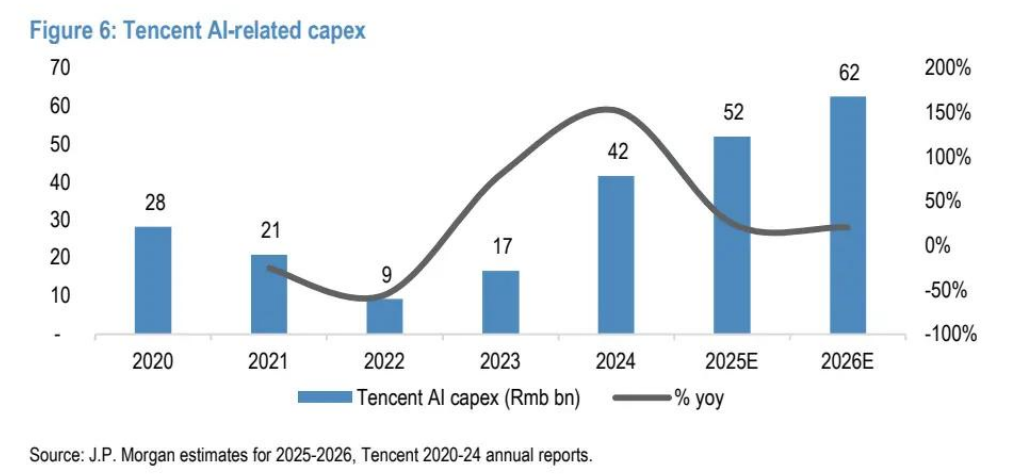
Group 1: Core Insights - The focus of the Q2 2025 earnings season is whether the profit downgrades for consumer internet companies (Alibaba, Meituan, Pinduoduo, Ctrip) have ended, which will influence investor decisions between digital entertainment leaders and consumer internet stocks [1][2] - Over the past three months, consumer internet stocks have seen an average price decline of 5%, while digital entertainment leaders have experienced a 31% increase, driven by intense competition and investment in the consumer internet sector [1][2] - Morgan Stanley's current preferred stocks in the industry are Tencent Music (TME), Kuaishou, Alibaba, Ctrip, and Tencent [1] Group 2: Investment Trends - There is no conclusive evidence that profit downgrades for consumer internet companies have ended, but Morgan Stanley believes selectively shifting from digital entertainment to consumer internet offers a favorable risk-reward ratio [2][3] - The investment intensity in the takeaway and instant retail sectors is expected to peak in Q3 2025, with a gradual easing of investment thereafter [4] Group 3: Competitive Landscape - Alibaba holds a competitive advantage in the market, while Meituan faces pressure due to a significant disparity in financial strength [5] - Meituan is projected to capture approximately 80% of industry revenue and 99% of industry profits in 2024, but new competition may lead to a decline in its revenue and profit share [5] Group 4: Stock Price Drivers - The narrative driving stock prices for some internet companies has shifted this year, with Alibaba focusing on cloud computing and AI, and Tencent Music transitioning to an ARPU-driven model [6] - Alibaba's cloud business is expected to be a core driver of revenue growth in the second half of 2025 [6] Group 5: AI Capital Expenditure - AI capital expenditure growth is expected to slow down but remain high, with Tencent's AI-related capital expenditure projected to increase by 152% in 2024, followed by a decrease to 25% and 20% in 2025 and 2026, respectively [7][10] - Alibaba plans to invest at least 380 billion yuan over three years starting March 2025, with AI capital expenditure expected to account for 65% of its total capital expenditure in the 2026 fiscal year [10] Group 6: Earnings Outlook - The investment intensity in takeaway and instant retail has peaked, with a 20% average downgrade in profit expectations for consumer internet companies over the past three months [12] - Major companies are expected to report varying earnings, with Tencent projected to have total revenue of 182 billion yuan and Alibaba expected to report 248 billion yuan [13][16] Group 7: Valuation and Market Sentiment - Despite a 20% downgrade in profit expectations for consumer internet companies, their average stock price has only declined by 4%, indicating potential for valuation recovery if profit downgrades have indeed bottomed out [17] - The digital entertainment sector has seen a 66% average stock price increase year-to-date, despite only a 3% upward adjustment in profit expectations, suggesting that short-term preferences are driving market behavior [17]


押注中国AI 国际资金出手
Shang Hai Zheng Quan Bao· 2025-08-07 16:08
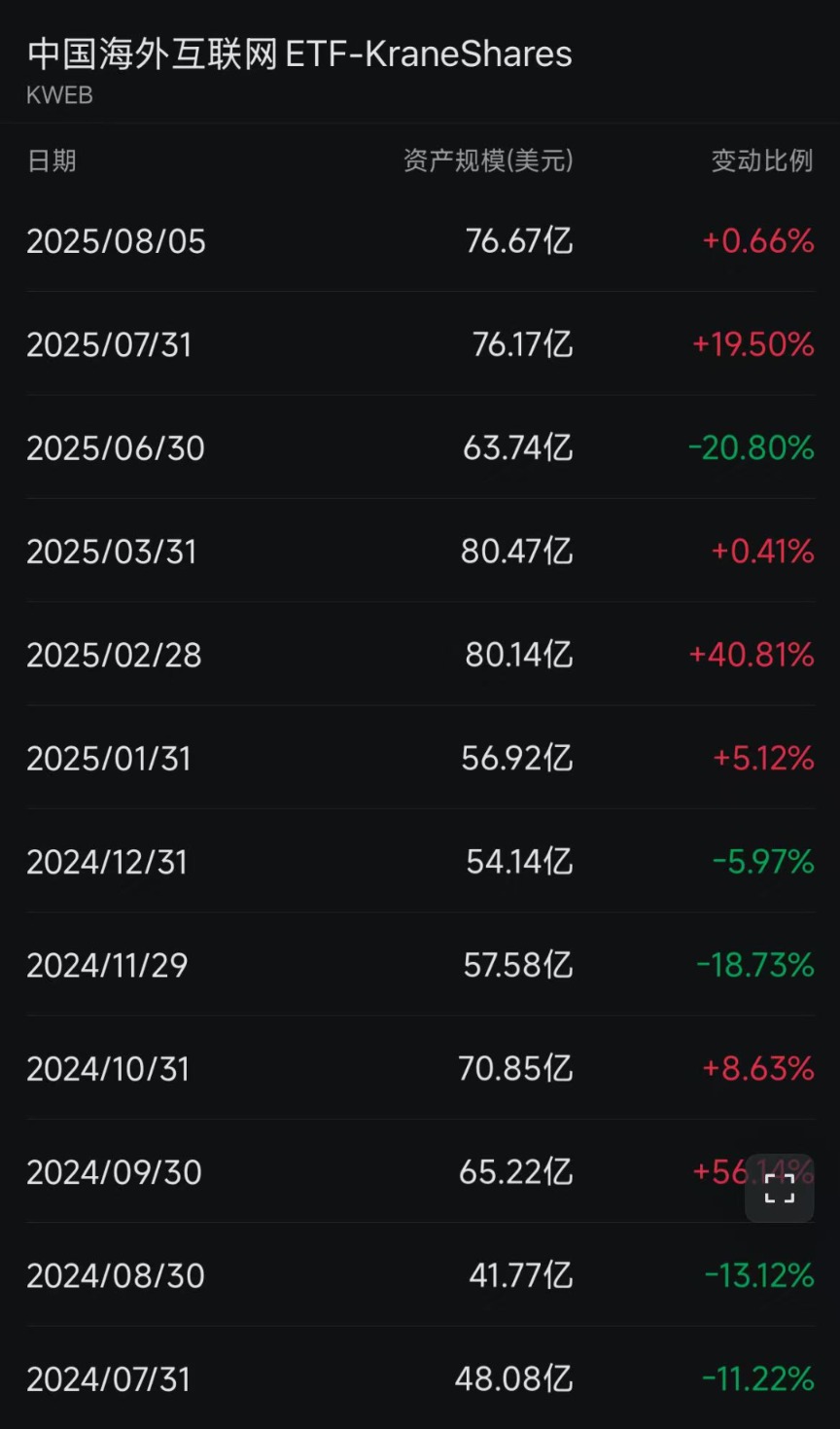
Group 1 - KIM, a South Korean investment management company, launched an ETF focused on China's AI sector, tracking 50 leading AI companies, which was listed on July 29 [1][2] - The ETF, named "KIM ACE China AI Big Tech TOP2+ Active ETF," aims to capture investment opportunities in artificial intelligence, digital platforms, and smart industrial technologies [2] - The underlying index, developed by Solactive, selects 25 companies from two main fields: cognitive technology and digital platforms, ensuring that selected companies have substantial AI technology layouts [2][3] Group 2 - Morgan Stanley predicts that China will become a global AI leader by 2030, with the core AI industry expected to reach a scale of $140 billion and an overall industry chain expansion to $1.4 trillion [3] - International capital has shown strong interest in Chinese tech stocks, particularly in emerging fields like AI, with the KraneShares China Overseas Internet ETF seeing a significant increase in assets under management, growing over 40% from $5.414 billion at the end of last year to $7.667 billion by August 5 [4][5] - The average price-to-sales ratio of comparable Chinese AI companies is around 15 times, significantly lower than that of typical American AI companies, which averages 42 times, indicating that Chinese AI firms may be undervalued [8]





快手、腾讯音乐娱乐(TME)、哔哩哔哩(BILI)与百度(BIDU):精彩时刻将至-Kuaishou, TME, BILI and BIDU It's showtime...raising TP for Kuaishou to HK$85 and TME to $25
2025-08-06 03:33
Summary of Conference Call Notes Industry Overview - The conference call discusses the outlook for digital media companies in China, specifically focusing on Kuaishou, Tencent Music Entertainment (TME), Bilibili, and Baidu. - The second quarter of 2025 (2Q25) is expected to show continued growth momentum in video and music platforms, with livestreaming GMV recovering from lows, while Baidu's Search continues to lose market share [1][2]. Company-Specific Insights Kuaishou (TP raised to HK$85) - Kuaishou is projected to achieve 4-5% platform growth, with a resumption of GMV growth for e-commerce and continued CPM growth, indicating revenue acceleration into the second half of the year [2][19]. - Tracker data shows a 20% acquisition in 2Q, suggesting a full-year number higher than the previous $100 million forecast [2]. - The target price (TP) has been raised to HK$85 based on a 13x forward multiple, reflecting improved long-term earnings expectations [7][19]. Tencent Music Entertainment (TP raised to $25) - TME is expected to deliver results that modestly beat estimates, with strong QoQ ARPU growth of approximately 10% [3][41]. - The focus is on future plans, particularly the potential synergies from the Ximalaya acquisition, which could create a new phase for the stock [3][41]. - The TP has been raised to $25, reflecting a three-year synergy creation roadmap worth at least $5 per share [7][41]. Bilibili (TP set at $28) - Bilibili is expected to have inline results with continued CPM improvement and strong MAU growth, but limited content monetization and a slow gaming cycle may hinder strong upside [4][9]. - The focus for the second half of the year will be on game commentary and potential revenue from upcoming releases [4]. Baidu (TP set at $90) - Baidu's results are expected to disappoint, with further downward revisions to Search revenue due to the removal of ad space and lack of monetization efforts [5][8]. - The company is shifting focus to video ads, but there are concerns about their effectiveness given the current consumer mind share [5]. Key Financial Metrics - Kuaishou's revenue is projected to grow approximately 11.5% in 2025, with a non-GAAP operating profit expected to improve by 25% YoY [10]. - TME's revenue is expected to show around 15% growth, with a focus on ARPU uplift and synergies from the Ximalaya deal [10]. - Bilibili's revenue is anticipated to grow in the high teens, while Baidu's revenue is expected to decline by a low single digit percentage [10]. Additional Insights - Kuaishou's MAU has improved, with a mid-single-digit YoY increase, driven by new downloads and stable retention rates [22][23]. - TME's core user base remains stable, but competition from other music platforms is increasing, leading to a decline in less engaged users [44]. - The advertising revenue growth for Kuaishou is strongest in categories like education, local services, and mini-dramas, with some categories seeing growth rates of 20-35% YoY [30][32]. Conclusion - The digital media landscape in China is showing signs of growth, particularly for Kuaishou and TME, while Baidu faces challenges in monetizing its Search product. - The focus for the second half of 2025 will be on product development and monetization strategies across these platforms, with varying degrees of success anticipated.


中证中国内地企业500通信服务指数报3105.25点,前十大权重包含中际旭创等
Jin Rong Jie· 2025-08-05 13:55
从中证中国内地企业500通信服务指数持仓的市场板块来看,深圳证券交易所占比36.49%、香港证券交 易所占比31.54%、纳斯达克全球精选市场证券交易所(Consolidated Issue)占比19.17%、上海证券交易所 占比7.84%、纽约证券交易所占比3.69%、纳斯达克股票市场证券交易所(Consolidated Large Cap)占比 1.27%。 从中证中国内地企业500通信服务指数持仓样本的行业来看,通信设备占比26.74%、数字媒体占比 20.11%、电信运营服务占比14.59%、文化娱乐占比4.95%、数据中心占比4.63%、营销与广告占比 3.01%、通信技术服务占比1.83%。 金融界8月5日消息,上证指数高开高走,中证中国内地企业500通信服务指数 (内地企业通信,931538) 报3105.25点。 数据统计显示,中证中国内地企业500通信服务指数近一个月上涨8.46%,近三个月上涨20.59%,年至 今上涨23.56%。 据了解,中证中国内地企业500行业指数系列从中证中国内地企业500指数样本中,按中证行业分类标准 进行分类,进入各自行业的全部证券作为相应行业指数的指数样本, ...


腾讯音乐上涨2.46%,报21.855美元/股,总市值338.51亿美元
Jin Rong Jie· 2025-08-05 13:52
Core Viewpoint - Tencent Music (TME) shows positive financial performance with significant revenue and profit growth, indicating a strong market position in the online music and audio entertainment sector [1][3]. Financial Performance - As of March 31, 2025, Tencent Music reported total revenue of 7.356 billion RMB, representing a year-on-year increase of 8.69% [1]. - The company's net profit attributable to shareholders reached 4.291 billion RMB, marking a substantial year-on-year growth of 201.76% [1]. Upcoming Events - Tencent Music is scheduled to disclose its fiscal year 2025 interim report on August 12, 2023, before the market opens (Eastern Time) [2]. Company Overview - Tencent Music Entertainment Group operates popular music products in China, including QQ Music, Kugou Music, Kuwo Music, and WeSing [3]. - The company provides a comprehensive platform for online music, audio, karaoke, live streaming, and online performances, enhancing user engagement through social interactions [3]. - Tencent Music collaborates closely with music labels and content owners for copyright protection and empowers artists in creation, distribution, and commercialization [3].
纳斯达克中国金龙指数小幅上涨,哔哩哔哩、知乎涨幅接近3%
Mei Ri Jing Ji Xin Wen· 2025-08-05 13:49
Core Viewpoint - The Nasdaq China Golden Dragon Index experienced a slight increase, with notable movements in various companies' stock prices [1] Company Performance - Bilibili and Zhihu saw stock price increases of nearly 3% [1] - Tencent Music and Aihuishou experienced stock price increases of over 1% [1] - Qifu Technology and Pony.ai both saw stock price declines of over 1% [1]



美股异动|腾讯音乐盘前续涨超1% 获机构看好
Ge Long Hui· 2025-08-05 09:36
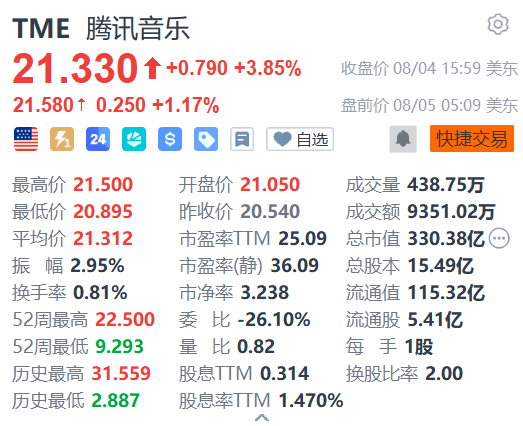
Group 1 - Tencent Music (TME.US) closed up 3.85% and continued to rise 1.17% in pre-market trading, reaching $21.58 [1] - According to Dongfang Securities, the long-term resilience of the streaming music industry against macroeconomic headwinds is strong, with a projected CAGR of 22% for China's streaming music industry from 2021 to 2024, significantly outperforming retail sales [1] - The expansion of audio content and refined operations in fan economy are expected to shift music platforms from competition for existing users to user growth [1] Group 2 - Continued optimization of head copyright management is driving gross margin growth, while AI is expected to decentralize supply [1] - The report suggests that Tencent Music's acquisitions and integrations will continue in the second half of the year, aiming to stabilize Kpop users and attract new long audio users [1] - The music industry is anticipated to achieve dual growth in traffic and payment through copyright expansion, with Tencent Music and NetEase Cloud Music enhancing traffic and payment rates through copyright supplementation and user operations [1] Group 3 - Tencent Music's acquisition of South Korea's SM and the proposed acquisition of Ximalaya are expected to attract Kpop and long audio users, while NetEase Cloud maintains stable traffic through independent musician incubation and Kpop copyrights [1] - The increase in the proportion of paid users and the expansion of SVIP benefits are driving ARPPU growth [1]
问答腾讯音乐和网易云音乐最近变了什么
2025-08-05 03:20
Summary of Key Points from the Conference Call Industry and Company Overview - The conference call discusses the performance and strategies of **Tencent Music** and **NetEase Cloud Music** in the online music industry, highlighting their financial results and market dynamics [1][2]. Core Insights and Arguments - **Tencent Music's Q1 Performance**: Tencent Music reported a strong Q1 with an increase in ARPU (Average Revenue Per User) from 8.3 RMB to 11.4 RMB, and a rise in paid users to 123 million, indicating a stable growth trend [1][5]. - **NetEase Cloud Music's Growth**: NetEase Cloud Music benefited from an increase in paid subscriptions, leading to improved overall revenue and profit margins [2]. - **User Migration Costs**: The migration cost for music platform users is higher than that for long video platforms due to established playlists and preferences, which enhances user retention [1][4]. - **Long Tail Effect of Music Copyrights**: Music copyrights exhibit a long tail effect, where classic songs continue to attract users over time, contrasting with the short content cycle of long videos [4]. - **Strategic Partnerships**: Tencent Music has strengthened collaborations with leading Korean entertainment companies and acquired the fan interaction platform Bubble, enhancing its influence in Korean pop culture [7][8]. - **Market Potential**: The domestic content-paying population is estimated to be between 150 million to 170 million, with Tencent Music targeting this demographic through differentiated VIP and SVIP services [9][10]. Additional Important Insights - **SVIP User Growth Target**: Tencent Music aims to increase the proportion of SVIP users from 15% to 30% and total paid users from 120 million to 150 million over the next three years [3][14]. - **AI Integration**: The integration of AI tools like Yuanbao is expected to enhance user experience and engagement, providing new pathways for user interaction and content discovery [6]. - **International Market Focus**: Tencent Music is focusing on the Korean market, leveraging the easing of restrictions to host more concerts and expand its international presence [12]. - **Content Acquisition**: The acquisition of Ximalaya is aimed at enriching Tencent Music's content ecosystem rather than directly increasing paid user numbers [13]. - **Competitive Positioning**: Tencent Music holds a significant advantage in copyright resources with approximately 90 million songs, compared to NetEase's 60 million, enhancing its competitive edge [19]. - **Pricing Strategy**: Tencent Music's pricing strategy is less sensitive to user price resistance due to its strong content library, allowing for potential price increases without significant user loss [20][21]. Future Outlook - **Growth Projections**: Tencent Music is projected to maintain stable growth with a profit increase of 15% to 17% CAGR over the next three years, supported by its robust copyright resources and user base [22].
腾讯音乐(TME.US)涨逾3% 机构:行业有望通过版权拓展实现流量与付费双增长
Zhi Tong Cai Jing· 2025-08-04 23:04
Core Viewpoint - The music industry is expected to achieve dual growth in traffic and paid subscriptions through copyright expansion, as highlighted by Dongfang Securities' recent report on Tencent Music (TME.US) and NetEase Cloud Music [1] Group 1: Company Insights - Tencent Music's stock rose over 3% to $21.31, indicating positive market sentiment [1] - The company is expected to enhance its user base by acquiring Korean company SM and planning to acquire Ximalaya, which will likely attract K-pop and long audio users [1] - The increase in the proportion of paid users and the expansion of SVIP benefits are driving growth in Average Revenue Per Paying User (ARPPU) [1] Group 2: Industry Trends - The report suggests that both Tencent Music and NetEase Cloud Music can stabilize and improve traffic and payment rates through copyright supplementation and user operations [1] - NetEase Cloud Music is maintaining stable traffic by incubating independent musicians and securing K-pop copyrights [1]
腾讯音乐涨逾3% 机构:行业有望通过版权拓展实现流量与付费双增长
Xin Lang Cai Jing· 2025-08-04 16:19
Core Viewpoint - The music industry is expected to achieve dual growth in traffic and paid subscriptions through copyright expansion, as highlighted by Dongfang Securities' recent report [1] Group 1: Company Insights - Tencent Music's stock rose over 3% to $21.31, indicating positive market sentiment [1] - Tencent Music is expected to enhance its user base by acquiring Korean company SM and planning to acquire Ximalaya, which will likely attract K-pop and long audio users [1] - NetEase Cloud Music is maintaining stable traffic through independent artist incubation and K-pop copyright [1] Group 2: Industry Trends - The report suggests that both Tencent Music and NetEase Cloud Music can stabilize and improve traffic and payment rates through copyright supplementation and user operations [1] - The increase in the proportion of paid walls and the expansion of SVIP benefits are driving growth in ARPPU (Average Revenue Per Paying User) [1]