TSMC(TSM)

Search documents
中国台湾起诉日本TEL公司!
国芯网· 2025-12-03 04:44
Group 1 - The Taiwanese court has announced the prosecution of Tokyo Electron Limited (TEL) and its employees for violating local security and trade secret laws, with a potential fine of 120 million New Taiwan Dollars [2][4] - This case marks the first instance in Taiwan where a company is prosecuted under the security law for allegedly stealing core technology trade secrets [4] - The prosecution claims that TEL failed to implement necessary measures to prevent the theft of trade secrets, which constitutes a management failure [5] Group 2 - A former employee of TEL is accused of soliciting colleagues at TSMC to steal confidential data related to TSMC's 2nm process technology, which is considered one of the most advanced chip manufacturing technologies globally [4][5] - TSMC reported the incident to law enforcement, emphasizing the high commercial value and strategic sensitivity of the 2nm process technology [5]


台湾检方起诉Tokyo Electron台湾子公司
日经中文网· 2025-12-03 02:59
Core Viewpoint - The Taiwanese subsidiary of Tokyo Electron has been indicted for its involvement in the theft of trade secrets from TSMC, with prosecutors seeking a fine of 120 million New Taiwan Dollars [2][4]. Group 1: Legal Proceedings - The Taiwanese prosecution has charged Tokyo Electron's subsidiary with violating multiple laws, including the Trade Secrets Act and the National Security Act, marking the first time a corporate entity has been prosecuted under national security laws for technology leakage in Taiwan [4]. - In August, three former TSMC employees were indicted for illegally using TSMC's trade secrets outside Taiwan, specifically related to the development of advanced 2-nanometer semiconductor technology [4]. Group 2: Company Responsibility - Investigations revealed that one of the indicted former TSMC employees joined Tokyo Electron's Taiwanese subsidiary and attempted to use TSMC's trade secrets in optimizing the performance of next-generation semiconductor equipment [5]. - The prosecution determined that Tokyo Electron failed to implement adequate measures to protect trade secrets, indicating a lack of effort in preventing information leaks, and thus holds the company criminally responsible [5]. - Tokyo Electron has stated that it is verifying the details of the announcement from Taiwanese authorities and previously claimed that no organized wrongdoing was found following the indictment of the former employees [5].

台积电2纳米制程泄密案最新进展
Xin Lang Cai Jing· 2025-12-03 02:22
Core Viewpoint - TSMC is involved in a significant technology leak case where a former engineer and two current employees are accused of stealing 2nm process technology and leaking it to a competitor, resulting in legal actions and fines against Tokyo Electron [1][3]. Group 1: Incident Overview - A former engineer, Chen Liming, colluded with two TSMC engineers, Ge Yiping and Wu Bingjun, to steal confidential 2nm process technology [1][2]. - The incident was discovered by TSMC in July 2023, leading to the company filing a complaint with the Taiwan High Prosecutors Office [2][4]. - The three individuals involved have been charged with multiple offenses under Taiwan's Security Law and Trade Secrets Law, with fines sought against Tokyo Electron totaling NT$120 million (approximately US$4 million) [1][3]. Group 2: Background of the Individuals - Chen Liming had an 8-year tenure at TSMC and was involved in advanced process defect improvement roles, including 5nm and 3nm technologies [2][4]. - After leaving TSMC, Chen was recruited by Tokyo Electron as a senior marketing specialist, where he sought assistance from current TSMC employees to access internal systems remotely [2][4]. - All three engineers involved graduated from the same university and had a senior-junior relationship, indicating a close connection among them [2][4]. Group 3: Legal Proceedings - The High Prosecutors Office concluded its investigation on December 2, 2023, and has requested severe penalties for the accused, with Chen facing a combined sentence of 14 years, Wu 9 years, and Ge 7 years [2][4]. - The three engineers were remanded for further investigation, with a decision made to extend their detention for three months [2][4].
AI趋势下洁净室产业链梳理
2025-12-03 02:12
Summary of Cleanroom Industry Conference Call Industry Overview - The cleanroom industry is experiencing significant growth driven by the expansion of the semiconductor sector, particularly led by TSMC and followed by companies like Micron. The demand for high-end cleanroom engineering services is surging, resulting in equipment shortages and presenting opportunities within the cleanroom supply chain [1][2]. Key Points and Arguments - **Cleanroom Engineering Services**: These services are akin to industrial construction, designed to meet strict cleanliness and air composition requirements across sectors such as semiconductors, renewable energy, and biomedicine. Cleanroom classifications range from level 1 to 9, with semiconductor applications typically requiring levels 1 to 5 [1][4]. - **Capital Expenditure Trends**: Domestic capital expenditure in semiconductor cleanrooms increased to 20-30 billion yuan in 2022, with a structural rise in advanced process investments due to AI demand, benefiting engineering service providers with advanced process experience [1][10]. - **Market Dynamics**: The cleanroom industry is currently witnessing a strong stock performance, with a new round of capital expenditure in the semiconductor supply chain across domestic and Southeast Asian markets. Companies are beginning to see fundamental improvements [2][6]. - **Core Players**: Major players in the cleanroom engineering services include M+W Group from Germany and Taiwanese firms like HanTang and AsiaXiang, which are securing significant projects from TSMC and other major clients [8][9]. Additional Insights - **Operational Complexity**: Cleanroom engineering involves two core components: design and installation by engineering service providers, and the supply of fans and filters. The highest difficulty level is in wafer manufacturing, with fewer players in this space [5]. - **Investment Opportunities**: In the current market, it is recommended to focus on cleanroom companies with solid fundamentals and low valuations, as high-end engineering service providers are experiencing supply shortages and strong equipment demand [6]. - **Future Projections for AsiaXiang**: AsiaXiang is expected to secure new orders exceeding 10 billion yuan in Singapore by 2025, with profit margins potentially exceeding 30% as management experience improves [13]. - **Impact of TSMC's Expansion**: TSMC's global expansion plans are driving investment enthusiasm throughout the supply chain, with significant capital expenditures announced by companies like Micron in North America and Japan [14]. Company-Specific Highlights - **Mei Ai Technology**: As a leading domestic cleanroom equipment manufacturer, Mei Ai holds a 30% market share in China's semiconductor cleanroom sector. The company benefits from both domestic and international capital expenditure trends and is expanding its overseas market presence through acquisitions [15][16][17]. - **Competitive Advantages**: Mei Ai's cost control capabilities and alignment with domestic localization needs position it favorably against international competitors. The company aims for significant revenue growth, targeting 7 billion yuan in revenue by 2026 [17]. Conclusion - The cleanroom industry is poised for continued growth, driven by robust capital expenditures in the semiconductor sector and increasing demand for advanced manufacturing processes. Companies with strong fundamentals and strategic positioning are likely to benefit significantly in the coming years [18].


摩根士丹利科技对话:Joe Moore和Brian Nowak关于亚洲行调研NVDA与AVGOGOOGL TPU以及AMZN Trainium,以及MU、SNDK、AMD、INTC、ALAB、AMAT
摩根· 2025-12-03 02:12
Investment Rating - The report maintains a positive outlook on NVIDIA's market position and growth potential, particularly in the AI chip sector, despite competition from Google's TPU and other self-developed chips [1][2]. Core Insights - NVIDIA dominates the AI chip market with quarterly processor revenues exceeding $50 billion, significantly outpacing Google's TPU revenue of approximately $3 billion [1][2]. - Google and Amazon are expected to remain significant customers for NVIDIA, with Google's procurement projected to exceed $20 billion next year [1][3]. - Broadcom has enhanced its product offerings to support Google projects, reflecting a shift towards lower-cost self-developed chips, although this will have limited impact compared to Broadcom's over $30 billion in ASIC revenue [1][4]. - The TPU units are crucial for Google's cloud growth, with potential sales of 500,000 units possibly increasing earnings per share by $0.40 to $0.50 by 2027 [1][5]. - Alphabet's stock valuation is estimated to reach the high 20s, driven by growth in GPU and machine learning businesses, despite current valuations appearing high at 30 times earnings [1][6]. Summary by Sections NVIDIA and AI Chips - NVIDIA's quarterly processor revenue is over $50 billion, while Google's TPU revenue is around $3 billion, indicating NVIDIA's strong market advantage [1][2]. - New deals with companies like Anthropic are expected to further boost NVIDIA's revenue [1][2]. Google and Amazon's Procurement - Google is projected to increase its procurement of NVIDIA chips to over $20 billion next year, while TPU purchases are expected to grow significantly [1][3]. - Amazon is anticipated to ramp up its purchases from NVIDIA, despite focusing on its self-developed Trainium chips [1][3]. Broadcom's Strategy - Broadcom has revised its product construction to a higher level, supporting Google projects, which may affect existing Meta or OpenAI projects [1][4]. - The shift towards TPU-centric development is crucial for Broadcom to remain competitive [1][4]. Google Cloud and TPU - The TPU units are vital for Google Cloud Platform's growth, with potential sales impacting earnings per share positively [1][5]. - Monitoring TPU procurement and internal usage is essential for assessing Google's long-term growth [1][5]. AWS and Chip Strategy - AWS's future growth is linked to its chip strategy and market demand, with expectations of significant growth from NVIDIA in 2026 [1][8]. - Collaborations with companies like Anthropic may also enhance AWS's revenue potential [1][8]. Memory Market - Micron is favored due to strong demand and tight supply in the DRAM market, with profitability expected to exceed market consensus [1][9]. - The NAND market remains robust, with both Micron and SanDisk showing solid fundamentals [1][9]. AMD and Intel - AMD is gaining market share in the server space due to Intel's supply issues, with growth opportunities expected to continue [1][10]. - Intel faces challenges with its manufacturing processes, leading to skepticism about its competitive position [1][11]. Semiconductor Capital Expenditure - Semiconductor capital expenditures are constrained by strict capacity limitations, with TSMC increasing 3nm capacity [1][13]. - The demand for advanced packaging technologies presents new opportunities for companies like Micron and Applied Materials [1][13].




台湾起诉日本设备巨头,涉台积电泄密案
半导体行业观察· 2025-12-03 00:44
Core Viewpoint - The Taiwanese prosecution has accused Tokyo Electron of failing to prevent its employees from stealing trade secrets from TSMC, seeking penalties under commercial secret and national security laws [1][2]. Group 1: Incident Overview - Tokyo Electron is being held responsible for a failed data theft incident involving TSMC's 2nm process technology, which is critical to TSMC's operations and competitive edge in the semiconductor industry [1]. - Three former and current TSMC employees were charged with attempting to steal sensitive data to assist Tokyo Electron in improving its etching equipment [1][2]. Group 2: Legal Actions and Company Response - The Taiwanese authorities are pursuing imprisonment for the individuals involved in the theft, while Tokyo Electron has stated it is cooperating with the investigation and has terminated one employee linked to the incident [2]. - Tokyo Electron claims to have strict policies in place to prevent employee misconduct and has not found evidence of sensitive data being leaked to third parties [2]. Group 3: Industry Implications - This incident marks the second significant legal action taken by TSMC against international companies attempting to acquire its key technologies, highlighting the ongoing challenges in protecting intellectual property within the semiconductor sector [2]. - The situation underscores the importance of TSMC and Taiwan in the global semiconductor supply chain, especially amid the rapid growth of the artificial intelligence industry [2].

三星大举杀入硅光赛道
半导体行业观察· 2025-12-03 00:44
Core Viewpoint - Samsung is heavily investing in silicon photonics technology to disrupt the AI chip foundry landscape and challenge TSMC by enhancing data transmission speeds using light [1][2][3]. Group 1: Technology Overview - Silicon photonics is seen as a disruptive technology for the future AI semiconductor market, utilizing light for information transmission, which offers advantages such as higher speed, lower heat generation, and reduced energy consumption [1][2]. - The technology combines silicon, a primary semiconductor material, with photonics, allowing for faster and more efficient data transmission by using light instead of electrical signals [3][4]. - The capacity for data transmission is expected to increase from gigabytes (GB) to terabytes (TB), with speed improvements exceeding 1000 times [3]. Group 2: Market Dynamics - Major semiconductor companies like NVIDIA, AMD, and Intel are shifting towards silicon photonics to meet the growing demand for rapid data processing in AI applications [2][3]. - The silicon photonics market is projected to grow to $10.3 billion (approximately 15 trillion KRW) by 2030, indicating significant market potential [2]. - TSMC is currently the leader in the Co-Packaged Optics (CPO) market, with NVIDIA actively developing silicon photonics technology [6][7]. Group 3: Samsung's Strategy - Samsung has identified silicon photonics as a key technology to attract more large foundry customers and to compete effectively against TSMC in advanced packaging markets [7]. - The company is expanding its global R&D network, particularly in Singapore, to enhance its capabilities in silicon photonics [6][7]. - Samsung plans to commercialize CPO technology by 2027, with competition against TSMC expected to intensify from that point onward [7].

Stock market today: Dow and S&P 500 rise, Nasdaq pares losses as key ADP jobs data shows weakness
Yahoo Finance· 2025-12-03 00:01
The Dow led diverging US stocks on Wednesday as doubts over AI demand put pressure on tech, and a surprise fall in private-sector employment revealed cracks in the job market. The Dow Jones Industrial Average (^DJI) rose 0.4% while the S&P 500 (^GSPC) added 0.1%. The tech-heavy Nasdaq Composite (^IXIC) pared gains to trade flat after the major gauges finished Tuesday with gains across the board. Microsoft (MSFT) helped spur a decline in tech stocks, with its shares down over 2% after The Information rep ...

Stock market today: Dow rises, S&P 500 and Nasdaq under pressure as key ADP jobs data shows weakness
Yahoo Finance· 2025-12-03 00:01
The Dow led diverging US stocks on Wednesday as doubts over AI demand put pressure on tech, and a surprise fall in private-sector employment revealed cracks in the job market. The Dow Jones Industrial Average (^DJI) rose 0.4% while the S&P 500 (^GSPC) added 0.1%. The tech-heavy Nasdaq Composite (^IXIC) slid 0.4%, after the major gauges finished Tuesday with gains across the board. Microsoft (MSFT) helped spur a decline in tech stocks, with its shares down over 2% after The Information reported that the ...
美股收盘:三大指数震荡收高,光通信牛股再创新高
Feng Huang Wang· 2025-12-02 23:21
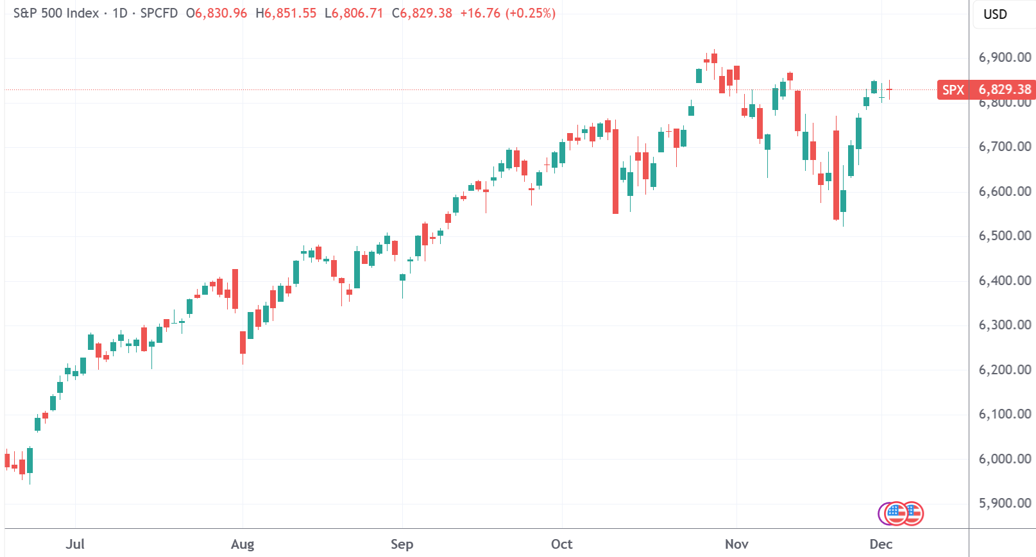
Market Overview - The cryptocurrency market has stabilized, leading to a rise in Bitcoin and tech stocks, which boosted trading sentiment and resulted in slight gains for the three major stock indices [1] - As of the market close, the S&P 500 index rose by 0.25% to 6829.37 points, the Nasdaq Composite increased by 0.59% to 23413.67 points, and the Dow Jones Industrial Average gained 0.39% to 47474.46 points [1] Market Sentiment and Predictions - The market is awaiting catalysts for a potential "Santa Rally," with more stocks declining than rising in the S&P 500 [3] - Analysts suggest that the market may need to consolidate before reaching new highs, with a mixed outlook for December [3] Stock Performance - Notable stock movements include Nvidia up by 0.86%, Apple up by 1.09%, and Boeing up by 10.15% due to expectations of returning to positive cash flow by 2026 [3][4] - Conversely, some stocks like Broadcom and Tesla saw declines of 1.17% and 0.21% respectively [3] Cryptocurrency and Related Stocks - Bitcoin's rebound of 6% positively impacted related stocks like MSTR and BMNR, while ABTC, linked to the Trump family, plummeted by 38% due to a lock-up expiration [6] - The Nasdaq China Golden Dragon Index fell by 0.65%, with Alibaba down by 1.91% and NIO down by 2.9% [6] Company Developments - Nvidia's CFO stated that the $100 billion investment in OpenAI has not yet been included in revenue guidance, as it is still in the letter of intent stage [7] - Amazon AWS launched its first 3nm AI chip, Trainium3, which boasts a performance increase of 4.4 times compared to its predecessor [8] - AWS also introduced a new large model training service, Nova Forge, allowing businesses to customize training with proprietary data [9] Philanthropic Initiatives - Dell's founders announced a donation of $6.25 billion to help establish investment accounts for 25 million American children, with each account receiving $250 [10]