
UBS(UBS)

Search documents
外资唱多中国股市
财联社· 2025-11-24 08:35
Core Viewpoint - The rise of Chinese stocks driven by artificial intelligence (AI) is not a bubble, as Chinese tech companies still have room to enhance valuations and profits through a focus on AI applications [1][3] Group 1: AI Investment and Market Dynamics - China is directing more funds towards AI applications compared to the U.S., leading to stronger short-term commercialization potential for AI in China [1] - The demand for AI-related products needs to be effectively converted into actual revenue by companies [1] - The optimistic sentiment surrounding China's emergence as an AI superpower has been fueled by the launch of efficient and low-cost AI models by startups like DeepSeek and major tech companies introducing new AI tools [1] Group 2: Valuation Comparisons - The total market capitalization of China's top ten tech companies is approximately $2.5 trillion, while their U.S. counterparts stand at $25 trillion, indicating a tenfold difference [3] - U.S. tech giants account for about 40% of the S&P 500 index's total market capitalization, whereas Chinese tech giants represent only around 15% [3] - The AI investment cycle in China is approximately 18 months behind that of the U.S., suggesting further growth potential and the possibility of translating this into profit and revenue growth [3] Group 3: Profit Growth and Market Outlook - Goldman Sachs forecasts a profit growth rate for Chinese companies of 12% to 13% next year, a significant increase from the current expectation of 2% to 3% [4] - After a 48% increase in the price-to-earnings ratio of the MSCI China Index since the end of 2022, future valuation adjustments are expected to slow to around 5% to 10% [4] - By 2027, Chinese stocks are projected to rise an additional 30% [4] - Factors contributing to profit growth include AI investment, overall GDP growth in China, anti-involution policies, and the globalization of Chinese companies [4] Group 4: Foreign Investment and Market Sentiment - Strong capital inflows from both domestic and international investors are expected to support the continuation of the bull market in Chinese stocks [5] - Global investors are increasingly willing to explore investment opportunities in China, recognizing the strong growth potential in the tech and AI sectors [5] - Clients from emerging markets such as Mexico, Chile, and the Middle East are actively investing in Chinese assets, viewing the tech sector as crucial for long-term growth and diversification [5] Group 5: Positive Outlook from Foreign Investment Banks - Despite recent pullbacks in global tech stocks, several foreign investment banks have expressed bullish views on Chinese stocks [6] - Morgan Stanley predicts that Chinese stocks will continue to rise through 2026, maintaining the strong momentum seen this year [7] - JPMorgan analysts indicate that the recovery of Chinese tech stocks from their lows is still in its early stages, with significant growth potential driven by tech companies and Hong Kong stocks [7] - UBS anticipates another fruitful year for Chinese stocks in 2026, supported by favorable factors including developments in innovative sectors [7]



中国医疗保健:专家电话会议核心要点-跨国企业如何看待中国医药市场、创新与资产-China Healthcare_ Expert call takeaways_ How do MNCs view China‘s pharma market, innovation and assets_
2025-11-24 01:46
Summary of Expert Call on China's Pharma Market Industry Overview - **Industry**: Pharmaceutical Industry in China - **Focus**: Multinational Corporations (MNCs) and their strategies in the Chinese market Key Insights 1. **Long-term Strategic Focus**: China is viewed as a top-five market for MNCs due to its large population and aging demographics, maintaining its strategic importance despite cost control policies impacting revenue growth [2][8][9] 2. **Cost Control Policies**: Policies like Value-Based Pricing (VBP) and Diagnosis-Related Groups (DRG) have led MNCs to shift focus from off-patent drugs to innovative drug sales, akin to a "patent cliff" scenario [3][8] 3. **Out-of-Pocket (OOP) Market**: MNCs are prioritizing the OOP market, which, despite higher prices compared to National Reimbursement Drug List (NRDL) drugs, has seen reduced patient costs through assistance programs and commercial insurance [3][10][11] 4. **In-Licensing Strategies**: MNCs are increasingly in-licensing innovative assets from China, driven by the improving quality of Chinese clinical trial data and faster development speeds [4][12][14] 5. **Collaboration Models**: New collaboration models are emerging, such as establishing NewCos and co-development agreements, as Chinese firms seek international R&D expertise [15][12] 6. **Regulatory Environment**: The Chinese pharmaceutical market is highly regulated, with ongoing refinements to policies like VBP, which now emphasizes drug quality [9][18] Additional Considerations 1. **Impact of CIDL**: The newly launched Commercial Insurance Innovative Drug List (CIDL) negotiations are expected to unlock growth opportunities for innovative drugs, particularly high-cost treatments [2][9] 2. **Geopolitical Factors**: MNCs are less focused on geopolitical factors when in-licensing Chinese assets, prioritizing therapeutic fit and strategic alignment instead [14] 3. **Quality of Clinical Trials**: MNCs maintain high standards for clinical trial data, with increasing investments in Chinese assets reflecting confidence in the quality of local clinical data [13][12] 4. **Risks in the Market**: Potential risks include unexpected price cuts from Group Purchasing Organizations (GPOs), intensified competition, and stricter regulations [18] This summary encapsulates the insights from the expert call regarding the evolving landscape of the pharmaceutical industry in China, highlighting both opportunities and challenges for MNCs operating in this market.

瑞银警示明年或面临四大风险,持续看好黄金为避险工具
Ge Long Hui A P P· 2025-11-24 01:31
Core Insights - AI is expected to remain a major market driver in 2024, but investors should be cautious of potential bubble risks [1] - By the end of 2026, global stock markets are projected to rise by approximately 15% due to favorable financial conditions supporting economic growth [1] Risk Factors - Four significant risks are anticipated by 2026: slower-than-expected AI adoption, resurgence of inflation, deepening US-China strategic competition, and the re-emergence of sovereign or private sector debt issues [1] - The expectation of US interest rate cuts is likely to suppress the dollar, while gold is viewed as a continued safe-haven asset [1]
专访瑞银财富管理中国区主管吕子杰:财富管理从来不是单一维度的金融投资
Mei Ri Jing Ji Xin Wen· 2025-11-23 15:48
Core Insights - The Chinese wealth management market is experiencing significant growth, with increasing importance in the global landscape, necessitating a reevaluation of asset allocation strategies in a complex geopolitical and economic environment [1] Group 1: Stock Allocation Value - High-net-worth clients in China prioritize asset value stability, often preferring to hold cash due to market risk aversion, but low interest rates make cash savings insufficient against inflation [2] - Asset allocation can enhance overall return potential while controlling risk; for conservative clients, a significant portion of funds is allocated to cash-like assets rather than pure cash [2] - UBS suggests a stock allocation of around 25% for Chinese clients, focusing on timing and sector selection rather than broad market entry [3] Group 2: Alternative Investments - Family offices are increasingly allocating 14% to 15% of their portfolios to alternative investments, up from single-digit percentages, despite their lower liquidity and longer investment horizons [4] - UBS recommends a diversified asset portfolio that includes 14% to 15% in alternative investments, alongside mid-term bonds and cash [4] Group 3: Gold Asset Allocation - Gold is viewed as a long-term investment rather than a short-term speculative asset, with central banks expected to purchase 900 to 950 tons of gold in 2025, maintaining a strong demand [5] - UBS forecasts a target gold price of $4,200 per ounce in the next 12 months, suggesting a 5% allocation to gold with a strategy of gradual investment rather than lump-sum purchases [5] Group 4: Art Collection - Wealth management encompasses not only financial investments but also personal and family needs, with art collection becoming a significant aspect of family legacy and value expression [6] - High-net-worth individuals are projected to allocate 20% of their wealth to art by 2025, with Chinese ultra-high-net-worth individuals leading at 44% [6] Group 5: Wealth Management Strategy - UBS aims to assist clients in achieving the "3L" goals: Liquidity, Longevity, and Legacy, with over $6.9 trillion in global investment assets [7] - The firm has over 15 years of experience in wealth management for high-net-worth clients in China, utilizing differentiated services through UBS Securities and UBS Switzerland [7] Group 6: Greater Bay Area Strategy - UBS emphasizes the importance of functional collaboration and institutional integration in the Greater Bay Area, leveraging Hong Kong's status as a financial hub to enhance cross-border business [8] - The firm focuses on serving high-net-worth and ultra-high-net-worth clients in China while connecting them to global opportunities [8] Group 7: Unique Value Proposition - UBS differentiates itself from other brokers and banks by offering unique value propositions and service dimensions [9]
韧性、创新、稳定、开放 国内外机构看好中国经济增长前景
Yang Shi Wang· 2025-11-23 03:19
Core Viewpoint - Multiple domestic and foreign institutions have released strategy reports for 2026, indicating that China's economy will continue to show steady growth next year [1][2]. Economic Growth Outlook - There is a positive consensus among various institutions regarding China's economic trajectory in 2026, driven by policy support, structural upgrades, and the release of potential [2]. - Morgan Stanley predicts moderate growth for China's economy in 2026 under a backdrop of appropriate easing policies and gradual rebalancing [2]. - UBS expects more precise policy support in 2026, contributing to resilient economic activity [2]. Export and Manufacturing Resilience - Exports remain a core support for economic growth, with strong resilience observed in manufacturing and exports [3]. - Analysts from various institutions believe that China's "going global" strategy will further enhance profit growth opportunities for enterprises [3]. Domestic Demand and Consumption - The potential of the domestic market is accelerating, with a series of consumption-boosting policies expected to play a key role in expanding domestic demand [4]. - The rise of new consumption sectors is injecting fresh momentum into economic growth, with a focus on brands gaining market recognition and expanding overseas [5]. Key Economic Themes - Resilience, innovation, stability, and openness are identified as key themes for the Chinese economy [6]. - The shift from traditional factor-driven growth to technology-driven growth is highlighted, with a focus on emerging technologies like AI and quantum technology [6][7]. - The stability of domestic policies is seen as a solid foundation for innovation and a crucial guarantee for steady economic progress [8]. Financial Sector Insights - Institutional openness and sustainable development concepts are viewed as vital for the continuous vitality of China's economy in the context of open cooperation [9].
Analog Devices to Participate in the UBS Global Technology Conference
Prnewswire· 2025-11-21 21:00
The webcast for the conference may be accessed live via the Investor Relations section of Analog Devices' website at investor.analog.com. An archived replay will also be available following the webcast for at least 30 days. About Analog Devices, Inc. Analog Devices, Inc. (NASDAQ: ADI) is a global semiconductor leader that bridges the physical and digital worlds to enable breakthroughs at the Intelligent Edge. ADI combines analog, digital, and software technologies into solutions that help drive advancements ...


瑞银:预计下周数据表现将足够疲软 推高美联储年底前降息概率
Sou Hu Cai Jing· 2025-11-21 14:40
Core Viewpoint - UBS Global Wealth Management strategists predict a potential weakening of the US dollar due to anticipated weak economic data to be released next week [1] Economic Data Summary - Key economic indicators to be released include retail sales, consumer confidence, and existing home sales on Tuesday, followed by durable goods orders, weekly initial jobless claims, and new home sales on Wednesday [1] - The strategists believe that the upcoming data will be weak enough to raise market expectations for a rate cut in December, which could put downward pressure on the dollar by year-end [1]
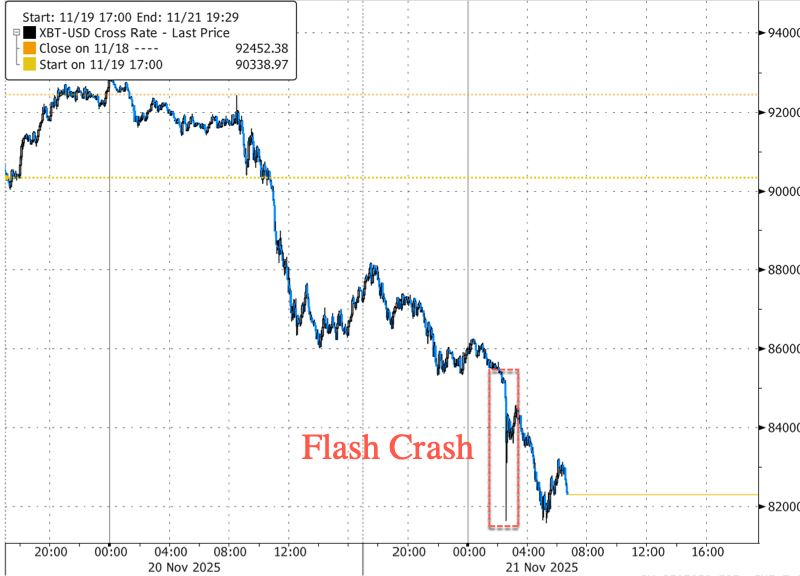
比特币闪崩跌破8.2万美元,瑞银:需要"彻底洗盘"才能转向乐观
Hua Er Jie Jian Wen· 2025-11-21 13:47
Core Viewpoint - Bitcoin is experiencing a significant decline, heading towards its worst monthly performance since 2022, with UBS warning that the market may need to undergo a "thorough washout" before turning optimistic [1][12]. Market Performance - On November 21, Bitcoin dropped as much as 6% to $81,500, with Ethereum and other smaller tokens also experiencing deep declines. Bitcoin's cumulative drop for the month has reached approximately 25% [1][4]. - The current prices of major cryptocurrencies include Bitcoin at $83,545.25, Ethereum at $2,733.81, and XRP at $1.91, all showing significant percentage declines over various time frames [3]. Market Dynamics - The recent crash led to nearly $1 billion in positions being liquidated during overnight trading, raising concerns about a deepening bear market in the cryptocurrency sector [4][8]. - The market is currently characterized by forced liquidations, liquidity shortages, and extreme panic, despite some positive factors such as increasing institutional adoption and favorable political attitudes towards cryptocurrencies [7][12]. Analyst Insights - UBS analyst George Redma indicated that the ongoing decline could force retail investors to sell their holdings, suggesting that a complete washout may be necessary for the market to adopt a more positive stance by year-end [6][12]. - Comparisons have been made to the cryptocurrency market crash in June 2022, with analysts noting that the current situation mirrors that period, dominated by forced liquidations and extreme fear [6][12]. - Morgan Stanley analysts have pointed out potential risks for companies like MicroStrategy (MSTR) due to upcoming MSCI and Nasdaq reviews, which could further impact market sentiment [11].
QUANTA SERVICES TO PARTICIPATE IN THE UBS GLOBAL INDUSTRIALS AND TRANSPORTATION CONFERENCE
Prnewswire· 2025-11-21 11:55
Core Viewpoint - Quanta Services, Inc. will participate in the UBS Global Industrials and Transportation Conference on December 2, 2025, where management will engage with institutional investors and participate in a live fireside chat [1] Group 1: Company Participation - Duke Austin, CEO, and Jayshree Desai, CFO, will represent the company at the conference [1] - The fireside chat will be hosted by UBS research analyst Steve Fisher at 10:30 a.m. Eastern time on the same day [1] - Live webcast links and archived replays will be available on Quanta's Investor Relations website [1] Group 2: Company Overview - Quanta Services is a leader in providing specialized infrastructure solutions across various industries, including utility, renewable energy, technology, communications, pipeline, and energy [2] - The company offers comprehensive services such as designing, installing, repairing, and maintaining energy and communications infrastructure [2] - Quanta operates in the United States, Canada, Australia, and select international markets, equipped with the necessary manpower and resources to handle projects of varying scopes [2]


当前股票、黄金和另类资产如何配置?专访瑞银财富管理吕子杰:财富管理从不是单一维度的金融投资
Mei Ri Jing Ji Xin Wen· 2025-11-21 11:44
Core Insights - The Chinese wealth management market is experiencing significant growth, with increasing importance in the global landscape, necessitating a reevaluation of asset allocation strategies in light of geopolitical and economic changes [1] - UBS Wealth Management's China head, Lu Zijie, emphasizes the need for a diversified asset portfolio that balances returns and liquidity, particularly in the context of rising gold prices and alternative investment opportunities [1] Investment Strategy - High-net-worth clients in China prioritize asset stability, often preferring cash holdings due to market risk aversion; however, low interest rates make cash savings insufficient against inflation [2] - Asset allocation should focus on risk control while enhancing overall return potential; for conservative clients, medium to long-term bonds are recommended as they typically yield higher returns than cash deposits [2] - UBS remains optimistic about stock investments but advises careful timing and sector selection due to significant market gains in the US, Hong Kong, and A-shares [2][3] Sector Preferences - In the US, UBS favors sectors with strong fundamentals such as healthcare and banking, while in Europe, high-dividend assets like REITs are preferred; in Asia, technology and AI sectors in Hong Kong and high-performing companies in mainland China are highlighted [3] - The recommended stock allocation for Chinese clients is around 25% to maintain stable growth without excessive market volatility [3] Alternative Investments - Family offices are increasing their allocation to alternative investments, rising from single-digit percentages to 14%-15%, which enhances portfolio stability despite lower liquidity [4] - Gold is viewed as a long-term investment rather than a short-term speculation, with central banks expected to maintain significant gold purchases, projected at 900-950 tons in 2025 [5] Art Investment - Art collection is evolving from a passion to a significant aspect of family legacy and value expression, with high-net-worth individuals expected to allocate 20% of their wealth to art by 2025, up from 15% in 2024 [6] - The Chinese ultra-high-net-worth demographic leads in art investment, with an average allocation of 44% of their wealth to art, reflecting a strong cultural and emotional connection to their collections [6] UBS's Wealth Management Position - UBS has a long-standing history in wealth management, with global investment assets totaling $6.9 trillion and $4.7 trillion specifically in wealth management, making it the largest in Asia [7] - The firm aims to assist clients in achieving liquidity, longevity, and legacy through differentiated services tailored to high-net-worth individuals in China [7][8] - UBS's integrated banking model enhances its ability to serve the Greater Bay Area, leveraging its extensive experience in Hong Kong and connections with Shenzhen and Guangzhou [8][9]