
XPENG(XPEV)

Search documents
美股收盘:三大指数震荡收高,光通信牛股再创新高
Feng Huang Wang· 2025-12-02 23:21
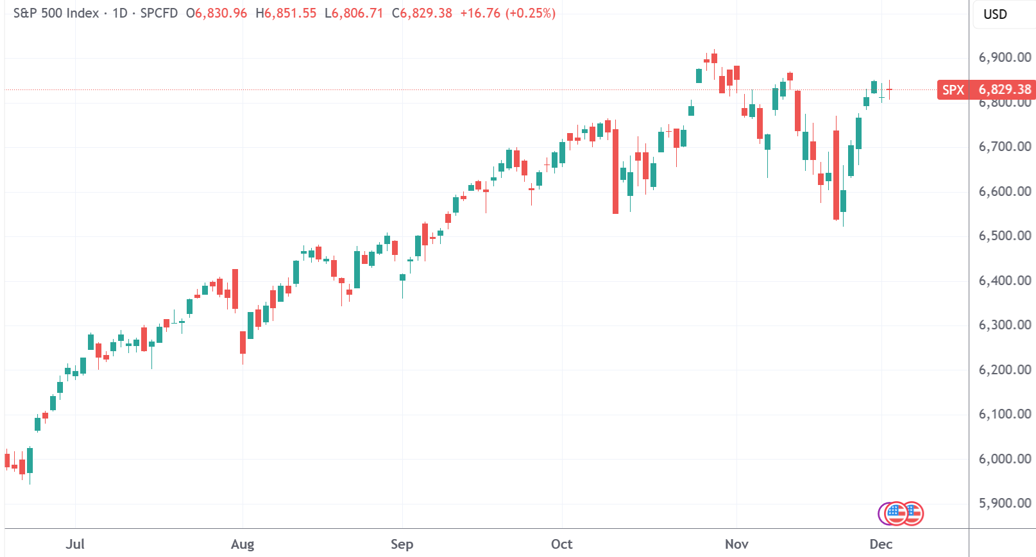
Market Overview - The cryptocurrency market has stabilized, leading to a rise in Bitcoin and tech stocks, which boosted trading sentiment and resulted in slight gains for the three major stock indices [1] - As of the market close, the S&P 500 index rose by 0.25% to 6829.37 points, the Nasdaq Composite increased by 0.59% to 23413.67 points, and the Dow Jones Industrial Average gained 0.39% to 47474.46 points [1] Market Sentiment and Predictions - The market is awaiting catalysts for a potential "Santa Rally," with more stocks declining than rising in the S&P 500 [3] - Analysts suggest that the market may need to consolidate before reaching new highs, with a mixed outlook for December [3] Stock Performance - Notable stock movements include Nvidia up by 0.86%, Apple up by 1.09%, and Boeing up by 10.15% due to expectations of returning to positive cash flow by 2026 [3][4] - Conversely, some stocks like Broadcom and Tesla saw declines of 1.17% and 0.21% respectively [3] Cryptocurrency and Related Stocks - Bitcoin's rebound of 6% positively impacted related stocks like MSTR and BMNR, while ABTC, linked to the Trump family, plummeted by 38% due to a lock-up expiration [6] - The Nasdaq China Golden Dragon Index fell by 0.65%, with Alibaba down by 1.91% and NIO down by 2.9% [6] Company Developments - Nvidia's CFO stated that the $100 billion investment in OpenAI has not yet been included in revenue guidance, as it is still in the letter of intent stage [7] - Amazon AWS launched its first 3nm AI chip, Trainium3, which boasts a performance increase of 4.4 times compared to its predecessor [8] - AWS also introduced a new large model training service, Nova Forge, allowing businesses to customize training with proprietary data [9] Philanthropic Initiatives - Dell's founders announced a donation of $6.25 billion to help establish investment accounts for 25 million American children, with each account receiving $250 [10]


【汽车】年底旺季效应趋弱,小鹏首款超级增程车型X9上市——新势力11月销量跟踪报告(倪昱婧/邢萍)
光大证券研究· 2025-12-02 23:06
点击注册小程序 查看完整报告 特别申明: 本订阅号中所涉及的证券研究信息由光大证券研究所编写,仅面向光大证券专业投资者客户,用作新媒体形势下研究 信息和研究观点的沟通交流。非光大证券专业投资者客户,请勿订阅、接收或使用本订阅号中的任何信息。本订阅号 难以设置访问权限,若给您造成不便,敬请谅解。光大证券研究所不会因关注、收到或阅读本订阅号推送内容而视相 关人员为光大证券的客户。 报告摘要 11月新势力交付数据披露: 1)小鹏交付量同比+18.9%/环比-12.6%至36,728辆;2)蔚来交付量同比+147.9%/环比-10.2%至36,275辆 (NIO品牌同比+18.7%/环比+8.9%至18,393辆、乐道品牌同比+132.1%/环比-32.0%至11,794辆);3)理想 交付量同比-31.9%/环比+4.5%至33,181辆。 小鹏首款超级增程车型X9上市: 11/20小鹏大七座MPV X9超级增程车型正式上市,上市1小时突破X9历史全天大定纪录。我们判断,小鹏 通过"大电池+全域高压平台"打造增程技术差异化,小鹏有望通过陆续推出更多超高性价比的"一车双 能"车型覆盖更多细分市场。 年终各车企购车优惠 ...



热门中概股收盘多数下跌 小鹏汽车跌近8%
Xin Lang Cai Jing· 2025-12-02 21:42
周二热门中概股收盘多数下跌,纳斯达克中国金龙指数跌0.65%。亚朵集团涨超5%,老虎证券涨超 1%,理想、京东、搜狐小幅收涨。小鹏汽车跌近8%,爱奇艺跌超3%,蔚来、万国数据、哔哩哔哩、金 山云跌超2%,阿里巴巴、网易、中通跌超1%,百度小幅收跌。 来源:滚动播报 ...
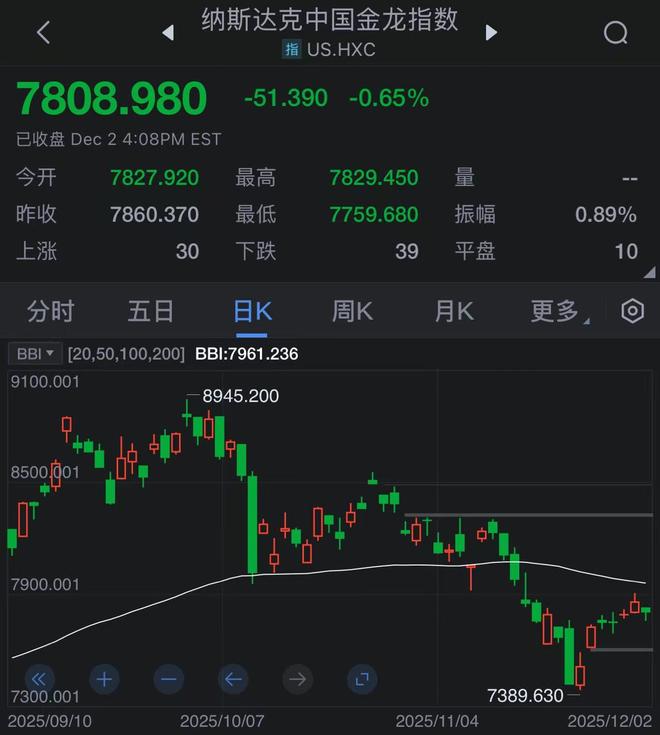
纳斯达克中国金龙指数收跌0.65%,热门中概股多数下跌
Mei Ri Jing Ji Xin Wen· 2025-12-02 21:14
Group 1 - The Nasdaq China Golden Dragon Index fell by 0.65% on December 3rd, indicating a downward trend in popular Chinese concept stocks [1] - Notable gainers included Atour, which rose over 5%, and Tiger Securities, which increased by over 2% [1] - Significant decliners included XPeng Motors, which dropped over 7%, and iQIYI, which fell over 3%, along with NIO, Global Data, and Bilibili, each declining over 2% [1] Group 2 - Alibaba, NetEase, and ZTO Express each experienced a decline of over 1% [1]

Top Stock Movers Now: Boeing, Intel, Sandisk, and More
Investopedia· 2025-12-02 17:15
Market Overview - Major U.S. equities indexes experienced gains, with the Dow Jones Industrial Average rising by 0.3%, the S&P 500 increasing by 0.2%, and the Nasdaq climbing by 0.4% [1] Company Highlights - Boeing (BA) shares surged by 8% after the new CFO announced at a UBS conference that the company's production ramp-up plan is on schedule, following previous safety issues that had significantly slowed production last year. Boeing also expects to generate positive free cash flow next year after incurring substantial losses over the past two years [2] - Intel (INTC) stock rose by 7% as the company revealed plans to invest approximately $200 million to expand its manufacturing operations in Malaysia. This increase follows a rally initiated by reports suggesting that Apple (AAPL) could become a significant customer for Intel [3] - MongoDB (MDB) shares jumped nearly 25% after the company reported quarterly results that exceeded estimates and raised its full-year forecasts, following the appointment of a new CEO [3] - XPeng (XPEV), a Chinese electric vehicle manufacturer, saw its U.S.-listed shares decline by 6% after reporting November sales data. The company delivered just under 37,000 EVs, marking a 19% increase year-over-year, but falling short of October's sales figures amid intense competition in the Chinese EV market [4] - Symbotic (SYM) shares fell by 16% after a significant rally of nearly 40% following last week's earnings report. The company had exceeded sales estimates and announced its first partnership with a medical supply company [5] - Sandisk (SNDK), a recent addition to the S&P 500, led the decliners on the index with a 5% drop [5] Commodity and Currency Update - Crude oil futures decreased by 0.5% to approximately $59.00 per barrel, while gold futures fell by 1.4% to around $4,212 per ounce. The yield on the 10-year Treasury note remained stable at about 4.09% [6]


新势力阵营展开“体系化能力”比拼
Zheng Quan Ri Bao Zhi Sheng· 2025-12-02 16:10
Core Insights - The Chinese new energy vehicle (NEV) market is experiencing a robust growth phase, with new force car manufacturers achieving record-high deliveries in November, indicating a maturation of the market [1] - The competition among NEV companies has shifted from relying on single popular models to a more systemic capability supporting multi-brand expansion [2][3] Group 1: Leading Brands - Leading new force car manufacturers continue to show strong growth, with a shift in growth logic towards systemic capabilities and multi-brand strategies [2] - Hongmeng Zhixing delivered 81,900 vehicles in November, benefiting from a comprehensive brand matrix and technological expansion, covering a price range from 150,000 to 1,000,000 yuan [2] - Leap Motor has consistently surpassed 70,000 deliveries for two consecutive months, focusing on cost structure optimization through self-research and electric drive platforms, establishing sustainable competitive advantages [2] Group 2: Emerging Players - Second-tier new force car manufacturers have also shown impressive performance, with several achieving historical best results, reflecting a clearer market segmentation [4] - Brands like Lantu, Zhiji, and Avita have seen significant growth, with Lantu surpassing 20,000 deliveries for the first time in November, indicating a broader acceptance of products centered around intelligent driving [5] - The competition is evolving from a head-dominated market to a multi-layered competition, with second-tier brands leveraging differentiated positioning to capture market share [5] Group 3: Market Dynamics - The expansion of the consumer base for NEVs is leading to a clear segmentation in user demand, with increasing interest in mid-to-large-sized vehicles, personalization, and intelligent driving features [4] - As the year-end approaches, manufacturers are expected to optimize sales through inventory control and rights management, with delivery capabilities and supply chain assurance becoming critical for year-end performance [5] - The core of competition is shifting towards building long-term, stable systemic capabilities, which will determine the leaders in the next phase of the market [5]
国内车企11月销量,“冰火两重天”
DT新材料· 2025-12-02 16:05
Core Viewpoint - The domestic automotive industry is experiencing a "two extremes" situation in November, with some leading companies showing a decline in sales while others report significant growth [2]. Group 1: Sales Performance - BYD's November sales reached 480,186 units, a year-on-year decrease of 5.25%, with domestic sales down by 26.81% [3][4]. - SAIC Group and Geely's new energy vehicle sales in November were 209,401 units and 187,798 units, respectively, showing year-on-year growth of 19.75% and 53.36% [3][4]. - Geely's high-end new energy vehicle brand, Galaxy, achieved sales of 132,700 units, a remarkable year-on-year increase of 76% [3]. - New car manufacturers like Leap Motor, Xiaomi Auto, and Xpeng Auto have completed their annual delivery targets ahead of schedule, with Xpeng achieving a 100% year-on-year growth, totaling 380,200 units [3]. - Lantu and Avita, state-owned new energy vehicle companies, reported record monthly sales of 20,005 units and 14,057 units, reflecting year-on-year growth of 84.28% and 25.29% respectively [3][4]. Group 2: Market Trends - The overall sales performance in November 2025 is weaker compared to November 2024, indicating potential short-term disruptions due to various factors [3]. - The implementation of the new energy vehicle purchase tax subsidy reduction starting January 1, 2026, is prompting companies to accelerate sales efforts by the end of 2025 [3].





美股异动 | 热门中概股普跌 小鹏汽车(XPEV.US)跌近6%
智通财经网· 2025-12-02 15:41
智通财经APP获悉,周二,纳斯达克金龙指数跌逾1%,热门中概股普跌,阿特斯太阳能(CSIQ.US)跌逾 10%,小鹏汽车(XPEV.US)跌近6%,阿里巴巴(BABA.US)跌逾2%。 ...


Li Auto ($LI) | NIO ($NIO) | XPeng ($XPEV) | ZEEKR Intelligent Technology ($ZK)
Youtube· 2025-12-02 13:55
Core Insights - The electric vehicle (EV) market is experiencing significant growth, with multiple companies reporting strong delivery numbers for November 2023 Company Performance - Lee Auto delivered 33,000 vehicles in November, bringing its total cumulative deliveries to nearly 1.5 million [1] - Neo sold 36,000 vehicles in November, marking a 76% year-over-year increase, with cumulative deliveries reaching 949,000 [2] - Xpang delivered 36,000 smart EVs in November, a 19% year-over-year increase, with total deliveries for the first 11 months of 2023 reaching almost 400,000 units, a 156% increase from the previous year [3] - Zeer Intelligent Technology reported 63,900 vehicles delivered in November, up 7% year-over-year [3] - Zeke and Link combined saw 63,000 deliveries, supported by over 2 million cumulative users [4] Market Trends - The growth in vehicle deliveries is driven by strong performance across various brands within the companies, indicating a competitive landscape focused on technology and product innovation [2][3] - The expansion of retail service and charging networks is a strategic focus for companies aiming for long-term competitiveness in the EV market [2]
小鹏汽车携手华为 小鹏X9超级增程全球首发华为DriveONE下一代增程发电机
Zheng Quan Ri Bao Zhi Sheng· 2025-12-02 13:48
Core Insights - Xiaopeng Motors and Huawei jointly launched the next-generation range extender generator, DriveONE, at a media technology sharing event, setting a new technical benchmark for the industry with a power density of 1.88 kW/kg and an efficiency of ≥92% [1][2][3] Group 1: Product Features - The Xiaopeng X9 Super Range Extender redefines "next-generation range extension" with a combination of ultra-fast charging large battery and a large fuel tank, targeting global family users [2][3] - The DriveONE generator is designed to meet high-performance standards, including long pure electric range, fast charging speed, sufficient power during low battery, low comprehensive energy consumption, low noise, and high spatial integration [2][3] - The generator achieves a power density exceeding 40% compared to industry standards, with a maximum power output of 85 kW, ensuring ample power during high-load scenarios [4][6] Group 2: Technical Innovations - The DriveONE generator features advanced technologies such as multi-slice oil cooling and precise active cylinder stop technology, reducing noise and vibration by over 60% during start-stop operations [4][7] - The generator's efficiency is rated at ≥92% for operational power generation and 3.6 kWh/L for fuel power generation, contributing to a comprehensive range of 1602 km, the longest in its class [6][7] - The system is designed to maintain stable and smooth operation across various driving conditions, ensuring a quiet and reliable range extension experience [4][6] Group 3: Collaborative Development - The collaboration between Xiaopeng Motors and Huawei addresses significant technical challenges in the development of the X9 Super Range Extender, particularly in optimizing space without compromising passenger comfort [5][6] - The integration of the generator and electronic control systems has led to a compact design, achieving a front cabin space utilization breakthrough [5][6]