
XPENG(XPEV)

Search documents
小鹏员工生三胎奖励3万元,生育基金累计发放超370万
Sou Hu Cai Jing· 2025-12-02 11:39
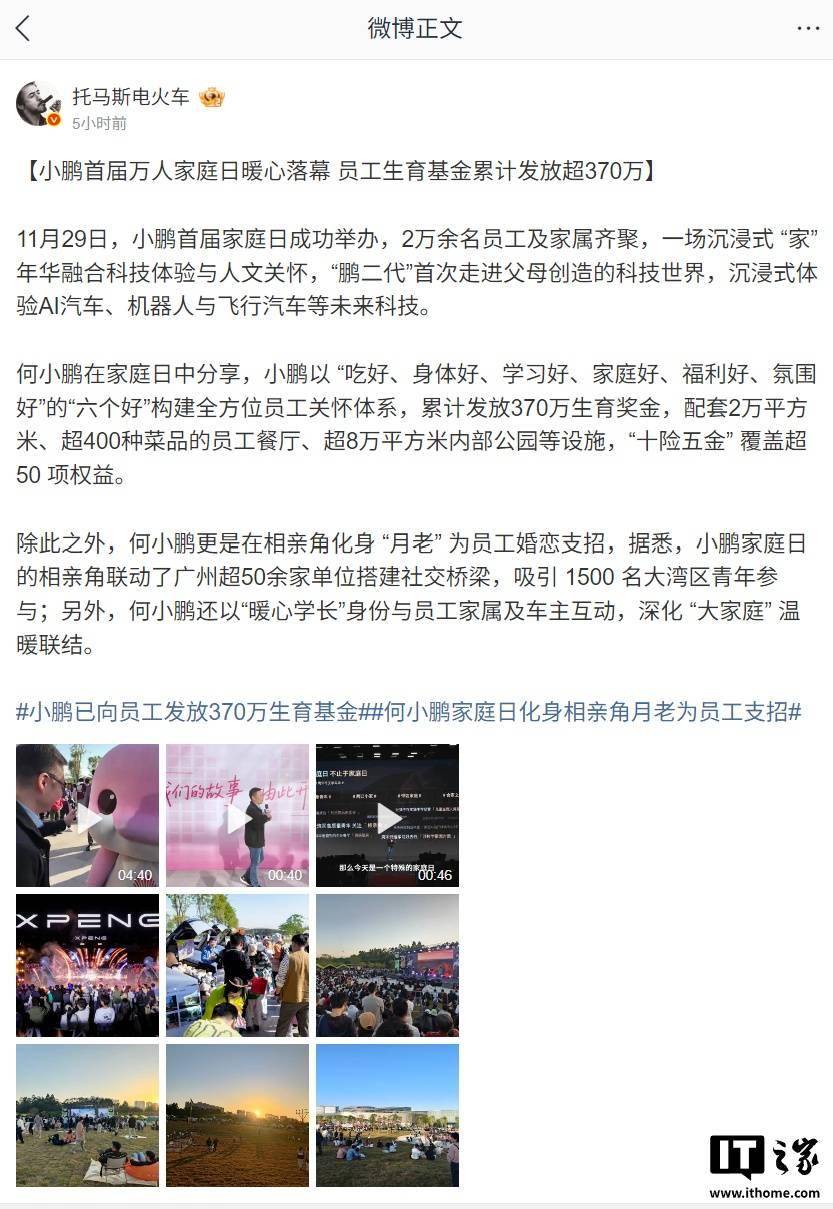
Group 1 - The core event was the successful hosting of the first family day by XPeng Motors on November 29, attracting over 20,000 employees and their families [3] - The company has distributed over 3.7 million in maternity funds and has established a comprehensive employee care system, including a 20,000 square meter cafeteria with over 400 types of dishes and an internal park covering over 80,000 square meters [3][4] - XPeng's chairman, He Xiaopeng, participated in a matchmaking event, connecting over 50 organizations in Guangzhou and attracting 1,500 young people from the Greater Bay Area [3][4] Group 2 - The company has announced three employee care plans, providing 10,000 for families with one or two newborns and 30,000 for families with three or more newborns [6] - He Xiaopeng has previously emphasized the encouragement of employee childbirth, offering increasing rewards for families with multiple children [6]


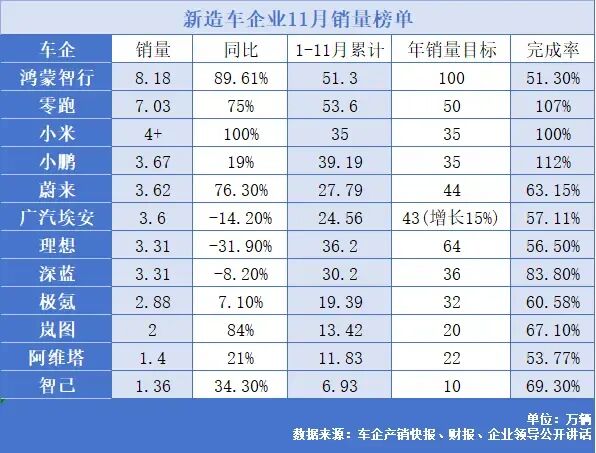
倒计时30天:2025年新造车企业谁能如愿收尾?
3 6 Ke· 2025-12-02 10:50
| | | | 新造车企业11月销量榜单 | | | | --- | --- | --- | --- | --- | --- | | 车企 | 销量 | 同比 | 1-11月累计 | 年销量目标 | 完成率 | | 鸿蒙智行 | 8. 18 | 89.61% | 51.3 | 100 | 51. 30% | | 零跑 | 7.03 | 75% | 53. 6 | 50 | 107% | | 小米 | 4+ | 100% | 35 | 35 | 100% | | 小腸 | 3.67 | 19% | 39. 19 | 35 | 112% | | 蔚来 | 3.62 | 76. 30% | 27.79 | 44 | 63. 15% | | 广汽埃安 | 3.6 | -14. 20% | 24. 56 | 43(增长15%) | 57. 11% | | 理想 | 3.31 | -31. 90% | 36. 2 | 64 | 56. 50% | | 深蓝 | 3.31 | -8. 20% | 30. 2 | 36 | 83. 80% | | 极氨 | 2. 88 | 7. 10% | 19. 39 | 32 | 60. ...


小鹏X9超级增程携手华为打造下一代增程发电机
Zheng Quan Shi Bao Wang· 2025-12-02 10:41
Core Insights - Xiaopeng Motors and Huawei jointly launched the Xiaopeng X9 Super Extended Range vehicle, featuring the Huawei DriveONE high-integration high-voltage oil-cooled generator, setting a benchmark for the next generation of extended range technology [1][2] - The Xiaopeng X9 aims to redefine the concept of "next-generation extended range" with its combination of ultra-fast charging large battery and a large fuel tank [1] - The new generator boasts an industry-leading continuous power density of 1.88 kW/kg and an efficiency of ≥92%, addressing existing pain points in traditional extended range systems [1] Company Developments - Xiaopeng Motors, previously focused on pure electric vehicles, is now venturing into the extended range market with the launch of the Xiaopeng X9 Super Extended Range [1][2] - The collaboration with Huawei on the DriveONE generator represents a significant technological advancement, overcoming challenges related to space layout, long-range capabilities, and power generation efficiency [1] Industry Trends - The Chinese electric vehicle market is experiencing a shift in technological strategies, with companies like Xiaopeng Motors and Li Auto adjusting their focus between pure electric and extended range technologies [2] - This "technical route adjustment" is expected to continue, benefiting consumers and the overall industry as multiple technological pathways compete under the goal of carbon neutrality [2]
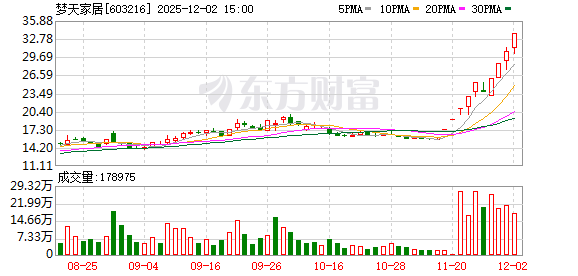
10天7板!603216,盘后紧急发声
Zheng Quan Shi Bao· 2025-12-02 09:56
Market Overview - A-shares experienced a broad pullback, with the ChiNext Index dropping over 1% and the Shanghai Composite Index closing down 0.42% at 3897.71 points [2] - The total trading volume in the Shanghai and Shenzhen markets was 16,073 billion yuan, a decrease of over 280 billion yuan compared to the previous day [2] - The technology sector, including semiconductor and brokerage stocks, collectively retreated, while consumer sectors like retail and food & beverage saw gains [2] Sector Performance - The food and beverage sector showed strong performance, with stocks like Hai Xin Food and An Ji Food hitting the daily limit, and Xue Tian Salt Industry rising nearly 5% [4][5] - The home furnishing sector also performed well, with stocks such as Hao Li Ke and Meng Tian Home hitting the daily limit, and Meng Tian Home achieving a cumulative increase of approximately 114% over the last 10 trading days [7] Conceptual Trends - The cross-strait integration concept saw significant gains, with stocks like Jia Rong Technology and Zhao Biao Shares hitting the daily limit, supported by new policies from the Fujian government aimed at promoting cross-strait development [10][12] - Fujian's government announced 12 new policy measures to support Taiwanese enterprises, including land and sea guarantees for Taiwanese businesses and tax service optimizations [12][13] Company-Specific Developments - Yun Zong Technology experienced a sharp decline, hitting the daily limit down after a significant increase of over 90% in the previous six trading days [14][16] - The company confirmed that its main business operations remain normal, focusing on consumer electronics and automotive electronics, with no major changes in market conditions or industry policies [16]




部分明星中概股美股盘前走低,小鹏汽车盘前跌4%
Mei Ri Jing Ji Xin Wen· 2025-12-02 09:28
Group 1 - Some prominent Chinese concept stocks in the US market experienced a decline in pre-market trading on December 2nd [1] - Xiaopeng Motors saw a pre-market drop of 4% [1] - Alibaba and Bilibili also faced declines, with drops of 1.4% and 1.3% respectively [1]


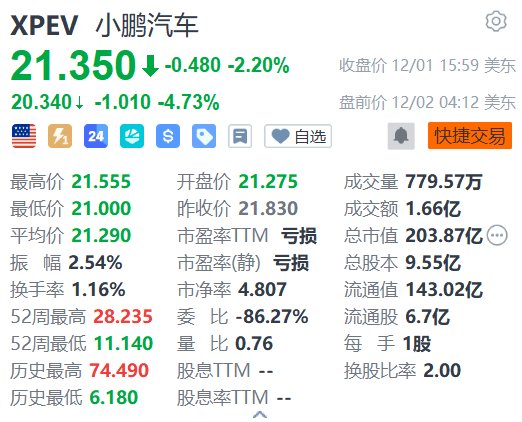
美股异动丨小鹏汽车盘前跌逾4% 11月交付量环比下降12.58%
Ge Long Hui· 2025-12-02 09:23
| XPEV 小鹏汽车 | | O | | --- | --- | --- | | 21.350 4 -0.480 -2.20% | | 收盘价 12/01 15:59 美东 | | 20.340 + -1.010 -4.73% | | 盘前价 12/02 04:12 美东 | | 一 52 24 9 8 8 | | ● 快捷交易 | | 最高价 21.555 | 开盘价 21.275 | 成交量 779.57万 | | 最低价 21.000 | 昨收价 21.830 | 成交额 1.66亿 | | 平均价 21.290 | 市盈率TM 亏损 | 总市值 203.87亿 (... ) | | 振 幅 2.54% | 市盈率(静) 亏损 | 总股本 9.55亿 | | 换手率 1.16% | 市净率 4.807 | 流通值 143.02亿 | | 52周最高 28.235 | 委 比 -86.27% | 流通股 6.7亿 | | 52周最低 11.140 | 量 比 0.76 | 色 主 1龄 | | 历史最高 74.490 | 股息TTM -- | 换股比率 2.00 | | 历史最低 6.180 | 股息率 ...
部分明星中概股美股盘前走低
Ge Long Hui A P P· 2025-12-02 09:15
Group 1 - Xiaopeng Motors saw a pre-market decline of 4% [1] - Alibaba experienced a drop of 1.4% [1] - Bilibili's stock fell by 1.3% [1]
普利特:公司是小鹏汽车的核心材料供应商和战略合作伙伴
Zheng Quan Ri Bao Zhi Sheng· 2025-12-02 09:07
Core Viewpoint - The company is a leading provider of modified polymer material solutions in China and serves as a core material supplier and strategic partner for XPeng Motors, contributing to the innovation and development of smart vehicles [1] Group 1: Company Overview - The company supplies materials for multiple XPeng models, including M03, P7, G6, and G9, supporting XPeng's continuous innovation in the smart automotive sector [1] Group 2: Industry Focus - The company is closely monitoring the rapid development of the robotics industry and emphasizes the application of new materials in areas such as lightweighting and functionality, replacing steel with plastics [1] - The company's materials can be utilized in humanoid robots for components like joints, bearings, gears, skeletal support parts, structural components, and skin [1] - The company is actively collaborating with relevant clients to develop and validate the use of its materials in the humanoid robotics sector [1]

硅基革命重构竞争格局:中国智驾的攻与守
Mei Ri Jing Ji Xin Wen· 2025-12-02 09:00
Group 1 - The global automotive industry is facing unprecedented challenges, with over 55,000 jobs lost in the past two years in Germany alone, and more than 100,000 layoffs reported worldwide in the last year [1][2] - In contrast, China's automotive sector is thriving, with significant advancements in smart electric vehicles and a robust supply chain, positioning itself as a global leader in the industry [1][3] Group 2 - 2025 is seen as a critical year for automotive manufacturers, with a focus on survival in the face of electrification and the need for innovation in smart technologies [2][10] - China's automotive industry has rapidly evolved, achieving over 30 million annual vehicle sales and over 50% penetration of new energy vehicles, showcasing its ability to catch up and lead in the electric transformation [3][10] Group 3 - Major automotive companies are balancing tradition and innovation, with firms like Mercedes-Benz adapting to local markets while maintaining high safety and quality standards [4][5] - The innovation paths of foreign and Chinese companies are converging, with a blend of cautious planning and agile execution becoming the norm in the industry [5][6] Group 4 - A significant debate is ongoing regarding the technical routes for intelligent driving, with different approaches such as Tesla's vision-based system and Huawei's lidar-based system highlighting diverse innovation strategies [6][7] - The introduction of mandatory safety standards for L2-level driving assistance in China marks a shift towards a more regulated and safety-focused industry [8][9] Group 5 - The Chinese government is facilitating the development of L3-level autonomous driving, with expectations for standards to be established soon, indicating a strong push towards advanced automated driving technologies [10][11] - The competitive landscape in China's smart driving sector is characterized by a diverse ecosystem of companies, fostering innovation and adaptability across various scenarios [10][11]

小鹏汽车-W(09868.HK):11月交付36,728辆汽车 同比增长19%
Ge Long Hui· 2025-12-02 08:36
小鹏汽车-W(09868.HK)11月交付36,728辆汽车,同比增长19%。2025年1月至11月,小鹏汽车累计交付 量达391,937辆,同比增长156%。 ...