蓝氏

Search documents
宠物食品行业2026年展望
2026-02-10 03:24
Summary of Pet Food Industry Conference Call Industry Overview - The pet food market is experiencing sluggish overall growth, with leading OEM companies facing performance pressures due to a slowdown in pet consumption in China and major brands building their own supply chains, resulting in reduced OEM orders. The number of new brands entering the market is also declining [1][3][5]. - The concentration of domestic pet food brands is increasing, with the CR5 market share surpassing 30% and CR10 approaching 50%. This high concentration is raising the barriers for new brands entering the market, leading to diminishing opportunities [1][4][5]. Market Dynamics - Online channels such as Taotian, JD.com, and Pinduoduo dominate the market, accounting for approximately 70% of sales. In contrast, traditional offline channels are seeing a decline in sales, with their share dropping below 7% [1][6]. - Supermarkets and convenience stores are experiencing faster growth, although their absolute sales figures remain low. For example, the supermarket sector grew by about 5% compared to 2024 [1][6]. - Douyin (TikTok) as a sales channel has a dual nature; brands with strong content can acquire customers at a low cost, but traditional omnichannel brands struggle to achieve profitability on this platform [1][7]. Future Outlook - The pet food industry is expected to face destocking, defoaming, and a cooling off in 2026, leading to intense competition. Small enterprises will face significant challenges, while large channels like department stores and supermarkets are expected to grow [1][8]. - The industry is likely to see increased consolidation and mergers, particularly among supply chain companies with revenues of 200-500 million and brand companies with revenues of 100-300 million. New opportunities are anticipated in the medical field and functional products, such as prescription food for senior dogs [1][9]. Growth Drivers - The primary growth driver for the pet food market over the next three to five years will be volume growth, with an expected annual growth rate of 10%-15%. However, due to intense price competition, overall consumption growth is not expected to exceed 10% [2][16]. Competitive Landscape - The competition among high-end cat food brands during the 2025 Double Eleven shopping festival is expected to be fierce, with no significant decline in advertising spending anticipated in 2026 [12][13]. - Domestic brands have a competitive advantage in the prescription food sector, with the potential for both volume and price growth as new medical needs arise [17]. International Expansion - Chinese pet food brands face challenges in international markets, particularly in Southeast Asia, which has significant potential due to high pet ownership rates. However, they must overcome local market policies and competition from established Western brands [10][12][11]. E-commerce and Retail Trends - Alibaba's platforms, including Taobao, remain the most critical online channels for businesses. The application of AR systems to enhance customer service and operational efficiency is also seen as a key growth strategy [18]. - The instant retail sector is rapidly developing, with Meituan and other players capturing significant market shares. The scale of instant retail is expected to reach 4-4.5 billion yuan, with a year-on-year growth of 30%-40% [19][20]. Conclusion - The pet food industry is at a critical juncture, with increasing concentration, evolving consumer preferences, and the need for brands to adapt to a competitive landscape. Companies must focus on cost efficiency and explore new market opportunities to sustain growth in a challenging environment [1][8][9].
宠物板块-专业视角再探国内功能粮处方粮发展前景
2026-01-26 15:54
宠物板块:专业视角再探国内功能粮处方粮发展前景 20260126 国内哪些品牌在处方粮或功能粮方面有较大潜力? 在国内,目前有一些品牌已经开始涉足处方粮领域。例如东方澳龙(雷米高旗 下品牌)已经推出了处方粮产品。此外,还有许多国产品牌正在积极探索这一 领域,他们希望通过与专家合作来开发具有竞争力的产品。然而,目前这些品 牌在研发阶段还存在一定的不确定性,需要进一步观察其实际效果和市场表现。 摘要 处方粮研发的核心难点在于严格的临床验证,美国 FDA 对功效宣称有严 格规定,需投入大量资源进行临床试验和生产线建设,导致功能性宠物 食品较少,而国内监管相对空白,功能性宠物食品发展迅速。 国内宠物主人养宠经验相对较少,易导致宠物更早需要处方粮和功能粮。 国产品牌在研发新处方粮或轻功能粮方面具有很大潜力,但需关注超高 蛋白食品可能导致的健康问题。 国内多家品牌正在研发或计划推出处方粮和功能性食品,如乖宝、仙朗 等,但进展各异,部分品牌如中总明确表示没有相关计划,蓝氏具备一 定研发实力但暂无计划。 希尔斯与皇家等国际大厂在产品设计逻辑上存在差异,希尔斯更注重长 期健康影响,避免高盐等可能引发代谢疾病的成分,且对原材料有 ...
2025猫粮行业趋势:社媒热度、品牌营销与需求洞察-数说故事
Sou Hu Cai Jing· 2026-01-23 10:25
Core Insights - The Chinese cat food industry is expected to thrive in 2025, with the overall pet food market projected to reach approximately 175 billion yuan, reflecting a year-on-year growth of 14.4% and maintaining a compound annual growth rate (CAGR) of 10%-15% over the next five years [6][12][10] - The growth is primarily driven by the steady increase in the number of pet cats, projected to reach 124 million by 2025, alongside rising consumer spending per pet due to trends like "scientific pet care" and "pet humanization" [6][13][12] Market Trends - The market exhibits distinct characteristics of premiumization, diversification, and functionalization, with cat snacks, wet food, and freeze-dried products being the most popular segments [6][15] - Social media platforms have become crucial marketing battlegrounds, with Douyin accounting for 78.80% of interaction volume, highlighting its role as the core interactive platform [6][20][15] Brand Competition - The competitive landscape is being reshaped, with brands like NetEase Yanxuan, Royal Canin, and Myfoodie leading in social media interaction volume [2][28] - Domestic brands are gaining market share through insights into local consumer needs, supply chain upgrades, and innovative marketing strategies, intensifying competition with international brands [2][28] Consumer Demand Insights - The "scientific feeding" concept has deeply resonated with consumers, who now demand high-quality, traceable ingredients, and high animal protein content (≥80%) in cat food [7][28] - New pet owners, referred to as "newbie cat owners," are increasingly seeking knowledge through social media, significantly influencing their purchasing decisions based on professional content and genuine reviews [7][28] Future Directions - Cat food brands need to focus on core consumer needs, investing in product development, technological innovation, and brand transparency, while employing precise and professional content marketing to build consumer trust and loyalty [2][28]


天猫双11宠物专家交流
2025-11-14 03:48
Summary of Tmall Double 11 Pet Industry Conference Industry Overview - The pet food sales on Tmall are projected to reach between 20 billion to 24 billion yuan in 2025, with a growth rate of approximately 23%-24% [10][1] - JD.com is expected to achieve sales of 8 billion to 9 billion yuan, while Pinduoduo may exceed 10 billion yuan [10][1] - Pinduoduo has shown rapid growth from 2 billion yuan in 2020 to 6.1 billion yuan in 2023, but its growth rate has slowed in recent years [10][1] Key Insights and Arguments - Tmall's Double 11 pet category growth is supported by platform incentives, increased UV traffic, AI technology applications, and rising Tmall traffic [1][5] - The average daily active users (DAU) on the platform reached 670 million, with flash sales driving 140 million DAU [6][1] - The average transaction value in the pet category increased by approximately 5-6 percentage points [6][1] - Sales figures during Double 11 included: - Cat food: 3.188 billion yuan, up 36.9% - Dog food: 2.082 billion yuan, up 24.59% - Cat snacks: 652 million yuan, up 47.8% - Dog snacks: 267 million yuan, up 41.26% [7][1] Brand Performance - Domestic pet brands have a higher concentration than foreign brands, with notable performances from brands like Xianlang, Maisidi, and Lanshi [1][9] - Xianlang achieved sales of 353 million yuan, with a promotional ROI of 1:12 and a quarterly repurchase rate of 64% [9][1] - Other brands like Maisidi and Lanshi also showed significant growth, with ROIs higher than those in the household and beauty sectors by 5-6 percentage points [9][1] Financial Metrics - Brand gross margins on Tmall are approximately 50%-60%, with e-commerce platform costs accounting for about 8.5% [20][1] - The cost structure includes advertising expenses, commissions, and technical service fees [20][1] - Leading brands like Maifudi and Royal have lower cost ratios, around 6%-8% [20][1] Market Dynamics - The pet food category is a key focus for Tmall, with increased support leading to a 16% increase in category coupons [33][1] - The overall GMV for Tmall during Double 11 was 1,093.48 billion yuan, with pet food GMV at 625.5 million yuan, up 34.19% [2][1] - The pet food market is characterized by a dual growth in quantity and price, particularly in the cat food segment [18][1] Consumer Behavior - There is a trend towards purchasing larger or higher-value products, with cat product sales volume increasing by 13% and prices rising by 7% [37][1] - Dog product sales are expected to increase by 3%, with actual volume growth around 5% and a price increase of 10% [37][1] Competitive Landscape - Tmall's market share has reached parity with Taobao, with Tmall's volume now equal to that of Taobao [19][1] - Different brands employ varied strategies for off-platform promotion, impacting their sales performance [21][1] Conclusion - The pet food market on Tmall is experiencing robust growth driven by strategic platform support, consumer trends towards premium products, and effective brand marketing strategies. The competitive landscape is shifting, with domestic brands gaining a stronger foothold against foreign competitors.
猫双11宠物行业市占率达64%,“它经济”迎来国货黄金时代
Sou Hu Wang· 2025-11-08 03:49
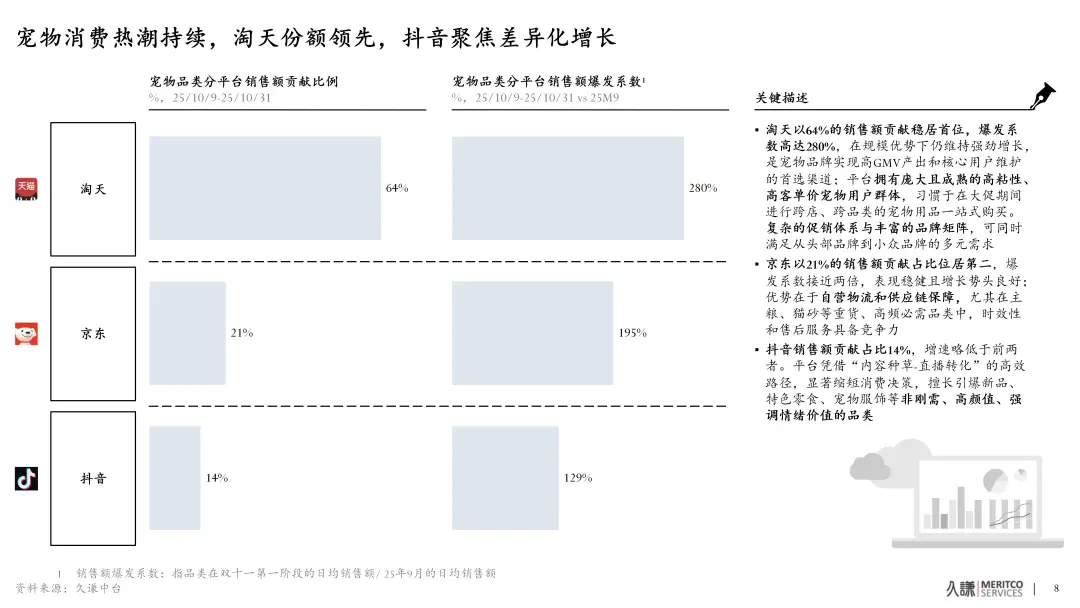
Core Insights - The pet consumption market is experiencing significant growth, with Tmall leading in sales during the Double Eleven shopping festival, contributing 64% of total sales and achieving a high explosion coefficient of 280% [1][3] - Tmall's pet industry has maintained double-digit growth despite its scale advantage, with pre-sale amounts surpassing last year's total within just half an hour [3] - Domestic brands are increasingly dominating the pet consumption landscape, accounting for 68% of the brands that achieved over 10 million in sales on Tmall during the event [3] Group 1 - Tmall's pet industry has shown remarkable growth, with 18 brands achieving over 10 million in sales within the first hour of the Double Eleven event [3] - The trend of domestic brand replacement is evident, with brands like 麦富迪 and Toptrees showing significant sales increases of over 90% and 170% respectively [3] - The pet consumption market is witnessing cross-industry integration, with brands like Adidas and Xiaomi entering the pet apparel and smart drinking fountain markets, respectively [4] Group 2 - Since its upgrade to a primary category in 2021, Tmall's pet sector has experienced continuous high growth, doubling in scale and surpassing 100 million annual purchasing users [6] - The pet industry is entering a "platform ecosystem competition" phase, with Tmall's user base supporting both short-term and long-term growth through diverse consumer insights [6] - The rise of the "it economy" is expected to further solidify Tmall's leading position in the pet industry [6]
25W43周观点:直补趋势化,AI赋能商家降本增效,即时零售贡献新增量-20251102
Huafu Securities· 2025-11-02 11:49
Investment Rating - The report maintains a rating of "Outperform the Market" for the home appliance sector [7]. Core Insights - The Double Eleven shopping festival has seen an earlier start and extended duration this year, with major platforms like Kuaishou, JD, and Douyin initiating pre-sales as early as October 7, 2025 [14][16]. - Direct subsidy trends have become prominent, simplifying promotional strategies and focusing on direct price reductions across platforms [14][16]. - AI tools are increasingly empowering marketing operations, helping merchants reduce costs and improve conversion rates through precise customer targeting and efficient ad spending [3][16]. - The instant retail market is expected to contribute significantly to this year's Double Eleven sales, with platforms like Taobao and JD enhancing their local life services and promotional strategies [4][20]. Market Performance Data - The home appliance sector experienced a weekly increase of 1.2%, with specific segments showing varied performance: white goods up 1.6%, black goods down 0.3%, small appliances up 1.1%, and kitchen appliances up 2.7% [26]. - Key brands in the home appliance sector have shown significant sales growth, particularly in 3C digital and AI innovation products, with order volumes for major categories increasing over 70% year-on-year [20][21]. Segment Tracking - The report highlights the performance of various segments within the home appliance industry, noting that brands like Haier and Midea have faced challenges in sales, particularly in offline channels [37][40][41]. - The small appliance segment has shown resilience, with brands like Joyoung and Supor reporting positive sales growth in specific product categories [40]. - Kitchen appliances have also seen varied performance, with brands like Boss and Huadi experiencing significant fluctuations in sales figures [41].
宠物食品竞争到底有加剧吗?
2025-10-27 00:30
Summary of Pet Food Industry Conference Call Industry Overview - The pet food market is experiencing a slowdown in overall growth in 2025, with platforms like JD and Douyin showing strong performance due to improvements in logistics and user experience, as well as user growth on emerging e-commerce platforms [1][4] - Market shares are approximately 40% for Tmall, 25% for JD, and 35% for Douyin [5] - The pet staple food market is dominated by puffed food (over 70% market share), while low-temperature baked food (about 20%) and freeze-dried food are rising in the mid-to-high-end market [1][5] Competitive Landscape - The competitive landscape is characterized by a "one strong, many strong" scenario, with Guobao Group leading and expected to achieve total revenue of 4.3 billion yuan in 2025 [1][9] - The second tier includes companies with revenues between 1.5 billion to 2 billion yuan, while the third tier consists of companies with revenues between 500 million to 1 billion yuan [9] - Head brands are expanding their market share steadily, while smaller brands face pressure to exit the market [1][10] Marketing and Sales Trends - Marketing expenses for pet food companies have significantly increased, with some brands like Blue's achieving rapid growth through high marketing investments, although marketing expense ratios exceeded 40%, impacting net profits [1][11] - In 2025, leading brands like Freigat and Xuanlang have increased their marketing expenditures to cope with fierce competition [1][11][12] - Sales growth during the Double Eleven shopping festival in 2025 showed JD's pet food sales growing by 15%-20%, Douyin by 20%-25%, while Tmall experienced a decline of -5% to -10% [2] Consumer Behavior and Pricing - The average consumer spending on pet food has increased, with Tmall's overall average price rising from 40 yuan to 45-50 yuan [3][18] - The high-end and mid-high-end pet food markets are expanding, driven by consumer demand for better quality and scientifically formulated products [17] Market Dynamics - The pet food industry is maintaining growth, with the cat food market showing significant growth rates of 15%-20%, while dog food is experiencing single-digit growth [3][16] - The market concentration is increasing, with the top 5 brands' market share rising from 15% to 20% and the top 10 from 27%-28% to 35% [3][16] Challenges for Smaller Brands - Smaller brands are facing increased competition and pressure to exit the market, with many experiencing reduced scale [10][14] - The competitive environment has intensified, particularly for non-head brands, which struggle to maintain market presence [10][22] Future Outlook - The overall growth target for companies is to achieve at least 10%-20% annual growth while maintaining a profit margin of around 8%-10% [31] - Companies are adapting to trends such as the aging of pets and the high-end market, although the demand for specialized aging pet food remains limited [32] Key Takeaways - The pet food industry is evolving with a shift towards high-end products and increased marketing investments, while competition intensifies among leading brands and smaller players face significant challenges [1][10][17]
宠物行业国货品牌的崛起之路(40页报告)
Sou Hu Cai Jing· 2025-10-01 22:36
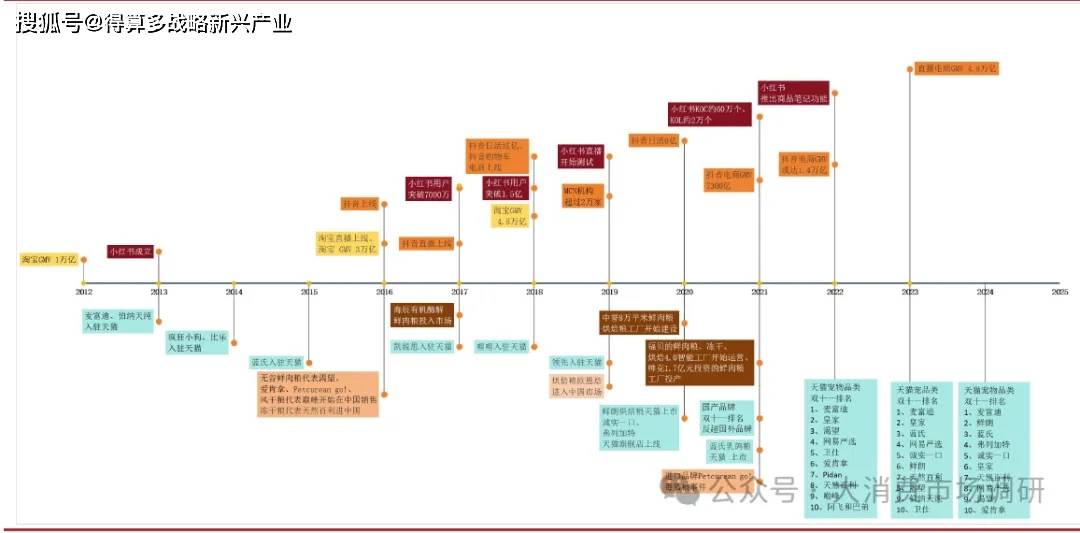
Core Insights - The Chinese pet industry has undergone a significant transformation from being dominated by foreign brands to the rise of domestic brands, which has occurred in multiple phases [1][16] - Domestic brands have successfully captured market share by leveraging e-commerce and social media, enhancing consumer trust through transparency and product safety [1][10] Group 1: E-commerce and Social Media Impact - The rapid growth of e-commerce from 2010 to 2015 provided new brands with substantial traffic support and low marketing costs, enabling quick market entry and sales growth [3] - The first wave of domestic brand emergence included companies like Maifudi and Crazy Dog, which utilized e-commerce platforms to achieve significant sales, with Maifudi reaching sales of 30 million yuan on Singles' Day in 2017 [4][12] - The rise of social media platforms post-2018 created new growth opportunities for domestic brands, allowing them to engage directly with consumers and enhance brand visibility through user-generated content [5][6] Group 2: Building Trust and Safety - Social media has enabled domestic brands to communicate directly with consumers, showcasing product safety through transparency initiatives like ingredient sourcing and quality reports [8] - In 2020, domestic brands collectively increased their focus on product safety, enhancing consumer trust and improving the industry's overall image [9] - The Petcurean go! incident in 2021, which raised concerns about imported brands, allowed domestic brands to gain consumer trust by emphasizing their safety and value [10] Group 3: Market Penetration and Pricing Strategy - Domestic brands identified and filled the price gap left by high-end imported brands, offering high-quality products at lower price points, typically between 20-50 yuan/kg [11][12] - Brands like Crazy Dog and Maifudi successfully targeted price-sensitive consumers, significantly increasing their market share through competitive pricing strategies [12][11] Group 4: Product Innovation and Competitive Advantage - Traditional imported brands primarily relied on meat meal-based products, which became less appealing as consumer expectations for quality increased [13] - The entry of high-end foreign brands introduced premium concepts, but their high prices limited market reach, creating opportunities for domestic brands to offer competitively priced alternatives [14][15] - Domestic brands capitalized on the demand for upgraded products by launching high-quality, cost-effective options, utilizing advancements in local production capabilities to enhance their offerings [15][16]
宠食升级新风尚,清凉零食降火润燥|世研消费指数品牌榜Vol.69
3 6 Ke· 2025-09-15 03:56
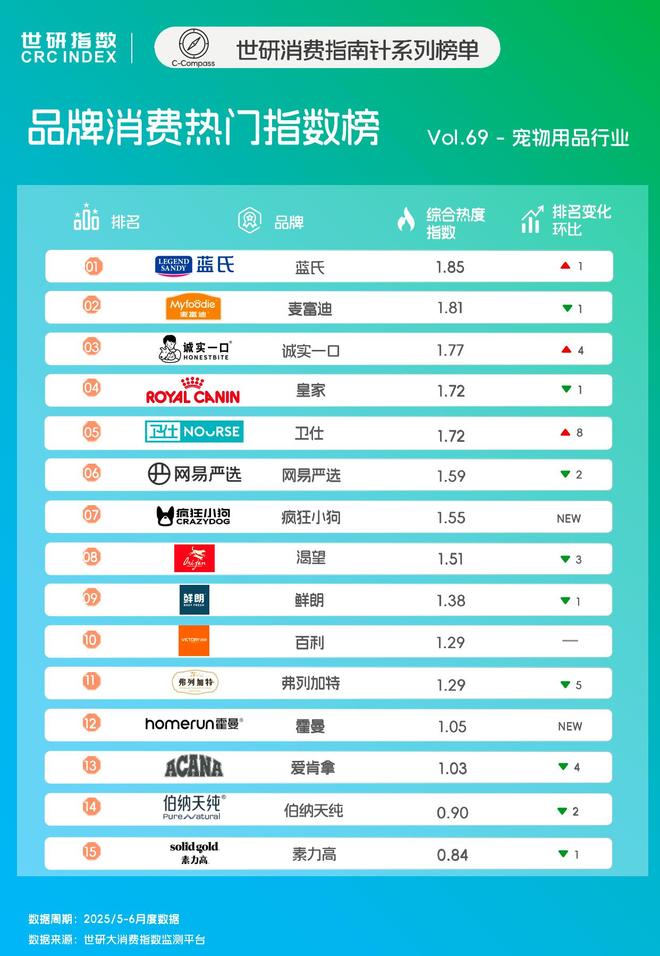
Core Insights - The article highlights the rising popularity of pet brands, with Blue's, Mytodie, and Honestbite leading in consumer interest, showcasing their strong market presence and brand loyalty [1][2]. Brand Popularity Rankings - The top three brands in the pet industry based on comprehensive popularity index are Blue's (1.85), Mytodie (1.81), and Honestbite (1.77) [2]. - Other notable brands include Royal Canin (1.72), The Nourish (1.72), and NetEase Select (1.59) [2]. Industry Trends - The fifth TOPS Pet Expo in Shanghai attracted over 8,000 pet brands, indicating a robust growth in the pet industry, covering food, supplies, medical, and smart technology sectors [3]. - Key trends observed include: - Craft upgrades such as the adoption of low-temperature baking technology - Functional segmentation targeting specific health issues like tear stains and gastrointestinal care - Integration of technology and emotional connections through public welfare and smart devices [3]. Product Innovations - The pet snack market is evolving towards diversified, scene-based, and emotional products, with a notable trend towards "cooling" elements in summer snacks, such as ice cream and jelly [4]. - New product launches include Crazy Dog's duck meat floss with sweet pear and Mytodie’s low-fat duck meat snacks, catering to health-conscious pet owners [4].
招商证券:2025年亚宠展规模再创新高 宠物消费增长强劲
智通财经网· 2025-08-25 06:25
Core Viewpoint - The pet consumption market is experiencing strong growth, with a focus on product refinement and functionality, as highlighted by the recent pet exhibition in Shanghai [1] Product Trends - The trend towards functional and refined pet food is rising, with an increase in players in the fresh and prescription food segments [2] - Functional pet food is becoming more popular, addressing specific needs for different life stages, such as growth for puppies and joint protection for older pets [2] - High-end pet food, particularly prescription and fresh food, is seeing increased competition, with domestic brands starting to enter a market previously dominated by imports [2] Marketing Strategies - The pet industry is shifting towards a "content + social" marketing approach, enhancing offline experiences to drive online engagement [3] - Brands are utilizing offline events to attract new customers and improve user profiles for targeted marketing [3] - Interactive activities and promotions at exhibitions are being used to engage consumers and promote products [3] Competitive Landscape - The competition in the pet food industry is intensifying, with a focus on innovation and differentiation among brands [4] - Domestic brands are moving upmarket, leveraging flexibility and pricing advantages, while international brands are increasing their marketing efforts in the mid-to-high-end segments [4] - The concentration of top brands is increasing, but competition among them remains fierce [4] Investment Recommendations - Companies with strong R&D capabilities and brand management are recommended, as the pet food sector is in a stable growth phase [5] - Key companies to watch include Zhongchong Co., Ltd. and Guibao Pet, which have strong operational and R&D capabilities [5] - Attention should also be given to Yuanfei Pet and Petty Co., Ltd. for their potential in the market [5]