益丰药房

Search documents
益丰药房(603939) - 益丰药房关于可转债转股结果暨股份变动公告
2026-01-05 08:01
未转股可转债情况:截至 2025 年 12 月 31 日,尚未转股的"益丰转债"面值 为人民币 1,797,249,000 元,占"益丰转债"发行总量的比例为 99.9898%。 本公司董事会及全体董事保证本公告内容不存在任何虚假记载、误导性陈 述或者重大遗漏,并对其内容的真实性、准确性和完整性承担个别及连带责任。 重要内容提示: 累计转股情况:截至 2025 年 12 月 31 日,累计已有面值 183,000 元"益丰转 债"转为公司 A 股普通股,累计转股股数为 5,571 股,占"益丰转债"转股前 公司已发行普通股股份总额的 0.0005%。 | 证券代码:603939 | 证券简称:益丰药房 | 公告编号:2026-001 | | --- | --- | --- | | 债券代码:113682 | 债券简称:益丰转债 | | 益丰大药房连锁股份有限公司 关于可转债转股结果暨股份变动公告 的"益丰转债"自2024年9月9日起可转换为公司股份。 本季度转股情况:"益丰转债"自 2024 年 9 月 9 日起可转换为公司股份,2025 年 10 月 1 日至 2025 年 12 月 31 日共有面值 2, ...

2026年,医药商业公司何去何从
Xin Lang Cai Jing· 2026-01-04 12:26
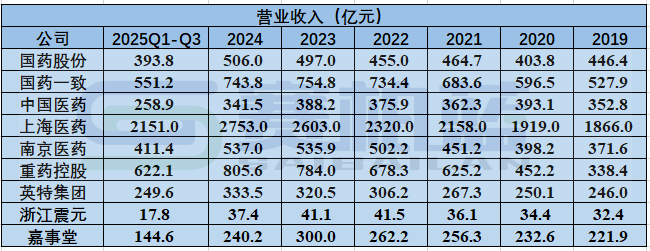
Core Viewpoint - The pharmaceutical commercial companies are often overlooked in the secondary market, with only a few experiencing significant stock price increases due to specific events, while most remain undervalued and lack growth potential [1][23]. Group 1: Market Performance - In December 2025, companies like HeFu China and others saw significant stock price increases, diverging from their fundamentals, while most pharmaceutical commercial companies remain "small transparent" in the market [1][23]. - The highest market capitalization among pharmaceutical commercial companies is Shanghai Pharmaceuticals, which relies on its industrial segment for valuation enhancement, while most companies have market caps below 30 billion [1][23]. Group 2: Financial Overview of State-Owned Enterprises - State-owned pharmaceutical commercial companies like Shanghai Pharmaceuticals have substantial revenue, with 215.1 billion in 2025 Q1-Q3, primarily from distribution and retail [3][4]. - The net profit margins for these companies are generally low, with Shanghai Pharmaceuticals reporting a net profit of 51.47 billion in 2025 Q1-Q3, reflecting the industry's low profitability [5][6]. - The asset-liability ratios for state-owned companies are high, with Shanghai Pharmaceuticals at 62.14% in 2025 Q1-Q3, indicating a reliance on flexible capital management [6][7]. Group 3: Financial Overview of Private Enterprises - Among private pharmaceutical commercial companies, Jiuzhoutong stands out with a revenue of 119.3 billion in 2025 Q1-Q3, significantly higher than its peers [9][10]. - The net profit for Jiuzhoutong in 2025 Q1-Q3 was 19.75 billion, showcasing its profitability compared to other private companies [9][10]. - The asset-liability ratio for Jiuzhoutong is 68.77%, indicating a similar financial structure to state-owned companies [12]. Group 4: Retail Pharmacy Operations - Retail pharmacies focus on regional operations, with companies like Yifeng Pharmacy and Laobaixing showing strong local market presence [13][14]. - The net profit margins for retail pharmacies are generally higher than those of pharmaceutical distribution companies, with Yifeng Pharmacy reporting a net margin of 7.64% in 2025 Q1-Q3 [15][14]. - Most retail pharmacy companies also have asset-liability ratios exceeding 50%, necessitating effective capital management [14][15]. Group 5: Future Directions - Pharmaceutical commercial companies are encouraged to explore transformation opportunities in traditional business areas, focusing on consumer healthcare and rehabilitation [21][22]. - The integration of retail pharmacies with online services and community engagement is essential for enhancing customer loyalty and market presence [22]. - Companies should leverage capital partnerships to establish investment funds for mergers and acquisitions, aiming to enhance their market valuation and profitability [22].


益丰药房:人口老龄化进程加快,零售药店作为社区健康流量入口,渠道价值将不断提升
Cai Jing Wang· 2026-01-04 07:36
Core Viewpoint - Yifeng Pharmacy has indicated that due to multiple factors such as the economic environment and industry cycles, the company will focus on improving operational quality, leading to a reduction in store openings and acquisition plans, resulting in a slowdown in revenue growth compared to previous periods [1] Group 1: Company Performance - For the period from January to September 2025, Yifeng Pharmacy achieved revenue of 17.286 billion yuan, representing a year-on-year growth of 0.39% [1] - The company reported a net profit attributable to shareholders of 1.225 billion yuan, which is a year-on-year increase of 10.27% [1] Group 2: Industry Outlook - The fundamental development logic of the industry remains unchanged, driven by factors such as accelerated population aging, medical reform separating medicine from medical services, and increased industry concentration [1] - Retail pharmacies are expected to continue to enhance their channel and social value as important entry points for community health [1] - The retail pharmacy industry is anticipated to experience new development opportunities with the ongoing innovation in diversified operations and the maturation of new retail models both online and offline [1]
医药行业2026年策略报告:坚定出海方向,把握结构性机遇-20251231
Huaxin Securities· 2025-12-31 11:05
Group 1 - The core investment theme for the pharmaceutical industry in 2025 is the overseas expansion of innovative drugs, which is expected to yield excess returns compared to the broader pharmaceutical sector and the CSI 300 index [2][21] - The innovative drug index has shown a significant increase, outperforming the pharmaceutical biological index by 37.48 percentage points, with a year-to-date increase of 65.99% [21] - Major transactions in the ADC and dual antibody fields are anticipated to continue, while there is a need to avoid repetitive competition in areas like small nucleic acids and focus on unmet clinical needs [3][4] Group 2 - The report emphasizes the importance of overseas markets for both innovative drugs and medical devices, suggesting that companies should seek growth opportunities beyond domestic market saturation [4][5] - The Chinese pharmaceutical industry is gradually becoming a global innovation center, with significant advancements in dual antibodies and ADCs, while also making strides in emerging fields like small nucleic acids and inhalation formulations [5][6] - The report highlights that the overseas authorization revenue has become a crucial funding source for innovative drug development, with a total upfront payment of $4.551 billion in the first three quarters of 2025 [29][32] Group 3 - The medical device sector is experiencing a shift towards overseas expansion, with a focus on high-value consumables and IVD products, as Chinese companies enhance their market share [7][55] - The export growth of high-value consumables is significant, with a recorded increase of 10.75% in the first half of 2025, particularly in the North American and European markets [57][66] - The report notes that the certification and market establishment processes for high-value consumables are long-term investments, requiring compliance with stringent regulations in the EU and the US [60][61] Group 4 - The recovery of financing in the domestic innovative drug sector has been robust, with a total of 324 financing events amounting to $5.51 billion in the first three quarters of 2025, marking a 67.6% increase year-on-year [70][72] - The CXO industry is experiencing varied recovery rhythms across different segments, with some areas like CDMO seeing order growth due to overseas financing recovery [74]




医药商业板块12月31日跌0.69%,鹭燕医药领跌,主力资金净流出7.81亿元
Zheng Xing Xing Ye Ri Bao· 2025-12-31 08:59
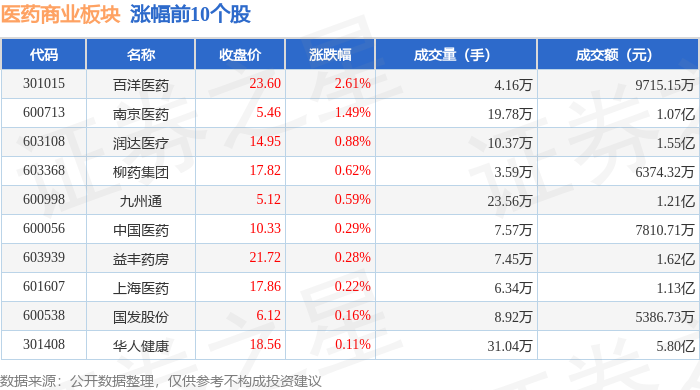
Market Overview - The pharmaceutical commercial sector declined by 0.69% on December 31, with Luyuan Pharmaceutical leading the drop [1] - The Shanghai Composite Index closed at 3968.84, up 0.09%, while the Shenzhen Component Index closed at 13525.02, down 0.58% [1] Stock Performance - Baiyang Pharmaceutical (301015) closed at 23.60, up 2.61% with a trading volume of 41,600 shares and a transaction value of 97.15 million [1] - Nanjing Pharmaceutical (600713) closed at 5.46, up 1.49% with a trading volume of 197,800 shares and a transaction value of 107 million [1] - Run Da Medical (603108) closed at 14.95, up 0.88% with a trading volume of 103,700 shares and a transaction value of 155 million [1] - Other notable stocks include Liuyuan Group (603368) at 17.82, up 0.62%, and China Pharmaceutical (600056) at 10.33, up 0.29% [1] Capital Flow - The pharmaceutical commercial sector experienced a net outflow of 781 million from institutional investors, while retail investors saw a net inflow of 762 million [2] - The main capital inflow and outflow for selected stocks include: - Huaren Health (301408) with a net inflow of 83.36 million from institutional investors [3] - Shanghai Pharmaceutical (601607) with a net inflow of 22.40 million from institutional investors [3] - Yifeng Pharmacy (603939) with a net inflow of 19.37 million from institutional investors [3]


药店行业专家交流会
2025-12-29 01:04
Summary of the Pharmacy Industry Conference Call Industry Overview - The pharmacy industry is undergoing significant changes due to tightened medical insurance policies and regular inspections, leading to the exit of non-compliant pharmacies and benefiting leading chain enterprises [1][2] - The overall pharmaceutical market is experiencing a decline, with retail sales showing a slight increase in online channels while offline sales are decreasing [1][4] Key Points and Arguments Regulatory Changes - From 2025, pharmacies must complete sales closure scanning, and by January 2026, all medical institutions must collect and upload drug traceability codes, enhancing industry compliance [1][4] - The National Medical Insurance Bureau has increased inspections, with approximately 42%-43% of pharmacies relying on medical insurance, leading to many pharmacies voluntarily exiting the insurance system [2] Financial Performance - The retail pharmacy gross margin has decreased from 33.4% to 28.6% due to centralized procurement policies, putting pressure on net profits for listed companies [1][4] - The overall pharmaceutical market sales declined by 1.1% year-on-year in the first three quarters, with hospital sales down 2.5% and retail sales up 3.2% [4] Market Dynamics - O2O (Online to Offline) channels are expected to grow by 36% in 2025, with sales projected to reach between 44 billion to 45 billion yuan, accounting for over 10% of total sales for leading chain enterprises [1][4] - The number of large chain brands has decreased, with over 15,000 stores closed in the first three quarters of 2025 [6] Additional Important Insights Strategic Adjustments - Leading chain pharmacies are slowing down expansion and focusing on profitability, optimizing store structures, and increasing franchise opportunities [3][6] - The industry is witnessing a shift towards diversified business models, including cross-industry collaborations and the establishment of DTP (Direct-to-Patient) pharmacies [3][19] Future Trends - The pharmacy industry is expected to continue its consolidation and cleaning process over the next two years, with a projected reduction of several thousand underperforming pharmacies annually [29] - By the end of 2026, the number of pharmacies is anticipated to stabilize around 500,000, marking a new phase of stable development and potential for large-scale mergers and acquisitions [29] Digital Transformation - Emphasis on digital capabilities and the integration of online and offline operations is crucial for enhancing operational efficiency and customer experience [8][25] - The industry is exploring innovative services such as telemedicine and smart delivery to improve customer engagement and service quality [8][19] Policy Support - Recent policies aim to simplify approval processes and encourage mergers, which could enhance competitiveness and drive industry consolidation [22][24] This summary encapsulates the key insights and developments within the pharmacy industry as discussed in the conference call, highlighting the regulatory environment, financial performance, market dynamics, strategic adjustments, future trends, digital transformation, and policy support.
医疗器械行业研究:政策推动创新器械应用,脑机接口加速商业落地
SINOLINK SECURITIES· 2025-12-27 15:39
Investment Rating - The report suggests a positive investment outlook for the medical device sector, particularly in brain-computer interface devices, which are expected to see accelerated commercialization due to supportive policies [1][3]. Core Insights - Recent policies have significantly increased support for innovation in medical devices, with the National Medical Products Administration actively promoting faster market entry for brain-computer interface devices, indicating a diverse application landscape and substantial future potential [1][3]. - The pharmaceutical sector is witnessing positive developments, such as GSK's approval of mepolizumab for a new indication in COPD patients, marking it as the first monthly administered biologic in China, which is expected to reduce the annual incidence of severe exacerbations significantly [1][32]. - The report highlights the approval of Wegovy® tablets in the U.S. for weight management, emphasizing its potential impact on the market as the first oral GLP-1 receptor agonist for this purpose [37][40]. Summary by Sections Pharmaceutical Sector - Mepolizumab has been approved for COPD treatment in China, with a monthly dosing schedule, targeting a significant patient population [1][32]. - The A/H share innovation drug sector maintains high activity levels, with new drug approvals and cross-border transactions remaining robust [16][28]. Biologics - Wegovy® tablets have been approved in the U.S. for weight management, showing similar weight loss efficacy to its injectable counterpart, with a significant portion of participants achieving substantial weight loss [37][40]. CXO and Pharmaceutical Supply Chain - The CXO sector continues to show upward momentum, supported by a stable order backlog, with November financing levels slightly above the annual average [44][46]. Medical Devices - The centralized procurement process for high-value medical consumables is progressing steadily, with high selection rates in multiple rounds of bidding, indicating a favorable environment for leading domestic companies [2][52]. Retail Pharmacy - The industry is undergoing a consolidation phase, with leading companies expected to benefit from increased market share through mergers and acquisitions [2][3]. Medical Services and Consumer Healthcare - Aier Eye Hospital's acquisition of 39 institutions for 960 million yuan strengthens its market position, with the acquired entities showing signs of financial recovery [2][3].



医药健康行业研究:药店、中药2026年度策略:蛰伏蓄势,以候风至
SINOLINK SECURITIES· 2025-12-26 08:55
Investment Rating - The report suggests a positive outlook for the pharmacy and traditional Chinese medicine sectors, anticipating a recovery in 2026 after a weak performance in 2025 [2][5]. Core Insights - The pharmacy sector is expected to benefit from market consolidation, with leading companies likely to increase their market share through mergers and acquisitions during the industry clearing phase [3][11]. - The traditional Chinese medicine sector is projected to stabilize and potentially recover, driven by an increase in flu incidence and the upcoming update of the essential drug list [57][60]. Summary by Sections Pharmacy Sector - **Market Review**: The pharmacy sector faced significant challenges in 2025, with a decline in same-store sales and an overall reduction in the number of operating stores since Q4 2024 [5][20]. - **Policy Environment**: Regulatory measures are promoting a more compliant and healthier industry ecosystem, which is expected to benefit leading companies [14][15]. - **Market Size**: In the first ten months of 2025, the sales scale of physical pharmacies was 501.3 billion yuan, a year-on-year decrease of 1.6%, primarily due to a decline in non-pharmaceutical sales [16][21]. - **Competitive Landscape**: The number of pharmacies in China reached approximately 684,000 by the end of 2024, with a notable increase in store closures, particularly among smaller chains [20][24]. - **Marginal Performance**: There has been a slight recovery in retail sales data, with leading companies showing improved performance through cost reduction and efficiency measures [32][34]. - **Outlook for 2026**: Focus on market consolidation and the development of non-pharmaceutical products is recommended, as leading companies are expected to enhance their market share [44][52]. Traditional Chinese Medicine Sector - **Market Review**: The traditional Chinese medicine sector experienced overall weak performance in 2025, with some companies seeing temporary valuation increases due to innovative pipelines [57][58]. - **In-Hospital Opportunities**: The upcoming update of the essential drug list is expected to benefit companies with products that have the potential to be included [60]. - **Out-of-Hospital Opportunities**: An increase in flu incidence in Q4 2025 is anticipated to aid in inventory digestion, with some companies expected to see improved performance [60]. - **High Dividend Stocks**: Companies such as Lingrui Pharmaceutical, Jichuan Pharmaceutical, and Dong'e Ejiao are highlighted as stable high-dividend investment opportunities [60].


益丰药房20251225
2025-12-26 02:12
Summary of Yifeng Pharmacy Conference Call Company Overview - Yifeng Pharmacy was established in 2001 and has grown to become a leading chain pharmacy in China through organic growth and acquisitions, with nearly 15,000 stores and over 100 million members as of Q3 this year [7][4] - The primary revenue source is retail, while the franchise and distribution business has relatively lower gross margins [7] Industry Insights - The pharmaceutical industry is currently in a clearing phase, with a slow but ongoing trend of prescription outflow, leading to relatively weak growth rates but still possessing development potential [2][5] - The number of offline pharmacies has decreased, but the pace of this clearing is slow, partly due to operators not promptly deregistering after closing stores [8] - Online sales are growing rapidly, impacting the offline market, but a balance between online and offline sales is expected in the long term [11] Key Financial Metrics - Yifeng Pharmacy's PE valuation is at historical lows, around the 1st percentile over the past 10 years, indicating limited downside and greater upside potential [6] - The overall pharmacy sector is at approximately the 20th percentile over the past decade [6] Growth Strategies - Short-term growth is supported by strong same-store sales due to flu season, expected to continue until early next year [4] - Medium-term strategies include acquisitions of mid-sized chain pharmacies at low prices (0.4-0.5 times PS) and expanding franchise operations, which currently have a low presence [4][2] - Long-term growth is anticipated through optimizing store layouts, improving operational efficiency, and expanding non-pharmaceutical business lines [12][13] Market Dynamics - The sales of Semaglutide in China are projected to reach approximately $400 million in the first half of 2025, with annual sales potentially hitting 7 billion RMB, contributing to online sales growth [10] - The current outpatient prescription ratio in China is significantly lower than in developed countries, indicating substantial room for growth [11] Investment Recommendation - Yifeng Pharmacy is recommended for investment due to its strong performance in a consolidating industry, effective management capabilities, and potential for market share growth in new regions [14]
2025年第51周:美妆行业周度市场观察
艾瑞咨询· 2025-12-26 00:05
Group 1: Industry Environment - The international college market has become a battleground for fashion and beauty brands, with Generation Z's annual beauty spending reaching $5 billion, and skincare usage starting as early as ages 11-13, showing a trend of gender convergence in consumption [3] - Brands are leveraging campus ambassadors, pop-up events, social media, and influencer collaborations to penetrate the college market, while health brands utilize clubs and TikTok to reach their target audience [3] - The strong purchasing power and loyalty of Generation Z make campus settings strategic for brands, necessitating innovative activities to capture attention [3] Group 2: Market Dynamics - Traditional chain pharmacies are accelerating their transformation by expanding into beauty and personal care categories to address industry challenges, with YST planning to add beauty and maternal products in 70% of its stores (nearly 8,000 locations) [5] - The beauty segment now accounts for nearly 60% of the health category in these pharmacies, as other chains like Shuyupingmin and Yifeng also enter the beauty market to cope with tightening medical insurance policies and declining foot traffic [5] - Cosmetic brands such as Winona and Kefu Mei are actively entering pharmacy channels to enhance brand value through professional credibility, although expanding OTC channels requires significant investment and faces challenges in product selection and private domain operations [5] Group 3: Major Brand Developments - Major beauty brands like L'Oréal and Estée Lauder have signed global ambassadors, enhancing their brand influence, while LVMH invests in the French niche fragrance brand BDK to support its international expansion [6] - The clean beauty sector is experiencing differentiation, with Korean brand Aromatica's stock surging while L'Oréal shuts down related brands [6] - Japanese high-end brand SUQQU is entering the Chinese market, targeting the premium segment [6] Group 4: Technological Innovations - Estée Lauder Group has launched a global innovation center for fragrance in Paris, integrating R&D and creative teams, utilizing AI to monitor trends, optimize formulas, and accelerate approval processes while respecting brand uniqueness [7] - AI assists perfumers in innovation by analyzing data and emotional preferences, with the launch of an AI fragrance consultant tool by Jo Malone in December, providing personalized fragrance recommendations [7] Group 5: Company Performance - Huaxi Biological has faced declining performance due to the diminishing market dividends of hyaluronic acid, with a 18.36% year-on-year revenue drop and a 30.29% decline in net profit for the first three quarters of 2024, resulting in a market value loss of 100 billion [8] - The company has adjusted welfare policies, reduced employee benefits, and cut staff, particularly in sales, while its skincare business has seen significant revenue declines and multiple sub-brands have been eliminated [8] - Increased competition and product homogenization in the hyaluronic acid market have pressured profits, prompting Huaxi Biological to explore new sectors like weight loss and invest in small nucleic acid drugs, although it faces fierce industry competition and consumer skepticism regarding ingredients [8] Group 6: Digital Transformation - Digitalization is increasingly important in retail for product management, marketing, and user experience, especially in a saturated market, necessitating innovative digital transformations to enhance efficiency [9] - Huamei's collaboration with Hanshu Technology has been recognized as an excellent digital innovation case, reshaping the beauty store shopping experience through a "warehouse-style display + artistic aesthetics" model [9] - The use of electronic price tags supports real-time information updates and enhances marketing conversion, demonstrating how digitalization can seamlessly integrate into brand identity and improve customer experience [9]