
中国人民银行

Search documents
前三季度养老产业贷款同比增长58.2%
Ren Min Ri Bao· 2025-11-12 23:58
Core Insights - The People's Bank of China (PBOC) has reported that the moderately accommodative monetary policy has been effective in supporting key sectors and economic transformation in 2023 [1] Monetary Policy Implementation - The PBOC has utilized various monetary policy tools, including quantity, price, and structure, to create a favorable financial environment for economic recovery and market stability [1] - As of the end of September, the balance of structural monetary policy tools aimed at supporting the "five major tasks" in finance reached 3.9 trillion yuan [1] Loan Growth by Sector - As of September, loans in several key areas showed significant year-on-year growth: - Technology loans increased by 11.8% - Green loans rose by 22.9% - Inclusive loans grew by 11.2% - Loans for the elderly care industry surged by 58.2% - Digital economy loans expanded by 12.9% - All these growth rates exceeded the overall loan growth rate [1] Future Policy Directions - The report emphasizes the need to continue implementing a moderately accommodative monetary policy, maintaining relatively loose social financing conditions, and enhancing the monetary policy framework [1] - The goal is to ensure that the growth of social financing and money supply aligns with economic growth and price level expectations [1]
每日债市速递 | 央行公开市场单日净投放1300亿
Wind万得· 2025-11-12 22:32
Market Overview - The central bank conducted a reverse repurchase operation of 195.5 billion yuan for 7 days at a fixed rate of 1.40%, with a net injection of 130 billion yuan after accounting for 65.5 billion yuan maturing that day [3][4]. Funding Conditions - The interbank market saw a balanced improvement in funding conditions, with overnight repurchase rates dropping by 9 basis points to around 1.41%. The overnight quotes on the anonymous X-repo system also fell to 1.43% [5][6]. Interbank Certificates of Deposit - The latest transaction rate for one-year interbank certificates of deposit among major banks remained stable at approximately 1.63% [7]. Government Bond Futures - The closing prices for government bond futures showed slight increases: 30-year contracts rose by 0.09%, 10-year by 0.02%, 5-year by 0.03%, and 2-year by 0.01% [11]. Government Procurement - The Ministry of Finance announced that the national government procurement scale for 2024 is projected to be 3,375.043 billion yuan, with goods, engineering, and services accounting for 23.54%, 41.01%, and 35.45% respectively [12]. Global Macro Developments - Japan's Prime Minister is set to propose a significant economic stimulus plan, indicating potential substantial spending to support the economy [14]. - South Korea's M2 money supply reached 4,430.5 trillion won (approximately 3.02 trillion USD) in September, marking a 0.7% month-on-month increase and an 8.5% year-on-year surge [14]. Bond Issuance Events - The China Development Bank plans to issue up to 19 billion yuan in three phases of fixed-rate bonds on November 13 [16]. - The Japanese Ministry of Finance will auction 800 billion yen of 20-year government bonds on November 19 [16]. Negative Events in Bond Market - Several companies, including Aerospace Hongtu and Zhejiang Yitian, have seen downgrades in their credit ratings or outlooks, indicating potential risks in the bond market [17]. Non-Standard Asset Risks - Various non-standard assets have been flagged for risk, including trust plans and private equity funds, highlighting ongoing concerns in the investment landscape [18].


前三季度养老产业贷款同比增58.2%
Ren Min Ri Bao· 2025-11-12 22:19
Core Insights - The People's Bank of China has implemented a moderately accommodative monetary policy throughout the year, which has led to a rapid growth in financial totals and an optimization of credit structure, effectively supporting key areas and strategic economic transformations [1] Summary by Categories Monetary Policy - The report indicates that various monetary policy tools have been employed to create a favorable financial environment for economic recovery and market stability [1] - As of the end of September, the balance of structural monetary policy tools supporting the "five major articles" in finance reached 3.9 trillion yuan [1] Loan Growth - By the end of September, loans in specific sectors showed significant year-on-year growth: - Technology loans increased by 11.8% - Green loans rose by 22.9% - Inclusive loans grew by 11.2% - Loans for the elderly care industry surged by 58.2% - Digital economy loans expanded by 12.9% - All these growth rates exceeded the overall loan growth rate [1] Future Outlook - The report emphasizes the need to continue implementing a moderately accommodative monetary policy, utilizing various tools to maintain relatively loose social financing conditions [1] - It also highlights the importance of improving the monetary policy framework and ensuring that liquidity remains abundant, aligning the growth of social financing and money supply with economic growth and price level expectations [1]
央行第三季度货币政策执行报告释放了哪些新信号?
Zheng Quan Ri Bao· 2025-11-12 16:24
Core Viewpoint - The People's Bank of China emphasizes the need for a balanced monetary policy that supports economic growth while managing risks, aiming for a stable economic environment and achieving a 5% growth target for the year [1][2]. Group 1: Monetary Policy Strategy - The central bank plans to implement a moderately loose monetary policy to maintain relatively relaxed social financing conditions, adjusting according to economic and financial conditions [2][3]. - The report highlights the importance of monitoring liquidity supply and demand in the banking system and financial markets, using various monetary policy tools to ensure ample liquidity [2][3]. Group 2: Financial Resource Management - The focus is on revitalizing existing financial resources rather than merely increasing credit volume, aligning with the transition from high-speed to high-quality economic development [3][4]. - The current balance of RMB loans is 270 trillion yuan, and the total social financing stock is 437 trillion yuan, indicating a shift in financing structure and the need for more attention to social financing scale [3][4]. Group 3: Interest Rate Relationships - The report discusses the necessity of maintaining reasonable interest rate relationships to enhance the effectiveness of monetary policy and reduce arbitrage opportunities [4][5]. - Various interest rate relationships are outlined, including those between central bank policy rates and market rates, as well as between different asset types and risk levels [4][5]. Group 4: Capital Market Dynamics - There is a perception that the slowdown in deposit growth is due to funds moving to the stock market, although this is seen as a redistribution of deposits rather than a net decrease [5]. - The adjustment in asset allocation is explained by changes in return rates and price relationships among different assets, influenced by the market-driven interest rate system [5].
央行:持续深化金融供给侧结构性改革 稳步推进金融高水平开放
智通财经网· 2025-11-12 11:30
原文如下: 智通财经APP获悉,11月12日,中国人民银行召开党的二十届四中全会精神宣讲报告会。央行行长潘功 胜指出,要深入研究谋划"十五五"时期中国人民银行重点工作,构建科学稳健的货币政策体系,健全覆 盖全面的宏观审慎管理体系和系统性金融风险防范处置机制,持续深化金融供给侧结构性改革,稳步推 进金融高水平开放,坚决维护国家金融安全,为实现党中央确定的"十五五"目标任务贡献更大金融力 量。 潘功胜指出,完善中央银行制度是"十五五"时期推动金融高质量发展、加快建设金融强国的战略举措。 要坚持党中央对金融工作的集中统一领导,纵深推进全面从严治党,全面贯彻全会部署,深入研究谋 划"十五五"时期中国人民银行重点工作,构建科学稳健的货币政策体系,健全覆盖全面的宏观审慎管理 体系和系统性金融风险防范处置机制,持续深化金融供给侧结构性改革,稳步推进金融高水平开放,坚 决维护国家金融安全,为实现党中央确定的"十五五"目标任务贡献更大金融力量。 潘功胜强调,学习宣传、贯彻落实党的二十届四中全会精神是中国人民银行的一项重要政治任务,各级 党委要认真组织开展学习培训,紧密联系实际抓好贯彻落实,多渠道、多维度开展全会精神宣传,营造 ...
做好金融“五篇大文章” 多维度读懂央行最新货币政策执行报告要点
Yang Shi Wang· 2025-11-12 08:44
Core Viewpoint - The People's Bank of China (PBOC) will implement a moderately accommodative monetary policy in the next phase, utilizing various tools to maintain relatively loose social financing conditions while improving the monetary policy framework and enhancing execution and transmission [1][4]. Group 1: Monetary Policy Implementation - The PBOC's upcoming monetary policy will focus on maintaining a moderately accommodative stance and ensuring that social financing conditions remain relatively loose [1][4]. - The report indicates that structural monetary policy tools will continue to play a significant role in optimizing financing structures and supporting key areas of the economy [4][6]. Group 2: Financing Structure Optimization - As of the end of September, various types of loans have shown significant year-on-year growth: technology loans increased by 11.8%, green loans by 22.9%, inclusive loans by 11.2%, elderly care industry loans by 58.2%, and digital economy industry loans by 12.9% [3][12]. - The total balance of structural monetary policy tools supporting the "Five Major Articles" reached 3.9 trillion yuan, indicating a reasonable growth in financial volume and low social financing costs [3][4]. Group 3: Focus on Key Areas - The growth rate of loans in areas related to the "Five Major Articles" has exceeded 10%, with elderly care industry loans approaching 60% growth [6][8]. - The PBOC's structural monetary policy tools are designed to incentivize financial institutions to support major national strategies and key areas of economic and social development [8][10]. Group 4: Future Directions - The report emphasizes that future monetary policy will prioritize support for technological innovation, consumption stimulation, small and micro enterprises, and stabilizing foreign trade [1][14]. - The balance of loans to technology-based small and medium-sized enterprises reached 3.6 trillion yuan, with a year-on-year growth of 22.3%, and technology loans accounted for over 30% of new loans [12].
央行最新报告显示:下阶段持续稳增长、稳就业、稳预期
Zhong Guo Jing Ji Wang· 2025-11-12 06:24
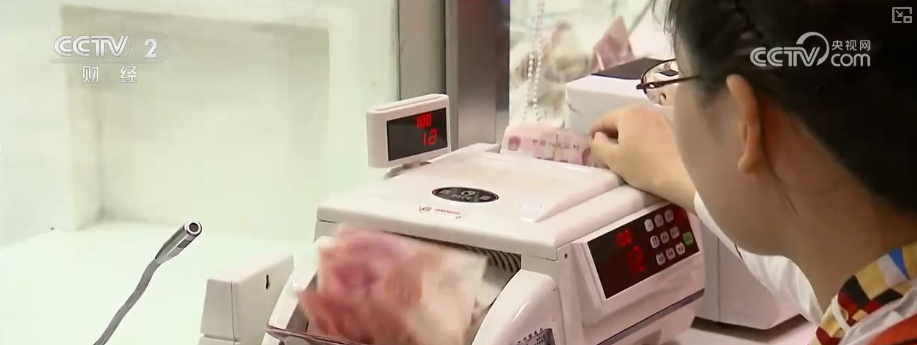
Core Insights - The People's Bank of China (PBOC) has maintained a moderately accommodative monetary policy throughout the year, with significant growth in financial metrics such as social financing and M2 money supply, which increased by 8.7% and 8.4% year-on-year respectively [1] - The report highlights a decline in social financing costs, with new corporate loans and personal housing loan rates dropping by approximately 40 and 25 basis points year-on-year [1] - The credit structure is improving, with notable growth in technology loans (11.8%), green loans (22.9%), inclusive loans (11.2%), elderly care industry loans (58.2%), and digital economy loans (12.9%), all surpassing the overall loan growth rate [1] - Despite external uncertainties and challenges in the global economy, China's economic fundamentals remain strong, with a call for strategic determination and confidence in achieving modernization goals [1] Monetary Policy and Financial Reform - The PBOC plans to deepen financial reforms and enhance high-level opening-up, aiming to build a robust financial system and a comprehensive macro-prudential management framework [2] - The focus will be on balancing short-term and long-term goals, stabilizing growth while managing risks, and ensuring the health of the banking system while supporting the real economy [2] - The PBOC will continue to implement a moderately accommodative monetary policy, utilizing various tools to maintain relatively loose social financing conditions [3] Future Directions - The PBOC aims to improve the monetary policy framework and enhance the execution and transmission of monetary policy [3] - There will be an emphasis on maintaining liquidity and aligning social financing and money supply growth with economic growth and price level expectations [3] - The central bank will also focus on promoting reasonable price recovery and refining the interest rate adjustment framework to lower financing costs [3] - The PBOC will explore expanding its macro-prudential and financial stability functions to maintain market stability and prevent systemic financial risks [3]
下阶段继续实施好适度宽松货币政策
Chang Jiang Shang Bao· 2025-11-12 06:01
Core Insights - The People's Bank of China released the "Monetary Policy Implementation Report for the Third Quarter of 2025," summarizing the monetary policy execution and analyzing the current economic and financial situation, while clarifying future policy directions [1][2] Group 1: Monetary Policy Execution - The report emphasizes balancing short-term and long-term goals, growth and risk prevention, internal and external equilibrium, and supporting the real economy while maintaining the health of the banking system [1] - A moderately loose monetary policy has been consistently applied this year, with significant growth in financial totals; as of September, the social financing scale and broad money supply (M2) increased by 8.7% and 8.4% year-on-year, respectively [1] - The cost of social financing remains low, with new corporate loans and personal housing loan rates decreasing by approximately 40 and 25 basis points year-on-year as of September [1] Group 2: Financial Indicators and Economic Analysis - The report highlights the importance of total financial indicators, suggesting that social financing scale and money supply are more comprehensive than bank loans; it notes that a natural decline in financial total growth is expected as the economy transitions to high-quality development [2] - An analysis of internal and external economic conditions indicates insufficient global economic growth momentum, differentiated inflation trends, and a cooling labor market, with ongoing impacts from tariff policies and high debt levels in major economies [2] Group 3: Future Monetary Policy Directions - The report outlines the intention to maintain a moderately loose monetary policy, ensuring social financing conditions remain relatively relaxed while enhancing the monetary policy framework and its execution [3] - It aims to keep liquidity ample, aligning the growth of social financing and money supply with economic growth and price level expectations, while also focusing on supporting consumption and small and medium-sized enterprises [3] - The report stresses the importance of preventing excessive exchange rate fluctuations and maintaining the stability of the RMB at a reasonable equilibrium level, alongside exploring macro-prudential measures to ensure financial market stability [3]
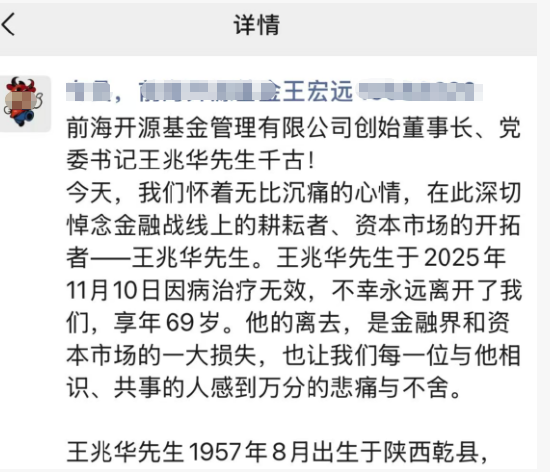
王宏远朋友圈悼念王兆华:前海开源基金创始人离世 金融战线上的耕耘者风范长存
Xin Lang Ji Jin· 2025-11-12 04:06
Core Points - The news announces the passing of Wang Zhaohua, the founder and first chairman of Qianhai Kaiyuan Fund Management Co., Ltd., who died on November 10, 2025, at the age of 69 due to ineffective medical treatment [1][3][4] - Wang Zhaohua is remembered as a significant figure in the financial sector and capital markets, with a career spanning over 40 years [3][6] Company Overview - Wang Zhaohua was instrumental in the establishment and growth of Qianhai Kaiyuan Fund Management Co., Ltd., leading the company from its inception to a management scale of approximately 150 billion RMB [6][7] - Under his leadership, the company achieved significant milestones, including generating over 20 billion RMB in profits for 19.2 million fund holders and increasing shareholder value by 13 times over 13 years [6][7] Career Highlights - Wang Zhaohua's career included key positions at various financial institutions, such as the People's Bank of China, Industrial and Commercial Bank of China, and Huaxia Securities, where he demonstrated exceptional leadership and reform capabilities [4][5][6] - His tenure at Qianhai Kaiyuan Fund Management Co., Ltd. was marked by a transformation from a startup to a major player in the industry, showcasing his vision and strategic acumen [6][7] Legacy - Wang Zhaohua is celebrated for his integrity, dedication, and contributions to the financial market reform and development of capital markets in China [7][8] - His life and work continue to inspire colleagues and industry peers, leaving a lasting impact on the financial community [7][9]
11月12日证券之星早间消息汇总:事关货币政策,央行最新表态
Sou Hu Cai Jing· 2025-11-12 00:55
Macro News - The People's Bank of China has released the monetary policy implementation report for Q3 2025, emphasizing the need for a moderately loose monetary policy and the use of various tools to maintain relatively loose social financing conditions, while also improving the monetary policy framework and execution [1] - The U.S. Department of Commerce announced a one-year suspension of export control rules, which is seen as a significant step in implementing the consensus reached during the U.S.-China economic and trade consultations in Kuala Lumpur [1] Industry News - The National Development and Reform Commission has indicated that the issuance of real estate investment trusts (REITs) in the infrastructure sector will enter a normalization phase in 2024, with a total of 105 projects recommended to the China Securities Regulatory Commission, of which 83 have been issued, raising a total of 207 billion yuan, expected to drive over 1 trillion yuan in new project investments [2] - The Ministry of Industry and Information Technology has issued a notice to accelerate the systematic layout and high-level construction of pilot platforms in the manufacturing sector, aiming to establish a modern pilot platform system by 2027 [2] - The China Passenger Car Association noted that the passenger car industry will see a rational return of promotions and price reductions in 2025, with improved market order and a significant reduction in price-cutting phenomena [2] Overseas News - On November 11, U.S. stock indices closed mixed, with the Dow Jones Industrial Average rising by 559.33 points to 47,927.96, a gain of 1.18%, while the S&P 500 increased by 14.18 points to 6,846.61, a rise of 0.21%. The Nasdaq Composite fell by 58.87 points to 23,468.3, a decline of 0.25% [3] - SoftBank Group reported that it sold 32.1 million shares of NVIDIA for $5.83 billion (approximately 41.5 billion yuan) in October 2025, and also sold T-Mobile shares worth $9.17 billion between June and September. Additionally, SoftBank plans to invest an additional $22.5 billion in OpenAI, with the full investment expected to be completed by December through the SoftBank Vision Fund 2 [3]

