
耐世特

Search documents
国泰海通晨报-20251217
Haitong Securities· 2025-12-17 01:50
Group 1: Company Overview - The report recommends a "Buy" rating for the company, predicting revenues of 4.132 billion, 4.685 billion, and 5.354 billion RMB for 2025-2027, with growth rates of 26%, 13%, and 14% respectively [1] - The adjusted net profits are forecasted to be 556 million, 624 million, and 712 million RMB for the same period, with growth rates of 33%, 12%, and 14% respectively [1] - The company operates multiple brands, including "沪上阿姨" (Hushang Aunt), "茶瀑布" (Tea Waterfall), and "沪咖" (Hushang Coffee), targeting different consumer segments and price points [2] Group 2: Market Potential - The ready-to-drink beverage market in China has significant growth potential, with increasing consumption rates and a rising chain store penetration [2] - The company has a projected store opening potential of 18,000 for its main brand and over 5,000 for "茶瀑布" (Tea Waterfall), with international expansion into Malaysia and the USA [2] - The coffee segment is expected to enhance store efficiency as it integrates into the main brand [2] Group 3: Industry Trends - The report highlights the increasing chain store advantage over independent tea shops, suggesting a trend towards consolidation in the tea beverage industry [2] - The report notes that the ready-to-drink beverage market is experiencing a surge in demand due to the growth of delivery services [2] - The digital RMB is positioned as a key driver for the internationalization of the RMB, with a projected transaction volume of 52.8 to 223.6 trillion RMB by 2030 [7] Group 4: Financial Insights - The company is valued at a target market cap of 12.2 billion HKD, with a target price of 116.56 HKD based on a 20x PE ratio for adjusted net profit in 2025 [1] - The report indicates that the digital RMB will benefit upstream technology support, midstream system adaptation, and downstream terminal deployment, suggesting broad growth potential across the industry [8]
东兴证券:汽车行业L3商用加速落地 有望推动智能底盘批量应用
智通财经网· 2025-12-17 01:35
Core Viewpoint - The approval of L3-level autonomous driving vehicles by the Ministry of Industry and Information Technology (MIIT) marks a significant step towards the commercialization of L3 autonomous driving in China, which is expected to accelerate the adoption of smart chassis technologies [1][2][3]. Group 1: Event Summary - The MIIT has granted conditional approval for Changan Automobile and BAIC BluePark Magna Automotive to produce L3-level autonomous vehicles, following the submission of their applications [2]. - The approval is part of the 401st batch of announcements by the MIIT, indicating a regulatory framework supporting the introduction of L3 autonomous driving products in the market [2][3]. Group 2: L3 Commercialization Impact - L3 autonomous driving allows for conditional self-driving capabilities, where the system controls vehicle movement and responds to environmental stimuli within a limited operational range, requiring driver intervention outside this range [3]. - The vehicles approved include Changan's Deep Blue model and BAIC's Arcfox Alpha S (L3 version), which features a high-performance sensor system with 34 sensors, including three LiDARs, ensuring comprehensive safety and redundancy [4]. Group 3: Smart Chassis Development - The commercialization of L3 driving is expected to drive the mass application of smart chassis technologies, including active suspension, electronic brake-by-wire (EMB), and steer-by-wire (SBW) systems [4][5]. - Active suspension systems will integrate air springs and variable damping to enhance vehicle handling and comfort, while EMB represents the future direction of braking systems, supported by mandatory national standards set to take effect in 2026 [4][5]. Group 4: Investment Strategy - The approval of L3 vehicles provides policy support for the widespread adoption of advanced autonomous driving technologies, benefiting companies that are actively investing in this sector [6]. - Key investment opportunities include automakers collaborating with Huawei, such as Seres, JAC Motors, BAIC BluePark, SAIC Group, and Changan, as well as companies in the smart chassis supply chain like Baolong Technology and Top Group [6].

汽车行业:L3商用加速落地,有望推动智能底盘批量应用
Dongxing Securities· 2025-12-16 14:56
Investment Rating - The report maintains a "Positive" investment rating for the automotive industry, indicating an expectation of performance that exceeds the market benchmark by more than 5% [3][19]. Core Insights - The commercial application of L3 level conditional autonomous driving is expected to accelerate, with more vehicles equipped with L3 features likely to receive regulatory approval in the future [1][2]. - The introduction of L3 systems is anticipated to drive the mass application of intelligent chassis technologies, including active suspension, electronic brake-by-wire (EMB), and steer-by-wire (SBW) systems, which are crucial for higher levels of autonomous driving [2][9]. - The report highlights the significant advancements in hardware and software for automotive intelligence, suggesting a robust growth trajectory for companies involved in these technologies [2][9]. Summary by Sections Industry Overview - The automotive industry consists of 232 listed companies, with a total market capitalization of approximately 46,540.79 billion and a circulating market value of about 36,782.9 billion [4]. - The average price-to-earnings ratio for the industry stands at 31.78 [4]. Key Developments - The report notes that the recent approval of L3 autonomous vehicles by the Ministry of Industry and Information Technology marks a significant step towards the commercialization of advanced driving technologies in China [1][2]. - The intelligent chassis is seen as the final piece in the puzzle for L3 and higher-level autonomous driving, with a focus on the upcoming mass production of active suspension, EMB, and SBW systems [2][9]. Investment Strategy - The report suggests focusing on two main areas for investment: the complete vehicle application sector, where leading companies are establishing advantages in training data and ecosystems, and the intelligent chassis sector, which is poised for rapid growth due to regulatory support and technological advancements [2][9].
国信证券:预计2026年L4迎元年时刻 自主Robo-X厂商有望崛起
Zhi Tong Cai Jing· 2025-12-16 07:36
Core Insights - The report from Guosen Securities indicates that the L4 autonomous driving market is expected to reach a significant milestone in 2026, driven by policy support, technological advancements, and decreasing costs of related components [1][2]. Market Space - By 2030, the global L4 market is projected to exceed one trillion, with the domestic ride-hailing and taxi market estimated at 236 billion annually. By 2025, Robotaxi is expected to account for 0.6% of the shared mobility sector [1][2]. - The potential market for Robovan in China is estimated at 164.5 billion, with a 2% share in logistics delivery vehicles by 2025. The Robotruck market is projected to reach 1.5 billion in 2024 and 90 billion by 2030, assuming sales of 0.1 and 6 million units respectively [2]. - The annual market for Robobus in China is estimated between 15 to 35 billion, with a share of less than 2% in public transport. The Robosweeper market is projected to be between 11.3 to 22.5 billion, with a 4.7% share in sanitation vehicles by 2025 [2]. Competitive Landscape - In the Robotaxi sector, companies like WeRide, Pony.ai, and Loongson are accelerating commercialization. For Robovan, key players include Jiusi Intelligent, New Stone Technology, and others. The Robotruck segment features companies like Xidi Zhijia and Yikong Zhijia, while Robobus includes WeRide and Qingsong Intelligent. Robosweeper is represented by companies like Xiantu Intelligent and DeepBlue Technology [3]. Recommended Companies - For Robo-X vehicle sales and operations, recommended companies include Pony.ai (02026), WeRide (00800), and XPeng Motors (09868), with a suggestion to pay attention to Youjia Innovation (02431) [4]. - In the components sector, recommendations based on data flow include Hesai Technology (02525) and Sutech (02498), with attention to Tudatong (02665). For data transmission, Hu Guang Co. (605333) is recommended, while data processing recommendations include Kobot (603786), Huayang Group (002906), and others. For data application, recommended companies include Baolong Technology (603197) and Bertley (603596) [4].

开源证券:法规松绑助力线控量产落地 EMB/SBW有望加速普及
Zhi Tong Cai Jing· 2025-12-16 07:04
Core Insights - The report from Kaiyuan Securities indicates that the braking system can be divided into control, power supply, transmission, and braking devices, with the upgrade process based on the electronicization of structural components [1][3] - The market for braking systems in China is expected to reach a scale of 50 billion by 2030, with the electronic mechanical brake (EMB) market projected at 16.4 billion [3] - The domestic production rhythm of local manufacturers is expected to be close to that of international giants like Bosch, allowing for competitive positioning [3] Summary by Category Braking Systems - The braking system is categorized into control, power supply, transmission, and braking devices, with the electronicization process being crucial for upgrades [1][3] - EMB is expected to benefit from regulatory relaxations starting in 2025, allowing for domestic mass production and potential overseas expansion [3] - The anticipated mass release of EMB-equipped vehicles is expected by the end of this year or early next year [3] Market Size and Dynamics - The domestic braking market is projected to reach 50 billion by 2030, with the EMB segment alone expected to be 16.4 billion [3] - Considering overseas markets and Robotaxi, the overall market size is likely to expand further [3] - The domestic market for line control chassis is expected to exceed 100 billion by 2030, with significant opportunities for local suppliers [1] Line Control Steering - Line control steering is crucial for enhancing driving experience and ensuring safety in advanced driving scenarios [2] - The SBW (Steer-by-Wire) system is seen as essential for L4/L5 autonomous driving, with potential benefits in cabin space and maneuverability [4] - The market for steering systems is expected to reach 50 billion by 2030, with SBW projected at 21.5 billion [4] Future Trends - The next generation of intelligent chassis is expected to break traditional system boundaries, integrating braking, driving, and steering through "corner modules" [6] - This integration aims to address issues such as control lag and pitch effects seen in early smart vehicles [6] Investment Opportunities - Companies with comprehensive platform capabilities in chassis systems and upstream motor/lead screw technologies are recommended for investment, including companies like Nissin Brake (01316), Zhejiang Shibao (01057), and others [7]
耐世特20251215
2025-12-16 03:26
Key Points Summary of the Conference Call Company Overview - The company discussed is **Nexteer Automotive**, focusing on its performance and strategic initiatives in the automotive steering systems industry. Core Industry Insights - **Order Target**: Nexteer aims to achieve nearly **$5 billion** in orders by 2025, with a significant increase in order inflow expected in Q4, driven by new steering orders from Chinese customers and global opportunities in steer-by-wire and rear-wheel steering systems [2][4]. - **Impact of Tariffs**: The company has effectively managed the impact of tariffs imposed by Mexico on Chinese imports by passing most of the costs onto downstream customers, achieving a localization procurement rate of nearly **90%** in North America [2][8]. - **Market Outlook for 2026**: Revenue in the European and American markets is expected to remain stable, but profitability is projected to improve. The Asia-Pacific region, particularly with a strong customer base in China, presents significant opportunities for new business and production [2][7]. Financial Performance - **EBITDA Expectations**: The company anticipates maintaining a **17% EBITDA** margin for the year, with further recovery potential in the European and North American markets despite short-term fluctuations due to tariffs and electric vehicle policies [3][13]. - **Profitability Improvement Measures**: Nexteer is optimizing production lines, establishing a localized R&D center in Mexico, and considering leasing or selling some factories to enhance efficiency and profitability in North America [2][14]. Product and Technology Developments - **Steer-by-Wire Systems**: The price range for steer-by-wire systems is approximately **3,000-4,000 RMB**, which represents an improvement over traditional EPS systems. The Chinese market is adopting a bundled procurement model for these systems [2][19]. - **Regulatory Changes**: New regulations regarding steer-by-wire technology in China are expected to be released in early 2026, which will facilitate the commercialization of this technology and support advanced driver-assistance systems (ADAS) and autonomous driving [4][20]. - **EMBA Project**: The EMBA project is projected to secure its first order in 2026 and commence production in 2027, with increased R&D investment planned for 2025 and 2026 to expedite commercialization [4][25]. Market Dynamics - **Global Supply Chain Trends**: Since 2024, there has been a trend towards localizing supply chains, with a significant reduction in trade exposure from China to North America. This shift is expected to continue as tariff policies evolve [8][9]. - **Competitive Landscape**: Nexteer remains a leading player in the EPS market, competing with companies like Bosch and ZF, while also expanding into high-end vehicle markets through partnerships with Chinese manufacturers [10]. Future Prospects - **Growth Opportunities in Europe**: The European market presents new growth opportunities, particularly with major clients like Fiat and PSA, and potential projects involving shared electric platforms expected to launch between 2028 and 2029 [15][16]. - **Tax Rate Expectations**: The effective tax rate is projected to stabilize around **30%** in 2025, with potential adjustments to approximately **20%** in the coming years as the company returns to profitability in the U.S. [17]. Conclusion - Nexteer Automotive is strategically positioned to leverage its strong customer base, innovative technologies, and localized supply chain strategies to navigate market challenges and capitalize on growth opportunities in the automotive industry.
工信部许可两款L3级自动驾驶车型产品,智驾正式进入L3时代
GUOTAI HAITONG SECURITIES· 2025-12-16 02:20
Investment Rating - The report assigns an "Accumulate" rating for the industry [2][11]. Core Insights - The Ministry of Industry and Information Technology has approved two L3 autonomous driving vehicle models, marking the official entry of China into the L3 era of autonomous driving. The next step involves pilot road tests in specific areas of Chongqing and Beijing [3][5]. - Recommended stocks include China Automotive Engineering Research Institute, Nexteer Automotive, XPeng Motors-W, and Changan Automobile, which are expected to benefit from early positioning in the L3 autonomous driving market [3][5]. - The L3 era is anticipated to create incremental business opportunities for the automotive testing industry and automotive hardware, with specific recommendations for China Automotive Engineering Research Institute and Nexteer Automotive [5]. Summary by Sections Regulatory Approval - The report highlights that the two approved models, one from Changan and the other from Arcfox, can operate under autonomous driving functions at speeds of up to 50 km/h and 80 km/h, respectively, in designated areas of Chongqing and Beijing [5][6]. Financial Projections - The report provides earnings per share (EPS) estimates for the recommended stocks, with China Automotive Engineering Research Institute projected at 1.01 CNY for 2025, Nexteer Automotive at 0.06 USD, XPeng Motors-W at -0.53 CNY, and Changan Automobile at 0.84 CNY [6]. Market Context - The report notes that the approval of L3 vehicles signifies a significant advancement in China's autonomous driving capabilities, which is expected to enhance the market landscape for related automotive companies [5].


港股异动 部分智驾概念股高开 首批L3级自动驾驶车型获准入 产业拐点有望加速到来
Jin Rong Jie· 2025-12-16 02:06
Group 1 - The core viewpoint of the articles highlights the significant advancements in the autonomous driving sector, particularly with the introduction of L3-level conditional autonomous driving vehicles in China, marking a shift from technology demonstration to regulatory compliance and operational deployment [1][2] - Several autonomous driving concept stocks experienced notable increases, with Zhejiang Shibao rising by 7.94% to 4.35 HKD, and others like Nexperia and Hesai also showing gains, indicating positive market sentiment towards the sector [1] - The Ministry of Industry and Information Technology in China officially released the first batch of L3-level conditional autonomous vehicle approval lists, with Chang'an Automobile and BAIC Jihe being the first companies to receive approval for their models [1] Group 2 - Haitong International suggests that the ongoing validation of Tesla's Robotaxi and the institutionalization of L3 vehicles in China are accelerating a pivotal moment in the high-level autonomous driving industry, which will significantly impact vehicle valuation systems and competitive dynamics [2] - Ping An Securities emphasizes that the technology behind L3-level conditional autonomous driving relies on mature and reliable environmental perception capabilities, necessitating the integration of various sensors such as cameras, millimeter-wave radar, and LiDAR for accurate perception in extreme weather and complex road conditions [2]
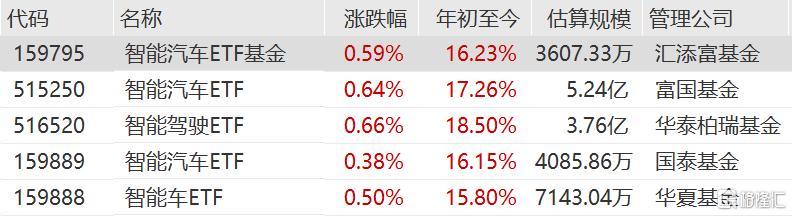
首批L3级自动驾驶车型获准入许可,智能汽车ETF基金、智能汽车ETF、智能驾驶ETF、智能车ETF上涨
Ge Long Hui A P P· 2025-12-16 02:04
Group 1 - The A-share market opened lower, while the smart driving concept stocks saw significant gains, with Wanji Technology hitting the 20% limit up and Zhejiang Shibao and Suoling Co. also reaching the limit up [1] - The smart car ETFs have shown strong performance, with year-to-date increases exceeding 15%, indicating a growing interest in the smart automotive sector [1][2] Group 2 - The Ministry of Industry and Information Technology has approved two L3-level autonomous driving vehicle models, which will be tested on specific roads in Chongqing and Beijing [3] - The approved models include a Changan electric sedan capable of autonomous driving at speeds up to 50 km/h in congested traffic and an Aiways electric sedan capable of 80 km/h on designated highways [3] - This approval marks the official entry of China into the L3 autonomous driving era, presenting new business opportunities for automotive testing and hardware sectors [4] Group 3 - The automotive industry is expected to experience high-quality development driven by policies supporting high-end, intelligent, and globalized growth, with projected sales exceeding 34 million vehicles in 2025 [4] - Domestic brands have captured 65% of the retail market share, a 5.5 percentage point increase from the previous year, with new energy vehicles accounting for a 50.7% penetration rate [4] - By 2026, the automotive market is anticipated to shift towards high-quality development, with projected passenger vehicle sales reaching approximately 31.1 million units [4]


智驾概念股部分高开 浙江世宝涨超13%佑驾创新涨超3%
Xin Lang Cai Jing· 2025-12-16 01:48
Group 1 - The core viewpoint of the article highlights the significant early morning gains in the smart driving concept stocks, indicating positive market sentiment towards this sector [1]. - Zhejiang Shibao (01057) saw a notable increase of 13.15%, reaching a price of 4.56 HKD [1]. - Youjia Innovation (02431) experienced a rise of 3.47%, with its stock priced at 10.37 HKD [1]. - Hesai Technology (02525) increased by 3.07%, trading at 163.40 HKD [1]. - Nexperia (01316) had a modest gain of 0.99%, priced at 6.10 HKD [1]. - Black Sesame Intelligence (02533) saw a slight increase of 0.05%, with a stock price of 19.74 HKD [1].

