
Vivo

Search documents
研报 | 2025年第一季智能手机生产量达2.89亿支
TrendForce集邦· 2025-06-12 07:29
June 12, 2025 产业洞察 根据TrendForce集邦咨询最新调查, 2025年第一季全球智能手机生产总数达2.89亿支,虽然较2024 年同期减少约3%,但各品牌生产表现相对平稳 。其中,中国第一季的销售得益于政策红利,带动销 量微幅成长。展望第二季生产表现,因国际形势的不确定性,市场需求受到抑制,各品牌的生产表现 预估持平第一季。 | Ranking | Brand | Production | QoQ | Market share | | --- | --- | --- | --- | --- | | 1 | Samsung | 64 | 21% | 22% | | 2 | Apple | 48 | -40% | 17% | | 3 | Xiaomi | 42 | -7% | 14% | | 4 | OPPO | 27 | -26% | 9% | | 5 | Vivo | 24 | -16% | 8% | | 6 | Transsion | 22 | -20% | 7% | 各主要品牌表现: 三星( Samsung ) 苹果( Apple ) Apple(苹果)随着新机铺货进入尾声,第一季生 ...





Navitas Semiconductor (NVTS) 2025 Conference Transcript
2025-06-03 13:30
Summary of Navitas Semiconductor (NVTS) Conference Call Company Overview - **Company**: Navitas Semiconductor - **Industry**: Power Semiconductors - **Key Materials**: Gallium Nitride (GaN) and Silicon Carbide (SiC) Core Insights and Arguments 1. **Market Position**: Navitas is a leading supplier of next-generation power solutions, focusing on GaN and SiC technologies, which are more efficient than traditional silicon-based semiconductors [2][4][6] 2. **Market Size**: The silicon carbide market is valued at approximately $3 billion to $4 billion, while GaN is a newer market with significant growth potential [6][8] 3. **Applications**: Navitas is expanding its applications from mobile chargers to data centers, electric vehicles (EVs), and solar inverters [6][12] 4. **AI Impact**: The rise of AI is creating a demand for high-power semiconductors, as AI processors require significantly more power than traditional CPUs [8][10] 5. **Data Center Evolution**: The shift from 12-volt to 48-volt and now to 800-volt data centers is crucial for efficiency, reducing power distribution losses by a factor of 16 when moving to higher voltages [14][17] 6. **Collaboration with NVIDIA**: Navitas is collaborating with NVIDIA to develop next-generation data centers that will utilize their GaN and SiC technologies [12][29] 7. **Revenue Growth**: The company anticipates significant revenue growth in 2026 and 2027 as it ramps up production for data centers and other applications [11][22] Additional Important Points 1. **Technological Advantage**: Navitas has integrated driver and control circuitry directly into GaN chips, which is a significant competitive advantage [26][46] 2. **Patent Portfolio**: The company holds over 200 patents related to GaN technology, enhancing its market position [46] 3. **Market Trends**: The transition to higher voltage systems is not unique to Navitas; it is a broader industry trend that all hyperscalers are adopting [36][38] 4. **Potential for Modules**: There is potential for Navitas to expand into power modules, which could significantly increase their market content [42][43] 5. **Competitive Landscape**: Infineon is identified as a major competitor, but Navitas has established a collaborative relationship through a cross-licensing agreement [48][50] 6. **Future of Power Semiconductors**: The need for high-voltage solutions will continue to grow as the global energy grid upgrades, with silicon carbide being the preferred material for high-voltage applications [56][58] This summary encapsulates the key points discussed during the Navitas Semiconductor conference call, highlighting the company's strategic direction, market opportunities, and technological advancements.


这是最「硬」的小米
雷峰网· 2025-05-26 07:12
Core Viewpoint - Xiaomi's ambition in chip development and automotive manufacturing reflects a long-term strategy, with the recent launch of the 3nm flagship processor "玄戒O1" and the SUV "YU7" marking significant milestones in its journey towards becoming a leading technology company [2][3][25]. Group 1: Chip Development - Xiaomi has pursued its "chip dream" for 11 years, with the establishment of its subsidiary Pinecone Electronics in 2014, indicating a long-term commitment to chip development [7][11]. - The first chip, "澎湃S1," took 28 months to develop and was launched in 2017, making Xiaomi the fourth smartphone manufacturer with self-developed chip capabilities [8]. - Despite initial setbacks with the 澎湃S1, Xiaomi's experience laid the groundwork for the development of the玄戒O1, which has seen over 135 billion RMB invested in R&D and a team of over 2,500 people [11][12]. - The玄戒O1 chip utilizes TSMC's second-generation 3nm process, featuring 19 billion transistors and a compact area of 109mm², showcasing Xiaomi's technological advancements [12]. - Although the玄戒O1 has competitive specifications, it still trails behind Apple's A18 Pro in several areas, indicating that Xiaomi is still in a catch-up phase [13][15]. Group 2: Automotive Development - The launch of the SU7 has been a significant success, with over 25.8 million units delivered, establishing it as a market leader in its price segment [17]. - The upcoming YU7 is positioned as a luxury high-performance SUV, with a focus on long-range capabilities and advanced features, aiming to compete directly with Tesla's Model Y [19][20]. - The YU7's pricing strategy will be crucial for its success, with expectations of a starting price in the range of 26-30 million RMB, while offering superior features compared to competitors [20][21]. Group 3: Long-term Strategy - Xiaomi's strategy emphasizes the importance of having its own "core" (chips) and "wheels" (vehicles) to maintain a competitive edge in the smartphone and automotive markets [23][25]. - The company has committed to a long-term investment plan of at least 500 billion RMB over the next decade for its chip business, alongside significant investments in automotive development [11][25]. - Xiaomi's approach reflects a patient and steady commitment to building its technological capabilities, with both chip and automotive projects seen as integral to its future success [25][28].

阿里AI产品爆发!吴泳铭最新研判
新华网财经· 2025-05-16 02:23
Core Viewpoint - Alibaba Group's financial results for the fourth quarter and fiscal year 2025 demonstrate strong growth driven by AI initiatives, with significant increases in revenue and shareholder returns [1][21]. Financial Performance - For the fourth quarter ending March 31, 2025, Alibaba reported revenue of 236.45 billion RMB, a year-on-year increase of 7%, and a non-GAAP net profit of 29.85 billion RMB, up 22% from the previous year [4][20]. - In fiscal year 2025, Alibaba achieved total revenue of 996.35 billion RMB, a 6% increase year-on-year, with adjusted EBITA growing 5% to 173.07 billion RMB [6][20]. - Alibaba Cloud's revenue grew 18% year-on-year to 30.13 billion RMB, marking the fastest growth in three years, driven by strong AI demand [10][12]. Shareholder Returns - Alibaba repurchased 1.197 billion shares for a total of 11.9 billion USD in fiscal year 2025, becoming one of the largest repurchasers among Chinese concept stocks [1][21]. - The company announced a total dividend of 4.6 billion USD for fiscal year 2025, reinforcing its commitment to enhancing shareholder returns [1][21]. AI and Cloud Business Growth - AI-related product revenue has seen triple-digit growth for seven consecutive quarters, indicating robust demand across various industries [1][12]. - Alibaba Cloud's market share has been recovering for three consecutive quarters, reflecting the increasing adoption of AI solutions [10][12]. Strategic Focus and Trends - CEO Wu Yongming highlighted two key trends in AI: the shift of AI applications from internal systems to user-facing scenarios in medium and large enterprises, and the expansion of AI usage among small and medium-sized enterprises [2][13]. - The company plans to invest over 380 billion RMB in cloud and AI hardware infrastructure over the next three years to meet growing AI demand [21]. Business Segment Performance - The International Digital Commerce Group's revenue grew 22% year-on-year to 33.58 billion RMB, driven by strong performance in cross-border business [19][20]. - The Local Services Group's revenue increased by 10% to 16.13 billion RMB, supported by order growth from Gaode and Ele.me [19][20]. - The Digital Entertainment Group's revenue rose 12% to 5.55 billion RMB, primarily due to strong performance in film and entertainment [19][20].


中美关系刚有缓和迹象,印度突然出手了?万斯果然没白跑一趟?
Sou Hu Cai Jing· 2025-05-07 11:11
据央视新闻报道,商务部新闻发言人就中美经贸对话磋商情况答记者问。有记者问:近期美方多次表 示,正与中方就经贸问题进行谈判,并会达成协议,请问商务部对此有没有进一步的消息和评论?商务 部新闻发言人表示,中方注意到美方高层多次表态,表示愿与中方就关税问题进行谈判。同时,美方近 期通过相关方面多次主动向中方传递信息,希望与中方谈起来。对此,中方正在进行评估。 经济上,美国推动的"印太战略"里,印度是重要一环,这让印度看到了借力发展的可能,此外,印度推 行的"印度制造"计划,需要外来投资和技术,而美国似乎被视为可以倚重的支持者,在这种背景下,向 美国示好,似乎成了一个"合情合理"的选择。而且,印度的"站队"行动并没有停留在口头,实际动作紧 随其后,还记得当时印度对中国部分钢铁产品加征临时关税的决定吗?表面上是为了保护国内钢厂,但 在时间点上显得意味深长,这种明显损害中国利益的行为,根本得不到中方的认可。 中美贸易(资料图) 印度(资料图) 记得那些年,中美贸易曾被誉为两国关系的"定海神针"。中国的便宜货占领美国超市货架,美国消费者 乐开花,美企也在中国市场赚得盆满钵满。然而,特朗普的一声"美国优先",打破了这份宁静。 ...

国产射频前端,天塌了?
半导体行业观察· 2025-05-06 00:57
Core Viewpoint - The domestic RF front-end industry is facing unprecedented challenges, with leading companies like ZTE Microelectronics, Weijie Chuangxin, and Huizhiwei reporting significant losses, indicating a severe market downturn driven by intense competition and overcapacity [1][4]. Group 1: ZTE Microelectronics - ZTE Microelectronics reported a revenue of 756 million yuan in Q1 2025, a year-on-year decline of 36.47%, with a net profit loss of 46.62 million yuan [1]. - The company has shifted its focus from RF switch products to integrated modules, achieving self-production of RF filters and power amplifiers, but this transition has not yielded the expected results, leading to a decline in revenue from RF switches [2]. - The Fab-Lite strategy adopted by ZTE Microelectronics aims to enhance supply chain control but has resulted in increased R&D costs and fixed asset depreciation, contributing to a 64.2% drop in net profit in 2024 [3]. Group 2: Weijie Chuangxin - Weijie Chuangxin, a leading player in the RF power amplifier sector, reported a revenue of 2.103 billion yuan in 2024, down 29.46% year-on-year, with a net profit loss of 23.73 million yuan [4][6]. - The company has maintained a strong market position in the RF power amplifier field, with a 40% market share in 4G PA and 30% in 5G products, but has faced challenges due to declining prices and increased competition [5]. - Despite its strong R&D capabilities and market presence, Weijie Chuangxin has struggled to maintain profitability, oscillating between profit and loss [6]. Group 3: Huizhiwei - Huizhiwei has focused on technological innovation as its core competitive advantage, achieving significant breakthroughs in RF front-end chip technology [7][8]. - The company has developed a reconfigurable RF front-end technology that combines SOI and GaAs materials, allowing it to compete effectively against international suppliers [8][9]. - Huizhiwei's Phase8L L-PAMiD module has achieved mass production and is positioned to enhance the domestic RF front-end industry's competitiveness against international players [9][10]. Group 4: Market Dynamics - The competition in the domestic RF front-end market is characterized by both technological and capital challenges, with companies needing to invest heavily in R&D while also managing operational costs [11]. - The market is expected to undergo significant changes, with the introduction of new products and technologies potentially reshaping the competitive landscape [12][13]. - The year 2025 is anticipated to mark the beginning of a more intense phase of competition in the domestic RF front-end sector, as companies strive to establish their market positions [13].




Apple Is Moving US iPhone Assembly to India Amid Tariff Turmoil
CNET· 2025-05-02 23:02
Core Viewpoint - Apple plans to source nearly all iPhones sold in the US from India, amounting to about 60 million units annually, in response to tariffs imposed by the Trump administration on China [1][2] Group 1: Manufacturing Strategy - The majority of iPhones sold in the US are expected to have India as their country of origin for the June quarter, with Vietnam being the source for most iPads, Macs, Apple Watches, and AirPods [2] - By relocating assembly to India, Apple aims to mitigate cost pressures from the trade war, although India may face new tariffs [3] - Apple's shift is part of a broader strategy that may involve increasing US component manufacturing, with plans to potentially double iPhone production capacity in India over the next two to three years [4] Group 2: Market Dynamics - Despite the shift, Apple will maintain a significant manufacturing presence in China, as 15% of its sales are expected to come from that market, and global iPhone manufacturing will still rely heavily on Chinese facilities [4] - The company is unlikely to move all iPhone production to the US due to cost constraints, but it may increase production of modems and internally designed processors in collaboration with Taiwan Semiconductor [4] Group 3: Competitive Landscape - Apple's move to increase manufacturing in India is not unprecedented, as competitors like Samsung, Oppo, Vivo, and Motorola have already established production in the country [7] - There are indications that Google may also shift production of its Pixel phone to India from Vietnam, highlighting a trend among tech companies to diversify manufacturing locations [7]

“知”产厚实!广东多项指标领跑全国,创新力“爆表”
Nan Fang Du Shi Bao· 2025-05-01 14:25
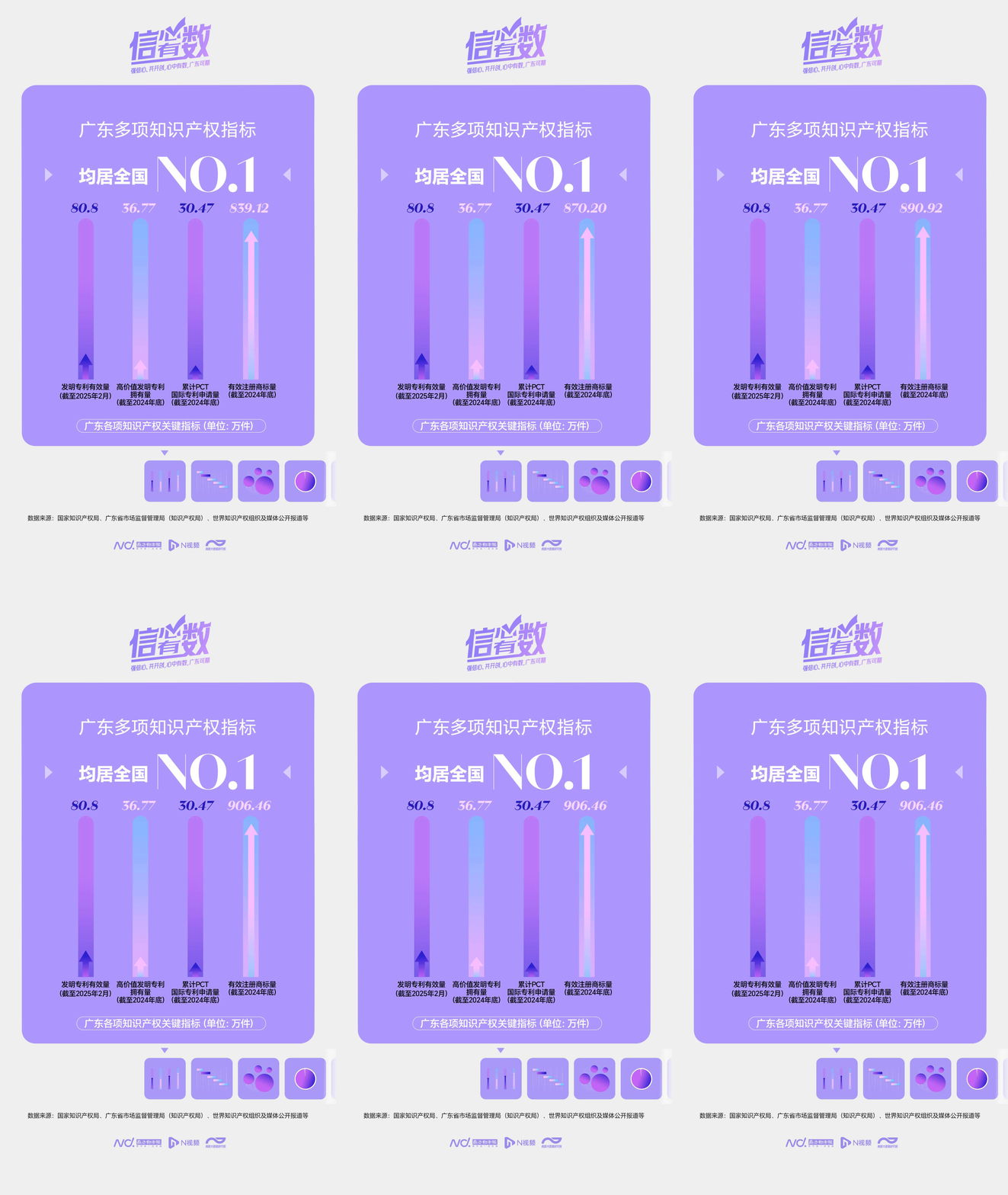
Core Insights - Guangdong is striving to become a leading province in intellectual property (IP) protection and innovation, with a focus on building an international first-class IP strong province and a world-class Bay Area for IP [2][3] Group 1: Intellectual Property Development - Guangdong has led the nation in the intellectual property development index for 12 consecutive years, with multiple key IP indicators ranking first in the country [2][3] - As of February 2025, Guangdong's effective invention patents exceeded 800,000, reaching 808,000, maintaining the top position in the nation for 25 years [3][6] - By the end of 2024, Guangdong had 367,700 high-value invention patents, 304,700 PCT international patent applications, and 9,064,600 effective registered trademarks [3][6] Group 2: Innovation and Industry Integration - Intellectual property is a strategic resource for industrial innovation and competitiveness, with Guangdong focusing on patent navigation and high-value patent cultivation [9][10] - As of February 2025, Guangdong's strategic industrial clusters held 561,200 effective invention patents, accounting for 69.43% of the province's total [10][12] - Enterprises are the main drivers of innovation in Guangdong, with 87% of the province's effective invention patents owned by 90,200 companies [12][14] Group 3: Patent Utilization and Financial Services - Guangdong has made significant progress in patent conversion and utilization, with over 170 universities and research institutions managing 99,200 patents and engaging more than 30,000 innovative enterprises [18][20] - In 2024, the province's patent and trademark pledge financing reached 345.397 billion yuan, a year-on-year increase of 49.74%, benefiting over 5,067 enterprises [20][22] - The added value of patent-intensive industries in Guangdong was 2.54 trillion yuan in 2023, accounting for 18.4% of the province's GDP, surpassing the national average [20][22]
百亿“养老机器人”市场融资不断:独家解析康复/护理/陪伴三大方向落地案例
3 6 Ke· 2025-04-29 02:45
Group 1 - The topic of elderly care robots has gained significant attention this year, with expectations for companion robots to enter households in about three years and care robots for the disabled in about five years [1][2] - The market for elderly care robots in China is projected to reach approximately 7.9 billion yuan in 2024, with a compound annual growth rate of around 15%, potentially reaching 15.9 billion yuan by 2029 [2][3] - The International Electrotechnical Commission (IEC) has released international standards for elderly care robots, marking a transition from exploration to standardized development in the industry [3][11] Group 2 - The demand for elderly care is surging, with over 300 million people aged 60 and above in China and more than 45 million disabled or semi-disabled elderly individuals, while the industry faces a shortage of 5.5 million caregivers [8][9] - Government policies are actively supporting the development of elderly care robots, with multiple initiatives aimed at promoting technological advancements and applications in the sector [9][10] - Various types of elderly care robots have been categorized, including rehabilitation robots, nursing robots, and companion robots, each serving different needs and applications [11][12] Group 3 - Rehabilitation robots are increasingly entering the consumer market, with companies like Cheng Tian Technology launching products aimed at enhancing mobility for the elderly [16][18] - Nursing robots are focused on addressing essential daily living needs for the elderly, with several companies developing solutions for tasks such as bathing and feeding [20][23] - Companion robots are gaining traction, providing emotional support and monitoring functions, with products designed specifically for elderly users becoming more prevalent [25][28] Group 4 - Major companies are investing in the elderly care robot sector, with collaborations between tech firms and rehabilitation institutions to enhance product development and application [30][31] - The high cost of elderly care robots remains a barrier to widespread adoption, leading to exploration of rental models to make these technologies more accessible [31][32] - The industry is expected to evolve towards a model where human labor and intelligent systems work collaboratively to provide comprehensive care solutions [32]


小米、OPPO奇袭,传音开始守不住非洲大本营
36氪· 2025-04-28 09:44
以下文章来源于硬氪 ,作者张子怡 硬氪 . 专注全球化、硬科技报道。36kr旗下官方账号。 非洲兄弟的生意还好做吗? 文 | 张子怡 编辑 | 袁斯来 来源| 硬氪(ID: south_36kr) 封面来源 | 企业官网 手机市场的战火,如今在没什么利润的地方也烧得铺天盖地。 在传音控股每一年的年报里,都能看到他们为了海外用户耗费心力。 尤其是,传音引以为傲的大本营非洲市场中,小米和Realme的增速都异常迅猛,Realme同比增速超89%。传音在非洲独特的分销渠道网络建设,曾经让 国内手机厂商望而却步,但在今天,各家逐渐学会了传音的路数。 对于业绩的增收不增利,传音回应称,受市场竞争以及供应链成本综合影响,毛利率有所下降,扣非净利润因此有所减少。 简单解释原因,就是新兴市场竞争显著加剧。传音在受到巨头持续的冲击。 小米除性价比之外,还着力结合本地化拉动"米粉";Vivo则主攻本土化出海战略;Realme则主打年轻潮流人群。 东南亚、拉美、中东市场同样如此。各家的目标很明确:瓜分传音的份额。 低价路线是传音的优势,也使得其难以向上做高端化。智能手机供应链高度成熟的今天,大厂一旦下定决心要流血占地,传音很难抵御 ...