大成基金

Search documents
资产配置中不可或缺的黄金和商品基金,最受欢迎的都在这里了
雪球· 2025-05-13 07:56
Core Viewpoint - The article discusses the performance of various funds, particularly highlighting the significant returns of gold and commodity funds compared to equity funds, emphasizing the importance of including commodity assets in investment portfolios for diversification and risk management [2][4]. Group 1: Fund Performance - From January 2, 2021, to May 7, 2023, the cumulative return of mixed equity funds was -19.00%, while gold ETFs, crude oil LOFs, and soybean meal ETFs achieved returns of 97.76%, 88.97%, and 59.70% respectively [2]. - The largest domestic gold ETF has surpassed 40 billion yuan in size, with several others exceeding 10 billion yuan, indicating a strong preference for domestic gold funds over QDII gold funds, which have a much smaller scale [6][8]. Group 2: Investment Strategy - The article suggests that investors should not chase high prices in gold and commodity assets but rather understand the low or negative correlation between commodities and equities, highlighting the essential role of commodity assets in asset allocation [4][8]. - It is noted that the E Fund Gold Theme LOF has outperformed other gold funds with a return of 25.22% in the first quarter, due to its strategy of investing not only in gold ETFs but also in gold stocks, which offer higher volatility and potential returns [8]. Group 3: Other Commodity Funds - Other commodity funds are limited, with the largest being the Huaxia Feed Soybean Meal Futures ETF, which tracks soybean meal futures prices and has a scale of 28.29 billion yuan [11][12]. - The Guotou Silver LOF, which directly invests in silver futures, ranks second among commodity funds with a scale of 17.85 billion yuan, indicating a trend of following gold price movements [12][13]. - The article also mentions various other commodity funds, including those focused on crude oil and colored metals, emphasizing their potential for high returns and the importance of monitoring their performance [15][17].


突然火了,2500亿!
Zhong Guo Ji Jin Bao· 2025-05-13 05:07
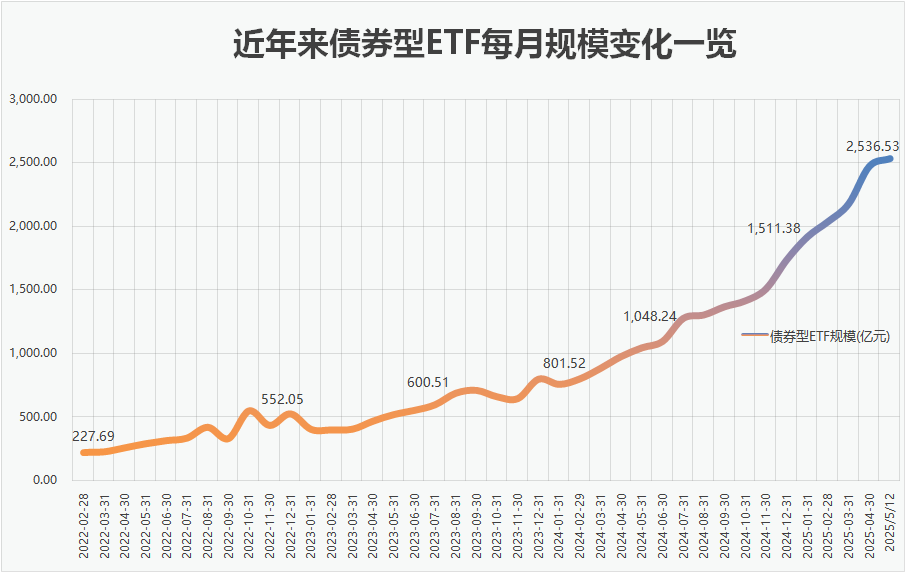
Core Insights - The rapid growth of bond ETFs in China has been highlighted, with the total scale surpassing 250 billion yuan, marking a significant increase in the market [2][3][8] Market Growth - As of May 12, the total scale of 29 bond ETFs reached 253.65 billion yuan, reflecting an increase of nearly 80 billion yuan this year, representing a growth rate of 45.8% [3][8] - The bond ETF market has seen a surge in new fund launches, with 8 new bond ETFs raising a total of 21.71 billion yuan this year, leading to a total management scale of 41.9 billion yuan, a 93% increase from the initial fundraising [5][6] Fund Inflows - Existing bond ETFs have also experienced significant net inflows, totaling 30.97 billion yuan this year, with notable contributions from specific funds such as the 30-year treasury ETF and various short-term bond ETFs [7][8] - The continuous growth of bond ETFs is attributed to multiple factors, including their clear risk-return characteristics, transparency of underlying assets, and stable positions, catering to diverse investor needs [7][8] Future Outlook - Industry experts believe that the bond market still holds good allocation value, and bond ETFs are expected to continue expanding [10][11] - Compared to mature markets like the U.S., the development of bond ETFs in China is still in its early stages, indicating significant growth potential [10][11] - The bond market may face short-term fluctuations but is expected to return to fundamentals in the medium to long term, with overall positive implications for the bond market [10][11]
两市ETF融资余额增加7024.35万元
Zheng Quan Shi Bao Wang· 2025-05-13 01:57
Core Insights - The total ETF margin balance in the two markets reached 100.77 billion yuan, an increase of 57.12 million yuan from the previous trading day, reflecting a 0.06% increase [1] - The ETF financing balance was 95.77 billion yuan, with an increase of 70.24 million yuan, representing a 0.07% increase [1] Market Overview - The Shenzhen market's ETF margin balance was 34.71 billion yuan, decreasing by 25.51 million yuan, while the financing balance increased by 7.70 million yuan [1] - The Shanghai market's ETF margin balance was 66.06 billion yuan, increasing by 82.63 million yuan, with the financing balance rising by 62.54 million yuan [1] ETF Financing Balances - There are 106 ETFs with financing balances exceeding 100 million yuan, with the highest being Huaan Gold ETF at 8.63 billion yuan [2] - The ETFs with the largest increases in financing balances include: - Jiashi Zhongzheng Hong Kong Stock Connect High Dividend Investment ETF: 634.2 thousand yuan, up 1464.42% - Wanjia Zhongzheng A500 ETF: 211.73 thousand yuan, up 325.57% - Boshi Science and Technology Innovation Index ETF: 169.28 thousand yuan, up 253.05% [2][3] Margin Trading Activity - The top three ETFs for net financing purchases were: - Huaxia Shanghai Stock Exchange Science and Technology Innovation Board 50 ETF: 131 million yuan - Guangfa Zhongzheng Hong Kong Innovative Medicine ETF: 79.48 million yuan - Southern Zhongzheng 1000 ETF: 49.49 million yuan [5] - The top three ETFs for net financing sales were: - Huaxia Hang Seng Technology ETF: 103 million yuan - Hang Seng Technology: 92.91 million yuan - E-Fund Growth Enterprise Board ETF: 86.89 million yuan [5] Margin Balance Changes - The ETFs with the highest margin balances include: - Southern Zhongzheng 1000 ETF: 1.74 billion yuan - Southern Zhongzheng 500 ETF: 1.62 billion yuan - Huaxia Zhongzheng 1000 ETF: 374 million yuan [9][10] - The ETFs with the largest increases in margin balances were: - Southern Zhongzheng 500 ETF: increased by 21.14 million yuan - Huatai Baichuan Shanghai-Shenzhen 300 ETF: increased by 16.88 million yuan [9][10]
增量资金涌入,债券型ETF规模突破2500亿元
Sou Hu Cai Jing· 2025-05-12 13:31
Core Viewpoint - The bond ETF market in China has experienced significant growth in 2023, with total assets surpassing 250 billion yuan, indicating a strong upward trend and potential for further expansion in the future [1][2][4]. Growth of Bond ETFs - Since the launch of the first bond ETF in March 2013, the market initially grew slowly, with only three ETFs issued in the first five years. However, recent years have seen rapid growth, with the total scale of bond ETFs reaching 253.129 billion yuan by May 9, 2023, up from 173.973 billion yuan at the beginning of the year, marking a 45.5% increase [2][3]. - The bond ETF market has shown a steady increase throughout the year, with monthly growth from 192.046 billion yuan at the end of January to 253.129 billion yuan by May [2]. Credit Bond ETFs - The number of credit bond ETFs has increased significantly, with eight new ETFs launched in January 2023, raising a total of 21.710 billion yuan. By May 12, 2023, these ETFs had grown to a total scale of 41.534 billion yuan, reflecting a 91.31% increase since their launch [3]. - The overall scale of credit bond ETFs has doubled from 54.074 billion yuan at the end of the previous year to 111.131 billion yuan by May 12, 2023, making it the largest category within bond ETFs [3]. Factors Driving Growth - Analysts attribute the influx of funds into bond ETFs to three main factors: the popularity of passive index investing, the increasing homogeneity of domestic city investment bonds, and a deeper understanding of the bond market by investors following a three-year bull market [3][4]. - Bond ETFs offer multiple advantages over traditional bond funds, including diversified risk management, liquidity, low fees, and active secondary market trading [4]. Market Outlook - Despite challenges faced by bond funds in 2023, many institutions remain optimistic about the future of the bond market. The overall bond fund scale decreased by 6.3% to 6.44 trillion yuan in the first quarter of 2025, with pure bond funds experiencing a significant decline [5]. - Analysts predict that the low interest rate environment may persist, with a downward trend in interest rates expected, although not as consistent as in previous years. The recent monetary policy adjustments signal a potential for further easing, which could benefit short-term and credit bonds [7].
科技主题行情催化下,部分相关绩优基金规模快速增长
Changjiang Securities· 2025-05-12 11:59
- The report does not contain any specific quantitative models or factor construction details related to quantitative investment strategies[1][2][3]
基金分析报告:深度价值基金池202505:保持绝对收益
Minsheng Securities· 2025-05-12 09:10
Group 1 - The deep value investment philosophy is derived from Graham's "cigar butt" approach, focusing on stocks priced significantly below their liquidation value, particularly during economic downturns [8][10] - The deep value fund pool has demonstrated stable historical returns, with an annualized return of 11.05% from February 2, 2015, to May 8, 2025, outperforming the equity fund index by 4.54% [10][13] - The fund pool exhibits a high-risk return ratio, with an annualized volatility of 20.46% and a Sharpe ratio of 0.54, indicating strong return stability [10][13] Group 2 - The excess returns of the fund pool are primarily attributed to dynamic allocation, style configuration, and stock selection, favoring low momentum, low elasticity, and low volatility styles [2][13] - The current portfolio has shifted towards increased allocation in the consumer sector while maintaining exposure to manufacturing and TMT sectors [21][22] - The deep value fund pool is defined by absolute undervaluation characteristics, with a focus on funds that have positive exposure to the BP factor and high expected net profit [24][25] Group 3 - The current deep value fund list includes several funds with varying scales and returns, such as Guangfa Stable Strategy with a scale of 2.39 billion and a return of 4.55% [25] - The fund pool's historical performance shows resilience even during market style shifts, maintaining positive absolute returns despite some drawdowns [13][21] - The fund pool's industry allocation has primarily been in financial and cyclical sectors, with recent adjustments to increase consumer sector exposure [21][22]
深证100指数ETF今日合计成交额1.47亿元,环比增加44.87%
Zheng Quan Shi Bao Wang· 2025-05-12 08:50
Core Viewpoint - The trading volume of the Shenzhen 100 Index ETFs increased significantly today, indicating heightened market activity and investor interest in these funds [1]. Trading Volume Summary - The total trading volume of Shenzhen 100 Index ETFs reached 147 million yuan today, an increase of 45.44 million yuan compared to the previous trading day, representing a growth rate of 44.87% [1]. - Specifically, the E Fund Shenzhen 100 ETF (159901) had a trading volume of 81.04 million yuan, up 31.12 million yuan from the previous day, with a growth rate of 62.33% [1]. - The Southern Shenzhen 100 ETF (159212) recorded a trading volume of 35.54 million yuan, an increase of 4.61 million yuan, with a growth rate of 14.92% [1]. - The Da Cheng Shenzhen 100 ETF (159216) saw a trading volume of 7.71 million yuan, up 3.58 million yuan, with a growth rate of 86.85% [1]. - The Industrial Bank Shenzhen 100 ETF (159970) and the Shenzhen 100 P ETF (159969) experienced remarkable increases in trading volume, with growth rates of 118,021.76% and 376.03% respectively [1]. Market Performance Summary - As of market close, the Shenzhen 100 Index (399330) rose by 1.79%, while the average increase for related ETFs was 1.76% [1]. - Notable performers included the Yongying Shenzhen 100 ETF (159721) and the Industrial Bank Shenzhen 100 ETF (159970), which increased by 2.53% and 1.87% respectively [1].
ETF月报:规模攀升突破,公募改革落地
HTSC· 2025-05-12 07:50
Investment Rating - The industry rating is "Overweight" indicating that the expected performance of the industry stocks will exceed the benchmark [7]. Core Insights - The total asset scale of the ETF market has surpassed 4 trillion yuan, with a month-on-month growth of 6.9%, and the stock ETF scale increased by 4.5% due to significant adjustments in the equity market caused by equal tariffs [11][12]. - The "Action Plan for Promoting the High-Quality Development of Public Funds" has been implemented, aiming to enhance the ecosystem of public funds and significantly increase the scale and proportion of equity investments in public funds, which is expected to accelerate the development of stock ETFs [5][31][32]. Summary by Sections Total Scale - As of the end of April 2025, the net asset value of stock ETFs reached 29,484 billion yuan, a month-on-month increase of 4.5%. The total net asset value of all ETFs exceeded 40,604 billion yuan, with a month-on-month growth of 6.9% [2][12]. Competitive Landscape - The concentration of leading fund companies has slightly increased, with the CR3, CR5, and CR10 reaching 45.1%, 57.8%, and 77.9% respectively, showing a month-on-month increase [3][17]. New Product Launches - In April 2025, stock ETFs raised a total of 9.6 billion yuan through batch issuance, including various thematic ETFs such as those focused on the aerospace and digital economy [4][23]. Policy Dynamics - The recently released "Action Plan for Promoting the High-Quality Development of Public Funds" outlines a comprehensive reform roadmap, emphasizing the need to bind fund company revenues to investor returns and enhance the scale of equity investments [5][31][32].
这类基金,总规模增长14倍
Zhong Guo Ji Jin Bao· 2025-05-12 03:08
Core Insights - The first batch of ETFs tracking the Hang Seng Tech Index has seen its total scale increase by 14 times over four years, indicating strong growth in the Chinese tech sector [1][2][5] Group 1: ETF Performance and Growth - As of May 9, the total scale of the first batch of Hang Seng Tech ETFs reached 755.63 billion, a significant increase from the initial scale of 49.89 billion, representing a growth of 14.15 times [2] - The Huatai-PB Southbound Hang Seng Tech ETF has grown to 249.85 billion, a 20-fold increase since its inception, while the Huaxia Hang Seng Tech ETF has reached 272.50 billion, leading among the six products [2][3] - Since 2024, the performance of the first batch of Hang Seng Tech ETFs has rebounded significantly, with an overall net asset value growth rate exceeding 40% [5][6] Group 2: Market Dynamics and Drivers - The growth of the Hang Seng Tech ETFs is driven by structural beta and alpha, reflecting the "Chinese tech industry upgrade dividend" and "global capital reallocation" [2][3] - Factors such as policy risk alleviation and capital flow have catalyzed short-term growth, while long-term support comes from technological iterations and business model innovations in new economy enterprises [2][3][6] - The Hang Seng Tech Index comprises 30 high-quality Chinese tech companies, which enhances its investment value, especially after experiencing a period of adjustment [3][6] Group 3: Future Outlook - The long-term logic of the Chinese tech industry remains unchanged, and the removal of risk factors that previously suppressed this logic suggests that related ETFs may recover and enter a new revaluation phase [6][7] - The Hang Seng Tech Index is expected to benefit from both interest rate cuts and high growth in the tech sector, with a projected earnings growth of over 50% for its constituent companies in 2024 [7] - The anticipated price-to-earnings ratio for the Hang Seng Tech Index in 2025 is 17.6, significantly lower than its historical average and the Nasdaq 100, indicating potential for continued strength [7]
ETF融资融券日报:两市ETF两融余额较前一交易日减少2.05亿元,博时中证可转债及可交换债券ETF融资净买入达8757.46万元
2 1 Shi Ji Jing Ji Bao Dao· 2025-05-12 02:32
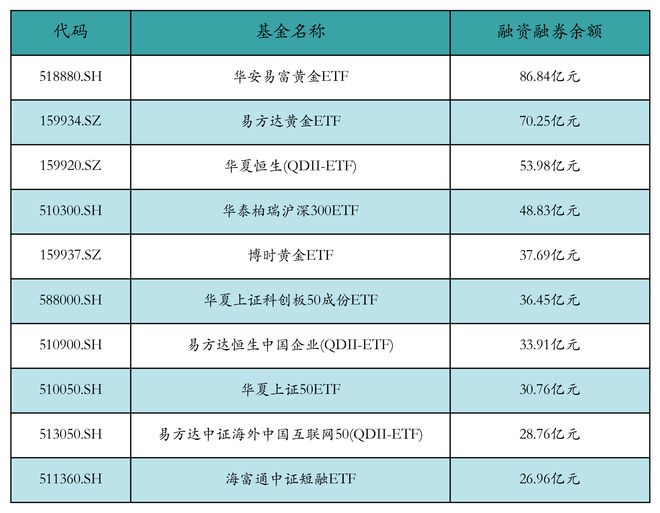
Market Overview - As of May 9, the total ETF margin balance in the two markets is 100.715 billion yuan, a decrease of 0.205 billion yuan from the previous trading day [1] - The financing balance is 95.699 billion yuan, down by 0.223 billion yuan, while the securities lending balance is 5.016 billion yuan, an increase of 18.2826 million yuan [1] - In the Shanghai market, the ETF margin balance is 65.977 billion yuan, a decrease of 0.201 billion yuan, with a financing balance of 61.68 billion yuan, down by 0.227 billion yuan [1] - In the Shenzhen market, the ETF margin balance is 34.738 billion yuan, a decrease of 0.034491 billion yuan, with a financing balance of 34.019 billion yuan, an increase of 3.708 million yuan [1] ETF Margin Balance - The top three ETFs by margin balance on May 9 are: - Huaan Yifu Gold ETF (8.684 billion yuan) - E Fund Gold ETF (7.025 billion yuan) - Huaxia Hang Seng (QDII-ETF) (5.398 billion yuan) [2] - The top ten ETFs by margin balance include: - Huatai-PB CSI 300 ETF (4.883 billion yuan) - Bosera Gold ETF (3.769 billion yuan) - Huaxia Shanghai Stock Exchange Science and Technology Innovation Board 50 ETF (3.645 billion yuan) [2] ETF Financing Buy Amount - The top three ETFs by financing buy amount on May 9 are: - Huaxia Hang Seng Technology (QDII-ETF) (0.776 billion yuan) - Haifutong CSI Short Bond ETF (0.775 billion yuan) - Huatai-PB Southern East England Hang Seng Technology Index (QDII-ETF) (0.706 billion yuan) [3][4] ETF Financing Net Buy Amount - The top three ETFs by financing net buy amount on May 9 are: - Bosera Convertible Bonds and Exchangeable Bonds ETF (87.5746 million yuan) - Haifutong CSI Short Bond ETF (79.5943 million yuan) - Huaxia Shanghai Stock Exchange Science and Technology Innovation Board 50 ETF (38.672 million yuan) [5][6] ETF Securities Lending Sell Amount - The top three ETFs by securities lending sell amount on May 9 are: - Southern CSI 500 ETF (61.0973 million yuan) - Southern CSI 1000 ETF (31.8994 million yuan) - Guotai CSI All-Index Securities Company ETF (14.3665 million yuan) [7][8]