华安基金

Search documents
首批商业不动产REITs正式申报,ABS一二市场热度提升
Zhong Cheng Xin Guo Ji· 2026-02-04 02:50
The provided content does not include any quantitative models or factors, nor does it contain any relevant information about their construction, evaluation, or backtesting results. The documents primarily discuss the development and issuance of REITs (Real Estate Investment Trusts) and ABS (Asset-Backed Securities) in China, along with market trends and statistics. If you have another document or specific quantitative research content, please provide it for analysis
绝对收益产品及策略周报(260126-260130):上周108只固收+基金创新高-20260204
GUOTAI HAITONG SECURITIES· 2026-02-04 01:31
- The report introduces a **macro timing model** for asset allocation, which predicts macroeconomic environments using proxy variables and selects optimal asset classes for absolute return portfolios. For Q1 2026, the model forecasts a "Slowdown" environment, with returns of 1.65% for CSI 300, 9.13% for CNI 2000, 8.61% for Nanhua Commodity Index, and 0.39% for ChinaBond Total Treasury Wealth Index[23][30] - A **macro momentum model** is constructed for monthly timing signals, considering factors such as economic growth, inflation, interest rates, exchange rates, and risk sentiment. This model is used for timing equities, bonds, and other major asset classes. Additionally, a multi-cycle gold timing strategy is built using macro, position, volume-price, and sentiment factors. For January 2026, the returns are 1.65% for CSI 300, 0.39% for ChinaBond Total Treasury Wealth Index, and 19.59% for AU9999 contract[23][30] - The **industry ETF rotation strategy** is based on a multi-factor model that incorporates historical fundamentals, expected fundamentals, sentiment, volume-price technicals, and macroeconomic factors. The strategy matches ETFs with their corresponding industry indices and selects ETFs from a benchmark pool of 23 first-level industries. For January 2026, the recommended ETFs include Guotai CSI Coal ETF, Guotai CSI Steel ETF, Guotai CSI All Securities ETF, and Huabao CSI Bank ETF, each with an initial weight of 25%[24][27][28] - The **20/80 stock-bond rebalancing strategy** driven by macro timing achieved a weekly return of 0.05% and a YTD return of 0.56%. The **stock-bond risk parity strategy** achieved a weekly return of 0.04% and a YTD return of 0.47%. When combined with the industry ETF rotation strategy, the enhanced 20/80 rebalancing strategy achieved a weekly return of 0.29% and a YTD return of 0.89%, while the enhanced risk parity strategy achieved a weekly return of 0.13% and a YTD return of 0.55%[4][30][33] - The **stock-bond-gold risk parity strategy** achieved a weekly return of 0.26% and a YTD return of 1.28%, with an annualized volatility of 2.96%, a maximum drawdown of 0.49%, and a Sharpe ratio of 6.90[4][30][35] - The **quantitative fixed-income plus strategy** includes stock-bond rebalancing models with different configurations. For the 10/90 monthly rebalancing strategy, the small-cap value style achieved a YTD return of 1.38%, while the small-cap growth style achieved 1.02%. For the 20/80 monthly rebalancing strategy, the small-cap value style achieved a YTD return of 2.60%, while the small-cap growth style achieved 1.88%. When combined with macro timing, the 20/80 monthly rebalancing strategy achieved a YTD return of 3.82% for the small-cap value style and 2.73% for the small-cap growth style. The 20/80 quarterly rebalancing strategy based on counter-cyclical allocation achieved a YTD return of 1.38% for the PB earnings + small-cap value combination and 1.02% for the PB earnings + small-cap growth combination[4][37][40]
四家公募提示旗下原油LOF风险
Xin Lang Cai Jing· 2026-02-03 19:46
(来源:经济参考报) 嘉实基金公告显示,近期,公司旗下嘉实原油证券投资基金(QDII-LOF)二级市场交易价格高于基金 份额净值,出现较大幅度溢价。特此提示投资者关注二级市场交易价格溢价风险,投资者如果盲目投 资,可能遭受较大损失。2月2日盘后,嘉实基金还发布了嘉实原油证券投资基金(QDII-LOF)暂停申 购业务的公告:为保证基金平稳运作,保护基金份额持有人利益,该基金决定自2026年2月3日起暂停申 购(含定期定额投资)业务。 近段时间,国际原油市场波动较大。从期货市场来看,2月2日亚洲交易时段,布伦特原油期货一度跌破 每桶67美元,WTI原油期货失守每桶63美元关口,日内跌幅均超过3%。国内多只原油LOF净值也出现 了较大波动,2月2日收盘,易方达、嘉实、华安、广发旗下的4只原油LOF全部跌停。 业内人士表示,国际局势的不确定状态为油价注入了风险溢价。然而一旦紧张局势出现缓和迹象,这部 分溢价就会迅速消退。短期内,原油市场的波动性可能持续,需进一步关注风险共振。 广发基金同时表示,若该基金2月3日二级市场交易价格溢价幅度未有效回落,本基金有权通过向深圳证 券交易所申请盘中临时停牌、延长停牌时间的方式,向 ...
多只石油LOF现高溢价 公募基金密集限购预警
Zheng Quan Ri Bao· 2026-02-03 16:42
Core Viewpoint - The recent volatility in the international oil market has led to a surge in trading activity for domestic oil and gas-themed funds, resulting in significant premium risks as market prices deviate from net asset values [1] Group 1: Premium Risks and Fund Responses - Multiple public fund institutions, including E Fund, GF Fund, Huaan Fund, and Harvest Fund, have issued warnings about high premium trading risks for their oil and petroleum LOF products, implementing measures such as suspensions and strict purchase limits to cool market enthusiasm [1][2] - On February 3, GF Fund and Huaan Fund reiterated warnings about premium risks in their oil LOF products, with GF Fund noting significant price deviations from net asset values, cautioning investors against blind investments in high premium funds [2] - Several public fund institutions have already warned investors about premium risks this year, with E Fund's oil LOF showing a net asset value of 1.1315 yuan on January 27, while the market closing price reached 1.437 yuan on January 29, prompting a suspension of trading [2] Group 2: Subscription Limit Adjustments - Many public fund institutions have reduced subscription limits for oil LOFs to prevent excessive capital inflow that exacerbates premium risks, with Huaan Fund adjusting its limit from 100 yuan to 2 yuan within a month [3] - E Fund's oil LOF reduced its subscription limit from 20 yuan to 10 yuan, while GF Fund lowered its limit from 500 yuan to 10 yuan, and Harvest Fund set its limit to 5 yuan, creating a "limit control matrix" across multiple products [3] Group 3: Market Dynamics and Risks - The high premiums for oil LOFs are attributed to a combination of limited QDII quotas, supply-demand imbalances, and the failure of arbitrage mechanisms, leading to a situation where investors turn to the secondary market, driving up prices [4] - The current high premiums are seen as driven by market sentiment rather than a reassessment of the underlying asset values, with warnings that investors may face dual risks of premium contraction and net asset value volatility [4] - Investors are advised to differentiate between the "net value (actual value)" of LOFs and "market price (supply-demand price)" and to monitor real-time net values and premium rates disclosed on fund websites to avoid potential risks [4]
1月14只ETF扩容逾百亿 释放什么信号?
2 1 Shi Ji Jing Ji Bao Dao· 2026-02-03 13:07
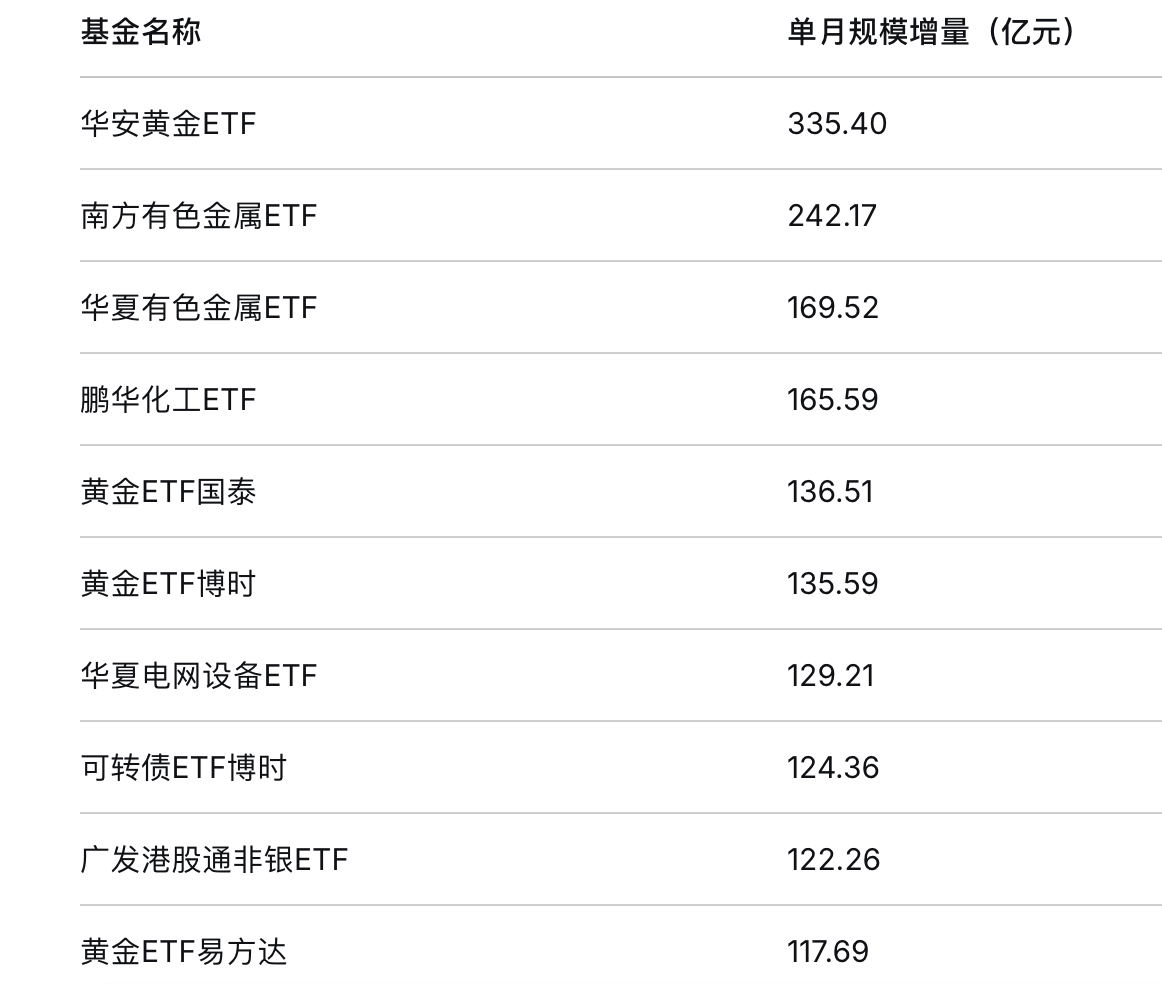
Core Insights - In early 2026, ETF fund flows showed significant divergence, with core broad-based ETFs experiencing large net outflows, while industry-themed ETFs gained popularity and saw substantial inflows [1][9] - The preference for industry-themed ETFs highlights a consensus among investors regarding the support from industrial policies and the positive fundamentals in specific sectors [1][6] ETF Performance - As of January 31, 2026, 14 ETFs had their scales increase by over 10 billion yuan, including 7 stock ETFs, 4 commodity ETFs, 2 cross-border ETFs, and 1 bond ETF [3] - Notable increases in scale included the Huaan Gold ETF (335.4 billion yuan), Southern Nonferrous Metals ETF (242.17 billion yuan), and Huaxia Nonferrous Metals ETF (169.52 billion yuan) [4][7] - The stock ETFs that saw significant scale growth were primarily industry-focused, indicating a market signal for bullish sentiment in related sectors [5][6] Market Trends - The overall ETF fund flow in January 2026 reflected a structural shift, with significant net outflows from core broad-based ETFs and inflows into industry-specific ETFs and gold [9][10] - The A-share market experienced a transition from exuberance to cooling, with the Shanghai Composite Index surpassing 4100 points before entering a consolidation phase [9][11] Investment Strategies - Institutions suggest that the market in February will likely experience volatility, with a focus on "growth and cyclical" dual strategies while being cautious of overheating sectors [11][12] - Recommended investment strategies include focusing on global manufacturing recovery, traditional industry improvements, and technology growth, particularly in AI applications and robotics [12][13]

越跌越买!“抄底”资金加仓
Zhong Guo Zheng Quan Bao· 2026-02-03 12:44
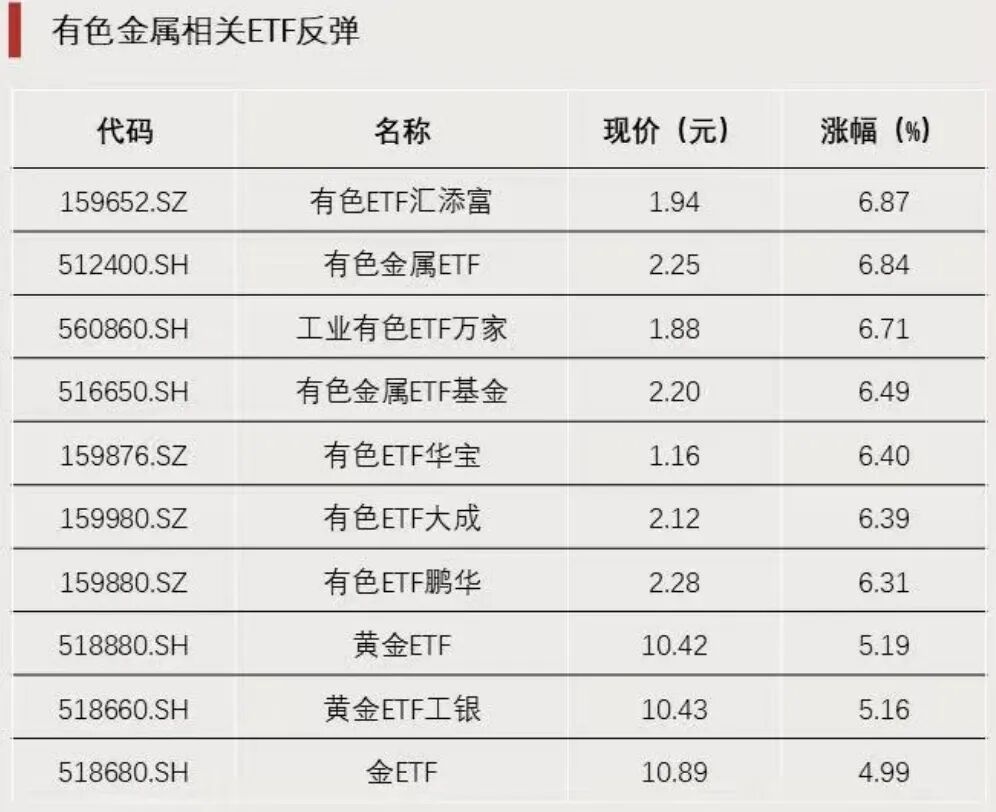
Group 1: Market Overview - On February 3, the A-share market rebounded after a dip, with resource-related ETFs such as gold, non-ferrous metals, and mining showing strong performance [1] - Multiple popular thematic ETFs saw significant inflows during the volatile market, with the Guotai Gold ETF experiencing a net inflow of over 2.2 billion yuan despite declines of 7.33% and 10% on January 30 and February 2, respectively [1][9] - The market is characterized by a clear divergence in hotspots, with the technology sector and cyclical sectors showing upward resonance [11] Group 2: Performance of Thematic ETFs - Non-ferrous metals and gold sectors experienced a notable rebound, with several related thematic ETFs rising over 5% [2] - The Huazhang Gold ETF closed with a gain of 5.19% and a trading volume of 21.613 billion yuan [3] - Specific ETFs such as the Zhonghan Semiconductor ETF and Guotai Photovoltaic ETF saw increases exceeding 6% [6] Group 3: Fund Inflows - The Guotai Gold ETF led the market in net inflows, with 1.371 billion yuan on February 2 and 871 million yuan on January 30 [10] - The Boshi Convertible Bond ETF also attracted significant inflows, with 1.054 billion yuan on February 2 and 276 million yuan on January 30 [9][10] Group 4: Sector Insights - The recent sharp decline in gold prices is viewed as a short-term technical adjustment rather than a long-term trend reversal, with macro structural factors supporting gold remaining intact [4] - The semiconductor sector, particularly the Zhonghan Semiconductor ETF, has shown a trading turnover rate exceeding 120%, with a cumulative increase of over 40% since 2026, leading the ETF market [7]
安培龙(301413) - 301413安培龙投资者关系活动记录表20260203
2026-02-03 10:20
Group 1: Investor Relations Activities - The company conducted specific investor research activities, including on-site visits and online meetings, with participation from various financial institutions such as Minsheng Securities and Huatai Asset [2] - The meetings took place between January 6 and January 29, 2026, primarily in the company meeting room and via Tencent Meeting [2] Group 2: Financial Performance and Future Outlook - The company expects a revenue growth of no less than 20% year-on-year for 2025, driven by factors such as domestic sensor replacement demand and new project advancements [3] - Key growth drivers include enhanced R&D investment, product quality improvement, and market expansion in various sectors [3] Group 3: Product Development and Market Expansion - The company has developed a diverse product matrix, including temperature sensors and various pressure sensors, and aims to expand its market share in the automotive and industrial control sectors [3] - In the robotics sector, the company is enhancing its force sensor product offerings and has initiated testing with multiple domestic robotics firms [3] Group 4: Fundraising and Project Financing - The company plans to raise up to CNY 54.44 million through a private placement of A-shares, with funds allocated for pressure sensor expansion and MEMS sensor chip development [5] - The MEMS sensor chip project has a total investment of CNY 57.90 million, with CNY 56.40 million sourced from the raised funds, aiming to produce over 500,000 pressure sensor chip modules annually [6]
ETF午评 | 光伏板块强势反弹,科创新能源ETF、光伏ETF国泰涨5%
Ge Long Hui· 2026-02-03 05:07
Market Performance - The three major A-share indices collectively rose in the morning session, with the Shanghai Composite Index up by 0.38%, the Shenzhen Component Index up by 0.93%, and the ChiNext Index up by 0.76% [1] - The North Star 50 Index saw a significant increase of 2.16% [1] - The total trading volume in the Shanghai and Shenzhen markets reached 161.69 billion yuan, a decrease of 40 billion yuan compared to the previous day [1] - Over 4,400 stocks in the market experienced gains [1] Sector Performance - Leading sectors included photovoltaic equipment, commercial aerospace, CPO, military equipment, cultivated diamonds, chemicals, rare earth permanent magnets, and storage chips, all showing notable increases [1] - Conversely, sectors such as precious metals, oil and gas extraction and services, banking, insurance, agricultural product processing, and beverage manufacturing faced declines [1] ETF Performance - The photovoltaic sector saw a strong rebound, with notable ETFs such as Penghua Fund's Science and Technology New Energy ETF, Guotai's Photovoltaic ETF, and E Fund's Science and Technology New Energy ETF rising by 5.25%, 5.24%, and 4.96% respectively [1] - The China Merchants Fund's Emerging Asia ETF increased by 5.12% [1] - The commercial aerospace sector also performed well, with Huaxia Fund's Aerospace ETF and Hua'an Fund's Aerospace ETF rising by 4.55% and 4.49% respectively [1] - The metals sector rebounded, with the Dachen Metals ETF increasing by 4.12% [1] Declining ETFs - The New Economy ETF from Yinhua fell by 5.9% [2] - Gold stocks continued to weaken, with the Gold Stock ETF and Gold Stocks ETF declining by 3.64% and 2.5% respectively [2] - The Hong Kong stock market showed weakness, with the Hong Kong Stock Connect Technology ETF from Ping An dropping by 2% [2]
华安基金:黄金短期波动加剧 关注中长期配置价值
Xin Lang Cai Jing· 2026-02-03 02:52
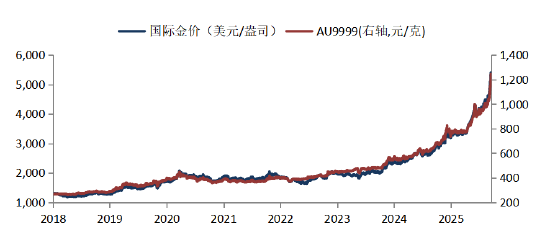
此外,地缘政治风险的演变也在微妙地影响市场情绪。上周,美伊紧张局势出现了新的动向。一方面, 双方言辞对抗激烈,美国向中东增派航母战斗群,伊朗则宣布在霍尔木兹海峡举行军演,将战争风险溢 价推至高位。另一方面,有消息显示,双方可能进行了后台接触,这又让市场对局势立即失控的担忧略 有缓解。 本轮回撤的根本原因,是黄金前期的交易过热与拥挤。我们此前已多次提示,黄金市场的技术指标已发 出严重过热信号,黄金期权隐含波动率已上升至历史极端位置,意味着波动率的放大、市场随时可能因 风吹草动而大幅回撤。国内外交易所近期上调保证金比例,正是试图为市场降温的明确信号。 本轮回撤的直接导火索,是美联储主席更迭引发的政策预期恐慌。上周五凯文·沃什被正式提名为下一 任美联储主席,尽管其政策主张复杂(支持降息但主张大幅缩表),但市场第一时间将其标签为"偏鹰 派"。这一提名被广泛解读为美联储可能转向更具纪律性的政策路径,美联储独立性担忧大大缓和,直 接动摇了支撑前期金价狂飙的核心逻辑之一——对流动性持续泛滥和通胀失控的预期。市场担忧未 来"降息+缩表"的组合会收紧美元流动性,从而打压以美元计价的黄金。 但沃什的政策主张并非简单的"鹰派"或" ...
千亿级ETF 跌停
Shang Hai Zheng Quan Bao· 2026-02-02 23:16
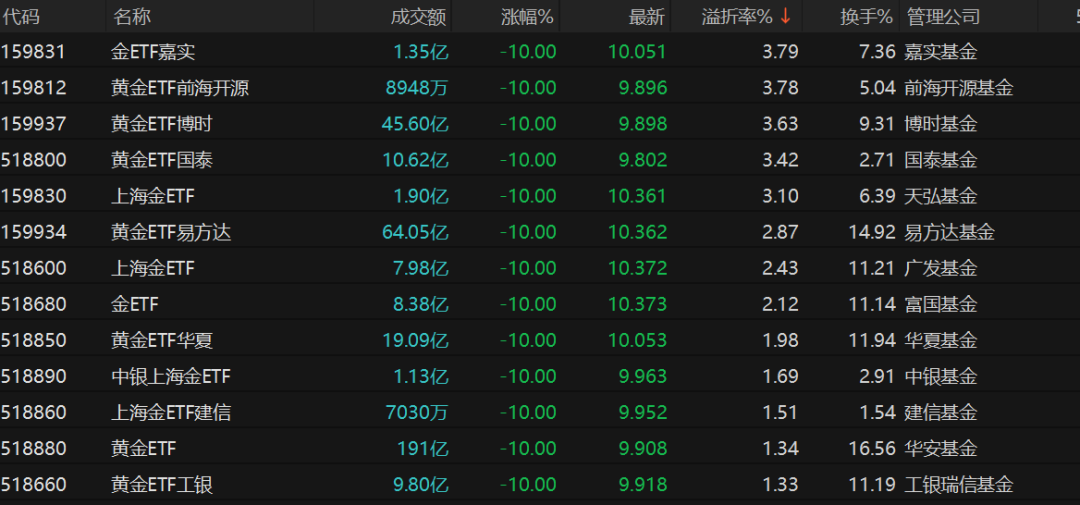
Group 1: Market Overview - Gold-related ETFs experienced significant declines, with multiple ETFs hitting the daily limit down [2][5] - The Huashan Gold ETF recorded a trading volume of 19.1 billion yuan, marking the third-highest trading day since its inception in 2013 [2][4] - The total scale of gold-related commodity ETFs reached 333.3 billion yuan as of January 30, up from 70.4 billion yuan at the beginning of 2025 [4] Group 2: Trading Performance - Several gold ETFs, including E Fund Gold ETF and Bosera Gold ETF, also saw high trading volumes, with E Fund Gold ETF at 6.4 billion yuan and Bosera Gold ETF exceeding 4.5 billion yuan [2][3] - The performance of various gold-related ETFs showed a uniform decline of 10% on the trading day [3][6] Group 3: Investor Sentiment and Recommendations - Analysts suggest that the recent drop in gold prices is a short-term technical adjustment and emotional release, emphasizing the importance of avoiding irrational trading behaviors [8] - Investment firms recommend that investors focus on long-term strategies and be cautious of leverage risks, especially in a high-volatility environment [8]