
紫金矿业

Search documents
银河期货铜3月报-20260227
Yin He Qi Huo· 2026-02-27 09:38
| . | | --- | | 战略储备需求增加,铜价偏强震荡 | 2 | | | --- | --- | --- | | 第一部分 | 铜市场综述 2 | | | 2 | | | | 2 | | | | 2 | | | | 第一部分 | 铜市场综述 3 | | | 3 | | | | 3 | | | | 第二部分 | 地缘局势紧张,战略储备需求增加 | 5 | | 第三部分 | 供应端 7 | | | 第四部分 | 消费面分析 15 | | | 15 | | | | 18 | | | | 21 | | | | 24 | | | | 26 | | | | 第五部分 | 供需平衡表 27 | | | 免责声明 | | 28 | 有色金属研发报告 铜 3 月报 2026 年 2 月 27 日 战略储备需求增加,铜价偏强震荡 第一部分 铜市场综述 邮 箱 银河期货 第 2 页 共 29 页 有色金属研发报告 铜 3 月报 2026 年 2 月 27 日 第一部分 铜市场综述 第 3 页 共 29 页 铜 3 月报 2026 年 2 月 27 日 图 1:铜价走势图 图 2:沪铜隔月价差(连一-连三)(元/吨) 图 ...
87位头部“公奔私”基金经理最新观点、动向出炉!
Sou Hu Cai Jing· 2026-02-27 09:27
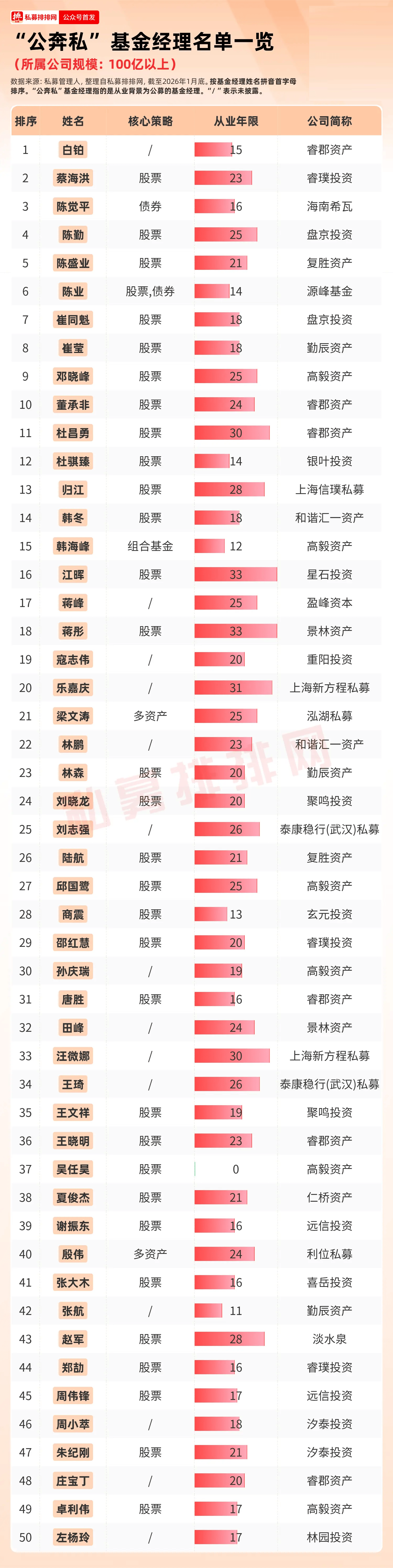
在私募行业蓬勃发展的几十年中,公募基金经理"奔私"潮持续涌动,这背后既有个人在职业天花板的突围,亦有平台派系更迭引发的变动。从早年王亚伟、 邱国鹭开风气之先,到近年董承非、周应波等人自立门户,"公奔私"基金经理已经成为私募行业的一个重要派系,甚至不少是自身私募机构的核心人物,掌 舵着公司的整体投研方向。 私募排排网数据显示,截至2026年1月底,"公奔私"基金经理共有859位。其中,头部私募旗下的"公奔私"基金经理共有87位,占比10.13%。 接下来,笔者将划分百亿私募(规模100亿以上)、准百亿私募(规模50-100亿)两个规模组,为大家盘点头部私募(规模50亿以上)旗下"公奔私"基金经 理的代表人物。 | 8 | 崔童 | 股票 | 18 | | --- | --- | --- | --- | | 9 | 邓晓峰 | 股票 | 25 | | 10 | 董承非 | 股票 | 24 | | 11 | 杜昌勇 | 股票 | 30 | | 12 | 杜骐臻 | 股票 | 14 | | 13 | 归江 | 股票 | 28 | | 14 | 韩冬 | 股票 | 18 | | 15 | 韩海峰 | 组合基金 | 12 ...

春季行情正当时!供给密集扰动下,碳酸锂剑指20万元大关?
Hua Er Jie Jian Wen· 2026-02-27 09:10
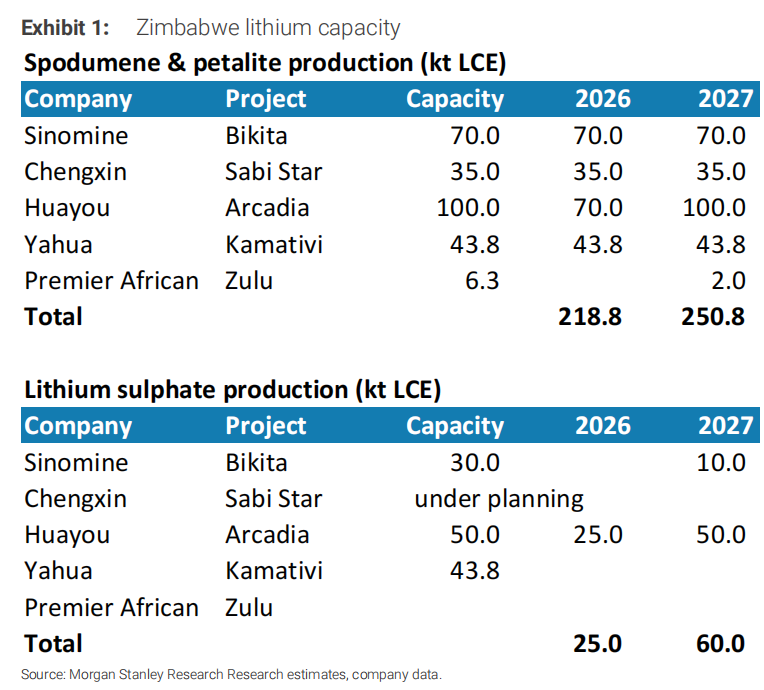
Core Viewpoint - Zimbabwe's sudden ban on all raw mineral and lithium concentrate exports has triggered a significant market reaction, with lithium carbonate futures surging over 11% to exceed 160,000 yuan/ton, indicating a potential new cycle in the lithium market driven by supply disruptions and surging demand from energy storage batteries [1][2][3]. Supply Side - The ban from Zimbabwe is expected to have a short-term impact, with current compliant export capacity limited to 25,000 tons of lithium carbonate equivalent (LCE) in 2026, increasing to 60,000 tons in 2027 [3][5]. - The global lithium supply is projected to be approximately 202,000 tons of LCE in 2026, with demand expected to reach around 201.7 million tons, indicating a tight supply-demand balance [22]. - The recovery of lithium production in Australia is anticipated to take at least a quarter, with many projects still in the planning stages, which limits immediate supply response to rising prices [8][12]. Demand Side - The demand for lithium is increasingly driven by energy storage, with global shipments of storage batteries expected to reach 900 GWh in 2026, translating to a demand for approximately 540,000 tons of LCE, a 50% year-on-year increase [16][18]. - Despite a temporary slowdown in demand for power batteries due to policy changes, the overall demand for lithium is expected to rebound significantly in 2026, with projections of 1.9 million electric vehicles sold in China, a 15.2% increase year-on-year [16][18]. Pricing Dynamics - The current low inventory levels, with social stocks of lithium carbonate dropping to around 10,300 tons, have significantly amplified price elasticity, leading to a market that is trading on "shortage driven by restocking" rather than waiting for supply-demand equilibrium [18][24]. - The pricing logic in the lithium market is shifting from "current period looseness" to "future period tightness," as financial attributes of lithium are becoming more pronounced, with market participants pricing in future scarcity [25][26]. Geopolitical Factors - The emergence of a "Lithium OPEC" in South America, involving Argentina, Bolivia, and Chile, aims to regain pricing power over lithium resources, which could further complicate supply dynamics [6][7]. - Geopolitical and policy variables, such as nationalization efforts in Chile and Mexico's strategic designation of lithium, are expected to layer additional pricing options that could influence market dynamics over time [6][7]. Future Outlook - Analysts predict that lithium carbonate prices could exceed 200,000 yuan/ton in the short term, supported by low inventory, concentrated supply disruptions, and the upcoming demand peak [26]. - The long-term outlook remains uncertain, with differing views on whether prices above 200,000 yuan/ton will be sustainable or if they represent a temporary window before supply increases catch up [26].




供需错配支撑铜价持续上行 对产业链上下游影响几何?
Zheng Quan Ri Bao Zhi Sheng· 2026-02-27 06:36
产业上下游影响分化 本报记者 冯雨瑶 2026年开年以来,铜价持续高位运行。生意社数据显示,截至2月26日,现货铜价最新为10.20万元/ 吨,同比增长32.51%。 供需错配支撑铜价上行 对于驱动铜价上涨的因素,上海钢联铜事业部分析师曾健辉告诉记者:"其一是供应的扰动为铜价提供 了上涨的逻辑支撑,铜精矿供应偏紧;其二是需求导向,传统领域需求不减,另外新能源、AI智能电 气化等对于铜消费又存在强预期;其三地缘政治冲突使得市场避险情绪升温,贵金属大幅上涨,带动铜 的避险属性。" 摩根大通最新预测,2026年全球铜市场将出现13万吨供应缺口,工业金属供需格局迎来关键转向。作为 新能源、电网、AI算力与高端制造的核心原材料,铜的短缺将直接抬升价格中枢,重塑产业链利润分 配,国内具备资源与产能优势的铜业龙头将显著受益。 供给端刚性约束是缺口形成的核心原因。据了解,全球铜矿勘探开发周期长达5年至8年,过去十年矿企 资本开支偏低,新增产能释放缓慢;主力矿山品位持续下滑、产区地缘扰动频发,进一步压制供给弹 性。国金证券报告指出,2025年铜矿产量指引多次下调,2026年预计增量有限。 而反观需求端,AI数据中心等正成为拉动 ...

A500ETF基金(512050)成交额超70亿,成分股中国天楹、烽火通信涨停,机构建议把握政策前后交易窗口
Xin Lang Cai Jing· 2026-02-27 05:16
数据显示,截至2026年1月30日,中证A500指数(000510)前十大权重股分别为宁德时代、贵州茅台、中 际旭创、中国平安、紫金矿业、招商银行、新易盛、美的集团、长江电力、兴业银行,前十大权重股合 计占比19.39%。 A500ETF基金(512050),场外联接(华夏中证A500ETF联接A:022430;华夏中证A500ETF联接C: 022431;华夏中证A500ETF联接Y:022979),相关指数基金(华夏中证A500指数增强A:023619;华夏 中证A500指数增强C:023620), A500增强ETF基金(512370)。 浦银国际证券指出,把握两会前后交易窗口期。对过去十年中国市场在全国两会期间及之后的表现进行 分析,发现中国市场在两会结束后一个月(3月中至4月中)均录得正回报,A股较港股表现稳健;市场 风格在两会前后切换明显,价值股赢率更高,信息科技板块的表现相对较佳,高弹性和前期落后板块涨 幅领先。由于A股受到政策面的利好更直接,资金面更充裕,若市场情绪提升,A股短期或能取得不错 表现。 A500ETF基金紧密跟踪中证A500指数,中证A500指数从各行业选取市值较大、流动性较好的 ...

锂矿禁令引爆有色板块,有色ETF景顺(560290)盘中最高涨超3%,跟踪指数成分股东方锆业10cm涨停
Xin Lang Cai Jing· 2026-02-27 05:16
机构认为,2026年有色金属行业核心逻辑为"供给刚性+新需求爆发"共振,叠加全球流动性宽松、地缘 冲突带来的避险情绪,行业整体呈现偏强态势,上涨动能充足。 有色ETF景顺(560290)紧密跟踪中证有色金属矿业主题指数,中证有色金属矿业主题指数从有色金属行 业中选取40只拥有有色金属矿产资源储量的上市公司证券作为指数样本,反映有色金属矿业主题上市公 司证券的整体表现。Wind数据显示,按照申万二级行业分类,指数前三大权重行业为工业金属 (48.51%)、小金属(21.52%)、贵金属(18.56%)。一键囊括紫金矿业、北方稀土、中金黄金、赣 锋锂业等细分行业龙头标的。 2026年2月27日,有色板块活跃。截至午间收盘,有色ETF景顺(560290)上涨1.59%,盘中最高涨超3%。 成分股东方锆业10cm涨停,厦门钨业上涨8.20%,宝钛股份上涨7.96%,云南锗业,中钨高新等个股跟 涨。 消息面上,津巴布韦于2月25日宣布立即暂停所有原矿及锂精矿出口(含在途货物),旨在加强矿产监 管并推动本地加工升级。中金公司分析认为,此举短期将显著收紧全球锂供给——2025年津巴布韦对华 锂精矿出口量折合碳酸锂约14.8 ...

又一A股实控人股份捐赠,近年已近20例,背后有一套税务逻辑
Xin Lang Cai Jing· 2026-02-27 04:34
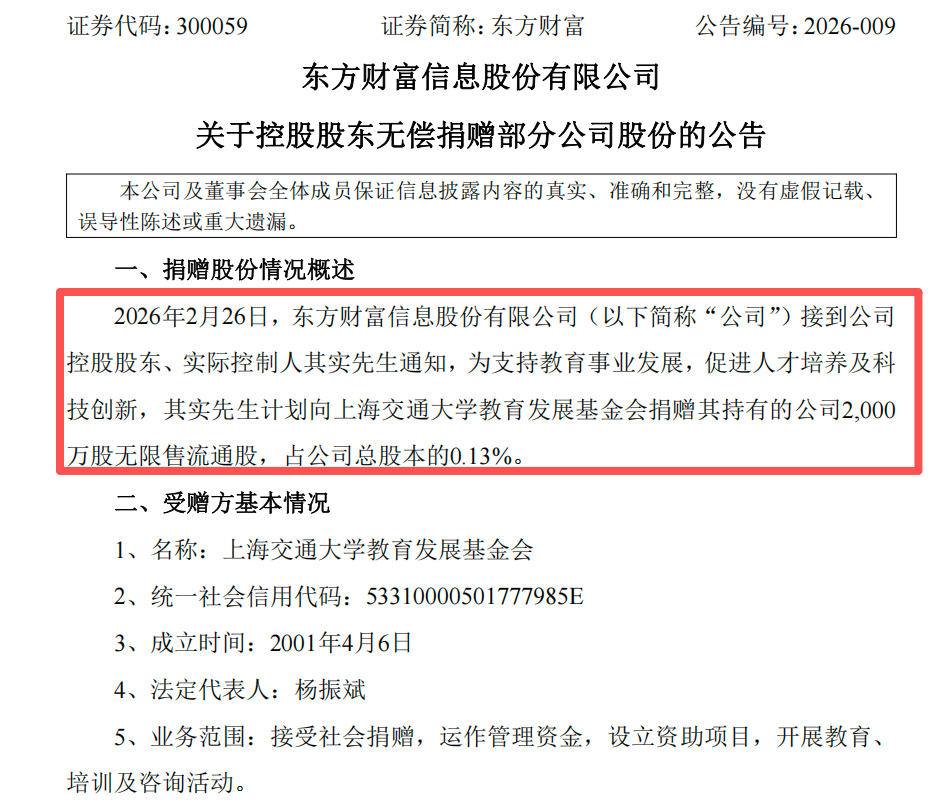
Core Viewpoint - The trend of listed company controlling shareholders donating shares or cash to support educational institutions has become increasingly common, reflecting a normalization of such philanthropic activities in the capital market [6][9][10]. Group 1: Recent Donations - On February 26, Dongfang Caifu announced that its controlling shareholder plans to donate 20 million shares, representing 0.13% of the company's total equity, to Shanghai Jiao Tong University, with a market value of 450 million yuan [1][8]. - On the same day, Ji Qi, founder of Huazhu Group and an alumnus of Shanghai Jiao Tong University, donated 100 million yuan to support the university's development [4]. - A total of at least 18 A-share listed companies' controlling shareholders or major shareholders have donated, with total donations amounting to 41.139 billion yuan, with 2025 being a particularly active year for such donations [4][10]. Group 2: Donation Statistics - Historical data indicates that there have been over 24 instances of donations from controlling shareholders or major shareholders of A-share companies, totaling 41.139 billion yuan [10]. - Share donations are the predominant form, accounting for 87.5% of total donations, with a total market value of approximately 40.539 billion yuan [11]. - The majority of donations have been directed to educational foundations, with 79.2% of donations going to such institutions [12]. Group 3: Motivations Behind Donations - These donations reflect not only the social responsibility and philanthropic intentions of entrepreneurs but also provide benefits such as tax optimization, improvement of shareholding structure, and stabilization of market expectations [7][14]. - Tax policies incentivize these donations, allowing for significant tax deductions and exemptions, which enhances the willingness of controlling shareholders to donate [15][16]. - From a corporate governance perspective, donations can help optimize shareholding structures while signaling confidence in the company's long-term value, thus stabilizing stock prices [17]. Group 4: Future Implications - The integration of "capital + charity + education" is expected to deepen, with more controlling shareholders likely to engage in share donations to support educational and technological advancements [18].

人民币强势归来:升值逻辑、产业重构与投资新范式
Sou Hu Cai Jing· 2026-02-27 03:10
Core Viewpoint - The recent appreciation of the Renminbi (RMB) against the US dollar is driven by multiple factors, including a weakening dollar, asset revaluation, a surge in currency settlement, and policy guidance from the central bank [2][3]. Group 1: Drivers of RMB Appreciation - The primary external driver of the RMB's appreciation is the significant decline in the US dollar index, which fell approximately 9.7% in 2025 due to weak economic data and expectations of a more accommodative monetary policy from the Federal Reserve [3]. - Internal dynamics have shifted from an "Anything but China" strategy to an "AI & China" focus, with foreign capital reassessing the value of Chinese assets, leading to a noticeable trend of capital inflow [3][4]. - The peak period for currency settlement among export enterprises, particularly around the Chinese New Year, has led to a substantial sell-off of US dollars in favor of RMB, creating a positive feedback loop that amplifies the appreciation momentum [4]. - The central bank has maintained stability in the RMB through market-oriented measures rather than direct intervention, ensuring that the real effective exchange rate remains competitive for exports [4]. Group 2: Beneficiary Sectors of RMB Appreciation - Cost-compression industries, such as aviation and paper manufacturing, benefit significantly from RMB appreciation due to reduced costs associated with dollar-denominated debts and imported raw materials [5][6]. - Resource and commodity import sectors, including steel and petrochemicals, gain from enhanced global purchasing power, allowing them to stabilize profit margins amid fluctuating international prices [6][7]. - Financial and technology sectors are likely to see increased foreign investment, enhancing the relative return on RMB assets and boosting consumer purchasing power for cross-border consumption [7][8].

港股速报|港股小幅高开 腾讯反弹 百度公布财报业绩超预期
Mei Ri Jing Ji Xin Wen· 2026-02-27 02:54
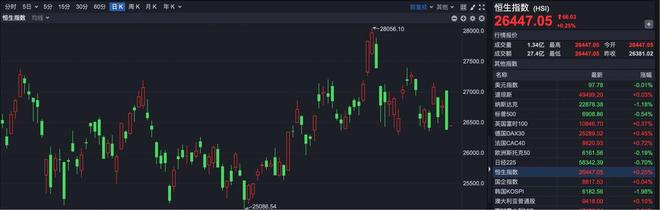
Core Viewpoint - The Hong Kong stock market shows a slight upward trend but remains weak overall, with the Hang Seng Index and Hang Seng Tech Index experiencing minor gains [1][2]. Company Performance - Baidu Group (HK09888) reported a total revenue of 129.1 billion yuan for 2025, with AI business revenue reaching 40 billion yuan; in Q4 2025, total revenue was 32.7 billion yuan, with AI business income accounting for 43% of general business revenue, exceeding market expectations [4]. - BeiGene (HK06160) achieved its first annual profit, with total revenue of 38.205 billion yuan, a year-on-year increase of 40.4%; product revenue reached 37.77 billion yuan, up 39.9%, driven by sales growth of drugs like Zebrutinib and Tislelizumab, with sales from licensed products from Amgen amounting to 3.471 billion yuan, a 33.6% increase [4]. - Tencent Holdings (HK00700) saw a slight rebound in early trading, with a gain of 1.07% [4]. Market Trends - Tencent's app, Tencent Yuanbao, re-entered the top 10 of the Apple App Store free app rankings, indicating a recovery in user demand post-Spring Festival [5]. - The technology sector stocks collectively rebounded, with Alibaba and JD.com showing slight increases, while the automotive sector weakened, with NIO dropping nearly 1% [5]. IPO Market Outlook - Multiple institutions express optimism regarding the Hong Kong IPO market for 2026, with UBS predicting a financing scale exceeding 300 billion HKD and around 150-200 listings [6]. - Huatai Securities estimates the main board IPO financing scale at approximately 310 billion HKD, with around 100 new companies [6]. - Deloitte forecasts about 160 new listings in the Hong Kong stock market, with a financing amount not less than 300 billion HKD [6]. - PwC anticipates around 150 new listings, with total fundraising between 320 billion to 350 billion HKD, potentially ranking among the top three globally [6]. - Analysts from China Merchants Securities note that the current valuation of the Hong Kong technology sector is at a historical low, suggesting it is undervalued in the context of the AI development and technology-driven growth era [6].


涨势不止!南方基金旗下有色金属ETF(512400)冲高涨超3%,连续5日净流入,有色金属板块迎多重利好支撑
Xin Lang Cai Jing· 2026-02-27 02:35
机构观点显示,有色金属行业一季度将延续平稳运行态势,全年工业增加值预计增长5%左右,营业收 入和利润有望保持增长。从价格走势看,近期国际金价持续走高,工业金属价格同步回暖,小金属、能 源金属等子板块表现突出。全球流动性改善预期下,叠加美联储降息周期启动,有色金属作为顺周期板 块,在需求端改善与资金流入推动下,具备持续上行动力,行业配置价值显著提升。 有色金属ETF(512400)紧密跟踪中证申万有色金属指数,中证申万有色金属指数从沪深市场申万有色金 属及非金属材料行业中选取50只上市公司证券作为指数样本,以反映沪深市场有色金属行业上市公司证 券的整体表现。指数前十大权重股分别为紫金矿业、洛阳钼业、北方稀土、中国铝业、华友钴业、中金 黄金、山东黄金、兴业银锡、赣锋锂业、赤峰黄金。 有色金属ETF(512400),场外联接(A类:004432;C类:004433)。 截至2026年2月27日 10:16,有色金属ETF(512400)一度涨超3%,现涨2.83%,盘中换手2.37%,成交9.44 亿元。跟踪指数中证申万有色金属指数成分股中钨高新上涨9.04%,厦门钨业上涨8.92%,锡业股份上 涨8.53%,中稀 ...