越疆科技

Search documents
绿源与越疆达成战略合作,5000台机器狗将应用于智慧门店
Xin Lang Cai Jing· 2025-11-27 12:30
Core Viewpoint - Green Source Group (2451.HK) and Yujian Technology (2432.HK) signed a strategic cooperation framework agreement to enhance smart store upgrades through the application of 5,000 robotic dogs, focusing on embodied intelligence in various scenarios such as smart stores and smart factories [1] Group 1 - The strategic cooperation aims to leverage deep consensus in product research and industrial application [1] - The initiative will explore the application of embodied intelligence in smart stores and smart factories [1] - The project targets the deployment of 5,000 robotic dogs for the smart store upgrade plan [1]
绿源与越疆达成战略合作,推动5000台机器狗规模应用于智慧门店升级计划
Zheng Quan Shi Bao Wang· 2025-11-27 12:27
Group 1 - The core viewpoint of the article is the strategic partnership between Luyuan Group and Yuejiang Technology to enhance smart store upgrades through the application of intelligent machines [1] - The collaboration aims to deploy a total of 5,000 robotic dogs as part of the smart store upgrade initiative [1] - The partnership will explore the application of embodied intelligence in various scenarios, including smart stores and smart factories [1]
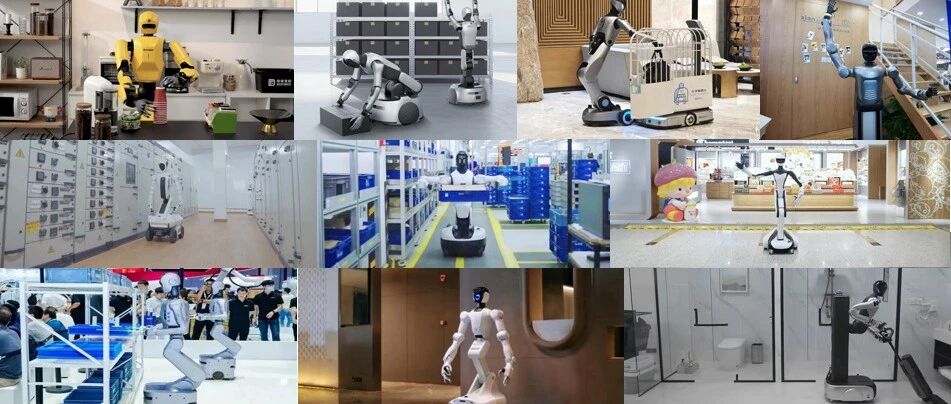
轮式人形机器人占比超八成!技术妥协还是战略选择?
机器人大讲堂· 2025-11-26 10:42
Core Viewpoint - The emergence of wheeled humanoid robots represents a significant trend in the embodied intelligence robotics sector, indicating a collective preference for this design approach among companies, with over 80% of new products adopting this configuration [1][3]. Group 1: Industry Trends - The current wave of wheeled humanoid robots is characterized by a focus on practical applications, with 45 out of 55 new products featuring a wheeled chassis and humanoid upper body design [1][3]. - The wheeled humanoid robots are seen as a rational choice in the industry, balancing technological feasibility and commercial viability, allowing companies to quickly validate application scenarios and accumulate operational data [3][4]. Group 2: Product Highlights - Several representative wheeled humanoid robots have been launched in 2023, showcasing their application in various sectors such as industrial manufacturing, warehousing logistics, and commercial services [4][5]. - Notable products include: - **Cruzr S2** by UBTECH, featuring a height of 176 cm, capable of carrying 15 kg, and equipped with advanced vision and motion control systems [7]. - **G2** by Zhiyuan Robotics, designed for high-precision tasks in automotive parts production, utilizing reinforcement learning for task optimization [9]. - **Q5** by Xingdong Jiyuan, with 44 degrees of freedom and advanced navigation capabilities for service applications [11][12]. - **ATOM-W** by Dobot, integrating immersive remote operation with high precision for flexible manufacturing needs [15]. - **XMAN-R1** by Qinglang Intelligent, designed for service tasks in high-traffic environments, featuring advanced interaction capabilities [17]. - **DexForce W1 Pro** by Kuawei Intelligent, offering modular development options and high-precision task execution [19]. - **X1-PRO** by Xiangong Intelligent, featuring a flexible design for complex operational environments [22]. - **巡霄** by Youai Zhihui, designed for high-value material handling with a focus on precision [24]. - **ZERITH-H1** by Zero Degree, capable of performing household tasks with advanced perception [26]. - **Quanta X2** by Zivariable Robotics, featuring a high degree of freedom for versatile applications [28].

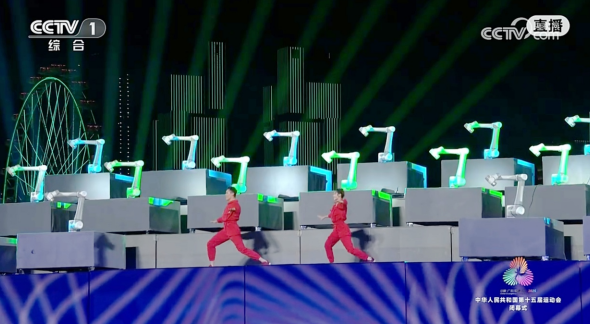
全运会闭幕式海上机器人共舞,越疆展现中国高端制造硬实力
Jing Ji Wang· 2025-11-25 09:32
Core Viewpoint - The performance featuring 30 Yujiang intelligent robots and a principal dancer from China Oriental Performing Arts Group marks a significant milestone in China's robotics technology, showcasing the ability of robots to perform in extreme environments and collaborate with humans in artistic expressions [1][12]. Group 1: Performance Highlights - The performance was a world-first "sea and sky" dual-scene robot cluster show, demonstrating advanced synchronization and stability under challenging conditions [1][2]. - The robots maintained millisecond-level synchronization despite wireless signal interference, showcasing their speed, rhythm control, and operational stability [2][3]. - The robots were designed with modular structures and advanced anti-corrosion treatments to ensure performance in high-humidity and high-salinity environments [2][9]. Group 2: Technological Innovations - Yujiang has developed a "body intelligence" technology system, with the humanoid robot Atom featuring a self-developed "brain-eye-hand" coordination system that provides 1500 TOPS computing power [6][10]. - The integration of EtherCAT bus technology and proprietary high-torque motors allows for a full-link synchronization mechanism, enabling the robots to respond quickly and maintain stability in dynamic conditions [2][6]. - The technology integration includes extreme environment protection, full-link collaboration, and embodied intelligent decision-making, forming a comprehensive system for static stability, dynamic adaptation, and human-robot collaboration [7][9]. Group 3: Industry Implications - The performance challenges the perception of robots as mere industrial tools, promoting their acceptance in cultural, entertainment, and commercial sectors [9][10]. - Yujiang's multi-scenario technology validation indicates that China's high-end robotics manufacturing can address both "cluster collaboration" and "single-point intelligence" challenges [10][12]. - The cross-scenario integration and value transformation by Yujiang may set a new benchmark for the global robotics industry, facilitating a shift from single-scene applications to full-scene empowerment [10][12].

大摩:除减速器外,机器人硬件皆可自研——核心壁垒正迁移到软件与数据
Hua Er Jie Jian Wen· 2025-11-24 06:44
Core Insights - The competitive landscape of the robotics industry is being reshaped, with a shift in focus from hardware manufacturing to software algorithms, data accumulation, and ecosystem building [1][2][3] Group 1: Hardware Development Trends - Self-research in hardware has become a mainstream trend in the robotics industry, with most companies emphasizing their internal component development capabilities [2] - The only exception noted is the gearbox, which all participating companies agreed needs to be sourced externally [2] Group 2: Software and Data as Competitive Advantages - Software is expected to become the core competitive advantage in the robotics industry, with data availability for training being a common challenge [3] - Companies that can acquire high-quality scenario data and develop superior algorithm models will stand out in the competitive market [3] Group 3: Focus on ROI in Industrial Applications - Discussions about robot forms are giving way to a more pragmatic focus on return on investment (ROI) in industrial applications [4] - Key factors driving ROI include efficiency, accuracy, and cost, emphasizing the importance of quantifiable economic value for customers [4] Group 4: Humanoid Robots Market Dynamics - The market for humanoid robots shows a mixed trend, with aggressive targets set by new startups while established companies remain cautious [5][6] - Startups are focusing on entertainment, research, and sales services, while companies like UBTECH are targeting industrial applications with more conservative delivery expectations [6]
“协作机器人第一股”越疆市值翻倍,却两度折价补血
阿尔法工场研究院· 2025-11-24 00:06
Core Insights - The article discusses the financial struggles of Yuejiang Technology, which went public as the "first stock of collaborative robots" but has faced significant funding challenges shortly after its IPO [2][3][11]. Financial Performance - Yuejiang Technology raised approximately 7.52 billion HKD during its IPO, with a market capitalization of 75.76 billion HKD at the time of listing [2]. - The company has conducted two rounds of discounted placements within four months, raising a total of 17.93 billion HKD, exceeding the IPO amount [2][11]. - As of November 21, the company's market value increased by 107.43% since its IPO, indicating a strong initial market response despite ongoing financial difficulties [2]. Funding Challenges - The company has been experiencing a cash flow crisis, with cash reserves dropping to 1.11 billion RMB by the end of 2023, a decrease of 62.73% year-on-year [5]. - Despite revenue growth from 241 million RMB in 2022 to 374 million RMB in 2024, operational expenses have also risen significantly, leading to persistent losses [6][8]. - Yuejiang's net losses were 524.77 million RMB in 2022, 1.03 billion RMB in 2023, and 953.63 million RMB in 2024, with a further loss of 408.7 million RMB in the first half of 2025 [8][9]. Market Competition - The collaborative robot market is becoming increasingly competitive, with predictions of a global market size reaching 5 trillion USD by 2050 [12]. - Yuejiang faces pressure from both traditional industrial robot companies and tech firms entering the market, necessitating higher spending to maintain market share [14][17]. - The company's sales expense ratio has been significantly higher than its competitors, indicating a need for aggressive marketing and sales strategies [12]. Strategic Initiatives - The two rounds of fundraising are aimed at enhancing technology development, production capabilities, and expanding sales channels [15][16]. - Yuejiang's funding allocation includes 40% for advanced technology research, 27% for production capacity development, and 16% for strategic alliances and acquisitions [15]. - The company is focusing on building an ecosystem around its core technology, aiming to integrate various industry applications and resources [19][20]. Future Outlook - The article emphasizes the need for Yuejiang to achieve a profitable business model to reduce reliance on external funding [20]. - The mismatch between the long-term nature of ecosystem development and the immediate cash flow needs poses a significant challenge for the company [20]. - Successful execution of its strategic initiatives and improved cost management will be crucial for enhancing its financial stability and market position [20].
专家解读深企快速上市核心密钥 全周期培育土壤 最前沿细分行业
Shen Zhen Shang Bao· 2025-11-20 23:27
谈及深圳如何保持这样的上市速度,周军民认为,要优化创新创业政策,鼓励年轻人创业,吸引全国全 球人才创业。同时,加强优质中小企业梯度培育体系,完善"个转企、小升规、规做精、优上市、市做 强"的全周期培育土壤,让企业每一个阶段都有对应政策与资金接力。 近日,深圳一组最新数据引人注目:深圳121家企业成立不到10年就成功上市,其中A股87家、港股34 家。这些企业包括影石科技、越疆科技、云天励飞、奥比中光、大族激光(002008)、速腾聚创等等。 据悉,近年来,深圳全力推动小微工业企业扩大生产、升规纳统。2023年深圳新增1726家工业企业"小 升规",超额完成1500家目标任务,纳统企业数量居全省前列;2024年深圳新增1314家工业企业"小升 规",超额完成1000家目标任务。2019年至2024年,深圳累计培育新增1.1万家规模以上工业企业,新纳 统的"小升规"工业企业对全市工业增速具有明显拉动作用,为全市经济发展积极贡献力量。 为何创立不到10年就能够上市?在中国(深圳)综合开发研究院产业经济研究中心主任周军民看来,这 一方面说明深圳和大湾区创新创业以及上市氛围非常活跃,另一方面说明深圳创业上市的途径明显增 ...
深企“成人礼”观察 |10年跃龙门:121家深企上市解码
Shen Zhen Shang Bao· 2025-11-20 03:51
Core Insights - Shenzhen has seen a remarkable speed in company listings, with 121 companies established for less than 10 years successfully going public, including 87 on A-shares and 34 on Hong Kong stocks, reflecting an efficient innovation ecosystem and strong policy support [1][3] Group 1: Listing Speed and Industry Focus - The average time for a startup in Shenzhen to grow into a listed company on the Sci-Tech Innovation Board is 13.35 years, which is 1.05 years faster than the national average [4] - The majority of the 121 companies are concentrated in strategic emerging industries such as new energy, semiconductors, artificial intelligence, robotics, and intelligent driving, indicating a shift towards technology-driven economic growth [4][5] Group 2: Innovation Ecosystem - Shenzhen's innovation ecosystem is characterized by a strong supply chain, allowing companies to quickly prototype products, with many raw materials available within a two-hour radius [5][6] - The city has established a comprehensive technology finance support system that enables rapid capital matching for Sci-Tech enterprises, facilitating their growth [5][6] Group 3: Policy Support and Development Mechanisms - Shenzhen has implemented a systematic approach to nurture market entities, focusing on the discovery and growth of "gazelle" and "unicorn" companies through targeted action plans [7][8] - Recent data shows that Shenzhen has exceeded its targets for the number of small enterprises transitioning to larger scales, contributing positively to the city's industrial growth [8]
10年跃龙门:121家深企上市解码
Shen Zhen Shang Bao· 2025-11-19 16:50
Core Insights - Shenzhen has seen a remarkable acceleration in the speed of company listings, with 121 companies established for less than 10 years successfully going public, including 87 on A-shares and 34 on Hong Kong stocks [3][6] - This trend reflects Shenzhen's efficient innovation ecosystem, precise policy support, and active capital market, contributing to a comprehensive market entity cultivation system [3][7] Group 1: Listing Speed and Industry Focus - The average time for a startup in Shenzhen to grow into a listed company on the Sci-Tech Innovation Board is 13.35 years, which is 1.05 years faster than the national average [6] - The majority of the 121 companies are concentrated in strategic emerging industries such as new energy, semiconductors, artificial intelligence, robotics, and intelligent driving, indicating a shift towards technology-driven economic growth [7][8] Group 2: Innovation Ecosystem - Shenzhen's strong innovation ecosystem supports rapid company growth, with a well-established industrial chain that allows for quick product development and prototype creation [8][9] - The city has a comprehensive technology finance support system that matches capital with innovative enterprises, facilitating their growth [8][9] Group 3: Policy Support and Development Mechanisms - Shenzhen has implemented a market entity cultivation system that includes mechanisms for discovering and nurturing unicorn and gazelle companies, focusing on strategic emerging industries [10][11] - Recent data shows that Shenzhen has exceeded its targets for the number of small enterprises transitioning to larger scales, indicating effective policy implementation and support for industrial growth [11]
今日,南沙耀目!科创+金融聚力,大湾区奔赴“星辰大海”!
券商中国· 2025-11-18 03:35
Group 1 - The article highlights the impressive technological innovations showcased at the 15th National Games, emphasizing the vibrant tech scene in the Guangdong-Hong Kong-Macao Greater Bay Area [1] - The Greater Bay Area, covering 56,000 square kilometers, is noted for its high level of openness and economic vitality, contributing to over 2 trillion USD in economic output, which is about 1/9 of the national total [6] - The region is recognized as a fertile ground for technological innovation, with continuous breakthroughs that provide vast opportunities for financial innovation [6][8] Group 2 - The article discusses the deep integration of technology and finance in the Greater Bay Area, where the three regions work together to overcome institutional barriers and accelerate mutual development [8] - Notable innovations include the use of autonomous vehicles for torch relay at the National Games, showcasing advancements in smart driving technology [9] - The article mentions the emergence of unicorn companies and the successful international contracts won by local firms, indicating a robust innovation ecosystem [10] Group 3 - A comprehensive innovation capital system is described, which supports companies from inception to maturity, with active participation from private venture capital firms and state-owned capital [10][11] - The article notes that Guangdong Province leads the nation with 2,466 private equity and venture capital fund managers and approximately 12,000 managed funds [11] - Traditional financial institutions are adapting by developing new financial products tailored to the needs of tech companies, including climate-friendly loans and insurance products [12][13] Group 4 - The article highlights the successful issuance of a knowledge property securitization product, which allows tech companies to leverage intangible assets for financing [14][18] - Various financial products such as tech loans and talent loans are being introduced to support innovation, with significant growth in tech loan balances reported [14] - The cross-border collaboration in the Greater Bay Area is exemplified by the first cross-border marathon event, which symbolizes the seamless integration of the three regions [16] Group 5 - The article concludes with the announcement of the 20th China Economic Forum, which will focus on the development of technology and financial innovation in the Greater Bay Area [20]