
长电科技

Search documents
AI服务器对存储需求呈现爆发式增长,集成电路ETF嘉实(562820)全面布局全产业链芯片龙头
Xin Lang Cai Jing· 2026-01-28 06:11
东海证券指出,受益于AI浪潮,国内相关A股标的预估2025全年业绩实现大幅增长。2026年全球AI服务 器出货量同比有望增长28%以上,拉动存储、CPU等相关芯片涨价。三星电子于2026Q1将NAND闪存的 供应价格上调100%以上,英特尔和AMD考虑将2026Q1服务器CPU均价调涨10%~15%。当前电子行业 需求持续复苏,供给有效出清,存储芯片价格上涨,我国国产化力度超预期。TrendForce预估2026年存 储器产业产值将同比增长134%达到5516亿美元。 数据显示,截至2025年12月31日,中证全指集成电路指数前十大权重股分别为寒武纪、中芯国际、海光 信息、兆易创新、澜起科技、豪威集团、紫光国微、长电科技、芯原股份、通富微电,前十大权重股合 计占比53.66%。 2026年1月28日盘中,半导体板块一度涨超3%,截至13:37,中证全指集成电路指数上涨0.68%,成分股 中微半导上涨17.61%,普冉股份上涨15.17%,燕东微上涨11.58%,北京君正上涨6.68%,力芯微上涨 6.27%。 集成电路ETF(562820)跟踪中证全指集成电路指数,是布局全产业链芯片龙头的便捷工具。 AI服务 ...
存储涨价潮蔓延,消费电子ETF(561600)红盘向上
Xin Lang Cai Jing· 2026-01-28 05:22
截至2026年1月28日 13:09,中证消费电子主题指数(931494)上涨0.51%,成分股北京君正上涨7.65%,兆 易创新上涨5.44%,闻泰科技(维权)上涨3.94%,华天科技上涨3.68%,长电科技上涨3.67%。消费电 子ETF(561600)上涨0.46%,最新价报1.31元。 消息面上,存储涨价潮蔓延,多家厂商继续涨价,涨价潮正从存储芯片扩展至代工与封测环节。三星电 子在今年第一季度将NAND闪存的供应价格上调了100%以上,这一涨幅远超市场此前预期。国内方 面,中微半导和国科微2家半导体公司相继发出涨价函。 数据显示,截至2025年12月31日,中证消费电子主题指数(931494)前十大权重股分别为立讯精密、寒武 纪、工业富联、中芯国际、京东方A、兆易创新、澜起科技、东山精密、豪威集团、生益科技,前十大 权重股合计占比54.35%。 消费电子ETF(561600),场外联接(平安中证消费电子主题ETF发起式联接A:015894;平安中证消费电 子主题ETF发起式联接C:015895;平安中证消费电子主题ETF发起式联接E:024557)。 大同证券指出,受益于AI浪潮推动产品附加值提升及汽 ...
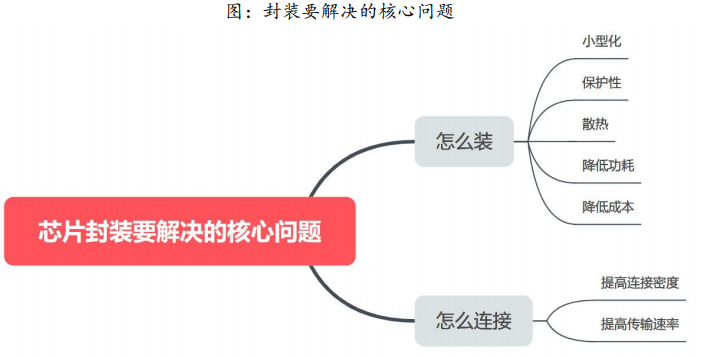
先进封装迎AI驱动黄金期,国产链加速突破赋能高集成未来
Sou Hu Cai Jing· 2026-01-28 04:05
Core Insights - TSMC has raised its 2026 capital expenditure to $52-56 billion, with 10-20% allocated to advanced packaging, indicating a high growth cycle driven by AI chip demand [1] - The advanced packaging market is expected to grow at a CAGR of 8.9% from 2019 to 2029, increasing its share from 45.6% to 50.9%, surpassing traditional packaging [1] Industry Trends - Technological advancements focus on enhancing electrical performance, integration, thermal management, and cost reduction, with key enabling technologies including Bump, RDL, Wafer-level packaging, and TSV [3] - Current trends include 2.5D/3D packaging and Chiplet technology, which offer significant advantages in yield improvement, cost reduction, and compatibility across multiple processes [3] Market Dynamics - Advanced packaging addresses multiple bottlenecks in the post-Moore's Law era, such as alleviating the "memory wall" with 2.5D/3D integration of high bandwidth memory, breaking the "area wall" through multi-chip stacking, and optimizing power consumption and heat dissipation to tackle the "power wall" [5] - The global packaging revenue is dominated by Taiwan (43.7%), the USA (21%), and mainland China (20.2%), with mainland China's advanced packaging share at approximately 15.5% [7] Growth Projections - The advanced packaging market in mainland China is projected to grow from 51.4 billion yuan in 2024 to 100.6 billion yuan in 2029, with a CAGR of 14.4% [7] - The global advanced packaging market is expected to reach approximately $45 billion in 2024, accounting for 55% of the packaging market, and is projected to grow to $80 billion by 2030, with a CAGR of 9.4% from 2024 to 2030 [7] Company Developments - Changdian Technology has launched the XDFOI® chip integration process and has begun mass production [8] - Tongfu Microelectronics plans to expand production through a private placement, with a 55.7% increase in net profit for the first three quarters of 2025 [8] - Huada Semiconductor has acquired Huayi Microelectronics to expand its power device packaging and has established a subsidiary to enhance 2.5D/3D advanced packaging [8] - Yongxi Electronics is leveraging the FH-BSAP platform to meet diverse advanced packaging needs, with expected revenue of 4.2-4.6 billion yuan in 2025 [8]

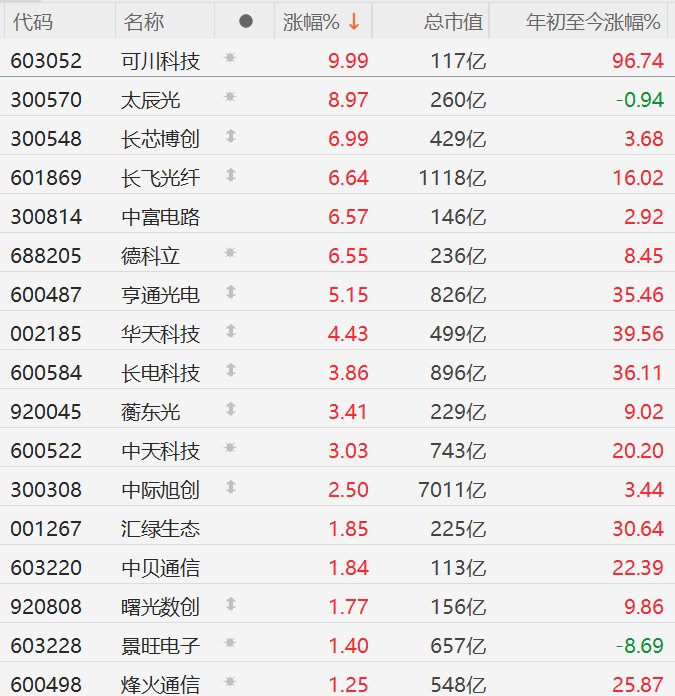
A股CPO概念股多数上涨,可川科技涨停,太辰光涨超8%
Ge Long Hui A P P· 2026-01-28 03:50
Group 1 - The CPO concept stocks in the A-share market mostly rose, with notable gains from companies such as 可川科技, 太辰光, and 长芯博创 [1] - 可川科技 reached a limit-up of 10%, while 太辰光 increased by over 8% [1] - Other companies like 长飞光纤, 中富电路, and 德科立 saw increases of over 6% [1] Group 2 - The market capitalization of 可川科技 is 11.7 billion, with a year-to-date increase of 96.74% [2] - 太辰光 has a market cap of 26 billion and a year-to-date decrease of 0.94% [2] - 长飞光线 has a market cap of 111.8 billion and a year-to-date increase of 16.02% [2]




日联科技20260127
2026-01-28 03:01
摘要 中国半导体 X 射线检测设备市场规模巨大,2030 年预计前后道市场将 分别达到 243 亿元和 65 亿元,但国产渗透率仅 5%,国产替代空间广 阔,为国内企业如日联科技带来发展机遇。 日联科技在后道封装测试 X 射线检测设备领域已取得技术突破, 2D、3D 设备达到国内领先或国际先进水平,并成功进入中芯国际、长 电科技等客户供应链,2025 年量产纳米级射线源,拓展至前道晶圆检 测。 日联科技于 2026 年 1 月完成对新加坡 SSTR 66%股权的收购。SSTR 掌握高端半导体检测诊断与失效分析设备技术,客户包括 AMD、三星、 美光等全球前 20 大半导体制造商。 日联科技与 SSTR 在技术上形成互补,实现从物理缺陷检测到功能检测 分析的覆盖;在制造上,利用马来西亚工厂提升产能并降低成本;在市 场上,通过渠道优势拓展国内外市场。 通过收购 SSTR,日联科技将结合自身经验与 SSTR 专利技术,共同研 发适配中国市场的先进制程检测试验,并建立研发基地推动国产化,提 升整体竞争力。 Q&A 日联科技 20260127 日联科技在高端半导体检测设备领域的布局和发展情况如何? 日联科技在高端半导体 ...

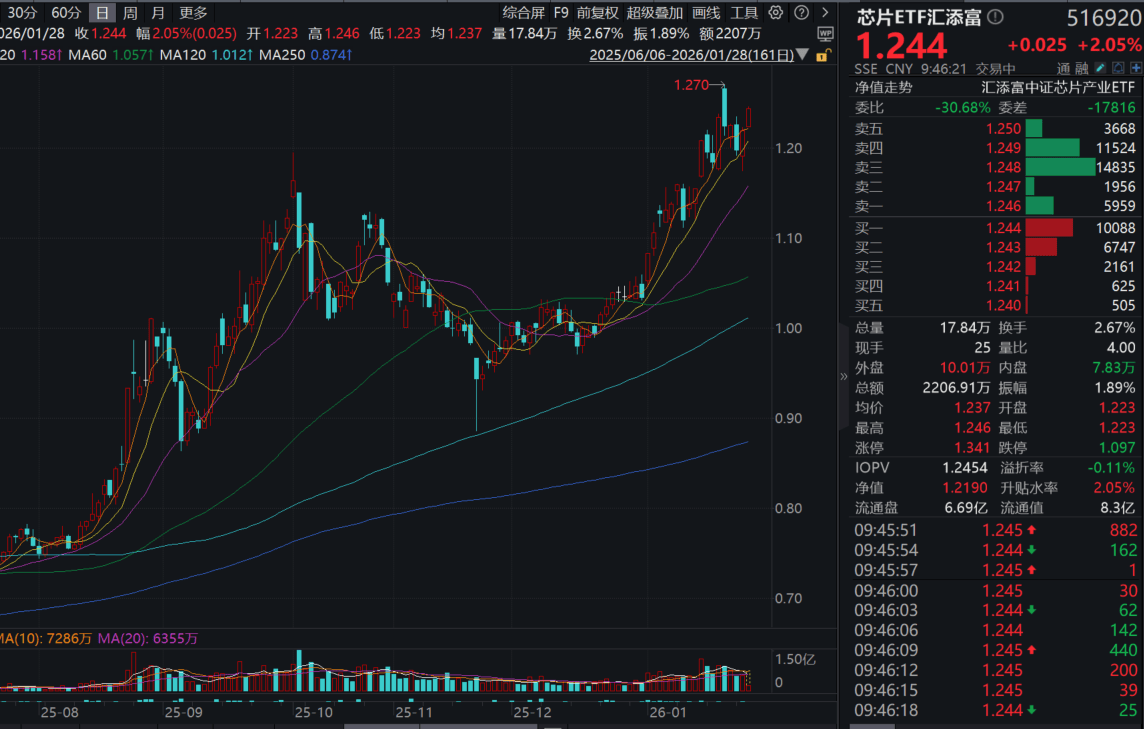
“芯片狂潮”终于蔓延至模拟芯片!芯片ETF汇添富(516920)一度大涨超2%!AI算力爆发引领半导体强势复苏
Sou Hu Cai Jing· 2026-01-28 02:52
Group 1 - Texas Instruments provided a strong outlook, indicating a significant recovery in demand for analog chips and MCUs, particularly driven by the AI data center construction [3][5] - The company's Q4 performance was slightly below market expectations, but the revenue and profit forecast for the current quarter exceeded expectations, leading to a nearly 10% increase in stock price during after-hours trading [3][5] - The semiconductor industry is expected to see a robust expansion, with a projected market value of $772.2 billion in 2025 and $975.5 billion in 2026, reflecting a year-on-year increase of 26% [6] Group 2 - The recent price hikes by cloud service providers like Google Cloud and Amazon Web Services may trigger a chain reaction among other cloud companies, impacting the overall market dynamics [4] - The semiconductor ETF Huatai (516920) has seen significant interest, with a notable increase in trading volume and several constituent stocks experiencing gains, indicating a positive sentiment in the chip sector [4][10] - Analysts suggest that the recovery in the semiconductor market, particularly for analog chips, is being driven by unprecedented AI demand, which is expected to continue into 2026 [5][7]

未知机构:1用玉米大豆模型把AI需求如何外溢到非AI芯片讲清楚-20260128
未知机构· 2026-01-28 02:00
Summary of Conference Call Transcript Industry Overview - The discussion revolves around the semiconductor industry, particularly the impact of AI demand on traditional chip production and supply dynamics [1][3]. Core Insights and Arguments 1. **Agricultural Analogy**: The author uses a "corn-soybean" model to explain how AI demand diverts resources from traditional chips (corn) to advanced chips (soybeans) like HBM and 3/4 nm processes [1][3]. 2. **Supply Shortage Evidence**: By 2026, three key indicators suggest a shortage of traditional chips: - **NAND**: Companies like Kioxia and SK Hynix report that their 2026 production capacity was sold out by January, with SSD spot prices increasing by 15-20% [2][6]. - **CPU**: Intel prioritizes 14/10 nm capacity for server CPUs, leading to a widening supply gap for PC CPUs, with Raptor Lake prices rising by 8-12% in January [2][6]. - **Packaging**: Major players like ASE and Tongfu report a 5-8% increase in lead frame and substrate prices due to rising costs of copper, gold, and BT resin, alongside tight 8-inch capacity [2][6]. 3. **Comparison of 2021 and 2026**: - **2021**: Supply constraints due to events like the Renesas fire and Texas freeze, with 8-inch utilization dropping to 75%. Demand surged due to pandemic-driven PC and electric vehicle sales [6]. - **2026**: Supply constraints persist, with AI demand causing negative capital expenditure for 8-inch lines for three consecutive years, and global capacity down 7% from 2021 levels. Demand remains weak, with mobile shipments expected to grow only 3% and automotive chip inventories at 2.2 months [6]. 4. **Potential Catalysts for Demand Recovery**: - **Macro Factors**: A global inventory replenishment cycle in the second half of 2026 could boost utilization rates from 85% to 95% [6]. - **Events**: A significant disruption at a major 8-inch wafer or packaging facility could lead to rapid price increases [6]. - **Policy Initiatives**: New government policies promoting domestic MCU and analog IC demand could significantly impact the market [6]. Additional Important Insights 1. **MCU Price Trends**: In January, 32-bit MCU prices showed a 5% increase for STMicroelectronics and a 7% increase for GigaDevice, indicating early signs of price recovery, although actual demand remains subdued [7]. 2. **Risk Factors**: If demand does not improve by Q2 2026, channel inventories may flood the market again, potentially driving prices back to 2022 lows [7]. 3. **Investment Strategy**: Recommended stocks include leading packaging firms (Changdian, Tongfu, Huada), specialized 8-inch wafer manufacturers (Huahong, China Resources Micro), and domestic MCU/analog design companies (GigaDevice, Silead, Systech) as a balanced investment approach [7].
存储芯片公司业绩亮眼 行业高景气2026年仍将持续
Shang Hai Zheng Quan Bao· 2026-01-27 22:31
Core Viewpoint - The profitability growth of storage chip companies is driven by the booming AI and computing industries, leading to a high prosperity cycle and continuous price increases in products [1] Group 1: Industry Performance - As of January 27, 2025, 34 storage concept companies in A-shares have released performance forecasts, with 19 companies achieving profitability, and 17 companies showing year-on-year profit growth, representing a 50% success rate [2] - Notably, 8 companies have projected profit growth exceeding 100%, with Baiwei Storage leading the growth [2] - Baiwei Storage expects revenue of 10 billion to 12 billion yuan, a year-on-year increase of 49.36% to 79.23%, and net profit of 850 million to 1 billion yuan, a year-on-year increase of 427.19% to 520.22% [2] Group 2: Price Increases - The primary reason for the high growth in the storage chip industry is the entry into a high prosperity cycle and product price increases [4] - Baiwei Storage indicated that from Q2 2025, as storage prices stabilize and rise, the company's sales revenue and gross margin will gradually improve [4] - The global storage industry began to rebound from Q2 2025, with major manufacturers like SanDisk initiating price increases, followed by others like Samsung and Micron [4] Group 3: Future Trends - The core factors behind the current price increases in storage chips are the explosive demand from AI and supply contractions, leading to structural supply-demand mismatches [5] - Industry experts predict that the core cycle of rising storage prices will last until the end of 2026, with high prosperity expected to continue at least until 2027 [5] Group 4: Expansion Strategies - Companies are actively expanding production to seize opportunities during the high prosperity cycle [6] - International manufacturers are focusing on expanding HBM and high-end NAND production capacities, with plans to gradually release these capacities from 2026 to 2028 [6] - Domestic manufacturers like Yangtze Memory and Changxin Technology are also accelerating their production expansion and technological upgrades [6] Group 5: Specific Company Actions - De Ming Li plans to raise no more than 3.2 billion yuan for SSD and DRAM expansion projects and to support its smart storage management and R&D headquarters [7] - Pu Ran Co. is enhancing its core competitiveness in the storage chip field through the acquisition of Noah Chang Tian, which allows it to take over SK Hynix's 2D NAND-related business [7]


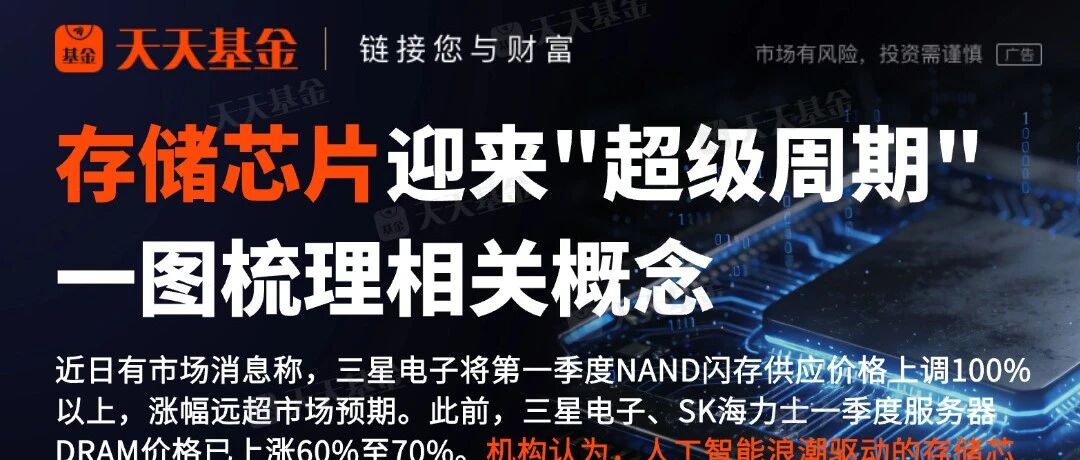
存储芯片迎来"超级周期"!一图梳理相关概念
天天基金网· 2026-01-27 10:26
Core Viewpoint - The storage chip industry is entering a "super cycle" driven by the demand surge from artificial intelligence (AI) and supply constraints, with significant price increases expected in NAND flash and DRAM products [1][6][7]. Price Increases - Samsung Electronics has raised NAND flash supply prices by over 100% in Q1, exceeding market expectations [6]. - DRAM prices for servers have increased by 60% to 70% in the same period [7]. Demand Drivers - The demand for storage chips is expanding due to increased investments in AI infrastructure, leading to a notable rise in enterprise solid-state drive (SSD) requirements [7]. - The trend of "edge AI," where devices perform AI computations directly, is further amplifying the need for high-performance storage solutions [7]. Market Outlook - Analysts predict that the storage chip market will experience a "super cycle" supported by both AI demand and domestic substitution, with price increases likely to continue [7]. - Global storage prices are expected to remain tight through 2026, with AI demand outpacing production capacity [7][8]. Investment Opportunities - The current market conditions suggest that various segments of the storage industry, including manufacturers, module companies, and testing/packaging firms, will benefit from the price surge [7]. - Investment in semiconductor-related funds and indices, such as the National Semiconductor Index and the China Semiconductor Index, is recommended for those looking to capitalize on the storage chip trend [9].


先进封装与测试专题报告:先进封装量价齐升,测试设备景气上行
Dongguan Securities· 2026-01-27 09:31
Group 1 - The report emphasizes that advanced packaging is crucial for enhancing chip performance and reliability, especially in the context of the AI wave driving demand for higher integration and performance in semiconductors [8][21][25] - The semiconductor packaging and testing industry in China is expected to grow significantly, with the market size projected to reach 438.98 billion yuan by 2029, reflecting a compound annual growth rate (CAGR) of 5.8% from 2024 to 2029 [28][29] - Advanced packaging is anticipated to account for 50% of the semiconductor packaging market by 2029, with a CAGR of 10.6%, outpacing traditional packaging growth [28][29] Group 2 - The report highlights the rise of independent third-party testing services in the semiconductor industry, driven by the increasing number of IC design companies and the growing demand for testing services [42][43] - The competitive landscape for wafer testing is relatively concentrated due to high technical and investment barriers, with fewer participants compared to finished chip testing [42][43] - The report notes that independent third-party testing firms often collaborate with integrated packaging and testing companies, outsourcing wafer testing while also competing in finished chip testing [42][43]


