
吉利汽车

Search documents
千里科技20260120
2026-01-21 02:57
Summary of Qianli Technology Conference Call Company Overview - Qianli Technology is positioned advantageously in the wave of intelligence, boasting top-tier AI and autonomous driving talent reserves, making it one of the few companies in the A-share market capable of providing a full suite of algorithm solutions [2][3] - The company underwent bankruptcy restructuring, bringing in strategic investors such as Geely and Liangjiang Capital, and established Ruiblu Automobile in partnership with Geely [2][4] - In 2024, the founder of Megvii, Yin Qi, will become the chairman, marking a transition to a technology-driven enterprise [2][4] Core Business Lines - Qianli Technology's core business includes three main segments: motorcycles, passenger vehicles (Ruiblu Automobile), and intelligent driving technology [6] - The motorcycle business is stable and profitable, while the passenger vehicle segment focuses on ride-hailing and exports, and intelligent driving technology is a key development area [2][6] Financial Status - The company's financial situation before 2025 relies heavily on motorcycle and Ruiblu Automobile sales, with motorcycle sales being stable and profitable, while Ruiblu's performance is more volatile [7] - Overall profit margins have remained stable since the restructuring, and cash flow is expected to improve in 2026 through H-share listing [7] Robot Taxi Development - Qianli Technology is optimistic about the Robot Taxi market, which is projected to grow significantly from 80 billion to 700 billion between 2030 and 2035 [8][9] - The company collaborates with Cao Cao Mobility and Geely to build a robust Robot Taxi ecosystem, providing algorithms, platforms, and vehicle models [9] - Plans include launching a low-cost Robot Taxi solution and participating directly in operations through local government partnerships [9] Future Plans - The company aims to deepen its AI and automotive strategy, enhancing technical capabilities and expanding market share [10] - As a core supplier for Geely in L2 support algorithms, Qianli Technology anticipates revenue potential of 10 billion to 20-30 billion [10] - Plans to achieve a scale of 10,000 Robot Taxis correspond to a market value potential of 30-50 billion [10] - The company will also explore expansion into cockpit and robotics sectors, driven by AI [10] Shareholding Structure - Liangjiang Venture Capital and other local government entities hold 30% of the shares, while Chongqing Lifan Holdings owns 13% [5] - Mercedes-Benz announced an investment in December 2025, acquiring a 3% stake in the company [5]

智驾与汽车Agent进展
2026-01-21 02:57
Summary of Key Points from Conference Call Industry Overview - The conference call discusses advancements in the automotive industry, particularly focusing on AI integration in vehicles and the development of autonomous driving technologies. The key players mentioned include traditional automakers and tech companies like Xiaomi, Huawei, and Nvidia. Core Insights and Arguments 1. **AI Cabin Assistants**: AI cabin assistants enhance user experience by providing immersive interactions and can increase purchase intent by 10%-15% when compared to traditional systems, with consumers willing to pay an additional 3,000 to 5,000 yuan for such features [1][5]. 2. **Full-Ecosystem Companies**: Companies like Xiaomi and Huawei have a competitive edge in automotive smart experiences due to their superior UI, UE, and UX design capabilities, allowing them to attract consumers more effectively than traditional automakers [1][7]. 3. **Integration of AI and Autonomous Driving**: The fusion of AI with autonomous driving technology is crucial for the development of Robot Taxis. Technologies such as VRA, VRM, and WM enhance environmental perception and decision-making capabilities [1][8]. 4. **Challenges in Advancing Autonomous Levels**: Transitioning from L2+ to L4/L5 remains challenging due to complex real-world environments and stringent legal regulations, which currently recognize only human drivers as legal operators [1][11]. 5. **Self-Developed Chips**: Automakers are increasingly developing their own chips to enhance algorithm and chip capabilities, reducing reliance on third-party suppliers and strengthening their competitive position [2][13]. 6. **Market Competition**: The competition among autonomous driving solution providers has intensified, with traditional automakers having advantages in ADAS/L2/L3 levels, while new entrants excel in Robot Taxi operations [2][22]. 7. **Consumer Preferences**: Consumers currently prefer hardware over software in vehicle purchases, although there is a growing willingness to pay for software features [20][21]. 8. **Platformization of Solutions**: There is a trend towards platformization among autonomous driving solution providers, which may lead to the elimination of smaller players in the market [18][19]. 9. **Potential for New Applications**: Automakers are exploring new directions such as AI glasses and embodied intelligent robots, which align with the evolving consumer needs for immersive experiences in vehicles [24][25]. Additional Important Content - **Market Dynamics**: The emergence of large models in AI is reshaping the competitive landscape, leading to a "survival of the fittest" scenario among autonomous driving firms [12]. - **Regulatory Environment**: The current legal framework poses significant barriers to the widespread adoption of higher-level autonomous driving technologies [11]. - **Consumer Sentiment**: While there is a strong interest in smart driving technologies, actual purchasing intent remains lower in markets outside of China, particularly in Europe [21]. - **Long-Term Commercialization**: The commercialization of embodied robots is expected to take 5 to 10 years, with many current projects still in experimental stages [28]. This summary encapsulates the key points discussed in the conference call, highlighting the advancements, challenges, and market dynamics within the automotive industry.

招银国际每日投资策略-20260121
Zhao Yin Guo Ji· 2026-01-21 02:51
招银国际环球市场 | 市场策略 | 招财日报 每日投资策略 行业点评 2026 年 1 月 21 日 全球市场观察 招银国际研究部 邮件:research@cmbi.com.hk | 环球主要股市上日表现 | | | | | --- | --- | --- | --- | | | 收市价 | | 升跌(%) | | | | 单日 | 年内 | | 恒生指数 | 26,488 | -0.29 | 3.34 | | 恒生国企 | 9,095 | -0.43 | 2.03 | | 恒生科技 | 5,683 | -1.16 | 3.04 | | 上证综指 | 4,114 | -0.01 | 3.65 | | 深证综指 | 2,678 | -0.83 | 5.80 | | 深圳创业板 | 3,278 | -1.79 | 2.34 | | 美国道琼斯 | 48,489 | -1.76 | 0.88 | | 美国标普 500 | 6,797 | -2.06 | -0.71 | | 美国纳斯达克 | 22,954 | -2.39 | -1.24 | | 德国 DAX | 24,703 | -1.03 | 0.87 | | 法 ...
上游涨价抬成本,关税松绑拓空间
HTSC· 2026-01-21 02:50
Investment Rating - The report maintains an "Overweight" rating for the automotive industry, indicating an expectation that the industry stock index will outperform the benchmark [6]. Core Insights - The automotive industry is undergoing significant changes, with rising costs from upstream components like storage chips and metals, alongside favorable tariff adjustments in Canada for Chinese electric vehicles [2][4]. - Bosch's declining profit margins reflect the broader challenges faced by traditional suppliers in Europe, highlighting the need for transformation amidst cost pressures [3]. - The reduction of tariffs on Chinese electric vehicles in Canada presents a new opportunity for Chinese automakers to penetrate the North American market [4]. Summary by Sections Upstream Cost Increases - The price increase of storage chips significantly impacts the cost of mid to high-end vehicles, with costs rising by 800 to 2304 RMB for mid-range cars and over 2700 RMB for high-end models due to increased RAM/ROM prices [2]. - Copper and aluminum prices are projected to rise, further increasing costs for electric vehicles, with cost increases of 1222 RMB for pure electric vehicles based on current price trends [2]. European Supply Chain Challenges - Bosch anticipates a profit margin drop to below 2% by 2025, down from 3.5% in 2024, due to restructuring costs and challenges in transitioning to electric and hydrogen technologies [3]. - The overall German automotive supply chain is experiencing similar pressures, with many companies facing reduced capacity utilization and increased operational costs [3]. Canadian Tariff Policy Changes - Canada has announced a significant reduction in tariffs on Chinese electric vehicles from 100% to 6.1%, which could reshape the competitive landscape in the North American market [4]. - This policy change allows Chinese brands to potentially increase their market share in Canada, particularly in the SUV and pickup segments, which account for 84% of sales [4]. Investment Recommendations - The report suggests focusing on two main investment directions: companies with strong supply chain advantages and cost reduction capabilities, and Chinese electric vehicle manufacturers poised to benefit from the new Canadian tariff policy [5].
限时指导价26.98万元起,吉利银河V900正式上市
Bei Jing Shang Bao· 2026-01-21 02:29
此外,银河V900全系标配智能双电机四驱,路特斯团队调校底盘。此外,该车型搭载AI增程系统与Flyme Auto2智能座舱。 据了解,银河V900以定位大家庭出行场景,车内有效长度达3.97米,并规划了"3个1000+"空间布局。同时,新车配备11层云感SPA座椅、27扬声器音响、冷 暖箱及图书馆级静谧座舱。 北京商报讯(记者刘晓梦)1月20日,吉利银河V900正式上市,新车共推出3个车型,上市限时指导价26.98万—32.98万元。 ...


公主岭市深耕汽车及汽车零部件产业“主阵地”,当好共建长春国际汽车城“助攻手”
Xin Lang Cai Jing· 2026-01-21 02:10
Core Insights - The automotive and auto parts industry in Gongzhuling City is experiencing significant growth, with the annual output value increasing from approximately 3-4 million to nearly 400 million yuan since its establishment in 2020 [1] - Gongzhuling City is implementing a "1369" high-quality development strategy to establish a new pattern of automotive and auto parts industry development through multi-point support and coordinated efforts [1][4] Group 1: Industry Development Strategy - Gongzhuling City is forming an automotive parts industry group by 2025, integrating over 90 supporting enterprises to enhance collaboration and resource sharing [2] - The establishment of the group aims to create a "chemical reaction" through strategic restructuring, allowing larger enterprises to assist smaller ones [2] Group 2: Internal and External Collaboration - The city is actively expanding its market presence by facilitating collaborations with major players like Geely and signing strategic cooperation agreements to explore new markets [3] - An information-sharing platform is being developed to streamline order flow and enhance internal collaboration among member companies [3] Group 3: Economic Impact - By 2025, Gongzhuling City is expected to have 69 large-scale automotive parts enterprises, achieving an output value of 9.84 billion yuan, which represents a 13.8% year-on-year growth and accounts for 47.8% of the city's industrial output [4] Group 4: Dual-Core Driving Force - Gongzhuling City is leveraging its strategic layout with two economic development zones, focusing on differentiated functional positioning to enhance industrial competitiveness [6][9] - The Gongzhuling Economic Development Zone is preparing for new energy vehicle projects and has attracted significant investments, including a 4.02 billion yuan project for high-energy power batteries [6][7] Group 5: Transition to Intelligent Manufacturing - The city is promoting a shift from traditional manufacturing to intelligent manufacturing, with companies like Shixin Stamping implementing automated production lines that significantly reduce labor costs [10][11] - The focus is on enhancing core competitiveness through technological innovation, digital transformation, and sustainable practices [11][12] Group 6: Future Outlook - The integration of the automotive and auto parts industry is evolving, with Gongzhuling City positioning itself as a strategic hub for the Changchun International Automotive City, enhancing its role in the broader automotive industry landscape [9][12]
外国一小哥把马斯克的星链给切开了,发现里面没啥东西,里面有一块电路板,和一个类似发动机的东西,感觉没啥技术含量,不过外形看上去像一台苹果电脑,做工非常先进,感觉星链在国内很多公司都可以做出来,不知道是不是这样?外网最近有一段视频热度极高:一位外国博主操起工具,把马斯克家的星链终端给大卸...
Sou Hu Cai Jing· 2026-01-21 01:59
Core Viewpoint - The disassembly of SpaceX's Starlink terminal reveals a simple internal structure, but the true complexity lies in the extensive satellite communication system and the technology behind it, which is not easily replicable by other companies [1][2][4]. Group 1: Technology and Complexity - The visible hardware of Starlink, such as the circuit board and components, is only a small part of the overall technology, which includes advanced algorithms and cost management in rocket launches [2][4]. - The integration of phased array antennas in the Starlink terminal allows for automatic tracking of high-speed satellites, a technology that was previously exclusive to military applications [4]. Group 2: Industry Comparison - While domestic companies like Galaxy Space and Geely's "Star Era" are working on low Earth orbit satellite communications, their total number of operational satellites is significantly lower than SpaceX's [2][3]. - The difference between being able to produce technology and successfully implementing it commercially is highlighted, with SpaceX's aggressive approach to testing and scaling contrasting with the more cautious domestic efforts [3][5]. Group 3: Market Dynamics and Challenges - SpaceX's success is attributed to its willingness to invest heavily in R&D and take risks, which is not as prevalent in traditional aerospace frameworks [3][5]. - The current regulatory and operational environment in China poses challenges for the rapid commercialization of low Earth orbit satellite projects, which are often hindered by approval processes and industry coordination [3][5]. Group 4: Future Outlook - As China progresses in 5G infrastructure, satellite navigation, and commercial space policies, there is potential for domestic companies to eventually surpass current capabilities in low Earth orbit satellite technology [5]. - The notion that technology is not merely about visible components but also about the execution and ecosystem surrounding it is emphasized, suggesting that future advancements may lead to better solutions than those currently offered by SpaceX [5].

41家港股公司回购 小米集团-W回购1.96亿港元
Zheng Quan Shi Bao Wang· 2026-01-21 01:49
证券时报·数据宝统计显示,1月20日有41家香港上市公司进行了股份回购,合计回购2511.52万股,回购 金额4.42亿港元。 | 代码 | 简称 | 回购股数 | 回购金额(万 | 回购最高价 | 回购最低价 | 年内累计回购金额 | | --- | --- | --- | --- | --- | --- | --- | | | | (万股) | 港元) | (港元) | (港元) | (万港元) | | 01810 | 小米集团 W | 550.00 | 19607.97 | 35.860 | 35.460 | 180162.63 | | 02382 | 舜宇光学 | 140.00 | 8860.84 | 64.300 | 62.550 | 62474.98 | | | 科技 | | | | | | | 00175 | 吉利汽车 | 378.80 | 6362.86 | 16.950 | 16.690 | 43777.56 | | 01024 | 快手-W | 39.30 | 2995.25 | 76.700 | 75.850 | 5991.29 | | 02096 | 先声药业 | 188.40 | 2 ...


重磅利好,中国电车能领德国补贴了,两国为新能源出海开政策绿灯
3 6 Ke· 2026-01-21 01:39
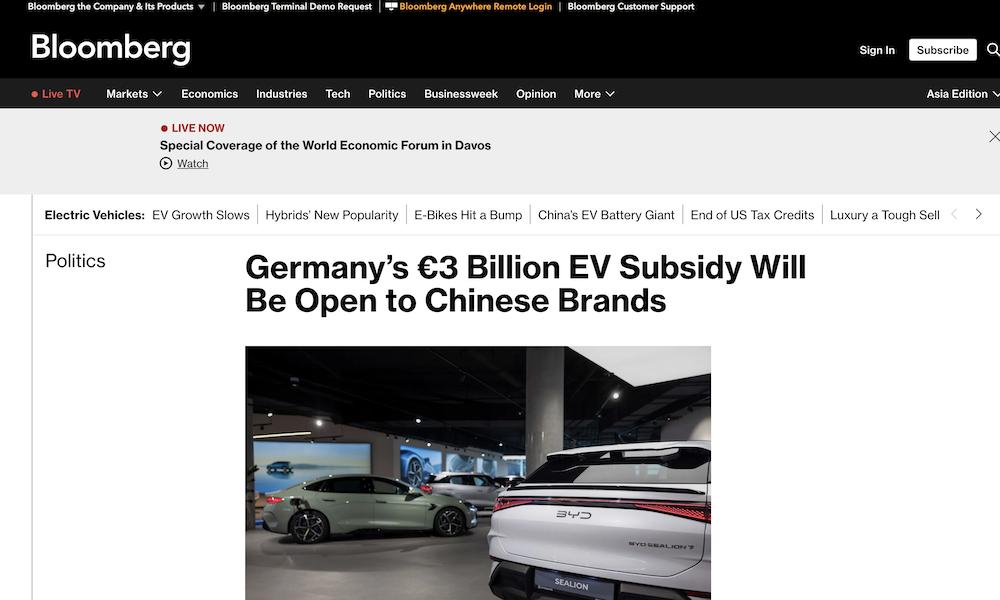
Core Viewpoint - Recent policy changes in Germany and Canada are creating favorable conditions for Chinese electric vehicle manufacturers to expand internationally, particularly in the European and North American markets [1][2][5]. Group 1: Germany's Policy Changes - The German government has announced a €3 billion (approximately ¥24.5 billion) subsidy plan for electric vehicles, providing up to €6,000 (approximately ¥49,000) for households purchasing new electric cars, which is open to all manufacturers, including Chinese brands [1][2]. - This subsidy aims to boost electric vehicle sales and support the automotive industry after a significant drop in demand following the end of previous subsidy programs [5]. - The German Federal Environment Minister emphasized the need to embrace competition rather than impose restrictions, indicating a welcoming stance towards Chinese automotive manufacturers [5]. Group 2: Canada's Policy Adjustments - Canadian Prime Minister Justin Trudeau announced the cancellation of a 100% tariff on Chinese electric vehicles and introduced an annual quota of 49,000 vehicles that will benefit from a 6.1% most-favored-nation tariff rate [1][8]. - This quota corresponds to the export volume from China to Canada before the imposition of additional tariffs, with expectations for gradual increases over the years [10]. - Trudeau highlighted China's undeniable advantages in the electric vehicle sector, aiming to learn from innovative partners to enhance Canada's competitive automotive industry [10]. Group 3: Export Growth of Chinese Automakers - In 2025, China's total automobile exports are projected to reach 8.32 million units, marking a 30% year-on-year increase, continuing a five-year growth trend [11]. - The export value is expected to grow from $34.5 billion (approximately ¥240.1 billion) in 2021 to $142.4 billion (approximately ¥991 billion) in 2025, reflecting a 21% increase [11]. - Notably, the export volume of new energy vehicles is anticipated to double, reaching 2.615 million units in 2025, with significant contributions from major automakers like BYD and Chery [11][16]. Group 4: Performance of Major Chinese Automakers - Chery is expected to lead in export volume in 2025, with 1.34 million units, while BYD's exports are projected to reach 1.05 million units, a 144% increase from the previous year [16][18]. - SAIC Group is also set to export 950,000 units, leveraging its joint ventures and brand portfolio [18]. - New entrants like Leap Motor and Xpeng are showing remarkable growth, with exports increasing by 600% and 150%, respectively, indicating a strong competitive presence in the international market [19][20]. Group 5: Industry Implications - The evolving international landscape for Chinese automakers signifies a historic shift from "bringing in" to "going out," enhancing the global influence of Chinese automotive brands [21]. - The advancements in technology, such as smart cabins and battery innovations, are contributing to the transformation of the global automotive industry [21]. - The current complex international environment and restructuring of the global automotive landscape suggest that Chinese automotive exports are likely to maintain a robust trajectory, becoming a key driving force in global mobility transformation [21].




蔚来全新ES8交付超5万辆,上汽MG7智能化升级|一周车闻
Di Yi Cai Jing· 2026-01-21 01:01
Group 1 - Chinese brands are accelerating their scale layout in the high-end and segmented markets, particularly in the high-end electric vehicle sector [1][2] - NIO delivered its 50,000th new ES8 vehicle in just 120 days since the launch, achieving a retail sales volume of 22,258 units by December 2025, ranking first in insurance volume among large SUVs in 46 cities [2] - The strong sales performance of NIO is attributed to its internal "efficiency revolution," but the company faces challenges in converting this into stable annual profitability to cover high R&D and infrastructure investments [2] Group 2 - SAIC's MG brand launched the 2026 MG7 with a starting price of 116,900 yuan, targeting the competitive 100,000 to 150,000 yuan sports sedan market, featuring significant upgrades in intelligence [3] - The 2026 MG7 aims to compete with models like Lynk & Co 03 and Honda Civic, leveraging "beyond-class" configurations to attract consumers [3] - SAIC-GM Wuling introduced its first rugged SUV, the Starlight 560, with a price range of 59,800 to 95,800 yuan, offering fuel, plug-in hybrid, and pure electric options [4] - The Starlight 560's fuel version features a 1.5T engine with a maximum torque of 290 Nm, while the pure electric version boasts a range of 500 km and a consumption of 13.1 kWh/100 km [4] - Wuling aims to achieve a total output value exceeding 100 billion yuan by 2025, with a year-on-year growth of 24%, and expects its new energy vehicle sales to surpass 1 million units, reflecting a 31.9% increase [4] Group 3 - Geely Galaxy launched its first large MPV, the Galaxy V900, with a starting price of 269,800 yuan, filling a gap in the MPV segment for Geely [5] - The Galaxy V900 features a range-extended power system with a 1.5T engine and dual motors, offering a pure electric range of 260 km and a combined range of 1,220 km [5] - The year 2026 is anticipated to be significant for MPV products, with other models like the Zhijie V9 and Leap Motor D99 expected to debut [5]
