抖音

Search documents
涪陵榨菜:榨菜销量下滑丨消费参考
2 1 Shi Ji Jing Ji Bao Dao· 2025-09-04 23:41
Group 1 - The core viewpoint is that Fuling Zhacai is reassessing its key pickled vegetable business due to changing market dynamics and consumer preferences [1][4] - In the first half of 2025, Fuling Zhacai reported a revenue increase of 0.5% year-on-year to 1.31 billion yuan, while net profit attributable to shareholders decreased by 1.7% to 440 million yuan [1] - Revenue from the pickled vegetable category was 1.12 billion yuan, with a year-on-year growth of 0.5%, while sales volume declined by 1.2% [1] Group 2 - The company is facing challenges in sales channels as consumer preferences shift towards alternative products, and urban population trends are affecting its market coverage [3] - Fuling Zhacai is implementing a strategy to expand product categories and market reach, focusing on new product development and channel expansion [3] - The company is adjusting its production plans by reducing conventional pickled vegetable production lines and increasing the production of multi-specification products and sauces [3] Group 3 - The stock price of Fuling Zhacai was reported at 13.24 yuan per share, with a slight increase of 0.76% [5] - The consumer index for the sector showed a decline, with the consumption index dropping by 2.21% [6]

袁雨晴、王金鹏:抖音生活服务赋能大连文旅,流量变现促进实体消费
Sou Hu Cai Jing· 2025-09-04 17:07
Core Insights - The report from Tsinghua University highlights how Douyin's life services are effectively converting short video and live streaming traffic into offline consumer footfall and spending, significantly boosting Dalian's cultural and tourism industry development [1][4]. Douyin's Innovative Model - Douyin's innovations in platform integration and visual storytelling provide users with a new experience, achieving over 600 million daily active users by June 2021 [3]. - Dalian, a northern Chinese port city, is leveraging short video live streaming as a new engine for tourism consumption, with over 270 million short videos generating 13.9 billion likes and 6.41 million visitors checking in by July 2025 [4]. Multi-Model Consumption Transformation - Douyin is driving various consumption models in Dalian's tourism sector, revitalizing traditional attractions and enhancing user engagement through local IP development and immersive experiences [5]. - For instance, Dalian Forest Zoo has successfully connected online users with offline experiences, significantly increasing venue visibility and ticket sales [5]. - Dalian Shengya Ocean World utilized a 12-hour live broadcast to achieve over 1 million views and sales exceeding 1.5 million yuan in group purchases, showcasing effective conversion from interest to sales [5]. Efficient Promotion of Local Cuisine - Local delicacies, such as sea urchin dumplings, have seen significant sales through Douyin live streaming, with single live sessions generating 400,000 to 500,000 yuan in GMV, contributing 15%-30% to seasonal revenue [8]. - Hotels are also benefiting from Douyin's services, with the Dongquan Holiday Hot Spring Hotel reporting a 10% increase in group purchase orders and sales reaching 190,000 yuan in just 10 hours during its first broadcast [8]. Collaborative Pathways for Tourism Development - The report emphasizes the need for multi-party collaboration to achieve high-quality development in Dalian's tourism sector, focusing on digital resource management and seasonal balance [9]. - Douyin's role as a key driver of traffic for Dalian's tourism is highlighted, with a call for innovative cooperation and interaction to explore new growth dynamics in the tourism industry [9].


4000亿携程的赌局
Hua Er Jie Jian Wen· 2025-09-04 12:23
Core Viewpoint - Ctrip has adopted a unique approach by allowing employees to work from home without approval, amidst a trend of major internet companies tightening attendance policies. This decision comes as the company reports a record high quarterly revenue of 14.8 billion yuan and maintains a gross margin above 80% [2][3]. Business Performance - Ctrip's Q2 2025 net operating revenue reached 14.8 billion yuan, a year-on-year increase of 16% and a quarter-on-quarter increase of 7%, slightly exceeding market expectations [3]. - Revenue growth was observed across all business segments: accommodation booking revenue was 6.2 billion yuan (up 21% YoY), transportation ticketing revenue was 5.4 billion yuan (up 11% YoY), vacation business revenue was 1.1 billion yuan (up 5% YoY), and business travel management revenue was 0.692 billion yuan (up 9% YoY) [4]. - Adjusted operating profit for Q2 was 4.67 billion yuan, a 10.4% increase YoY, surpassing market expectations by approximately 390 million yuan [4]. Market Trends - The international business segment showed significant growth, with total bookings on Ctrip's international OTA platform increasing by over 60% YoY. Outbound travel bookings have recovered to 120% of 2019 levels, exceeding the industry average recovery of 84% [5]. - The domestic tourism market is booming, with 3.285 billion domestic trips taken in the first half of 2025, a 20.6% increase YoY, and total spending of 3.15 trillion yuan, up 15.2% YoY [5]. Competitive Landscape - The online travel market in China is projected to exceed 1.7 trillion yuan by 2025, intensifying competition among players. Ctrip's market share is being challenged by new entrants like JD.com and Douyin, which are adopting aggressive pricing and innovative marketing strategies [7][9]. - JD.com aims to reduce industry costs by one-third with a "three-year zero commission" policy, while Douyin leverages content-driven marketing to enhance user engagement and shorten the booking decision process [7][8]. Strategic Responses - Ctrip is focusing on enhancing its technology and service offerings to address competitive pressures, including the introduction of an upgraded AI-based itinerary planner to improve user experience [10][11]. - The company is also aware of its vulnerabilities in the mid-to-low star hotel market, which is being targeted by competitors like Meituan and Douyin [10]. Future Outlook - Analysts predict that Ctrip's domestic revenue will maintain a steady growth rate of around 10% in Q3 2025, while outbound travel revenue growth is expected to normalize to low double digits [6].
多平台上线AI内容标识功能 助力行业转向规范创新
Sou Hu Cai Jing· 2025-09-04 06:11
Core Viewpoint - The implementation of the "Artificial Intelligence Generated Synthetic Content Identification Measures" aims to regulate the production and dissemination of AI-generated content, enhancing transparency and accountability across various platforms [1][6]. Group 1: Implementation by Platforms - Major platforms such as Tencent, Douyin, DeepSeek, Weibo, Bilibili, and Kuaishou have announced the launch of AI-generated content identification features to comply with the new regulations [1][3]. - Douyin requires users to actively add explicit identification when publishing AI-generated content and will verify unmarked content for AI generation [3]. - DeepSeek has implemented identification for AI-generated content and prohibits users from maliciously altering or hiding these identifiers [3]. - Bilibili and Weibo have also introduced similar identification features, ensuring that unmarked AI-generated content will be flagged according to community rules [4]. Group 2: Challenges and Considerations - Platforms face multiple challenges in implementing these measures, including the need for advanced computational power and algorithms to handle vast amounts of content identification [5]. - There is a necessity for user education to reduce resistance to the identification process and to ensure compliance with the new regulations [5]. - Experts suggest that a dual identification system (explicit and implicit) will significantly enhance content transparency and help users quickly identify AI-generated information [6][7]. Group 3: Impact on the Industry - The new measures are expected to reshape the current AI content ecosystem by enforcing a clear identification system that can help mitigate the spread of false information and deepfakes [6][7]. - The identification requirements will likely disrupt low-quality content generation models while favoring high-quality, human-assisted content creation [7]. - In the long term, the identification system is anticipated to establish a trustworthy foundation for the healthy development of the AI industry, shifting it from "wild growth" to "regulated innovation" [7].





21社论丨推动平台经济开拓更多新增量
21世纪经济报道· 2025-09-03 23:45
Core Viewpoint - The article highlights the impact of aggressive subsidy competition among major internet platforms on their profitability, while also noting their efforts to explore new growth markets. Group 1: Financial Performance - In Q2, major players Meituan, Taobao, and JD.com engaged in a subsidy competition for food delivery, resulting in significant profit declines: Meituan's net profit dropped by 89%, JD.com's by 50.8%, and Alibaba's by 18%, collectively losing over 20 billion yuan compared to the previous year [1][2]. - The intense competition in the e-commerce sector, characterized as a zero-sum game, leads to reduced profits and hinders long-term development capabilities [1]. Group 2: Market Expansion Strategies - Alibaba's Q2 report showed a 26% year-on-year increase in cloud business revenue, with AI-related product revenue growing for eight consecutive quarters, indicating a shift towards a technology-driven model [2]. - JD.com announced its acquisition of Ceconomy, the parent company of MediaMarkt and Saturn, marking a significant step in its global expansion strategy and enhancing its international market presence [2]. - Didi's international business has expanded to 14 countries, achieving a GTV of 27.1 billion yuan and a 24.9% increase in daily orders, indicating strong growth in the Latin American market [3].




抖音AI「三驾马车」成型,涵盖社交、内容消费、内容生产三大赛道|AI产品榜·应用榜8月榜
36氪· 2025-09-03 13:35
Core Insights - The article discusses the latest AI product rankings for August 2025, highlighting significant growth in various AI applications, particularly those under Douyin (TikTok) and Tencent [2][9]. Group 1: AI Application Rankings - The AI product rankings include nine categories, such as global MAU, domestic MAU, and subscription revenue rankings [2]. - Douyin's AI applications, including Jimeng AI and Xinghui, are noted for their rapid growth, with Jimeng AI achieving a 15.76% increase in MAU to 32.5 million users and Xinghui experiencing a remarkable 294.47% growth to 6.06 million users [4][5][6]. - Tencent's only listed application, Tencent Yuanbao, ranked fifth in the domestic total list with a 26.33% increase in MAU to 56.51 million users [8]. Group 2: Global and Domestic Trends - The global total list features ChatGPT at the top with 727.75 million MAU, followed by Quark and Douyin's Doubao [10][19]. - The article emphasizes that Douyin's applications are becoming significant players in the AI space, covering social, content consumption, and content production sectors [6][3]. - The subscription revenue rankings show Grok leading with an annual recurring revenue (ARR) of $2,996 million, followed by Claude and ChatGPT [33]. Group 3: Growth and Decline - The article notes that several applications are experiencing declines, such as Genius and DeepSeek, which saw decreases in MAU of 20.35% and 9.71%, respectively [29]. - Conversely, applications like seekee and Xinghui are highlighted for their impressive growth rates, with seekee achieving a 25.62% increase in MAU [17][27]. - The overall trend indicates a competitive landscape where certain applications are rapidly gaining traction while others are losing user engagement [14][28].

AI生成内容强制“打标”实测:抖音、小红书、微博自动识别“失灵”
Mei Ri Jing Ji Xin Wen· 2025-09-03 11:17
Core Viewpoint - The implementation of the "Artificial Intelligence Generated Synthetic Content Identification Measures" on September 1 has revealed that platforms like Xiaohongshu, Douyin, and Weibo are currently unable to automatically identify AI-generated content and add appropriate labels [1] Group 1: Platform Responses - Douyin's representative stated that the platform has not been able to verify or identify the metadata of the works, and while it attempts to detect content that may be AI-generated, its technical identification capabilities have limitations and complexities [1] - The ability to timely identify works depends on various factors such as production technology and view counts, indicating that not all content without implicit labels can be immediately recognized and tagged upon release [1] - Weibo has not provided a direct response regarding its inability to identify AI content [1] - Xiaohongshu also did not respond directly to the situation of failing to identify AI-generated content [1]
AIGC标识办法9月开始实施,平台、大模型公司响应“加水印”
Bei Ke Cai Jing· 2025-09-03 06:15
Core Viewpoint - The implementation of the "Artificial Intelligence Generated Synthetic Content Identification Measures" (referred to as "Identification Measures") began on September 1, requiring all AI-generated content to include appropriate identification labels [1][2]. Content Platforms - Major content platforms such as Tencent, Douyin, Bilibili, and Kuaishou have announced compliance with the Identification Measures, implementing explicit and implicit labeling for AI-generated content [2][4]. - Bilibili has introduced a feature allowing users to declare AI-generated content during submission, enhancing content governance [3]. - Tencent has optimized its content identification capabilities to ensure transparency and user trust, prohibiting any alteration or concealment of AI identification labels [4]. - Douyin has launched two core features: an AI content identification function and an AI content metadata identification function to assist users in recognizing AI-generated content [5][6]. - Kuaishou has also implemented explicit and implicit labeling for AI-generated content, emphasizing compliance with national laws and platform rules [6]. Large Model Companies - DeepSeek has added identification labels to AI-generated content on its platform, providing users with information about the content's AI origin [7]. - SenseTime has committed to adhering to regulatory policies by implementing both explicit and implicit labeling for its AI-generated services [7][8]. E-commerce Platforms - Douyin E-commerce has issued a notice to strengthen governance against the misuse of AI content, highlighting issues such as false advertising and misleading promotions [9][10]. - The platform has identified typical violations, including the use of AI to create false product displays and impersonate celebrities, which can mislead consumers [10][11]. - Douyin E-commerce emphasizes that all AI-generated content must be self-declared and prohibits the use of misleading AI-generated materials [11].
抖音张一鸣拿下苹果手机大单
Sou Hu Cai Jing· 2025-09-03 02:04
Group 1 - Apple has officially launched its flagship store on Douyin, marking a significant move in its online retail strategy [4][10] - The flagship store will offer a range of Apple products, including iPhones, iPads, Macs, and accessories, with prices synchronized with Tmall and support for up to 12 months of interest-free installments [4][7] - Douyin will serve as a key platform for the global launch of new Apple products, indicating its importance in Apple's sales strategy [7][13] Group 2 - Apple's entry into Douyin is part of a broader strategy to expand its online sales channels, especially as its revenue in the Chinese market has started to decline, with a quarterly drop of up to 13% reported in Q3 2023 [10][13] - The collaboration with Douyin is expected to enhance consumer access to genuine Apple products, thereby increasing sales of high-ticket 3C products on the platform [13][17] - Douyin's commercial ambitions are evident as it aims to strengthen its position in the 3C digital product category, which is anticipated to become a significant growth driver for its e-commerce business [13][18] Group 3 - The partnership is seen as mutually beneficial, leveraging Douyin's vast user base of 1 billion monthly active users and its content-driven e-commerce model to reach younger consumers [15][17] - Douyin has been enhancing its support for merchants, with initiatives that have saved businesses over 14 billion yuan in operational costs in the first half of 2023 [19][23] - The platform's focus on high-quality content and user engagement is expected to create a more robust e-commerce ecosystem, positioning Douyin favorably in the competitive landscape [28][29]


从“模式创新”迈向“生态构建” 不断催生发展新模式新动能 四川重磅加码 助力平台经济进阶
Si Chuan Ri Bao· 2025-09-03 00:13
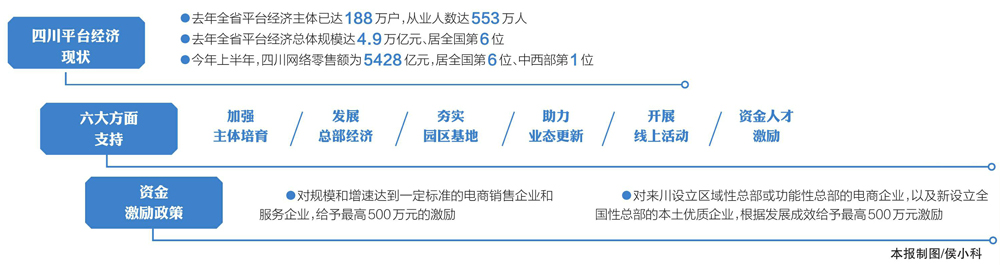
Core Insights - Sichuan is set to introduce policies to support the high-quality development of the platform economy, offering incentives up to 5 million yuan for e-commerce and service enterprises meeting specific criteria [2][3] - The platform economy is seen as a crucial link between urban and rural areas, contributing to domestic demand, employment stability, and public welfare [2] Group 1: Economic Development - The platform economy in Sichuan, focusing on e-commerce, is one of the key industrial chains, with 1.88 million entities and 5.53 million employees, generating a total scale of 4.9 trillion yuan, ranking 6th nationally [3] - In the first half of this year, Sichuan's online retail sales reached 542.8 billion yuan, placing it 6th in the country and 1st in the Midwest [3] - The province aims to enhance the platform economy by focusing on six areas: nurturing key players, developing headquarters economy, strengthening park bases, updating business formats, conducting online activities, and incentivizing talent and funding [3] Group 2: Project Initiatives - Six projects were signed at the conference, including a digital trading center for vegetables and a live-streaming e-commerce promotion project for Sichuan tea, aimed at enhancing the industrial chain's development momentum [4] Group 3: Technological Integration - The platform economy is increasingly leveraging technologies like AI, cloud computing, and blockchain to drive the development of various industries in Sichuan [5] - The live-streaming e-commerce sector is projected to exceed 100 billion yuan in retail sales by 2024, accounting for nearly 20% of e-commerce in the province [6] Group 4: Future Goals - By 2027, Sichuan aims to surpass 1.1 trillion yuan in online retail sales and increase the number of online merchants to over 2 million [7] - Chengdu is positioned as the main hub for platform economy development, attracting major e-commerce companies and facilitating efficient matching of platform resources with industrial demands [7]