长安汽车

Search documents
2025汽车行业年鉴 | 新技术篇:故事是开局,商业化才是终点
Jing Ji Guan Cha Wang· 2025-12-30 11:01
Group 1: Industry Overview - The Chinese automotive industry is at a pivotal moment, with significant advancements in technology expected by 2025, including solid-state batteries and new charging methods [2] - The competition among companies is shifting from storytelling to the robustness of their technological systems, with a focus on market scale, cost control, and user reputation [2] Group 2: Battery Technology - By 2025, solid-state batteries are on the verge of mass production, while semi-solid batteries are already being used in high-end models, with brands like NIO and Zhiji promoting these technologies [3] - Traditional liquid battery manufacturers are adopting a dual strategy, investing heavily in solid-state battery research while maintaining their market position with innovative liquid battery designs [3] - Startups in the solid-state battery space are leveraging venture capital to bypass traditional patents and seek partnerships with second-tier automakers [3] Group 3: Charging Solutions - The competition between fast charging and battery swapping is intensifying, with new models featuring 800V high-voltage platforms enhancing fast charging capabilities [4] - Companies are focusing on user experience and profitability in their charging networks, with Tesla and NIO expanding their proprietary networks while third-party operators form alliances [4] - The battery swapping model is gaining traction through partnerships with major automakers, although it faces challenges related to high fixed asset investments and operational complexities [5] Group 4: Driving Technologies - Range-extended electric vehicles are experiencing rapid growth, appealing to family buyers and mid-to-high-end SUV consumers [6] - There are concerns about the long-term impact of range-extended vehicles on the industry, particularly regarding resource allocation for pure electric vehicle development [7] - The introduction of steer-by-wire systems is set to revolutionize vehicle control, enhancing the potential for advanced driver-assistance systems and future autonomous driving [7] Group 5: Future Trends - The industry is expected to move towards a more integrated approach, balancing various technologies rather than focusing on a single solution [8] - By 2026, solid-state batteries may begin to see limited commercial deployment, primarily in high-end models, serving as a proof of concept rather than a mass-market solution [8] - Companies are likely to adopt mixed charging and swapping strategies based on user needs, optimizing their offerings for different market segments [8] - The distinction between high-end range-extended and plug-in hybrid vehicles is blurring, with market success determined by the ability to provide a seamless user experience [9]


L3级自动驾驶上路,我们离「放手」开车还有多远?
3 6 Ke· 2025-12-30 10:26
Core Insights - The transition from L2 to L3 autonomous driving is not merely a technical upgrade but involves comprehensive challenges related to legal responsibilities, costs, and user trust [1][6][11] Group 1: Policy and Regulation - The Ministry of Industry and Information Technology (MIIT) has approved the first two L3 autonomous driving models in China: Changan Deep Blue SL03 and BAIC Blue Valley Arcfox Alpha S Pioneer Edition, set to be tested under specific conditions by the end of 2025 [2][3] - The L3 level allows for conditional automation where the driver can fully disengage from driving tasks, but responsibility for accidents may be shared between the system and the driver [2][3] - New regulations, such as the Beijing Autonomous Driving Vehicle Regulations, have established accident liability rules, requiring manufacturers to bear product liability and maintain insurance of at least 5 million yuan [3] Group 2: Technical Challenges - Transitioning from L2 to L3 involves a significant shift in responsibility, technology architecture, and business logic, necessitating redundant systems to ensure safety [6][7] - The cost of implementing redundancy in systems, such as steering, can increase significantly, with estimates suggesting costs could rise from 1,500-2,000 yuan to 4,000-6,000 yuan per unit [6][7] - The choice between in-house development and third-party suppliers complicates the responsibility chain in the event of an accident, requiring clearer regulations [7] Group 3: User Experience and Trust - Users have reported issues such as "phantom braking" and hesitation during lane changes, highlighting a gap between marketing promises and actual user experiences [5][8] - Many users express a lack of trust in autonomous systems, often feeling uncertain about when to intervene, which can lead to negative experiences and a reluctance to use the technology [8][11] - Education on the capabilities and limitations of autonomous driving systems is lacking, with few manufacturers incorporating training into the sales process [9][10] Group 4: Recommendations for Improvement - Companies must take responsibility for educating users about autonomous driving, while regulatory bodies should promote clear and understandable guidelines [11] - Enhancing human-vehicle interaction through transparent communication of system intentions can help build trust and improve user experiences [11] - The successful integration of L3 autonomous driving into everyday life requires a collective effort from the industry, regulators, and consumers to foster understanding and trust [11]



2025汽车行业年鉴|政策篇:精准出击、关键护航
Jing Ji Guan Cha Wang· 2025-12-30 10:23
Core Insights - The Chinese automotive industry is facing intense competition and price wars as it approaches an annual production and sales milestone of 32.3 million vehicles, with one in three cars sold globally coming from China. The industry is experiencing a shift from quantity expansion to quality improvement, driven by a series of government policies aimed at stabilizing growth and promoting transformation [2][10]. Policy Measures - The 2025 automotive policies focus on stabilizing consumption and fostering transformation, addressing the current "involution" issues in the industry. Key measures include extending the exemption of the vehicle purchase tax for new energy vehicles (NEVs) until the end of 2027 and increasing the maximum tax exemption from 30,000 RMB [4][5]. - A new action plan for large-scale equipment updates and consumer goods replacement will continue into 2025, with subsidies of up to 10,000 RMB for scrapping old vehicles and purchasing new energy passenger cars, stimulating demand in the stock market [4][5]. - The introduction of a pilot program for intelligent connected vehicles, allowing for conditional Level 3 autonomous driving, marks a significant regulatory advancement, clarifying liability and encouraging innovation [5]. Industry Challenges - The intensifying price wars are squeezing profits for automakers, leading to extended payment terms for small suppliers, which can exceed 120 days. This creates financial strain on smaller companies and hampers the overall efficiency of the automotive supply chain [5][9]. - The implementation of the "Regulations on Payment of Small and Medium-sized Enterprises" aims to alleviate financial pressures by mandating that payments to small suppliers be made within 60 days [5]. Future Outlook - For 2026, the automotive market is expected to see a decline in sales, with predictions of a 5% drop in passenger vehicle sales to 28.5 million units. The focus will remain on stabilizing consumption incentives, achieving breakthroughs in core technologies, and enhancing export quality [6][7]. - New policies will include a reduction in the NEV purchase tax by half starting January 1, 2026, and a continued emphasis on key technology breakthroughs, particularly in automotive chips and solid-state batteries [7][8]. - The export strategy will shift towards quality enhancement, with measures to regulate the export of used cars and improve after-sales service networks, ensuring better quality control [8][9]. Regulatory Environment - The introduction of the "Automotive Industry Price Behavior Compliance Guidelines" aims to curb the detrimental effects of price wars and promote a focus on product quality and technological innovation [9].

2025汽车行业年鉴|供应链篇:整零深度绑定、场景决定未来
Jing Ji Guan Cha Wang· 2025-12-30 10:23
Core Insights - In 2025, the Chinese automotive industry will experience a deepening transformation towards intelligence, shifting the supply chain from "price competition" to "value competition" and evolving towards a "fully intelligent ecosystem co-construction" [2] - Level 3 autonomous vehicles will be legally operational in China, marking a significant milestone for companies like Robotaixi, which is expected to achieve profitability [2] - The supply chain's global competitiveness will accelerate as the intelligent wave drives the evolution from component assembly to technological ecosystems, with advancements in areas like unmanned delivery and flying cars [2] Group 1: Industry Trends - The most notable feature of the automotive intelligent supply chain in 2025 will be "ecological integration" replacing "single-point cooperation," with leading automakers and core suppliers forming deep collaborative barriers through strategic investments and equity binding [3] - Capital injection is crucial for resource binding, exemplified by Chery and Luxshare's joint investment of $100 million in Lightyear, and other strategic investments by major players like FAW and Geely [3] - The restructuring of major automotive companies, such as Changan becoming a new central enterprise, will lead to the establishment of intelligent manufacturing and asset management platforms [3] Group 2: Technological Advancements - Core suppliers are transitioning from "component providers" to "full-stack solution enablers," with companies like Huawei leading the charge in defining products and channels through their HarmonyOS [4] - The implementation of a 60-day payment term by major automakers aims to restore the credit system within the supply chain, fostering a shift from competition to strategic partnerships [4] - Significant regulatory changes include the mandatory adoption of Advanced Emergency Braking Systems (AEBS) and the introduction of stringent safety standards for power batteries [5] Group 3: Commercialization and Market Expansion - The commercialization of Level 4 autonomous driving technology is entering a verification phase, with the Ministry of Industry and Information Technology granting licenses for Level 3 systems to specific models [6] - The Robotaxi sector is witnessing critical breakthroughs, with companies like Pony.ai and WeRide achieving dual listings and significant advancements in autonomous driving systems [6] - Unmanned delivery is transitioning from pilot projects to large-scale applications, with companies like New Stone and JD Logistics deploying thousands of unmanned vehicles [7] Group 4: Challenges and Future Outlook - Despite significant breakthroughs in 2025, the Chinese automotive supply chain faces three major challenges: reliance on external sources for raw materials like lithium and cobalt, dependency on imported chips, and limitations in foundational software technologies [8]

机器人执行器概念爆发,13位基金经理发生任职变动
Sou Hu Cai Jing· 2025-12-30 09:09
Market Performance - On December 30, A-shares showed mixed performance with the Shanghai Composite Index closing flat at 3965.12 points, the Shenzhen Component Index rising by 0.49% to 13604.07 points, and the ChiNext Index increasing by 0.63% to 3242.90 points [1] Fund Manager Changes - On December 30, a total of 13 fund managers experienced changes in their positions, with 640 fund products having manager changes in the past 30 days [3] - One fund manager left due to a job change, managing two funds during their tenure [3] - Tianhong Fund's Wang Fan managed assets totaling 254 million yuan, with the highest return of 17.84% on the Tianhong Yongyu Balanced Pension Fund over 3 years and 193 days [3] New Fund Managers - On December 30, 24 fund products announced new fund managers, involving 12 fund managers [4] - Baiying Fund's Cai Dan manages assets of 2.597 billion yuan, with the highest return of 103.05% on the Baiying CSI A100 Index Enhanced Fund over 8 years and 149 days [4] Fund Research Activity - In the past month (November 30 to December 30), Huaxia Fund conducted the most company research, engaging with 42 listed companies, followed by Southern Fund, Bosera Fund, and Huitianfu Fund with 37, 34, and 32 companies respectively [6] - The most researched industry was specialized equipment with 155 instances, followed by computer equipment with 111 instances [6] Recent Fund Research Focus - In the last week (December 23 to December 30), the most researched company was Pulite, a plastic products company, with 28 fund institutions participating in the research [7] - Other companies with significant research attention included Nord Shares, Xiangyu Medical, and Desai Xiwai, with 23, 22, and 22 fund institutions respectively [7]


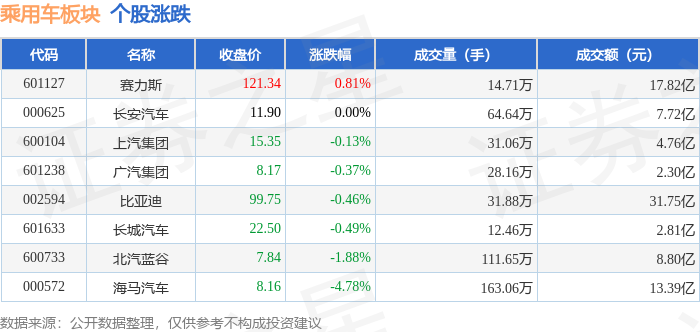
乘用车板块12月30日跌0.25%,海马汽车领跌,主力资金净流出8531.2万元
Zheng Xing Xing Ye Ri Bao· 2025-12-30 08:56
Group 1 - The passenger car sector experienced a decline of 0.25% compared to the previous trading day, with Haima Automobile leading the drop [1] - The Shanghai Composite Index closed at 3965.12, showing no change, while the Shenzhen Component Index rose by 0.49% to 13604.07 [1] - The trading volume for the passenger car sector showed a net outflow of 85.31 million yuan from institutional investors and 186 million yuan from retail investors, while retail investors had a net inflow of 271 million yuan [1] Group 2 - The table of individual stocks in the passenger car sector indicates that Sairus (601127) had a closing price of 121.34 with a gain of 0.81%, while Haima Automobile (000572) closed at 8.16 with a significant drop of 4.78% [1] - The net capital flow for Sairus was 89.44 million yuan from institutional investors, while it faced a net outflow of 51.52 million yuan from speculative investors [2] - BYD (002594) saw a net inflow of 24.64 million yuan from institutional investors, despite a net outflow of 62.58 million yuan from speculative investors [2]





【快讯】每日快讯(2025年12月30日)
乘联分会· 2025-12-30 08:39
Domestic News - The State-owned Assets Supervision and Administration Commission (SASAC) emphasizes accelerating the transformation and upgrading of traditional industries, focusing on intelligent, green, and integrated development to enhance the competitiveness of traditional industries globally [6] - The National Energy Administration calls for the construction of a high-quality charging infrastructure system, aiming for a "three-year doubling" action plan to improve service capabilities and safety in electric vehicle charging [7] - In November, China's electric vehicle exports surged by 87% year-on-year, reaching 199,836 units, with significant growth in Asia (71%) and Latin America (283%) [8] - Changan Automobile plans to raise no more than 6 billion RMB through stock issuance to enhance its R&D and market competitiveness in the new energy vehicle sector [9] - NIO has announced the launch of a battery swap station in Deqin, completing a battery swap route over 2,700 kilometers with 19 stations [12] - CATL has established a new energy technology company in Xishuangbanna, focusing on new energy technology research and sales [13] International News - The market share of imported cars in South Korea is expected to exceed 20% in 2025, driven by the surge in Tesla sales and high demand for premium brands [15] - TIERIV has received support from the Japanese government to build a large-scale autonomous driving data set, enhancing industry competitiveness through AI data collection [16] - Waymo is conducting autonomous taxi tests in London, showcasing its electric vehicles on the streets [17] - General Motors plans to launch its sixth-generation V8 engine in 2027, offering two displacement options of 5.7L and 6.7L [18] Commercial Vehicles - The first fully vehicle-compliant unmanned logistics vehicle is set to launch in early 2026, with several domestic manufacturers focusing on unmanned logistics solutions [21] - Dongfeng Motor has completed dual national standard certification for vehicle information security and software upgrades, positioning itself at the forefront of compliance in the industry [23] - Iveco's electric vehicle has been awarded the title of "Green and Efficient City Distribution Recommended VAN" at a recent industry event [24] - The Fei Die Qitu MX (air brake version) light truck has been launched in Shaanxi, expanding the product lineup to meet diverse transportation needs [26]




“价格战”刹车,新能源车企不再亏本卖车
Xin Jing Bao· 2025-12-30 08:20
Core Narrative - 2025 marks a pivotal year for the global economy and China's industries, transitioning from chasing trends to a focus on deep differentiation and value reconstruction, with significant changes in various sectors such as storage chips, electric vehicles, gold prices, AI, and content consumption [1] Group 1: Automotive Industry Dynamics - The automotive supply chain is experiencing a shift in payment terms, with payment periods reducing from an average of 180 days to closer to the contractually agreed 60 days, alleviating cash flow pressures for suppliers [2][4] - A new consensus is forming within the automotive industry that vehicles do not necessarily need to be sold at lower prices, moving away from a previous mindset of relentless price competition [2][5] - The competition logic in the electric vehicle sector is fundamentally changing, shifting from capital-driven expansion to a focus on technology, quality, and sustainable profitability [3][6] Group 2: Policy and Regulatory Changes - A series of policies implemented in mid-2025, including the revised Anti-Unfair Competition Law and regulations on payment terms, are reshaping the competitive landscape by prohibiting large enterprises from delaying payments [5][9] - The government has intensified efforts to curb irrational competition in the automotive sector, emphasizing the need for a healthy and sustainable industry ecosystem [9][10] Group 3: Market Trends and Consumer Behavior - As the price war subsides, consumer focus is shifting towards product quality, with increased interest in features such as intelligent driving systems and battery safety [3][11] - The automotive industry is moving towards a phase where companies prioritize quality and sustainable growth over mere market share, indicating a significant shift in competitive strategies [12][13] Group 4: Future Outlook - The industry is expected to focus on three main tasks: achieving breakthroughs in core technologies, building a complete intelligent ecosystem, and advancing global expansion [13] - The transition from price competition to value competition is essential for long-term sustainability, requiring both regulatory support and a commitment to innovation from companies [13]
回望2025|“价格战”刹车,新能源车企不再亏本卖车
Bei Ke Cai Jing· 2025-12-30 08:03
Core Narrative - The year 2025 marks a critical point for the global economy and China's industries, transitioning from chasing trends to a more rational examination of underlying changes, including the "super cycle" in storage chips, the global expansion of new energy vehicles, and the rise of AI applications in various sectors [2][3] Industry Changes - The automotive supply chain is experiencing a significant shift, with payment terms improving from an average of 180 days to closer to the contractually agreed 60 days, alleviating cash flow pressures for suppliers [8][12] - A new consensus is forming within the industry that vehicles do not necessarily need to be sold at lower prices, moving away from a previous mindset of relentless price competition [9][10] - The competition logic in the new energy vehicle sector is fundamentally changing, focusing on technology, quality, and sustainable profitability rather than capital-driven expansion [10][22] Policy Impact - A series of policies implemented in mid-2025, including the revised Anti-Unfair Competition Law and regulations on payment terms, are reshaping the market dynamics and encouraging healthier competition [14][25] - The government is actively working to curb irrational competition in the new energy vehicle sector, emphasizing the need for a sustainable industry ecosystem [24][32] Market Behavior - As the market stabilizes, consumer focus is shifting from price to product quality, with increased interest in features like intelligent driving systems and battery safety [10][27] - The end of the price war has allowed dealers to operate with more confidence, focusing on customer service and experience rather than just pricing [28] Future Outlook - The industry is at a turning point, with surviving companies recognizing that future growth cannot rely solely on price competition but must also emphasize quality and innovation [29][30] - Key tasks for the industry moving forward include achieving breakthroughs in core technologies, building a comprehensive intelligent ecosystem, and advancing global strategies [30][31]
深蓝汽车完成增资扩股,招商银行AIC投资5亿元
Guan Cha Zhe Wang· 2025-12-30 08:00
Core Viewpoint - Changan Automobile's subsidiary, Deep Blue Automotive Technology Co., Ltd., successfully completed a C-round financing of 6.122 billion yuan, with a notable 500 million yuan investment from the newly established China Merchants Bank Financial Asset Investment Co., Ltd. [1] Group 1: Financing Details - The total financing amount for Deep Blue Automotive reached 6.122 billion yuan, with a significant 500 million yuan investment from China Merchants Bank Financial Asset Investment Co., Ltd. [1] - China Merchants Bank Financial Asset Investment Co., Ltd. is one of the first batch of financial asset investment companies (AIC) approved by the National Financial Supervision Administration, with a registered capital of 15 billion yuan [2]. Group 2: Strategic Implications - The establishment of China Merchants Bank's AIC reflects a broader trend of banks engaging in equity investments, enhancing their role from traditional debt financing to a comprehensive financial service provider [3]. - The investment in Deep Blue Automotive aligns with national policies supporting the development of the new energy vehicle industry and aims to explore innovative service models such as "debt-equity linkage" [4]. Group 3: Company Performance - Deep Blue Automotive reported a revenue of 20.654 billion yuan in the first half of 2025, with a net loss of 553 million yuan, indicating a significant reduction in losses compared to the previous year's total loss of 1.572 billion yuan [5]. - As of June 30, 2025, Deep Blue Automotive's total assets amounted to 26.095 billion yuan, while total liabilities reached 30.141 billion yuan, resulting in a negative equity of approximately 4.046 billion yuan [5].