
美的集团

Search documents
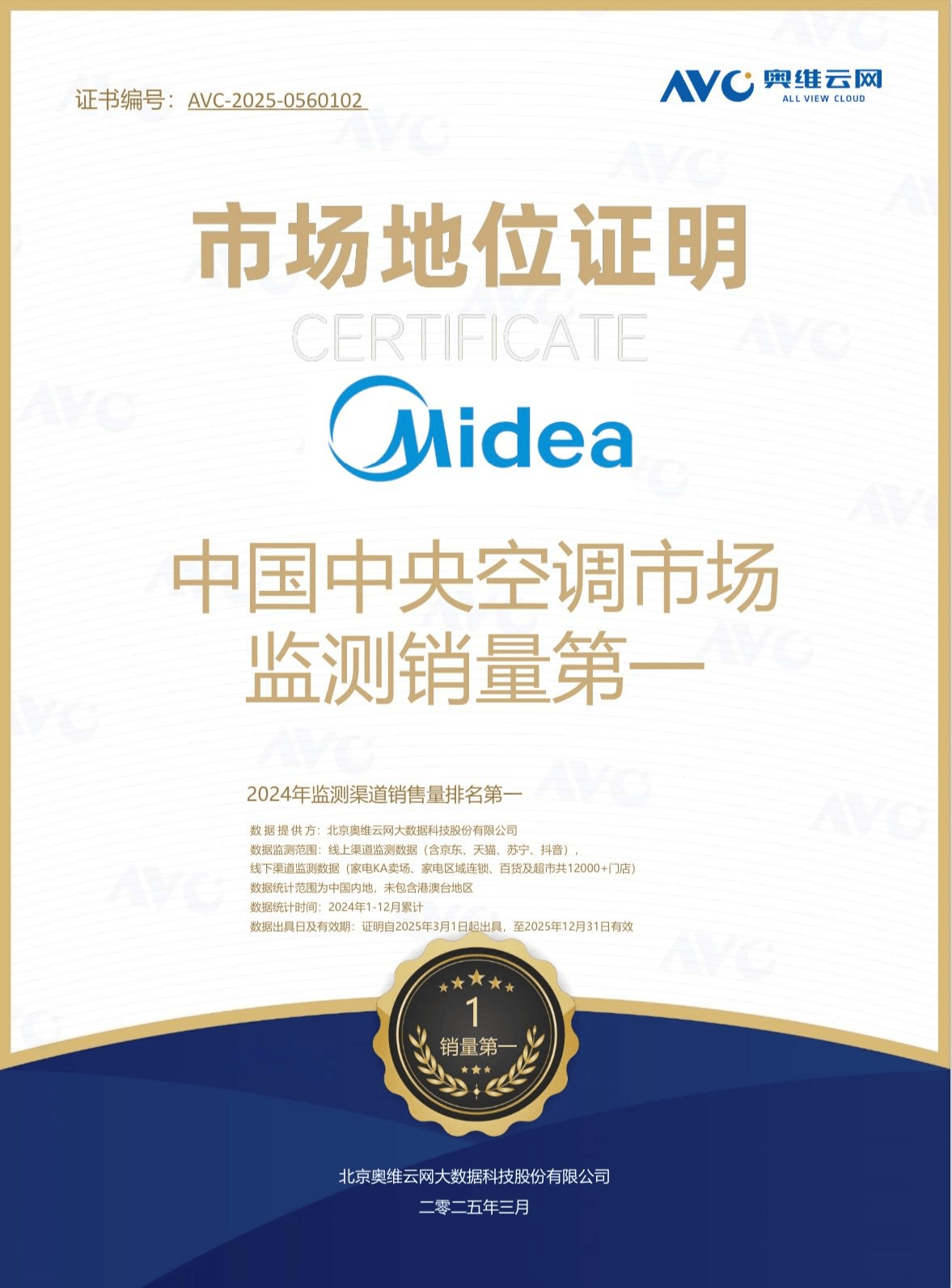
从攻克“心脏”到引领标准:美的中央空调以“舒适黄金三角”创新引领行业向上突破
Sou Hu Cai Jing· 2025-12-31 03:51
Core Insights - The Chinese home appliance industry has developed a large-scale and complete industrial system, yet it faces challenges in high-end core components, particularly in the air conditioning sector where reliance on imports remains significant [1][4] - Midea's central air conditioning division has adopted a unique path of "independent innovation + system leadership," providing a model for high-quality development in Chinese manufacturing [1][4] Group 1: Industry Challenges - Despite being the largest market globally, China's air conditioning industry struggles with a lack of self-sufficiency in high-end compressor technology, which affects profit margins and innovation [1] - In 2021, China exported 159 million compressors worth 26.93 billion yuan but imported 16.71 million units valued at 7-9 billion yuan, highlighting the gap in high-end production capabilities [1] Group 2: Midea's Innovation Strategy - Midea has shifted its strategic focus from optimizing external technologies to reconstructing core technologies internally, leading to a significant transformation in its research and development logic [4][5] - Over the past five years, Midea has invested over 18 billion yuan in R&D, concentrating on foundational areas like compressors and control systems, establishing a localized R&D framework [4][5] Group 3: Breakthroughs in Technology - Midea achieved a historic breakthrough in compressor technology, enabling self-research and production, which enhances supply chain security and performance [5] - By 2025, Midea's self-developed ultra-low frequency steady-state technology is expected to receive international recognition, significantly improving energy efficiency and comfort in central air conditioning systems [5][10] Group 4: New Standards in the Industry - The introduction of the "Comfort Golden Triangle" redefines the standards in the central air conditioning industry, shifting focus from technical parameters to user experience [6][12] - This new evaluation system emphasizes "temperature balance, noise balance, and comfort," marking a transition from performance metrics to comprehensive user experience [6][12] Group 5: Market Recognition and Impact - Midea's technological advancements have led to a significant market share in central air conditioning, with recognition from industry awards validating its innovative approaches [10][15] - The "Comfort Golden Triangle" is becoming a benchmark for the industry, indicating a shift where Chinese innovation is not just a participant but a trendsetter [12][15] Group 6: Broader Implications for Chinese Manufacturing - Midea's journey illustrates how Chinese manufacturing can overcome core technological bottlenecks and transition from being "large but weak" to "large and strong" [17] - The company's focus on independent innovation and understanding user needs positions it as a leader in defining future standards and experiences in the global market [17]


国补625亿狂撒!全民换手机家电白送钱?
Sou Hu Cai Jing· 2025-12-31 03:43
Group 1 - The government is providing substantial subsidies for the replacement of household appliances and digital devices, with up to 1,500 yuan for high-end air conditioners and 500 yuan for smartphones priced under 6,000 yuan [2][4] - A total of 625 billion yuan in special long-term bonds has been allocated to stimulate consumer spending during the New Year and Spring Festival, encouraging consumers to upgrade their appliances and devices [4] - The initiative aims to boost domestic demand, stabilize the economy, accelerate the elimination of outdated production capacity, and support the domestic smart terminal industry, benefiting companies like Huawei, Xiaomi, Gree, and Midea [4] Group 2 - The program is described as a "national asset renewal plan," indicating a strategic approach to enhance consumer spending while promoting green and low-carbon transitions [4] - Consumers are advised to be cautious about potential price increases by retailers and the availability of subsidy quotas, highlighting the need for vigilance in the market [4] - The government-led "consumption carnival" is set to begin in early 2026, suggesting a significant opportunity for consumers to take advantage of these subsidies [4]

中金公司港股晨報
CICC· 2025-12-31 03:21
Core Insights - The report indicates that the Hang Seng Index has recently rebounded to around 25,855 points, influenced by easing US-China trade relations and ongoing tariff news, with short-term market conditions expected to be affected by these factors [9][10]. - The People's Bank of China maintained the 5-year LPR at 3.50% and the 1-year LPR at 3.00%, while the US Federal Reserve lowered interest rates by 0.25% to a range of 3.50-3.75% [9]. - The report highlights the performance of major indices, with the Hang Seng Index up 28.9% year-to-date, and the H-share Index up 23.3% [3]. Market Overview - The Hang Seng Index closed at 25,855 points, up 219 points or 0.86%, with a total market turnover of HKD 1,998 million [10]. - The H-share Index rose to 8,991 points, gaining 99 points or 1.12%, while the Hang Seng Technology Index increased by 95 points or 1.74% [10]. - The report provides a summary of the best and worst performing stocks within the Hang Seng Index, with Baidu Group (9888) leading with an increase of 8.9% and a year-to-date gain of 56.8% [3]. Company Analysis: Midea Group (0300.HK) - Midea Group reported a revenue of RMB 111.9 billion for Q3 2025, reflecting a year-on-year increase of 10.06%, and a net profit attributable to shareholders of RMB 11.87 billion, up 8.95% year-on-year [24]. - For the first three quarters of 2025, the company achieved a revenue of RMB 363.1 billion, a year-on-year increase of 13.82%, with a net profit of RMB 37.88 billion, up 19.51% [24]. - The total assets of Midea Group were RMB 593.3 billion, down 1.8% year-on-year, while total liabilities decreased by 4.6% to RMB 359.2 billion [25]. New IPO Dynamics - The report outlines upcoming IPOs, including Zhiyu (2513) in the artificial intelligence sector, with a proposed price of HKD 116.20 and a maximum fundraising amount of approximately HKD 4.348 billion [30]. - Tian Shu Intelligent Chip (9903) is also set to launch with a proposed price of HKD 144.60, aiming to raise around HKD 3.677 billion [30]. - The report notes that these IPOs are expected to generate significant market interest due to their medium to large scale [30][31].
家电数码补贴15% 2026年国家补贴上线淘宝天猫
Huan Qiu Wang· 2025-12-31 03:07
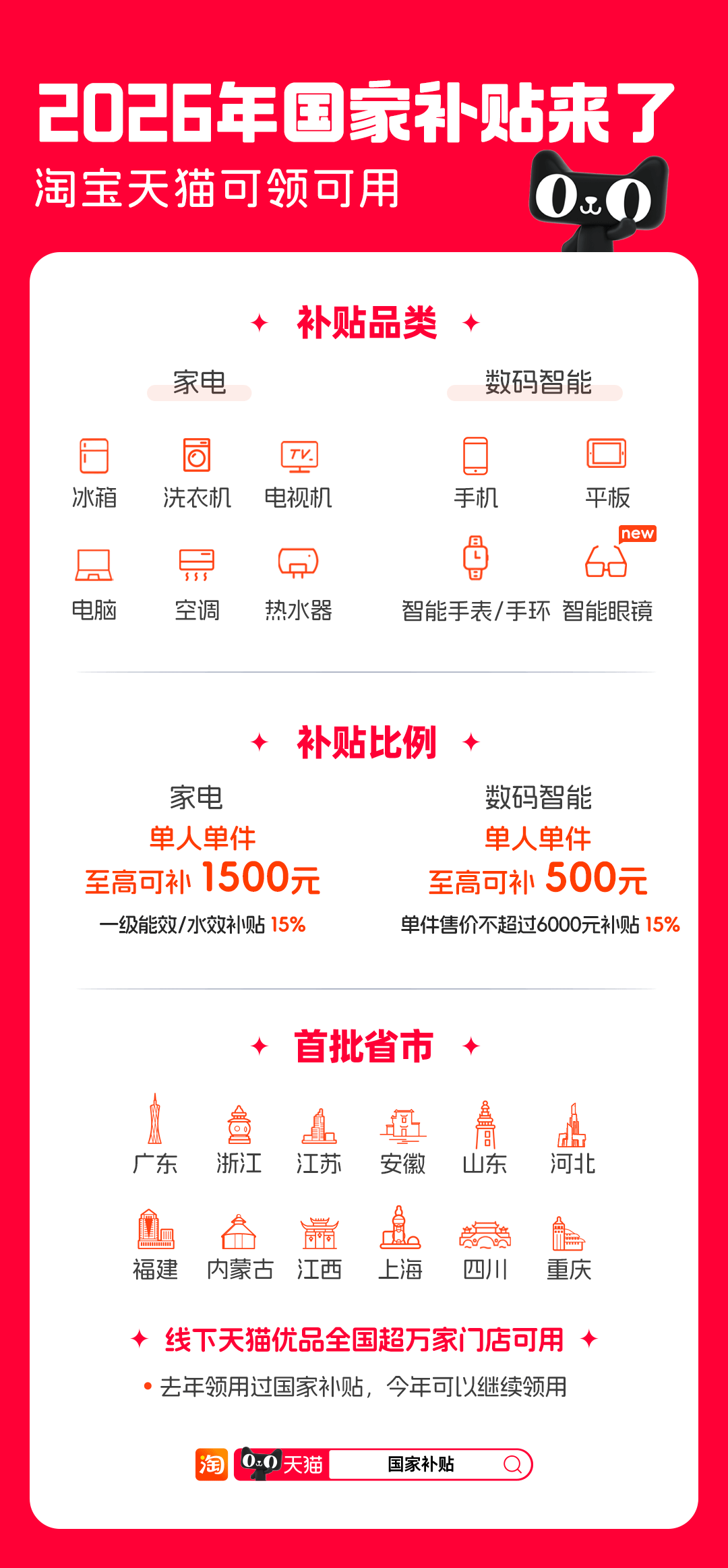
Core Viewpoint - A new round of national subsidies has been officially launched, effective from January 1, 2026, covering ten categories of products including refrigerators, washing machines, televisions, air conditioners, computers, water heaters, mobile phones, tablets, smartwatches, and smart glasses, with smart glasses being a newly added category [1][4]. Group 1: National Subsidy Details - The national subsidy rate is set at 15%, with a maximum subsidy of 1500 yuan for energy-efficient appliances and 500 yuan for digital and smart products priced under 6000 yuan [1]. - The subsidy program is available on platforms like Taobao and Tmall, with over 10,000 offline Tmall stores nationwide participating [4]. Group 2: Promotional Activities - From January 1 to 3, Tmall is collaborating with brands like Haier, Midea, Huawei, and Siemens to host a "National Subsidy Renewal Season" event, offering additional discounts of up to 90% and extra consumption vouchers worth 950 yuan [4]. - The promotion allows consumers to purchase home appliances at prices as low as 50% after applying the national subsidy and additional discounts [8]. Group 3: Product Pricing and Discounts - Specific products and their original and discounted prices include: - Gree air conditioner originally priced at 4799 yuan, discounted to 4.1 times lower after subsidies [8]. - Haier refrigerator originally priced at 11999 yuan, available at 50% off after discounts [8]. - Vivo X300 Pro originally priced at 5299 yuan, with a subsidy saving of 500 yuan [8]. - Thunderbird smart glasses Air 4 Pro originally priced at 1888 yuan, eligible for additional discounts [8]. Group 4: Market Reach and Consumer Engagement - By 2025, over 3000 product categories and more than 10,000 brands will be available under the national subsidy program on Taobao and Tmall, attracting an average of over 150 million daily visits to the subsidy section [8].




2026年国补来了 1月1日起上淘宝天猫领取,家电数码补贴15%
Jin Rong Jie Zi Xun· 2025-12-31 02:42
积极响应国补以旧换新增量政策,给消费者更大力度让利,1月1日至3日,天猫联合海尔、美的、华 为、西门子等上千个品牌,举办"国补焕新季"活动,超级立减9折起,在国家补贴基础上,消费者额外 可领950元国补焕新季消费券,多重优惠叠加,家电低至5折。 2026年第一个好消息来了,新一轮的国家补贴正式开启,1月1日起,上淘宝天猫领取马上可用。同时, 线下天猫优品全国超万家门店全面承接2026年国补。 最新政策显示,2026年国补覆盖品类为:冰箱、洗衣机、电视、空调、电脑、热水器、手机、平板、智 能手表手环、智能眼镜10大品类;其中,智能眼镜为2026年国补新增品类。国补力度上,统一调整为补 贴15%,一级能效/水效家电补贴上限1500元,数码和智能产品(单件销售价格不超过6000元)补贴上 限500元。 目前,广东、浙江、江苏、安徽、福建、内蒙古、江西、上海、四川、山东、河北、重庆等省市国补率 先上线淘宝天猫,消费者在淘宝首页「国补」频道或者搜索「国家补贴」即可领用。天猫线上线下全面 承接2026年国补,线下天猫优品全国超万家门店也支持领用国家补贴。 据悉,2025年超3000多个品类,1万多个品牌,50万款商品,在 ...
美的、海尔、海信、TCL,一场决定未来十年命运的战争
Xin Lang Cai Jing· 2025-12-31 02:07
Core Viewpoint - The Chinese home appliance industry is at a critical juncture, with the theme for 2026 being "going overseas" as domestic market saturation and overcapacity issues become more pronounced. This shift represents a "second entrepreneurship" for companies like Haier, Midea, Hisense, and TCL, marking a decisive battle for the next decade [2]. Group 1: Market Overview - The global home appliance market is nearly 4.5 trillion yuan, indicating significant overseas market potential [4]. - Midea and Haier are projected to generate around 270 billion yuan in revenue each in 2024, translating to a global market share of only about 6% [5]. - Domestic brands struggle to exceed 10% market share in most overseas regions, while leading competitors like Samsung and LG dominate [8]. Group 2: Historical Context and Challenges - Chinese home appliance companies have historically relied on capacity export and brand acquisitions for overseas expansion, but this growth model is becoming less effective [9]. - The gap between global manufacturing share (over 45%) and retail share (less than 20%) highlights a significant challenge in value creation and brand premium [9]. - Haier and Midea's overseas revenue share has stagnated around 50% and 42% respectively over the past five years, indicating a lack of growth [9]. Group 3: Brand and Channel Development - The need for a "second entrepreneurship" in brand and channel development is emphasized, as domestic brands face challenges in replicating their successful domestic strategies in international markets [15]. - Building brand recognition and effective distribution channels in overseas markets is crucial, as traditional strategies may not apply [16][20]. - The complexity of overseas channels, dominated by large retailers, poses significant barriers for Chinese companies [20]. Group 4: Opportunities and Strategies - Technological innovation is seen as a key to overcoming brand premium challenges, with Chinese companies making strides in areas like AI and smart home technology [22]. - Emerging markets such as Southeast Asia and Latin America present significant growth opportunities due to low penetration rates and less established competition [29]. - E-commerce is becoming a vital channel for market entry, allowing brands to reach consumers without heavy investment in physical stores [34]. Group 5: Future Outlook - The transition to a full value chain operation by 2026 signifies a shift from manufacturing management to comprehensive brand and channel strategies [36]. - Success in this transformation is critical for elevating Chinese manufacturing from a "global factory" to a "global brand," enhancing competitiveness in the global market [36].


2026年家电以旧换新政策出台,有望提振家电消费景气
Guotou Securities· 2025-12-31 02:04
Investment Rating - The report assigns an "A" rating for the investment in major appliance companies such as Midea Group, Haier Smart Home, and Gree Electric Appliances, indicating a "Buy" recommendation with target prices of 94.68, 31.81, and 50.60 CNY respectively [4]. Core Insights - The 2026 appliance replacement policy is expected to boost consumer demand for home appliances, focusing on energy-efficient products and providing subsidies of 15% of the product price, capped at 1500 CNY per item [1][2]. - The 2026 policy has optimized the subsidy scope, reducing the number of supported appliance categories from eight to six, and lowering the subsidy rate from 20% to 15% for high-efficiency products [2][11]. - The first batch of funding for the 2026 policy amounts to 625 billion CNY, a 23% decrease from the previous year's 810 billion CNY, indicating a potential decline in total subsidy funds for the year [2][12]. Summary by Sections Policy Changes - The 2026 policy focuses on six categories: refrigerators, washing machines, televisions, air conditioners, computers, and water heaters, excluding other appliances like stoves and microwaves [2][11]. - The subsidy for high-efficiency products is now set at 15% of the sales price, with a cap of 1500 CNY per item, and consumers can only receive one subsidy per product category [2][11]. Market Impact - The 2025 replacement policy effectively stimulated appliance consumption, with retail sales of home appliances increasing by 14.8% year-on-year from January to November 2025, and over 12.84 million units replaced [3]. - The introduction of the 2026 policy is expected to improve domestic appliance sales, despite some pressure on consumption due to earlier demand release and high base effects [3][9]. Investment Recommendations - The report suggests focusing on three investment themes: 1. High-quality white goods companies with strong cash flow and high dividend yields, such as Midea Group and Haier Smart Home [9]. 2. Companies with strong global capabilities, particularly in emerging markets where appliance penetration is low [9]. 3. Technology-driven appliance companies that are expanding into new business areas, leveraging AI and robotics to enhance product offerings [9].
美的集团股价涨1.01%,中银证券旗下1只基金重仓,持有7500股浮盈赚取6000元
Xin Lang Cai Jing· 2025-12-31 01:57
Group 1 - Midea Group's stock price increased by 1.01% to 79.65 CNY per share, with a trading volume of 338 million CNY and a turnover rate of 0.06%, resulting in a total market capitalization of 605.173 billion CNY [1] - Midea Group, established on April 7, 2000, and listed on September 18, 2013, is primarily engaged in the manufacturing and sales of home appliances, with major products including HVAC systems, kitchen appliances, refrigerators, washing machines, and various small appliances [1] - The company's revenue composition includes 66.58% from smart home business, 25.70% from commercial and industrial solutions, and 8.74% from new energy and industrial technology, with additional contributions from smart building technology and robotics and automation [1] Group 2 - A fund under Bank of China Securities holds Midea Group as its eighth largest position, having reduced its holdings by 10,900 shares to 7,500 shares, representing 1.18% of the fund's net value, with an estimated floating profit of approximately 6,000 CNY [2] - The Bank of China Securities CSI A500 Index A fund, established on March 19, 2025, has a current scale of 42.4495 million CNY and has achieved a return of 25.06% since inception [2] Group 3 - The fund managers of the Bank of China Securities CSI A500 Index A are Liu Xianzheng and Zhang Yimin, with Liu having a tenure of 7 years and 338 days and Zhang having a tenure of 5 years and 109 days, both managing a total fund size of 794 million CNY [3] - Liu's best fund return during his tenure is 118.04%, while the worst return is -34.66%, and Zhang's best return is 24.68% with a worst return of -40.75% [3]

美的集团股价涨1.01%,东方阿尔法基金旗下1只基金重仓,持有6.7万股浮盈赚取5.36万元
Xin Lang Cai Jing· 2025-12-31 01:49
Group 1 - Midea Group's stock rose by 1.01% to 79.65 CNY per share, with a trading volume of 327 million CNY and a turnover rate of 0.06%, resulting in a total market capitalization of 605.173 billion CNY [1] - Midea Group, established on April 7, 2000, and listed on September 18, 2013, is primarily engaged in the manufacturing and sales of home appliances, with major products including HVAC systems, kitchen appliances, refrigerators, washing machines, and various small appliances [1] - The company's revenue composition includes 66.58% from smart home business, 25.70% from commercial and industrial solutions, and 8.74% from new energy and industrial technology, with additional contributions from smart building technology and robotics and automation [1] Group 2 - The Oriental Alpha Fund holds a significant position in Midea Group, with the Oriental Alpha Xingke One-Year Holding Mixed A Fund owning 67,000 shares, representing 6.96% of the fund's net value, ranking it as the tenth largest holding [2] - The Oriental Alpha Xingke One-Year Holding Mixed A Fund, established on September 28, 2022, has a current scale of 57.0589 million CNY, with a year-to-date return of 14.96% and a one-year return of 13.88% [2]
制冷设备行业2026年度投资策略:产业并购活跃,布局全球化与前沿冷却技术
Donghai Securities· 2025-12-31 01:46
1. Report Industry Investment Rating The provided content does not include the report industry investment rating. 2. Core Views - The Chinese refrigeration and air - conditioning equipment industry is at a critical turning point. The domestic household market is in a stable development stage dominated by stock replacement demand, and growth is driven by the improvement of energy - efficiency standards. The report analyzes structural growth opportunities and long - term evolution trends by benchmarking overseas leading companies [2]. - Overseas expansion should focus on local in - depth development and value extension of the industrial chain. It is a systematic project, and mergers and acquisitions are strategic choices. Chinese enterprises are moving from the initial stage of "Made in China, Sold Globally" to the new stage of globalization of "brand, technology, and management" [2]. - The commercial refrigeration field, especially the data center refrigeration track, is a short - term growth highlight. The capital expenditure of overseas HVAC giants is directed towards data center infrastructure, and there is a market for high - end refrigeration solutions due to the need to improve energy efficiency and reduce PUE [2]. - Investment suggestions: In the household refrigeration equipment field, pay attention to industry leaders such as Midea Group; in the special - purpose refrigeration equipment field, focus on companies like Invic and Shenling Environment; for upstream components, pay attention to Hanzhong Precision Machinery, Binglun Environment, and Sanhua Intelligent Control [2]. 3. Summary by Relevant Catalog 3.1 Traditional Refrigeration Equipment Overview - **Global Refrigeration and Air - Conditioning Market**: The global refrigeration and air - conditioning market has shown steady growth. From 2018 to 2024, the global air - conditioner sales increased from 232.5 million units to 261.2 million units, with a compound annual growth rate of 2.0%. The proportion of household air - conditioners in 2024 was 73.7%, and the central air - conditioning market grew faster, with a compound annual growth rate of 4.0% from 2018 to 2024. It is predicted that by 2028, the global air - conditioner sales will reach 293.3 million units, with a compound annual growth rate of 2.9% from 2024 to 2028. Asia, North America, and Europe are important regional markets, and China is the largest single air - conditioning market [22]. - **Household Air - Conditioning**: In the 2024 cold year, China's household air - conditioner production accounted for 80.8% of the global total. Many domestic enterprises are increasing overseas layout. In the 2024 cold year, overseas production capacity increased by nearly 7 million units. In the 2025 cold year, domestic household air - conditioner exports were about 99.29 million units, a year - on - year increase of 16.7%, with the highest export proportion to Asia [28]. - **Central Air - Conditioning and Chiller Units**: There are various types of central air - conditioning and chiller units. The export of screw and centrifugal chiller units for data centers is strong. The Asian market has a large - scale demand and is gradually recovering, while the North American market has a prominent growth rate due to its small base. The domestic market is waiting to stabilize, and leading enterprises are strengthening their competitive advantages [33]. 3.2 Household Market: Domestic Sales Review and Challenges for Leading Companies - **Price Wars and Market Competition**: After several price wars, the concentration of the domestic household refrigeration and air - conditioning market has increased. The competition has evolved from scale and price to technology, product, channel, service, and ecosystem. In 2025, the domestic sales volume of household air - conditioners increased by 8.7% year - on - year, but the growth driven by policies and climate is difficult to sustain. The long - term driving force is stock replacement and structural upgrading [35][36]. - **Energy - Efficiency Upgrade**: China has introduced multiple air - conditioner energy - efficiency standards, which have promoted the transformation from fixed - frequency to variable - frequency air - conditioners. Leading enterprises have advantages in technology and industrial layout for energy - efficiency improvement [39]. - **Challenges for Leading Companies**: In 2024 - 2025, a new round of price wars occurred. Xiaomi's entry has challenged the traditional hardware - profit model. Leading companies are facing challenges in terms of efficiency and sustainable profit growth. They are promoting digital reform, channel and logistics innovation to enhance competitiveness [40][43][44]. 3.3 Overseas Expansion of Domestic Enterprises - **Difficulties and Solutions**: There are differences in regional usage habits overseas. The US market has high access barriers, and the European market has low air - conditioner penetration and high energy - efficiency requirements. Overseas acquisitions are an important way to enter the market. Chinese enterprises are accelerating overseas production capacity construction in Southeast Asia and other regions [52][54]. - **Southeast Asian Market**: Exports to ASEAN are on an upward trend. In 2024, China's cumulative exports of white goods to ASEAN reached $14.87 billion, a year - on - year increase of 19.8%. The demand in the ASEAN market is driven by urbanization and industrialization [63]. 3.4 Overview of Overseas Representative Enterprises' Operations - **Business Models and Strategies**: Overseas HVAC representative enterprises have different business models and strategies. Johnson Controls has transformed from an equipment manufacturer to a builder of smart building ecosystems; Trane Technologies has upgraded its services and transformed its strategy; Daikin has acquired relevant enterprises to supplement its data center refrigeration business [73][82]. - **Performance of Leading Enterprises**: Leading international enterprises such as Trane Technologies, Johnson Controls, Carrier Global, and Vertiv have shown different performance. They are all focusing on high - growth areas such as data center refrigeration [83][86][87][88]. 3.5 Commercial Market: Pay Attention to Refrigeration Demand in Data Centers - **Demand for Data Center Refrigeration**: The development of AI and other industries is expected to drive the construction of data centers. The demand for data center capacity is expected to increase at a compound average growth rate of 19% from 2023 to 2030. Reducing the energy consumption of refrigeration equipment is crucial for the green and low - carbon development of data centers [94]. - **Refrigeration Technologies**: There are various data center refrigeration technologies, including water - cooled, air - cooled, indirect evaporation cooling, "glacier" phase - change cooling, and liquid cooling. Liquid cooling has advantages in energy consumption, and the development of liquid - cooling technology is a trend [96][104]. - **Investment Suggestions**: Enterprises in different segments are recommended, including traditional HVAC enterprises such as Midea Group, precision temperature - control equipment enterprises such as Invic, special - purpose air - conditioner manufacturers such as Shenling Environment, and upstream component enterprises such as Hanzhong Precision Machinery, Binglun Environment, and Sanhua Intelligent Control [112][113].