高盛

Search documents
美国抢黄金,抢出了“经济恐慌”?
华尔街见闻· 2025-03-03 11:37
Core Viewpoint - Recent economic activity data in the US has shown signs of weakness, leading to pessimistic expectations for Q1 GDP growth, with the Atlanta Fed's GDPNow model predicting a decline to -1.5% annualized growth [1][2] Group 1: Trade Deficit and Gold Imports - The significant increase in gold imports has been identified as a major factor contributing to the widening trade deficit, with January's goods trade deficit exceeding 6% of GDP [2] - Goldman Sachs estimates that gold imports in January amounted to approximately $25 billion, accounting for nearly the entire $31 billion increase in the trade deficit [2] - The surge in gold imports is primarily driven by market participants in Europe seeking to mitigate potential tariff risks, rather than reflecting immediate consumption needs [2][3] Group 2: GDP Growth Predictions - Goldman Sachs forecasts a Q1 2025 GDP growth rate of 1.6%, which, while lower than previous expectations, remains above the Atlanta Fed's prediction [3] - The firm maintains its Q4 2025 GDP growth forecast at 2.2%, slightly down from an initial expectation of 2.4% [3] Group 3: Consumer Spending and Unemployment Claims - Weak consumer spending in January is attributed to multiple factors, including cold weather, seasonal influences, and a normal correction following rapid consumption growth in the latter half of 2024 [6] - The rise in unemployment claims may be overstated due to seasonal volatility and difficulties in seasonal adjustment, with past spikes in claims often reverting quickly [6]


高盛:周一将是美股空头痛苦的一天,数字币暴涨只是开始
华尔街见闻· 2025-03-03 11:37
Core Viewpoint - The global asset market has experienced significant volatility since the beginning of the year, with a strong start in February followed by a sharp decline in various assets by the end of the month [1] Group 1: Market Dynamics - Goldman Sachs traders anticipate a potential short squeeze in the U.S. stock market, suggesting that risk assets may see a substantial rise due to recent developments in the cryptocurrency space [2] - The S&P 500 and Nasdaq 100 indices fell by 0.98% and 3.38% respectively last week, with meme stocks and long-term momentum stocks also experiencing significant declines [2][4] - As of February 28, the market showed positive signals with pension funds needing to purchase approximately $13 billion in stocks, which helped absorb about $20 billion in S&P 500 sell-offs [3] Group 2: Hedge Fund Activity - Hedge funds have recorded a significant increase in short positions, with total leverage dropping to 206.5% and net leverage decreasing to 53.5%, marking the largest weekly decline since September 2023 [4][6] - The market's momentum indicators have reached a ten-year low, often signaling a potential reversal, while several positive factors are accumulating that could catalyze a sudden market rise [5] Group 3: Economic and Geopolitical Factors - Recent geopolitical developments, such as the potential restart of the Nord Stream 2 pipeline, could lead to lower natural gas prices in Europe, benefiting risk assets [10] - Trade tensions appear to be easing, with the U.S. indicating that tariffs on Mexico and Canada may be lower than 25%, which could trigger a rebound in emerging market risk assets [10] - Germany's new government has established two special funds of €400 billion each for defense and infrastructure, which may stimulate economic activity [10] Group 4: Market Sentiment and Strategy - The market is at a delicate balance, with high short positions and momentum indicators suggesting a potential squeeze, while macroeconomic data remains mixed with uncertainties in inflation and employment [9] - Investors are advised to closely monitor market sentiment and position changes, as the potential for a short squeeze could create significant market movements [11]


高盛交易员:当下市场,我最关注这张图
华尔街见闻· 2025-03-02 12:40
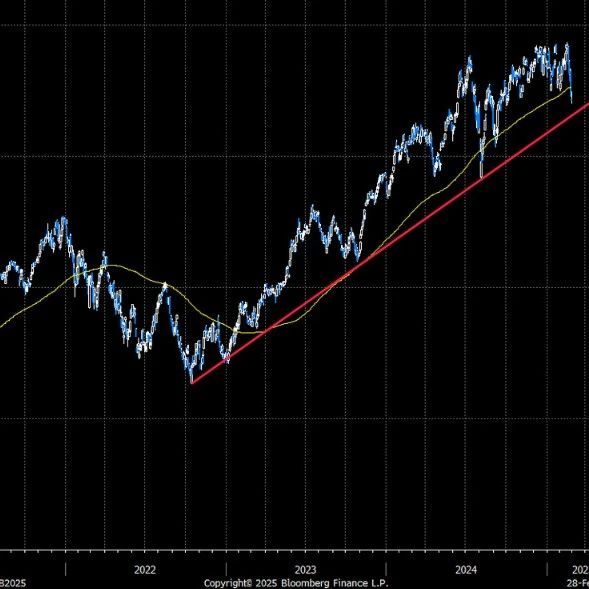
Core Viewpoint - The global market has become increasingly complex, with significant challenges arising from weak tech stocks, fluctuating consumer sentiment, and policy uncertainties impacting investor decisions [1][4]. Group 1: Market Dynamics - The "Magnificent 7" tech giants have seen an 8% decline this year, contrasting with a 4% increase in the remaining 493 companies in the S&P 500, highlighting a shift in market dynamics [5]. - Recent weeks have shown a significant rise in market difficulty, with hedge funds experiencing their second-worst five-day performance in nearly two years [6]. - The "momentum" factor has recently contributed significantly to hedge fund returns, but has shown volatility since the U.S. elections, indicating a shift towards new sectors and industries [7]. Group 2: Economic Indicators - U.S. GDP growth rate estimates have dropped from slightly above 3% to below 2% in the past month, reflecting economic uncertainty [9]. - Investor sentiment data from the American Association of Individual Investors (AAII) is nearing historical highs, indicating a rapid shift in investor mood [10]. Group 3: Sector Analysis - The technology sector ETF (XLK) has recently fallen below its 200-day moving average but remains above the upward trend line established since Q4 2022, indicating potential for further movement [14]. - Xiaomi's recent launch of an electric vehicle, with the first batch of 10,000 units selling out in 10 minutes, demonstrates the resurgence of innovation among Chinese private enterprises [16].

如何看AH和美股科技回调——美股七巨头牛市调整复盘【广发策略刘晨明&李如娟】
晨明的策略深度思考· 2025-03-02 05:51
Group 1 - The recent decline in the MAG7 index, which has dropped 13.6% since its peak at the end of 2024, is attributed to factors such as lowered growth expectations, increased inflation forecasts, and reduced spending by major companies like Microsoft [1][12][15] - The MAG7 index has experienced five adjustments since early 2023, with the current adjustment being the fifth, lasting 47 trading days [3][5][16] - The first four adjustments were primarily driven by liquidity shocks, while the fourth and fifth adjustments have been influenced by fundamental issues, indicating a shift in market dynamics [6][19][20] Group 2 - During the fourth and fifth adjustments, there was a noticeable style shift in the market, with technology stocks declining while sectors like utilities and healthcare showed gains [8][30][31] - In response to the adjustments, it is suggested that investors should consider traditional low-beta sectors such as utilities and consumer staples for risk mitigation [8][31] Group 3 - The MAG7 index's performance is closely linked to economic conditions, with high economic growth correlating with higher relative returns [32] - The current economic outlook indicates a potential decline in growth rates, with expectations for 2025 and 2026 showing a decrease from 55.8% to 31.7% and further to 15.6%, respectively [36][37] - The individual stocks within the MAG7 index exhibit varying trends, with companies like Apple and Microsoft expected to maintain stable performance, while others like Nvidia and Amazon may face greater adjustment pressures [38]

逼近3000美元,黄金突然高位跳水!什么情况?高盛继续看涨,抄底良机还是破灭前兆...
雪球· 2025-03-02 04:08
到底什么情况? 01 金价高位跳水 2月25日,现货黄金价格冲高至每盎司2956美元后,没能延续涨势,而是开始掉头向下; 2月27日,国际金价跳水冲上热搜,现货黄金跌1.33%,跌破每盎司2900美元关口; 长按即可免费加入 距3000美元一步之遥,金价掉头跳水! 2月最后一天,金价以跌幅0.68%、每盎司2858.58美元收官。 消息面上,美联储官员放鹰,美联储官员哈玛克明确表示,支持维持当前的政策利率不变,在当 前展望中不考虑加息。 他指出通胀预期仍保持稳定,且未来将继续缩减资产负债表以应对政府财务障碍。他强调资产负 债表操作将作为管理流动性需求的主要工具。 回顾近十年(2015年至今)黄金价格走势,主要是经历了五个阶段。2015年1月至12月的震荡下跌 期,COMEX黄金价格最低跌至1045.4美元/盎司;2016年1月至2018年10月震荡筑底,价格运行区 间为1050美元/盎司至1368美元/盎司; 2018年11月至2020年8月大幅上涨,COMEX黄金价格最大涨幅达到73.6%,创下2089美元/盎司的 高点;此后在2020年9月至2022年10月间金价持续高位震荡调整;2022年11月至今黄金 ...

睿远基金,举牌这只港股!
券商中国· 2025-03-01 12:27
Core Viewpoint - Public funds are increasingly interested in AI healthcare, with a notable investment in the Hong Kong-listed Chinese medicine chain, Guoshengtang, by prominent public fund institutions like Ruiyuan Fund [1][2][4]. Group 1: Investment Activities - Ruiyuan Fund has significantly increased its stake in Guoshengtang, acquiring 410,000 shares at a price of HKD 38.6889 per share, totaling approximately HKD 15.86 million, raising its holding to 6.04% [3]. - On February 21, Ruiyuan Fund also purchased 753,400 shares at an average price of HKD 33.6615, valued at about HKD 25.36 million, increasing its holding from 4.7% to 5.01% [3]. - Other major funds holding Guoshengtang include Southern Fund, E Fund, and Huashan Fund, with some funds exceeding a 10% holding [3]. Group 2: AI Healthcare Trends - The surge in Ruiyuan Fund's investment is speculated to be linked to the growing trend of AI in healthcare, particularly with Guoshengtang's inclusion in the newly launched China AI Healthcare Index [4][6]. - Guoshengtang has been proactive in integrating AI technologies into its operations, focusing on smart diagnostics, remote healthcare, and electronic medical record management [4][7]. Group 3: Business Model and Market Position - Guoshengtang is recognized as the largest Chinese medicine service chain, serving millions annually, and has been acknowledged for its innovative practices in AI healthcare [6]. - The company has adopted a new OMO (Online-Merge-Offline) business model, expanding its physical presence to 74 clinics across 20 cities, with a focus on digital healthcare solutions [12]. - In the first half of 2024, Guoshengtang reported a revenue of CNY 1.365 billion, a year-on-year increase of 38.4%, driven by its healthcare solutions [12].

美股全线反弹
Wind万得· 2025-02-28 22:32
Market Overview - The US stock market experienced a rebound on Friday after a turbulent week and a declining month, with major indices closing higher despite rising geopolitical risks [1][3] - The S&P 500 index rose by 1.59% to close at 5954.50 points, the Dow Jones Industrial Average increased by 1.39% to 43840.91 points, and the Nasdaq Composite gained 1.63% to 18847.28 points [1][2] February Performance - Despite the rebound on Friday, the overall performance in February was disappointing, with the Nasdaq index down nearly 4%, including a 3.5% drop this week, marking its worst month since April 2024 [3] - The S&P 500 index fell by 1.4% in February, while the Dow Jones index showed a monthly decline of 1.6% [3] Market Volatility and Investor Sentiment - The market remains highly volatile, influenced by geopolitical and economic factors, with any news regarding the Russia-Ukraine situation potentially exacerbating uncertainty [4] - Investor sentiment is heavily news-driven, and recent comments from Trump regarding tariffs and economic warning signals have unsettled investors [3][5] Fund Flows and Institutional Behavior - In January, US stock mutual funds and ETFs saw an outflow of nearly $11 billion, indicating a shift in investor sentiment as more funds were withdrawn than invested [5] - Institutional investors are reassessing market risks, with a notable decline in risk appetite reflected in the S&P Global Investment Manager Index [5] Foreign Investment in China - As capital market reforms progress, the attractiveness of Chinese assets to global investors is expected to increase, with foreign institutions intensifying their research on Chinese listed companies [7] - Major foreign firms like Goldman Sachs and Schroders have been actively involved in researching sectors such as AI, healthcare, and consumer goods in the A-share market [7]
公安部回应美方威胁再加征
券商中国· 2025-02-28 15:39
Core Viewpoint - The Chinese government expresses strong dissatisfaction and firm opposition to the U.S. threat of imposing an additional 10% tariff on Chinese products, citing the fentanyl issue as the reason [1]. Group 1 - The U.S. plans to impose tariffs starting March 4, using the fentanyl crisis as a pretext, which China views as an unjustified action [1]. - China emphasizes its strict drug control policies and international cooperation efforts in combating drug issues, asserting that it has made significant contributions to addressing the fentanyl problem [1]. - The root cause of the fentanyl crisis is identified as domestic issues within the U.S., and China urges the U.S. to focus on reducing domestic drug demand and enhancing law enforcement cooperation [1]. Group 2 - The Chinese government warns that the U.S. approach of shifting blame to other countries will not resolve the underlying issues and could severely impact Sino-U.S. cooperation in drug control [1]. - China calls for the U.S. to correct its erroneous actions and to maintain the positive momentum of bilateral drug control cooperation, which has been hard-won [1].

美股暴跌,恐慌抛售将触发首批400亿美元CTA清盘
美股研究社· 2025-02-28 10:47
Core Viewpoint - The article discusses the impact of Trump's policies on market dynamics, highlighting concerns over growth stagnation and increased trade uncertainty, which have led to a decline in momentum trading and a shift in investor sentiment towards defensive sectors [2][3]. Group 1: Market Performance - The S&P 500 index has seen a cumulative decline of 0.3% in 2025, underperforming European and Canadian benchmarks, with a weekly drop of 2.5% and a monthly drop of 3% [3]. - The S&P 500 index fell by 1.59% on a recent Thursday, with the Nasdaq Composite down 2.78% and the Dow Jones Industrial Average down 0.45%, resulting in a collective market cap loss of nearly $550 billion for major tech stocks [2]. Group 2: Sector Analysis - Technology, communication, and discretionary consumer sectors are expected to lead the S&P 500 in 2023 and 2024, but are projected to be at the bottom in 2025 due to stock sell-offs [2]. - Defensive sectors such as healthcare and consumer staples are anticipated to outperform in 2025 as investors shift towards safer investments [2]. Group 3: Investor Sentiment - Investor sentiment has turned extremely bearish, with expectations of stock price declines rising over 20 percentage points to nearly 61% in a recent week [5]. - Retail investors have begun to exit momentum-driven speculative trading, with a significant sell-off of $1.1 billion in stocks occurring in just the first two hours of trading on a recent Monday, marking the largest outflow since March 2020 [5]. Group 4: Technical Indicators - The S&P 500 index has breached critical mid-term CTA liquidation trigger levels, potentially leading to sell-offs of at least $12.6 billion and $58 billion in the coming weeks [6]. - Major stock indices have also broken through key technical support levels, indicating increased market volatility and potential further declines [6].
突然大跌,发生了什么?下周,这一重磅会议要来!
天天基金网· 2025-02-28 10:14
Core Viewpoint - The A-share market has experienced a significant pullback, particularly in the ChiNext index, which fell over 3% amid a broader global market decline, raising questions about future market direction and investment opportunities [2][4]. Group 1: Market Performance - The A-share market adjusted in response to a collective downturn in global markets, with over 4,700 stocks declining [2]. - The trading volume in the two markets decreased to 1.8 trillion, with technology and brokerage sectors leading the declines, while automotive, consumer, and healthcare sectors also weakened [3][4]. Group 2: Reasons for Decline - The primary reasons for the A-share decline include a pullback in the global technology sector and unexpected negative news [5]. - The overnight drop in U.S. markets, particularly with Nvidia's revenue growth slowing down, contributed to negative sentiment across Asia-Pacific markets, including Japan, Hong Kong, and A-shares [5][6]. - The U.S. threat to impose additional tariffs on Chinese imports has also heightened market concerns, with China's Ministry of Commerce expressing strong opposition [7]. Group 3: Investment Strategy - Despite short-term market volatility, structural opportunities remain, and investors are advised to adjust strategies based on risk tolerance while seeking quality assets at lower prices [8]. - The upcoming National People's Congress (NPC) is expected to influence market trends, with historical data suggesting positive performance before the meetings and potential adjustments during the sessions [12][14]. Group 4: Sector Opportunities - Three main sectors are anticipated to benefit from potential policy support during the NPC: technology growth (focusing on AI and robotics), cyclical sectors (including infrastructure and real estate), and state-owned enterprise reforms [14][15][16]. - Historical analysis indicates that the market often experiences a rally leading up to the NPC, with a focus on small-cap stocks outperforming large-cap stocks [13].