零跑汽车

Search documents
铁流股份:近年来公司在新能源车辆高精密零部件领域取得了突破
Zheng Quan Ri Bao Wang· 2025-12-17 13:41
证券日报网12月17日讯铁流股份(603926)在12月16日回答调研者提问时表示,公司深耕车辆传动系统 制造以及高精密加工领域,凭借技术创新能力、高适配度特点,与国内主流整车企业均有合作;同时, 近年来公司在新能源车辆高精密零部件领域也取得了突破,与理想汽车、零跑汽车、大众汽车等新能源 车企建立了合作。公司将利用自身在汽车市场积累的客户资源和品牌影响力,积极开拓机器人零部件市 场业务。通过与整车企业的紧密沟通,了解他们在机器人应用方面的潜在需求,为其提供定制化的解决 方案。同时,积极拥抱新业态,与具身机器人本体企业进行技术对接,配套开发关键零部件。 ...

2026年各大车企新车规划揭秘
Xin Lang Cai Jing· 2025-12-17 12:59
Core Insights - The Chinese automotive market is expected to face intense competition in 2026, particularly in the new energy vehicle (NEV) sector, following significant developments in 2025 [1][34] - Major automakers are planning to launch new models in response to the anticipated challenges of 2026, with a focus on advanced driving technologies and competitive pricing [1][34] Company Plans Huawei's Hongmeng Zhixing - Hongmeng Zhixing will launch multiple new models in 2026, including the Wanjie M6, a mid-large SUV priced between 250,000 to 300,000 yuan, and the Zhijie V9, Huawei's first MPV [4][37] - The Wanjie M6 is expected to fill the market gap between the Wanjie M5 and M7, with a length of around 5 meters and a wheelbase of approximately 3 meters [4][37] - The company will also introduce a revamped Wanjie M5 and potentially a new Wanjie M9 L model [4][37] Xiaomi - Xiaomi's YU9, its first range-extended model, is anticipated to be a three-row, six-seat SUV over 5.2 meters long, with an expected price around 300,000 yuan [6][40] - The YU9 is likely to feature an 80 kWh battery pack with a pure electric range exceeding 400 km, aiming to compete directly with models like the Wanjie M8 and Li Auto L9 [6][40] Li Auto - Li Auto's L9 will undergo significant upgrades in 2026, focusing on smart driving, smart cockpit, powertrain, and chassis systems [10][42] - The new model is expected to reach a length of 5.3 meters and will include a new self-developed chip and advanced battery systems [10][42] Leap Motor - Leap Motor plans to introduce five new models in 2026, including the D19, a large SUV over 5.2 meters long, and the A10, a small pure electric SUV [14][45] - The D19 will offer both pure electric and range-extended versions, with the latter featuring an 80.3 kWh battery and a pure electric range of 720 km [14][45] XPeng Motors - XPeng will launch over ten models in 2026, including three super range-extended models in the first quarter [16][47] - The highlight will be a new large SUV, G01, featuring a range-extended powertrain and a battery capacity of 63.3 kWh, with a pure electric range exceeding 400 km [16][47] NIO - NIO plans to release two SUVs, the ES9 and ES7, in 2026, with the ES9 being a flagship model larger than the ES8 [19][49] - The ES7 will be a five-seat pure electric mid-large SUV, expected to be priced around 250,000 yuan [19][49] Volkswagen - Volkswagen's ID.ERA series will debut in 2026, featuring multiple pure electric and hybrid models, including a large SUV with a range exceeding 1000 km [21][50] - The Passat ePro will also be launched, utilizing a new PHEV platform with a 30 kWh battery [21][50] Toyota - GAC Toyota's flagship model for 2026 will be the BZ7, a mid-large pure electric sedan equipped with advanced driving systems and priced around 200,000 yuan [25][52] - The BZ7 will feature a battery capacity of 88.13 kWh, offering a range of up to 710 km [26][52] Nissan - Nissan's NX8 will be a significant model in 2026, featuring an 800V high-voltage platform and a range-extended version with a 1.5T engine [28][53] - The NX8 will have dimensions of 4870 mm in length and will include advanced driving systems [28][53] Audi - Audi's E7X, a mid-large pure electric SUV, will be launched in 2026, featuring a 300 kW motor and a range exceeding 700 km [30][55] - The E7X will also include advanced driving technologies and a high-voltage battery system [30][55] Zeekr - Zeekr's 8X is set to launch in early 2026, focusing on performance with a starting price of around 350,000 yuan [32][57] - The model will feature advanced battery technology and a sophisticated suspension system [32][57] Market Outlook - The 2026 automotive market is expected to be challenging, with potential impacts on consumer purchasing behavior due to increased costs associated with new energy vehicle taxes [58] - The market is poised for significant changes as automakers adapt to evolving consumer demands and competitive pressures [58]


最后15天,明年起购置税退坡,20万元档车辆或多付1万元
3 6 Ke· 2025-12-17 11:38
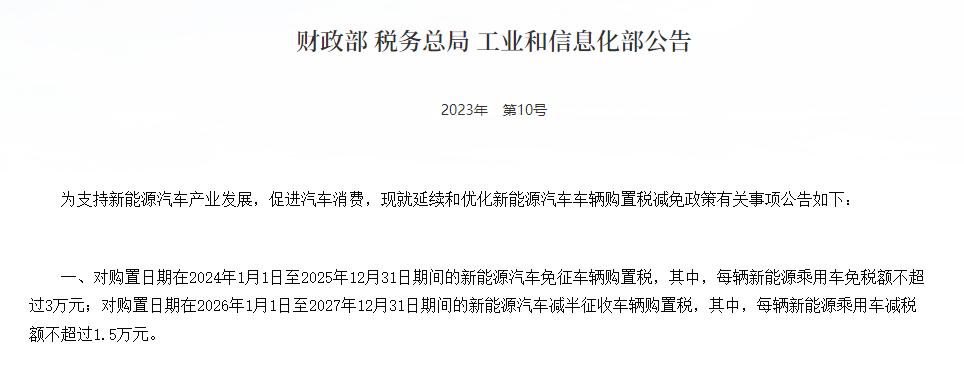
Group 1 - The core issue in the automotive market is the impending reduction of the new energy vehicle purchase tax from full exemption to a 50% reduction starting January 1, 2026, which could increase costs for vehicles priced around 200,000 yuan by nearly 10,000 yuan [1][3][4] - The "trade-in" policy is extended but lacks clarity in implementation, with low lottery rates for subsidies in cities like Shanghai, diminishing the benefits for consumers [1][2] - Over 20 brands, including Li Auto, NIO, and Zeekr, have introduced purchase tax subsidy policies, with some offering up to 15,000 yuan, but these often come with conditions such as loan completion by a specific date [1][4][8] Group 2 - Data indicates a decline in new energy vehicle retail sales, with a 17% year-on-year drop in the first seven days of December, highlighting the tension among automakers, consumers, and policies [2][11] - The current purchase tax policy is the last year of full exemption, with a maximum tax reduction of 15,000 yuan per vehicle under the new 5% tax rate [3][4] - The financial performance of automakers varies significantly, with companies like Xiaomi and Leap Motor showing strong growth and profitability, while others like Li Auto face declining sales [8][10] Group 3 - The market is witnessing a split among consumers, with some eager to take advantage of current tax benefits while others prefer to wait for technological advancements like solid-state batteries [11][12][14] - The Shanghai government has not announced any changes to the green license plate policy, which continues to support new energy vehicle purchases [6][10] - The competitive landscape is shifting, with traditional automakers like BYD maintaining strong sales while newer entrants struggle with profitability [10][11]
GJD,突然出手!
Sou Hu Cai Jing· 2025-12-17 10:14
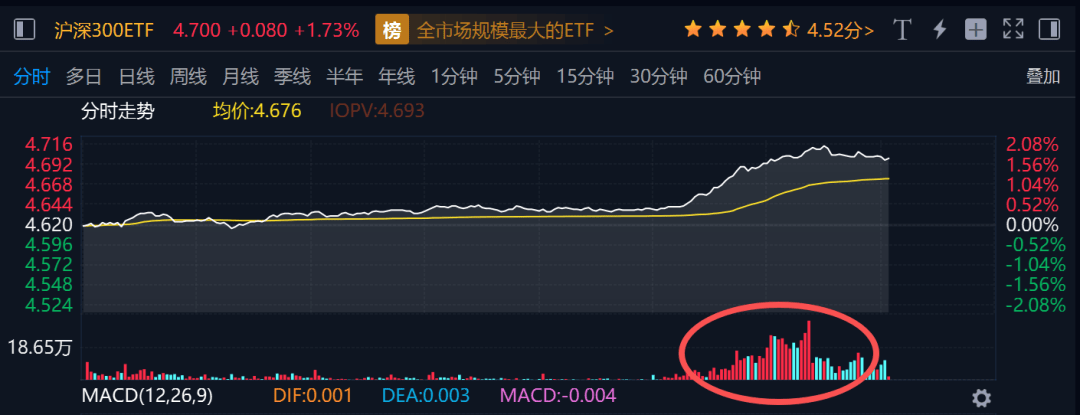
有看到消息,汇金宣布今日购买各类ETF以稳定股市,鼓励长期价值投资,后续还将继续维护市场健康发展。 这是GJD又出手了,泪汪汪~ 从成交额来看,今天A500大爆发了,5只中证A500ETF合计成交452.91亿,其中,A500ETF华泰柏瑞(563360)成交额达141.18亿元,再创历史新高。 盘面上,CPO、碳酸锂、有色,热点不断,牛市,又回来了? 来源:市场资讯 (来源:ETF万亿指数) 今日午后,多只宽基ETF放量异动,沪深300ETF(510300)、800ETF(515800)等宽基成交额大增 所以,在内外不确定下,资金避险情绪浓厚,恒生科技指数10月以来最大回撤17.17%,累计跌幅超16%。同时,南向资金近期也以防守为主,普遍等待更 明确信号。 港股这边,恒生指数涨0.92%、恒生科技指数涨1.03%,回了一口血。 近期港股下跌原因分析 前阵子恒科为什么一直下跌呢?找找原因。可能是11月经济数据,可能是美联储虽然如期降息,但前期因宏观能见度下降,市场对流动性宽松的预期曾一 度恶化。 另外,港股消费科技板块Q3财报结构性分化,像阿里巴巴、美团等公司因行业竞争激烈,战略投入扩大导致利润回调,影响了 ...

11月新能源销量放榜,奇瑞首次进入前三,跨界具身智能寻求新增长极
Jin Rong Jie· 2025-12-17 10:11
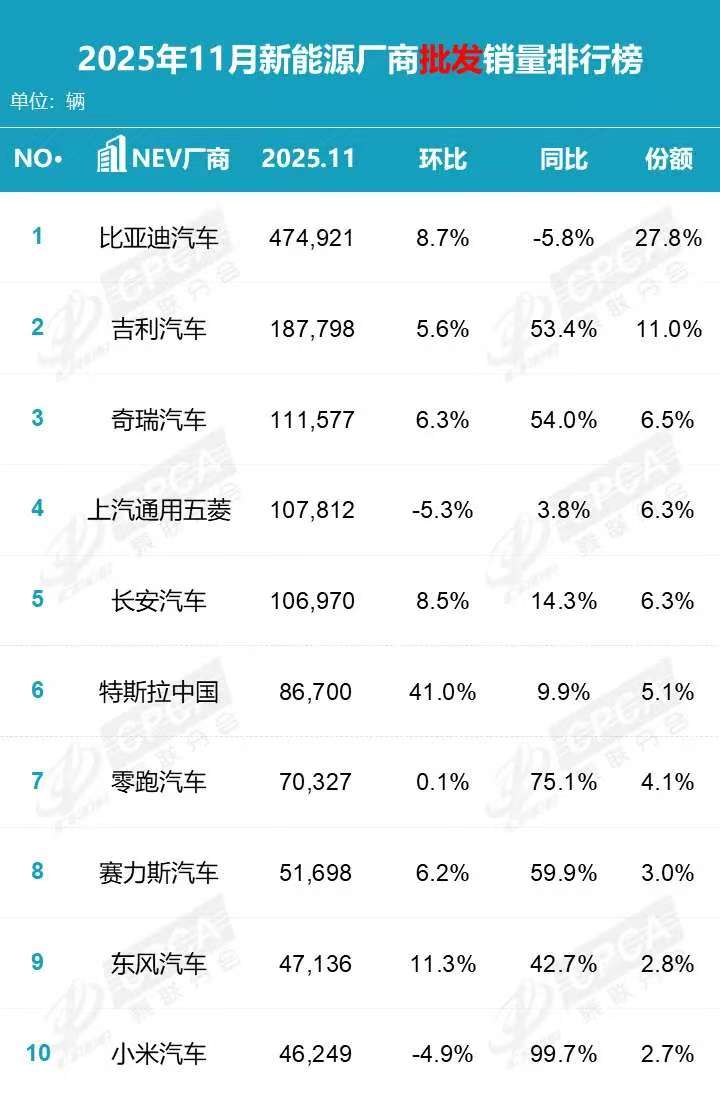
Core Viewpoint - Chery's new energy vehicle (NEV) sales reached a record high in November, marking significant growth and positioning the company among the top three in the industry for the first time [1][3]. Group 1: Sales Performance - In November, Chery's NEV wholesale sales reached 111,577 units, a year-on-year increase of 54% and a month-on-month increase of 6.3% [1][2]. - Chery Group's total NEV sales for November were 116,794 units, reflecting a 50.1% year-on-year growth, contributing to a cumulative total of 814,685 units sold from January to November, which is a 69.4% increase year-on-year [3][6]. Group 2: Market Position - Chery's market share in the NEV sector reached 6.5% in November, placing it third behind BYD and Geely, which had shares of 27.8% and 11.0% respectively [2]. - The company has achieved four consecutive months of sales growth in the NEV segment, indicating a strong upward trend [5]. Group 3: Technological Advancements - Chery's growth in the NEV market is supported by its robust R&D capabilities, including the development of the Kunpeng Tianqing hybrid engine with a thermal efficiency of over 48% and the Rhino solid-state battery with an energy density of 600 Wh/kg [7][10]. - The company has introduced several successful models, such as the A9L and T11, which have significantly contributed to its market presence [8]. Group 4: International Expansion - Chery's NEV products have gained recognition in international markets, with accolades such as the "Car of the Year" in the UK for the Tiggo 8 and multiple five-star safety ratings from European NCAP [11][19]. - The company is actively expanding its global footprint, with plans to establish 26 new overseas R&D centers to enhance local development capabilities [19]. Group 5: Financial Performance - Chery reported a revenue of 214.83 billion yuan for the first three quarters of 2025, a 17.9% increase from the previous year, with a net profit of 14.37 billion yuan, up 28% year-on-year [22].
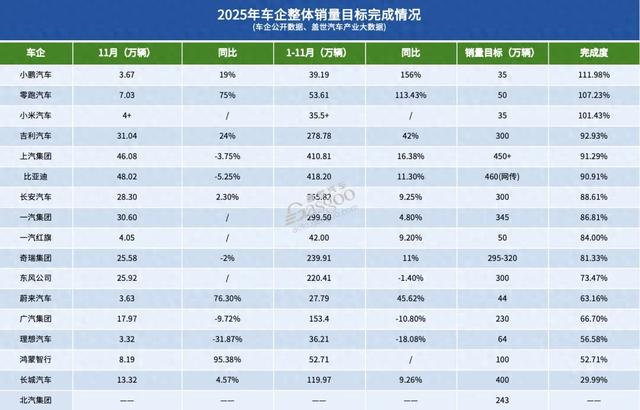
16家车企仅四成有望达成全年销量目标,新能源汽车与出口成关键因素
Xin Lang Cai Jing· 2025-12-17 03:49
Core Viewpoint - As the end of the year approaches, major automotive companies are reporting their sales for November, allowing for predictions on whether they will meet their sales targets for 2025. The total sales targets set by these companies exceed the overall market forecast, indicating that some may not achieve their goals due to intensified competition and fluctuating pricing dynamics [1][3]. Group 1: Sales Performance of Key Companies - Three companies, Leap Motor, Xiaomi Auto, and Xpeng Motors, have already met their 2025 sales targets ahead of schedule, showcasing strong performance in a competitive market [3][4]. - Leap Motor achieved a cumulative sales volume of 536,000 units from January to November, exceeding its target by 7.23% [4]. - Xiaomi Auto delivered over 355,000 units in the same period, surpassing its target of 350,000 units, despite facing production and delivery challenges [5]. - Xpeng Motors reported cumulative deliveries of 392,000 units, achieving a year-on-year growth rate of 156% and exceeding its target of 350,000 units [5][6]. Group 2: Overall Market Trends - The overall automotive market is experiencing pressure on traditional fuel vehicle sales, while the growth of new energy vehicles continues to outpace the market, driving structural transformation in the industry [3][6]. - Major companies like BYD, SAIC, Geely, Changan, and FAW have completion rates above 80%, indicating a relatively stable performance [7][10]. - However, companies with higher sales targets face significant challenges in the final month, needing to sell tens of thousands of vehicles to meet their goals [8][12]. Group 3: Challenges Faced by Other Companies - Companies such as NIO, Great Wall Motors, and Dongfeng have completion rates below 70%, making it unlikely for them to meet their annual targets [14][17]. - NIO, for instance, has a target of 440,000 units but has only delivered about 280,000 units, requiring a significant increase in December sales [14]. - The challenges faced by these companies include overly ambitious targets, lack of competitive new products, and insufficient progress in their new energy segments [14][17]. Group 4: Factors Contributing to Success - Successful companies share common traits, including realistic target setting, clear growth engines, and robust systemic capabilities that enhance their resilience during the year-end push [13][17]. - For example, Geely's Galaxy series has significantly contributed to its sales, while BYD benefits from a comprehensive product matrix supported by its entire supply chain [11][13].





港股汽车股震荡调整
Mei Ri Jing Ji Xin Wen· 2025-12-17 02:15
每经AI快讯,港股汽车股震荡调整,零跑汽车跌1.69%,小鹏汽车跌1.38%,北京汽车跌近1%。 ...
竞争不过中国就掀桌,欧盟不惜“违背祖训”…
Guan Cha Zhe Wang· 2025-12-17 01:17
Core Viewpoint - The European Union (EU) is planning to abandon its 2035 ban on new combustion engine vehicles due to pressure from automotive manufacturers, marking a significant retreat from its green policies [1][7]. Group 1: Proposal Details - The EU Commission's proposal will allow the continued sale of certain non-electric vehicles, including plug-in hybrid and range-extended combustion engine vehicles, in response to competition from Tesla and Chinese manufacturers [1][4]. - The new carbon emission targets will be adjusted to a 90% reduction from 2021 levels, rather than achieving zero emissions for all new cars and vans by 2035 as previously mandated [1][2]. Group 2: Industry Reactions - Major automotive manufacturers, such as Volkswagen, view the new carbon reduction targets as economically reasonable and support the flexibility in setting goals for electric vehicles [5]. - The Climate Group criticized the measures as a "tragic victory" for traditional automotive industries, arguing that it undermines the push for electric vehicles and stability in the market [5]. Group 3: Competitive Landscape - German automakers are under significant pressure as they face fierce competition from Chinese electric vehicle manufacturers, both domestically and in international markets [6][10]. - The EU's decision to relax emission targets is seen as a response to the anxiety among European leaders regarding the competitiveness of their automotive industry against Chinese firms [7][8]. Group 4: Broader Implications - The relaxation of emission targets may weaken investments in critical charging infrastructure and hinder Europe's transition to clean driving, potentially allowing China to advance further in the electric vehicle sector [10][11]. - The EU's shift in policy reflects a broader trend of reevaluating environmental goals in light of economic pressures and competitive dynamics in the global automotive market [8][10].
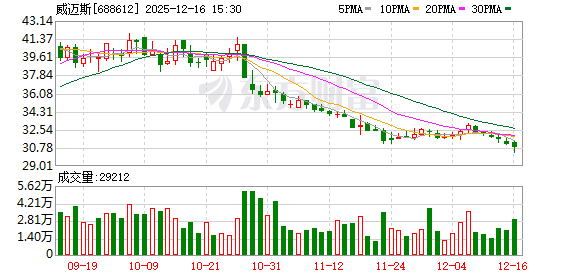
威迈斯:公司一直积极巩固拓展境内市场份额并开拓更多境内外客户
Zheng Quan Ri Bao· 2025-12-16 14:17
(文章来源:证券日报) 证券日报网讯 12月16日,威迈斯在互动平台回答投资者提问时表示,公司一直积极巩固拓展境内市场 份额并开拓更多境内外客户,目前公司客户涵盖了理想汽车、零跑汽车、小鹏汽车等造车新势力整车 厂;上汽集团、吉利汽车、长安汽车、奇瑞汽车、长城汽车等众多知名车企;上汽通用、上汽奥迪等合 资品牌以及Stellantis集团、雷诺、阿斯顿马丁、法拉利等海外知名车企。其他客户情况目前基于保密规 定不便透露。 ...

「禁止亏本卖车」,价格猫腻要藏不住了
36氪· 2025-12-16 13:35
Core Viewpoint - The automotive industry is on the brink of a significant reshuffle due to the introduction of the "Automotive Industry Pricing Behavior Compliance Guidelines," which aims to end the ongoing price war and establish clearer pricing regulations [5][10]. Group 1: Compliance Guidelines - The guidelines prohibit car manufacturers from selling vehicles below production costs and require clear pricing and delivery terms [8][16]. - Multiple car manufacturers, including BYD, Xpeng, and Changan, have expressed support for the guidelines, emphasizing the need to eliminate price fraud and unfair competition [11][13]. - The guidelines detail nine prohibited behaviors, including disguised price reductions and excessive discounts, which could lead to legal risks [16][18]. Group 2: Market Impact - The price war has severely impacted the industry's profit margins, with the overall profit rate for the automotive industry dropping to a historical low of 4.4% in 2025 [26][28]. - The average gross profit per vehicle in the automotive supply chain is only 14,000 yuan, and over 52.6% of automotive dealers are experiencing losses [28][29]. - The ongoing price war has led to a decline in consumer confidence, with a significant increase in the number of potential buyers delaying their purchases due to price fluctuations [32][34]. Group 3: Consumer Behavior - Consumers are increasingly associating vehicle prices with quality and features, with the percentage of buyers believing "you get what you pay for" rising from 13% in 2023 to 34% in 2025 [34]. - The expectation of continuous price reductions has led consumers to postpone purchases, as they believe waiting will yield better deals [35][36]. - The end of the price war is expected to lead to more rational competition in the automotive market, improving product safety and quality [36].