
美的集团

Search documents
国补延续有望激发供需两端消费潜能,2026年一季度白电排产稳健
Orient Securities· 2025-12-29 10:12
Investment Rating - The industry investment rating is maintained as "Positive" [4] Core Viewpoints - The continuation of national subsidies is expected to stimulate consumption potential on both supply and demand sides, with stable white goods production planned for Q1 2026 [2][3] - The "Two New" policy is optimized and extended, which is anticipated to activate greater consumption potential in the home appliance sector [6] Summary by Relevant Sections Domestic Sales Outlook - The effect of national subsidies is expected to improve domestic sales conditions in Q1 2026 after the arrival of subsidy funds, despite a marginal slowdown in the subsidy effect [3][6] - January 2026 white goods production data shows a total of 34.53 million units, a 6% increase year-on-year, with variations in production across different product categories [6] Investment Recommendations and Targets - Investment suggestions include focusing on leading companies with higher operational efficiency and mature overseas production layouts, which are seen as stable choices for investment [3] - Key stocks to consider include Midea Group (000333, not rated), Haier Smart Home (600690, not rated), and Hisense Visual (600060, increase holding) [3] - The long-term focus on overseas expansion is highlighted, with expectations for a valuation switch in 2026, particularly for Stone Technology (688169, not rated) [3] - Companies with stable core business performance and potential for a second growth curve, such as Anfu Technology (603031, not rated), are also recommended [3]





被动型固收+利器:股债恒定指数ETF
NORTHEAST SECURITIES· 2025-12-29 09:46
Group 1: Report Summary - The report analyzes the settings of domestic and international stock-bond constant indices and their impacts on underlying assets and the asset management product ecosystem. Since 2024, China Securities Index Co., Ltd. has released a series of stock-bond constant indices, with 9 allocation strategies, 5 stock-bond ratio gradients, and a total of 39 stock-bond constant ratio indices [1][2][112]. - Stock indices in the stock-bond constant indices focus on 2 smart beta indices (dividend and cash flow) and the A500 index representing industry-balanced mid- and large-cap stocks. Bond indices correspond to a combination of medium- to high-grade credit and treasury and policy financial bond indices [1][2][112]. - From a 3-year perspective, stock-bond constant indices are in a low-drawdown, medium-elasticity range. The stock-bond ratio determines cost-effectiveness, the bond style determines the return bottom, and the equity index determines return elasticity. Historically, the 20:80 stock-bond constant index has a better risk-return ratio than many secondary bond funds [2][100][113]. Group 2: Background of Stock-Bond Constant Indices - In 1952, Harry M. Markowitz proposed the modern portfolio theory, providing a mathematical basis for asset allocation. Diversified asset allocation has become an important direction in wealth management, and multi-asset funds are key tools for implementing this strategy [15]. - The constant ratio strategy, especially the stock-bond constant ratio, is a common strategy in multi-asset index compilation. In the US market, the correlation between stocks and bonds varies with inflation and monetary policy. In the domestic market, stocks and bonds are mainly negatively correlated, and the correlation among stock indices has been decreasing [16][17][20]. Group 3: Basic Information and Risk-Return Characteristics of Stock-Bond Constant Indices 3.1 Basic Information of Stock-Bond Constant Series Indices - As of the end of November 2025, China Securities Index Co., Ltd. has released 100 multi-asset indices, covering strategies such as constant ratio, risk parity, volatility control, target date, and target risk [28]. - The newly released stock-bond constant series indices have 9 allocation strategies and 5 stock-bond ratio gradients, with a total of 39 indices. Stock indices focus on dividend and cash flow smart beta indices and the A500 index, while bond indices are a combination of medium- to high-grade credit and treasury and policy financial bond indices [32]. 3.2 Components and Industry Characteristics of Stock-Bond Constant Indices - The report focuses on the component stocks and sample adjustment of stock indices in stock-bond constant indices. For example, the CSI Dividend Index adjusts its samples once a year, and the CSI 800 Cash Flow Index adjusts quarterly [43][50]. - There are differences in the component stocks among the CSI Dividend Index, CSI 800 Cash Flow Index, and CSI A500 Index. The A500 Index emphasizes industry balance, while the Dividend Index is more concentrated in the financial and energy sectors [58]. 3.3 Return, Volatility, and Drawdown Performance of Stock-Bond Constant Indices - In the past 3 years, the CSI 800 Cash Flow Index has a higher annualized return, followed by dividend-related indices, and the A500 Index has the lowest return among the three. Among bond indices, medium- to high-grade credit bonds have a higher return-volatility ratio [61]. - In the past year, the performance of these indices has changed. The growth style represented by innovation has outperformed the dividend style, and the A500 Index has exceeded the CSI 800 Cash Flow and dividend-related indices in terms of return [74]. Group 4: Comparison between Stock-Bond Constant Indices and Active Fixed-Income Plus Products - Stock-bond constant indices have strong defensive capabilities. Based on the long-term weak negative correlation between stocks and bonds, the 10/90 and 20/80 stock-bond constant indices can reduce volatility and enhance portfolio defense [93]. - In the past three years, the overall return of stock-bond constant indices has been better than that of the WIND Secondary Bond Fund Equal-Weighted Index, and their volatility is lower. The 20:80 stock-bond constant index performs better than most secondary bond funds in the same maximum drawdown range [96][100]. - If stock-bond constant ETFs are launched, due to their low fees and high liquidity, some funds may switch from secondary bond funds to stock-bond constant ETFs, which may cause passive selling of secondary capital bonds and local structural frictions [106][108].
周十条丨多地陶企宣布涨价、王宁担任居然之家董事长兼CEO、友邦吊顶筹划控制权变更……
Sou Hu Cai Jing· 2025-12-29 09:17
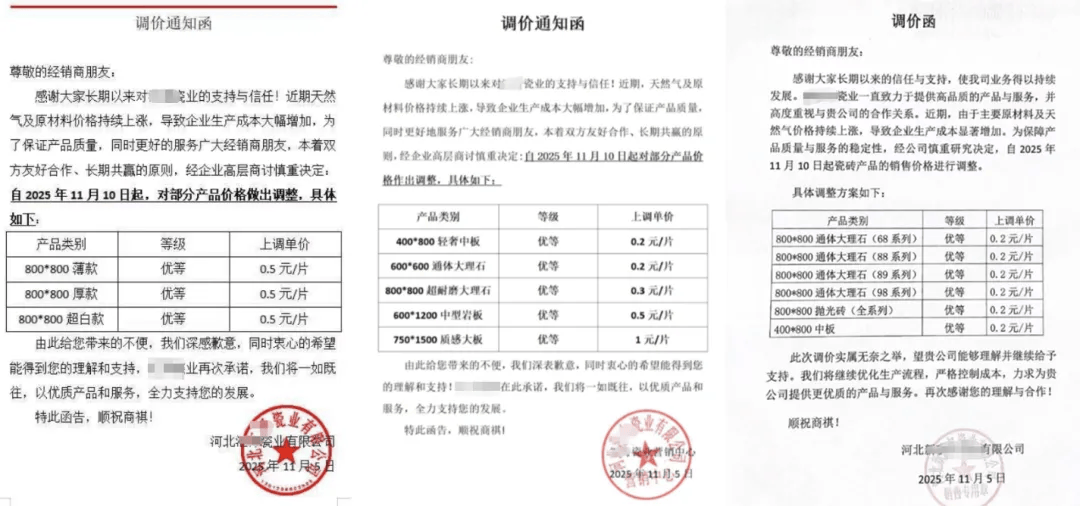
Price Increase in the Ceramics Industry - The ceramics industry is experiencing a wave of price increases as companies in Shandong, Hebei, Sichuan, Guangxi, and Chongqing announce price hikes for tiles and roofing products [1] - The primary reasons for the price increase are seasonal rises in energy costs, such as natural gas, and the upward trend in raw material costs, which are increasing production pressure on companies [1] - Additionally, some companies facing operational challenges have reduced or halted production, leading to a shift in supply and demand dynamics [1] Specific Price Adjustments - Various product categories have seen price adjustments, including: - 800*800 thin tiles: increased by 0.5 yuan per piece - 800*800 thick tiles: increased by 0.5 yuan per piece - 800*800 ultra-white tiles: increased by 0.5 yuan per piece - 400*800 luxury medium boards: increased by 0.2 yuan per piece - 600*600 full-body marble: increased by 0.2 yuan per piece - 800*800 ultra-wear-resistant marble: increased by 0.3 yuan per piece - 600*1200 medium-sized boards: increased by 0.5 yuan per piece - 750*1500 large boards: increased by 1 yuan per piece [3] - Additional adjustments include: - 800*800 full-body marble (68 series): increased by 0.2 yuan per piece - 800*800 full-body marble (88 series): increased by 0.2 yuan per piece - 800*800 full-body marble (89 series): increased by 0.2 yuan per piece - 800*800 full-body marble (98 series): increased by 0.2 yuan per piece - 800*800 polished tiles (entire series): increased by 0.2 yuan per piece - 400*800 medium boards: increased by 0.2 yuan per piece [4] Corporate Developments - Aoyuan Ceiling announced a suspension of trading due to plans for a change in control, which may lead to a change in the company's controlling shareholder [5] - Juran Home announced a board reshuffle, electing Wang Ning as the new chairman and CEO [8] - Bull Group is suing a competitor for 4.2 million yuan over misleading advertising claims [10] - Several home furnishing companies, including Gujia Home and Arrow Home, have announced guarantees for their subsidiaries, reflecting a trend of financial support as year-end funding needs rise [12] - Mona Lisa Group provided a guarantee of up to 100 million yuan for its wholly-owned subsidiary, indicating ongoing financial strategies to support business operations [18]


白色家电板块12月29日跌0.48%,澳柯玛领跌,主力资金净流入6074.62万元
Zheng Xing Xing Ye Ri Bao· 2025-12-29 09:06
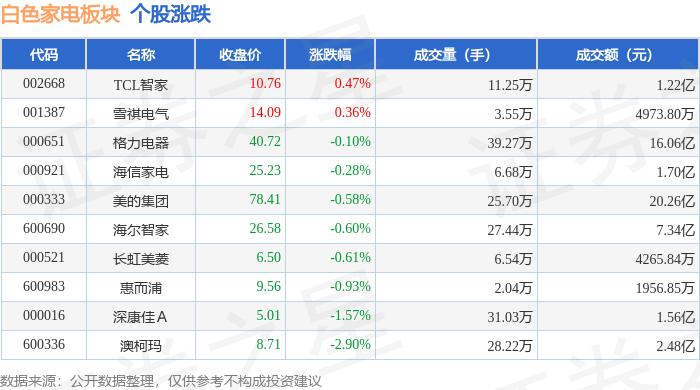
Market Overview - The white goods sector experienced a decline of 0.48% on December 29, with Aucma leading the drop [1] - The Shanghai Composite Index closed at 3965.28, up 0.04%, while the Shenzhen Component Index closed at 13537.1, down 0.49% [1] Stock Performance - TCL Smart Home (002668) closed at 10.76, up 0.47% with a trading volume of 112,500 shares and a transaction value of 122 million yuan [1] - Gree Electric Appliances (000651) closed at 40.72, down 0.10% with a trading volume of 392,700 shares and a transaction value of 1.606 billion yuan [1] - Midea Group (000333) closed at 78.41, down 0.58% with a trading volume of 257,000 shares and a transaction value of 2.026 billion yuan [1] - Haier Smart Home (600690) closed at 26.58, down 0.60% with a trading volume of 274,400 shares and a transaction value of 734 million yuan [1] - Aucma (600336) closed at 8.71, down 2.90% with a trading volume of 282,200 shares and a transaction value of 248 million yuan [1] Capital Flow - The white goods sector saw a net inflow of 60.7462 million yuan from institutional investors, while retail investors experienced a net outflow of 625.939 million yuan [1] - Gree Electric Appliances had a net inflow of 160 million yuan from institutional investors, but a net outflow of 58.1725 million yuan from retail investors [2] - Midea Group had a net inflow of 41.9801 million yuan from institutional investors, with a net outflow of 52.5536 million yuan from retail investors [2] - Haier Smart Home experienced a net outflow of 81.9545 million yuan from institutional investors, while retail investors had a net inflow of 9.8857 million yuan [2]




港股黄金股大跌
Di Yi Cai Jing Zi Xun· 2025-12-29 08:59
| 名称 | 现价 | 涨跌 三 | | --- | --- | --- | | 万国黄金集团 | 7.800 | -6.59% | | 3939.HK | | | | 紫金黄金国际 | 144.500 | -5.86% | | 2259.HK | | | | 坛金矿业 | 0.520 | -5.45% | | 0621.HK | | | | 赤峰黄金 | 30.120 | -5.40% | | 6693.HK | | | | 山东黄金 | 35.200 | -5.27% | | 1787.HK | | | | 招金矿业 | 31.440 | -5.24% | | 1818.HK | | | | 中国黄金国际 | 153.800 | -5.00% | | 2099.HK | | | | 龙资源 | 6.620 | -4.89% | | --- | --- | --- | | 1712.HK | | | | 灵宝黄金 | 18.160 | -4.27% | | 3330.HK | | | | 潼关黄金 | 2.780 | -4.14% | | 0340.HK | | | | 梦金园 | 13.080 | -3. ...
港股黄金股大跌
第一财经· 2025-12-29 08:51
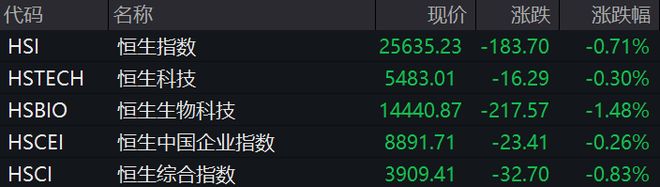
Market Overview - The Hang Seng Index closed at 25,635.23, down by 183.70 points or 0.71% [1] - The HSTECH index decreased by 16.29 points, a drop of 0.30% [1] - The Hang Seng Biotech Index fell by 217.57 points, down 1.48% [1] - The Hang Seng China Enterprises Index declined by 23.41 points, a decrease of 0.26% [1] - The Hang Seng Composite Index dropped by 32.70 points, down 0.83% [1] - Sectors such as non-ferrous metals, home appliances, food and beverage, and pharmaceuticals saw significant declines, while paper, oil and petrochemicals, banking, and steel sectors experienced gains [1] Gold Sector Performance - Gold stocks experienced a significant decline, with the WanGuo Gold Group falling over 6% [2] - Other notable declines included Zijin Gold International, Chifeng Jilong Gold, Shandong Gold, and China National Gold, all dropping around 5% [2] - Specific stock performances included: - WanGuo Gold Group at 7.800, down 6.59% [3] - Zijin Gold International at 144.500, down 5.86% [3] - Chifeng Gold at 30.120, down 5.40% [3] - Shandong Gold at 35.200, down 5.27% [3] - China National Gold at 153.800, down 5.00% [3] Other Notable Stock Movements - Stocks such as JD Health, Midea Group, and Horizon Robotics fell over 3%, while SMIC dropped over 2% [4] - Alibaba and Xiaomi Group saw declines of over 1%, while NIO, Xpeng Motors, and BYD stocks showed resilience with gains [4] - Specific stock performances included: - JD Group at 112.000, down 0.71% [7] - Alibaba at 143.300, down 1.85% [6] - BYD at 97.100, up 3.74% [8] - Xpeng Motors at 79.050, up 3.88% [8] - NIO at 40.320, up 4.89% [8]

智通AH统计|12月29日
智通财经网· 2025-12-29 08:19
Core Viewpoint - The report highlights the premium rates of AH shares, with Northeast Electric, Zhejiang Shibao, and Hongye Futures leading in premium rates, while CATL, China Merchants Bank, and Heng Rui Medicine are at the bottom of the list [1][2]. Premium Rate Summary - Northeast Electric (00042) has a premium rate of 847.37%, followed by Zhejiang Shibao (01057) at 428.73% and Hongye Futures (03678) at 283.73% [1]. - The lowest premium rates are observed in CATL (03750) at -11.13%, China Merchants Bank (03968) at -3.84%, and Heng Rui Medicine (01276) at 3.17% [1]. Deviation Value Summary - The highest deviation values are recorded for Zhejiang Shibao (01057) at 136.00%, Junda Co. (02865) at 40.42%, and Nanjing Panda Electronics (00553) at 24.71% [1][2]. - The lowest deviation values are seen in Northeast Electric (00042) at -35.46%, GAC Group (02238) at -26.23%, and Nanhua Futures (02691) at -17.44% [1][3]. Top and Bottom AH Shares - The top ten AH shares by premium rate include companies like Sinopec Oilfield Service (01033) with a premium rate of 271.43% and Fudan Zhangjiang (01349) at 250.53% [1]. - The bottom ten AH shares by premium rate include Weichai Power (02338) at 9.88% and WuXi AppTec (02359) at 10.47% [1].
戳破省电虚标,电费刺客克星来了!美的酷省电二代预售:认准这颗海思「强芯」
Sou Hu Wang· 2025-12-29 07:29
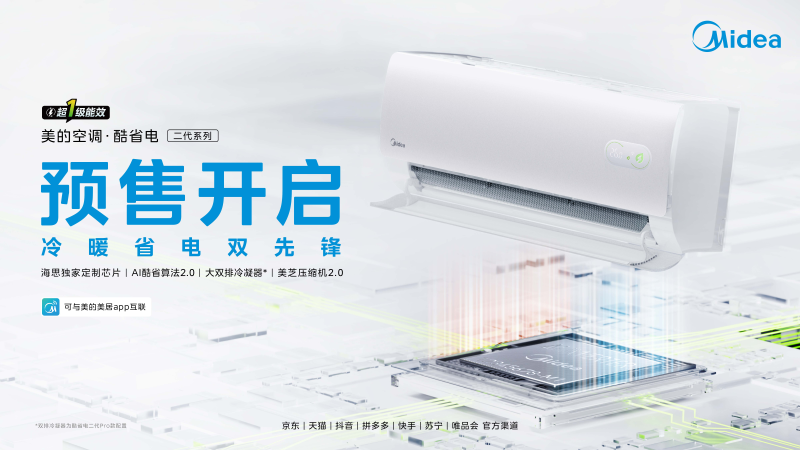
Core Insights - The introduction of the "New Level Energy Efficiency" label in the Chinese air conditioning market has not fully addressed consumer pain points, particularly high electricity costs during winter heating [1] - The air conditioning industry is facing a need for a deep transformation that prioritizes user value and integrates both hardware and software [1] - Midea's new "Cool Energy Saving 2nd Generation" series, which has sold over 10 million units, aims to redefine energy efficiency and performance standards through a partnership with HiSilicon to develop a custom AI variable frequency chip [1][3] Group 1: Technological Advancements - The "Cool Energy Saving 2nd Generation" features a proprietary AI variable frequency chip that marks the transition to a "Smart Energy Saving 3.0" era, enhancing energy-saving technology from hardware reliance to high-performance chip-driven solutions [3] - The chip boasts a 700% increase in computing power, enabling rapid local edge computing without full dependence on the cloud, and can respond in under 3 milliseconds to environmental changes [3] - The system can autonomously optimize its operation based on complex data, allowing for real-time adjustments to maintain comfort while improving energy efficiency [3] Group 2: Hardware Innovations - The product incorporates a high-performance architecture with a unique 15-slot, 10-pole variable frequency compressor that allows for rapid heating and cooling while enhancing stability and quiet operation [4][5] - It features a large dual-row evaporator and condenser that increase heat exchange area by 77% and efficiency by 10.7%, working in conjunction with a high-precision electronic expansion valve for optimal refrigerant flow control [5] - The outdoor unit utilizes fifth-generation air-cooled heat dissipation technology, capable of operating in extreme temperatures from -35°C to 65°C, ensuring reliability in harsh conditions [5] Group 3: User Experience Focus - The launch of the "Cool Energy Saving 2nd Generation" represents a shift from mere parameter competition to a revolution in user experience, emphasizing that true energy savings should not compromise comfort, reliability, or long-term performance [6] - The dual strategy of leveraging top-tier chips and robust hardware aims to enhance user experience, placing actual consumer satisfaction at the forefront [6] - The product is available for pre-sale on major platforms and is positioned as a quality choice for families seeking energy efficiency and comfort throughout the year, potentially driving the industry towards a user experience-centric "chip" energy efficiency era [6]
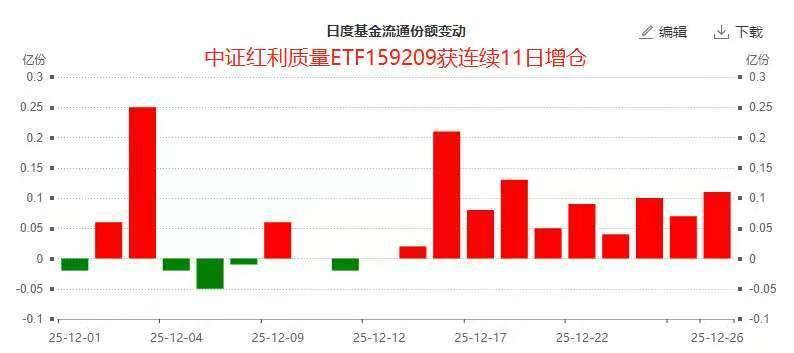
根本停不下来!年内领涨A股红利,中证红利质量ETF(159209)获连续11日增仓
Sou Hu Cai Jing· 2025-12-29 06:29
Core Insights - The China Securities Dividend Quality ETF (159209) has outperformed traditional dividend strategies in 2025, achieving over 20% growth year-to-date and reaching a price high since its inception nine months ago [1][2] - The ETF has experienced continuous net inflows for 11 consecutive trading days, indicating strong investor interest [1] Group 1: ETF Performance - The ETF's unique "high dividend + high quality" dual selection logic has contributed to its strong performance amidst a challenging market for traditional dividend strategies [1] - The ETF has led the market in the dividend ETF category, showcasing its resilience and appeal to investors [1] Group 2: Investment Strategy - Unlike typical dividend strategies, the ETF tracks the China Securities Dividend Quality Index, which emphasizes not only dividend yield but also the stability, growth, and financial quality of companies [2] - The investment philosophy aligns with value investing, focusing on acquiring quality companies at reasonable prices [2] Group 3: Portfolio Composition - Following a rebalancing in December, Kweichow Moutai has become the largest weighted stock in the ETF, alongside other quality companies like Midea Group and Dong-E E-Jiao, which have consistent dividend capabilities and profit growth [2] - Historical data indicates that the index has significantly outperformed the CSI 300 Index over the long term, with its total return index leading its peers this year [2] Group 4: Market Context - In a market environment where risk-free returns are declining, the "quality dividend" strategy is emerging as an important allocation direction for investors seeking both dividend income and long-term growth [2]
中国家电巨头正扎堆去泰国
2 1 Shi Ji Jing Ji Bao Dao· 2025-12-29 05:49
Core Viewpoint - Chinese home appliance companies are increasingly establishing production bases in Thailand, positioning it as a strategic hub for their international expansion, with significant growth in overseas revenue reported by major players like Midea and Haier [1][2][3]. Group 1: Market Expansion and Strategy - Midea's overseas revenue has significantly increased, with OBM revenue accounting for over 45% of its TO C business in 2025 [1]. - Haier's overseas market revenue reached 79.08 billion yuan in the first half of 2025, growing by 11.7% [1]. - Midea has established its largest overseas manufacturing base in Thailand and aims to make it its "second home market" after China [3][4]. Group 2: Reasons for Choosing Thailand - Thailand offers advantages in political stability, supply chain infrastructure, and population demographics, making it an attractive location for Chinese home appliance companies [4]. - The eastern economic corridor of Thailand, particularly in Chonburi and Rayong, is a strategic focus for many Chinese brands due to its proximity to major ports [4]. Group 3: Consumer Trends and Brand Positioning - The Thai home appliance market is experiencing a consumption upgrade, with consumers increasingly willing to invest in higher-end products [5][6]. - Chinese brands are gaining market share in Thailand, with Haier leading in air conditioning and Midea dominating in refrigerators and microwaves [6][7]. Group 4: Product Development and Innovation - Chinese home appliance companies are noted for their rapid product iteration and responsiveness to market demands, which contrasts with the slower innovation cycles of traditional Japanese and Korean brands [7]. - High-end product development is becoming a trend, with companies recognizing the need to move beyond low-cost competition to capture higher profit margins [8]. Group 5: Challenges and Opportunities - Despite significant market presence, Chinese brands still face challenges in brand recognition and consumer perception in Thailand [10][11]. - After-sales service is critical for success, with companies investing heavily in service networks to enhance customer satisfaction [11]. Group 6: Globalization and Regionalization - The concept of regionalization is emerging as a strategy to mitigate risks associated with global trade, allowing companies to leverage local production capabilities to support global operations [12]. - The home appliance industry is transitioning towards a comprehensive ecosystem approach, integrating R&D, supply chain, sales, and after-sales services in overseas markets [12].