
伊利股份

Search documents
从"嘴巴经济"看伊利,消费龙头的价值几何?
格隆汇APP· 2025-11-02 14:03
Core Viewpoint - The article emphasizes the optimistic outlook for the A-share market, particularly highlighting the recovery of the consumption sector and the long-term investment value of companies like Yili in the context of a changing global asset allocation landscape [2][3]. Financial Performance - Yili's revenue for the first three quarters reached 90.564 billion yuan, a year-on-year increase of 1.71%, while the net profit attributable to shareholders, excluding non-recurring items, was 10.103 billion yuan, up 18.73% year-on-year, indicating strong operational resilience in a complex environment [3][5]. - The company reported a net cash flow from operating activities of 6.436 billion yuan in Q3 alone, with a net profit of 3.226 billion yuan, resulting in a cash flow to profit ratio of 2:1, showcasing high profitability quality [5]. Business Segmentation - Yili's liquid milk segment maintains the largest market share in the industry, while its milk powder business achieved a revenue of 24.261 billion yuan, growing 13.74% year-on-year, marking a historical high [6][8]. - The cold drink segment also showed steady growth, with a revenue of 9.428 billion yuan, up 13%, maintaining its industry-leading position for 30 consecutive years [8]. Innovation and Cost Control - Yili is focusing on innovation and cost control to drive growth, launching several new products that cater to changing consumer demands, such as the "Golden Classic Fresh Pure Milk" and "Yili Instant Health Water" [11][14]. - The company has optimized its sales expense ratio, which decreased by 0.98 percentage points to 18.28% year-on-year, reflecting strong operational efficiency [15][16]. Strategic Positioning - Yili aligns its growth strategy with national priorities like rural revitalization and health initiatives, integrating these into its business model to seize market opportunities [17][19]. - The company is building a deep processing system for dairy products, enhancing its value chain and ensuring supply chain resilience amid global fluctuations [19]. Market Outlook - The article suggests that the ceiling for China's dairy industry has not yet been reached, with significant potential for growth in per capita dairy consumption, especially in rural areas [23]. - Yili's strong brand, channel, and R&D capabilities position it well to benefit from the industry's maturation and the increasing focus on quality and value creation [24]. Dividend Policy - Yili announced a cash dividend plan totaling 3.036 billion yuan, with a history of 25 dividend distributions amounting to 58.566 billion yuan since its listing, reflecting its commitment to returning value to shareholders [25].


2025三季报总结:白酒加速出清,大众品景气分化
GOLDEN SUN SECURITIES· 2025-11-02 13:22
Investment Rating - The report suggests a positive investment outlook for the liquor sector, indicating that the absolute allocation value is gradually becoming apparent, with specific recommendations for various companies [1][2]. Core Insights - The liquor industry is experiencing a significant downturn, with a notable decline in revenue and profit margins, particularly in the high-end and regional segments. The report highlights that the industry is at a turning point, with potential for recovery as supply clears and demand stabilizes [2][3]. - In the beverage sector, leading companies are maintaining high growth rates, while the snack food segment shows a mixed performance, with some companies achieving remarkable growth through product innovation and channel expansion [3][4]. - The report emphasizes the recovery in the restaurant supply chain, with seasonal income improvements despite competitive pressures in pricing [4][7]. Summary by Sections 1. Liquor Industry - In Q3 2025, the liquor sector reported revenues of 786.9 billion, a year-on-year decline of 18.4%, with net profits down 22.0% to 280.6 billion. This marks the largest quarterly decline since 2013 [2][12]. - The high-end liquor segment saw revenues of 546.6 billion, down 15.0%, while regional liquor revenues fell by 35.2% [2][15]. - Major brands like Guizhou Moutai and Shanxi Fenjiu showed slight revenue increases, while others like Wuliangye and Luzhou Laojiao experienced declines exceeding 50% [2][19]. 2. Beverage and Snack Food - The beverage sector achieved Q3 revenues of 123.1 billion, up 11.3%, with net profits increasing by 30.2% to 22.2 billion. The overall growth in the beverage sector is driven by leading brands like Dongpeng Beverage [3][21]. - The snack food segment reported Q3 revenues of 133.8 billion, a slight decline of 1.0%, with net profits down 32.9% to 7.6 billion, indicating a need for strategic adjustments in this area [3][8]. 3. Restaurant Supply Chain - The restaurant supply chain reported Q3 revenues of 112.3 billion, a year-on-year increase of 1.8%, although net profits decreased by 6.3% to 5.2 billion, reflecting ongoing competitive pressures [4][7]. - The beer segment showed a slight revenue increase of 0.5% in Q3, with net profits rising by 7.4% to 28.3 billion, indicating resilience in the face of weak demand [4][7]. 4. Dairy and Health Products - The dairy sector reported Q3 revenues of 443.7 billion, down 1.5%, but net profits increased by 0.7% to 34.6 billion, suggesting a stabilization in profitability [8][19]. - The health products segment saw significant growth, with Q3 revenues of 59.7 billion, up 12.4%, and net profits soaring by 66.0% to 6.0 billion, highlighting a strong recovery in this area [8][19].




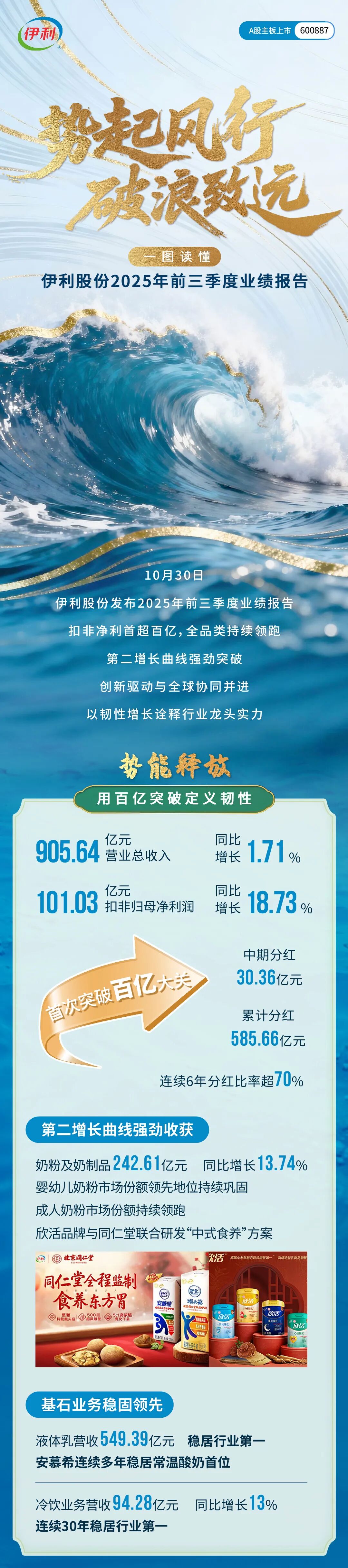
势起风行,破浪致远丨一图读懂伊利股份2025年前三季度业绩报告
Mei Ri Jing Ji Xin Wen· 2025-11-02 11:32
Core Insights - Yili Group reported a total revenue of 90.564 billion yuan, a year-on-year increase of 1.71% [2] - The company's net profit attributable to shareholders, excluding non-recurring items, reached 10.103 billion yuan, marking an 18.73% year-on-year growth [2] - The company declared a mid-term dividend of 3.036 billion yuan, contributing to a cumulative dividend of 58.566 billion yuan over the years [3][4] Revenue Breakdown - The infant formula and dairy products segment generated 24.261 billion yuan, reflecting a year-on-year growth of 13.74% [4] - Liquid milk revenue stood at 54.939 billion yuan, maintaining the industry's leading position [6] Innovation and Awards - Yili won two awards at the International Dairy Federation (IDF) Dairy Innovation Awards, including the Human Nutrition Dairy Product Innovation Award for its "Xinhui Bone Nutritional Formula Milk Powder" [7] - The company introduced new product categories such as "light milk juice drinks" and "fresh milk green bean ice cream," showcasing its commitment to innovation [8][10] Market Expansion - Yili's overseas business showed strong performance, particularly in frozen drinks and infant goat milk powder, achieving high growth rates [15] - The company successfully entered new markets, including Singapore and Hong Kong, with its JinDian brand [17]
伊利股份(600887):液体乳同比承压,宣布中期分红
Western Securities· 2025-11-02 07:22
Investment Rating - The investment rating for the company is "Buy" [7][12]. Core Views - The company reported a revenue increase of 1.71% to 90.564 billion yuan for the first three quarters of 2025, while the net profit attributable to shareholders decreased by 4.07% to 10.426 billion yuan. The net profit excluding non-recurring items increased by 18.73% to 10.103 billion yuan [1][3]. - In Q3 2025, the company's revenue decreased by 1.70% to 28.631 billion yuan, and the net profit attributable to shareholders decreased by 3.35% to 3.226 billion yuan, with net profit excluding non-recurring items down by 3.08% to 3.086 billion yuan. The revenue and profit figures met market expectations [1][3]. - The company announced a mid-term dividend of 3.036 billion yuan, accounting for 29.12% of the profit for the first three quarters [1]. Product Performance - In Q3 2025, revenue from liquid milk, milk powder and dairy products, cold drinks, and other products were 18.814 billion, 7.683 billion, 1.199 billion, and 0.590 billion yuan respectively, showing a year-on-year change of -8.83%, +12.65%, +17.35%, and +219.35%. The decline in liquid milk revenue is attributed to continued weak demand, while milk powder and cold drinks have shown a positive growth trend [2]. - By region, Q3 revenues were 8.163 billion, 6.886 billion, 5.331 billion, 4.276 billion, and 3.631 billion yuan for North China, South China, Central China, East China, and other regions, with year-on-year changes of +3.07%, -8.69%, -0.89%, -7.14%, and +12.77% respectively [2]. Financial Metrics - The gross margin for Q3 decreased by 1.09 percentage points to 33.76%. The company adopted a cautious expense strategy due to weak demand, resulting in a net profit margin of 11.27%, a slight decrease of 0.19 percentage points year-on-year [3]. - The company expects EPS for 2025, 2026, and 2027 to be 1.75, 1.91, and 2.05 yuan respectively, maintaining a "Buy" rating [3].
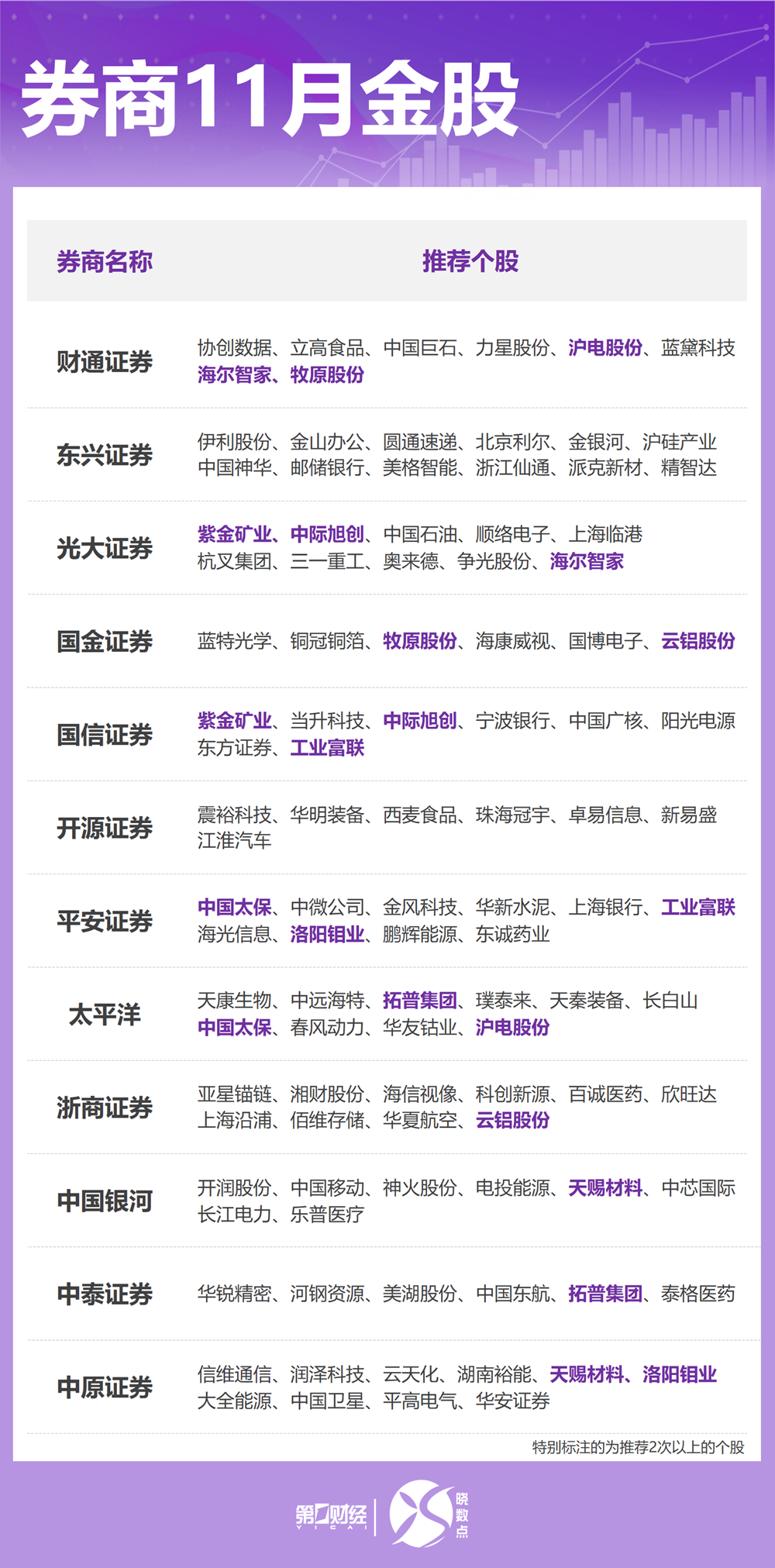
券商11月金股出炉:这些股获力挺,看好有色、医药等方向




Di Yi Cai Jing· 2025-11-02 07:21
Core Viewpoint - The A-share market showed a mixed performance in October, with the Shanghai Composite Index rising by 1.85%, while the Shenzhen Component Index and the ChiNext Index fell by 1.1% and 1.56% respectively. The focus is on identifying investment opportunities for November as multiple brokerages have released their monthly investment portfolios across various sectors [1]. Group 1: Recommended Stocks - A total of 11 stocks, including Huadian Technology, Industrial Fulian, and Yun Aluminum, received recommendations from two brokerages each [4]. - Among the recommended stocks, Zhongji Xuchuang had the highest increase in October, rising over 17% to a closing price of 473.01 yuan, while Top Group experienced the largest decline, falling over 8.9% to a closing price of 73.78 yuan [4]. Group 2: Industry Preferences - Several brokerages suggest focusing on sectors such as non-ferrous metals, brokerage firms, and pharmaceuticals, indicating a potential increase in market volatility [6]. - Guosheng Securities recommends a balanced asset allocation to navigate short-term fluctuations, emphasizing the importance of verifying economic conditions, particularly in sectors like non-ferrous metals, lithium batteries, and storage [6]. - Zhongyuan Securities anticipates a continuation of structural oscillation in the market, advising investors to consider low-volatility assets as a fundamental allocation [6]. Group 3: Investment Strategies - Donghai Securities highlights three main investment lines, including a focus on technology, particularly in artificial intelligence, and investment opportunities related to the "14th Five-Year Plan" strategic emerging industries [7]. - The expectation of increased investment in the fourth quarter is also noted, particularly regarding its impact on upstream resource demand [7].
伊利股份2025年三季报深度解读:营收净利双增筑牢龙头地位 全品类创新与全球化布局打开增长新空间
Zhong Guo Jing Ying Bao· 2025-11-02 05:57
Core Insights - Yili Group reported a total revenue of 90.564 billion yuan for the first three quarters of 2025, marking a year-on-year increase of 1.71%, while the net profit attributable to shareholders exceeded 10.103 billion yuan, with a significant growth rate of 18.73% [1][2] - The company proposed a cash dividend of 3.036 billion yuan, highlighting its commitment to shareholder returns and reflecting its robust operational resilience and strong profitability [1][2] - Yili's performance demonstrates strong market resilience, achieving growth above the industry average despite intensified competition and changing consumer demands [1][3] Financial Performance - The core performance of Yili in the first three quarters of 2025 can be summarized as "steady growth in scale and significant profit increase," with the net profit growth rate outpacing revenue growth due to improved cost control, product structure upgrades, and enhanced operational efficiency [1][3] - The company has maintained a leading position in shareholder returns, with a total dividend payout of 58.566 billion yuan since its listing and a consistent dividend ratio exceeding 70% for six consecutive years [2] Business Segments - Yili's growth is driven by a diversified product portfolio, with liquid milk, milk powder, and ice cream all contributing to revenue growth, while non-dairy products are also emerging as significant contributors [4][7] - The liquid milk segment generated revenue of 54.939 billion yuan, maintaining its industry-leading position, while the ice cream business achieved a revenue of 9.428 billion yuan, growing by 13% year-on-year [4][7] - The milk powder segment reached a revenue of 24.261 billion yuan, with a year-on-year growth of 13.74%, solidifying its market leadership [7] Innovation and Market Strategy - Yili's success is attributed to its ability to understand consumer needs and its strategic channel development, focusing on health and nutrition with innovative products [5][6] - The company has adopted a three-pronged strategy of product innovation, channel upgrades, and user engagement to enhance its competitiveness in the milk powder market [8] - Yili's non-dairy segment, particularly the Yike Huoquan brand, has shown remarkable growth, achieving a 70% increase in revenue, driven by innovative health-focused products [9] Global Expansion and Future Outlook - Yili is pursuing global expansion and innovation to drive long-term growth, with significant achievements in overseas markets and a focus on integrating local resources and innovation [10][11] - The company has shifted its international strategy from merely exporting products to building a comprehensive system that includes local talent development and sustainable practices [11] - Yili's commitment to innovation is evident in its recent international awards and the introduction of new products that meet evolving consumer demands [12] Conclusion - Overall, Yili Group's performance in the first three quarters of 2025 reflects its strong resilience as a market leader, with strategic initiatives in product diversification, global expansion, and innovation positioning it for sustained growth in the future [13]
养乐多一年连关两厂!
Zhong Guo Jing Ying Bao· 2025-11-02 05:57
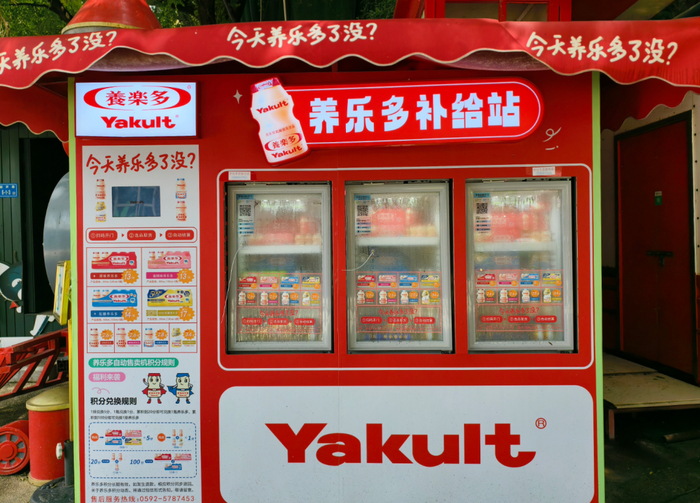
Core Viewpoint - Yakult is experiencing significant operational challenges in the Chinese market, leading to the closure of its first factory in Guangzhou and a strategic shift to consolidate production capabilities in response to declining sales and increased competition from local brands [3][5][6]. Production Capacity Adjustment - Yakult announced the closure of its Guangzhou factory, which will officially shut down on November 30, following the closure of its Shanghai factory less than a year ago [3][4]. - The decision to close the factory is driven by two main factors: a substantial decline in sales resulting in excess capacity and intensified competition from domestic giants like Mengniu and Yili [3][5]. - The company aims to optimize its production system by consolidating three factories into two, enhancing production efficiency and resource allocation [4]. Sales Performance - Yakult's sales in China have significantly decreased, with daily sales figures dropping from a peak of 760.9 million bottles to 447.2 million bottles in the first half of 2025, reflecting a mismatch between production capacity and sales [5][6]. - The sales performance of Yakult's Shanghai and Guangzhou operations was notably below other regions, with sales at 81.1% and 88.7% of the previous year's levels, respectively [6]. Market Competition - The overall market for probiotic beverages is facing a downturn, with Yakult not only contending with local brands but also experiencing a decline in consumer demand for traditional high-sugar probiotic drinks [7][9]. - The shift in consumer preferences towards low-sugar and low-fat options has made it challenging for Yakult's classic products, which are high in sugar, to attract consumers [7][9]. Innovation and Product Development - Yakult has struggled to innovate beyond its core probiotic drink category, with recent product launches primarily focused on flavor variations rather than new product lines [8][9]. - In contrast, local competitors are rapidly innovating, introducing products with lower sugar content and targeting specific consumer segments [9][10]. Strategic Recommendations - To address market challenges, Yakult is advised to enhance its research and development efforts, expand into new retail channels, and focus on product differentiation to avoid price wars [10]. - The company should consider leveraging its cold chain logistics for premium product offerings and target specific consumer demographics in urban areas [10].
千亿险资系私募基金,最新动向曝光
Zhong Guo Zheng Quan Bao· 2025-11-02 04:10
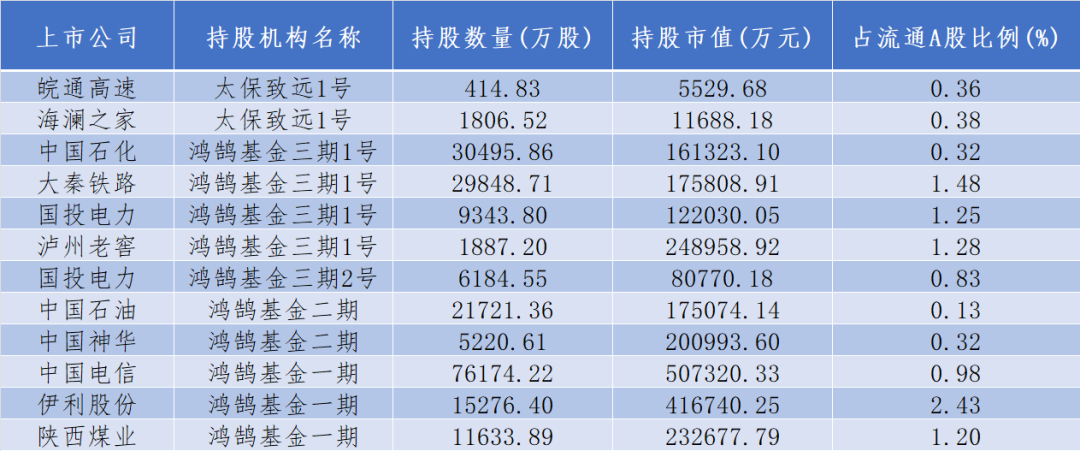
Core Insights - The trial reform for long-term investment of insurance funds has accelerated this year, with the latest holdings of insurance-related private equity funds revealed following the disclosure of listed companies' Q3 reports [1][9] - Five insurance-related private equity funds have disclosed their latest holdings, with significant investments in companies such as Sinopec, Daqin Railway, Guotou Power, Luzhou Laojiao, Anhui Expressway, and HLA [1][4] Holdings Summary - As of the end of Q3, Taibao Zhiyuan No. 1 Private Securities Investment Fund has appeared in the top ten circulating shareholders of Anhui Expressway and HLA, holding 4.1483 million shares and 18.0652 million shares respectively [3][6] - The holdings of five insurance-related private equity funds are detailed in a table, showing the number of shares, market value, and percentage of circulating A-shares for each listed company [5] - The Honghu Fund Phase III No. 1 has emerged as a major shareholder in Sinopec, Daqin Railway, Guotou Power, and Luzhou Laojiao, with holdings of 304.9586 million shares, 298.4871 million shares, 93.438 million shares, and 18.872 million shares respectively [6][7] Investment Focus - The insurance-related private equity funds are primarily concentrated in sectors such as petrochemicals, transportation, coal, public utilities, food and beverage, telecommunications, and textiles, with many holdings being industry leaders characterized by high dividends and low volatility [7][10] - The ongoing trial reform has seen the number of operational insurance-related private equity funds increase to seven, with a total approved scale of 222 billion yuan [9][10]



奶粉市场格局生变:外资三巨头增长超10%,国产份额再承压!
Sou Hu Cai Jing· 2025-11-01 09:43
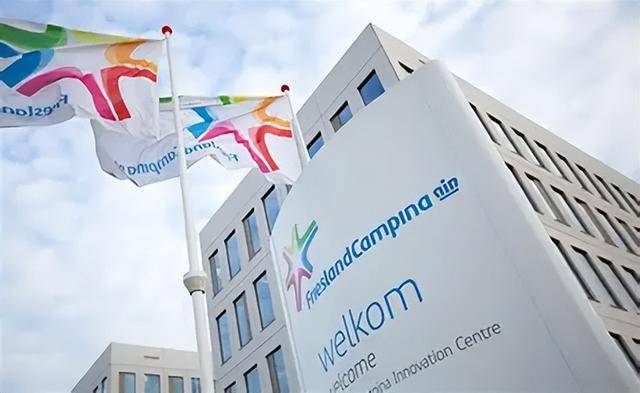
Core Insights - The Chinese infant formula market is experiencing a significant shift, with foreign brands showing strong growth despite an overall market increase of only 0.5% [1][3] - The return of foreign brands marks a new phase in the competitive landscape of the Chinese infant formula market, which has seen dramatic changes over the past two decades [3][5] Market Dynamics - In 2008, the melamine scandal led to a collapse in consumer trust for domestic brands, allowing foreign brands to capture up to 60% market share [3][5] - The following decade was dominated by foreign brands, with companies like Mead Johnson and Wyeth leading the market [5] - A turning point occurred in 2017 when domestic brands began to regain market share, culminating in Feihe surpassing Wyeth in 2019 [5][8] Current Performance - In the first half of 2025, Feihe reported a revenue decline of 9.36% and a net profit drop of 46.66%, while foreign brands like FrieslandCampina and A2 Milk Company continued to grow [8][9] - FrieslandCampina's brand, Friso, has become the leading international brand in the Chinese infant formula market, with its product becoming the best-selling SKU [8][11] Strategies of Foreign Brands - Foreign brands are leveraging a three-pronged strategy to reclaim market share: 1. **Premiumization**: Focusing on high-end products, with the ultra-premium segment accounting for 64.4% of the market [10][11] 2. **Channel Penetration**: Expanding into lower-tier cities through digital platforms, enhancing direct connections with retailers [15][16] 3. **Price Stability**: Maintaining price integrity amidst a domestic price war, ensuring profitability for retailers [16][17] Challenges for Domestic Brands - Domestic brands face significant challenges, including a fragmented pricing structure and declining consumer confidence [18][20] - The transition to new national standards has led to pricing chaos and reduced channel profitability [20] - Domestic brands are also struggling with cost competitiveness, as imported raw materials can be cheaper than local production [20] Strategic Shifts for Domestic Brands - Domestic companies are diversifying their product offerings and exploring international markets to counteract declining sales [21][23] - The focus is shifting towards all-age nutrition, expanding from infant formula to products for children, adults, and seniors [23][30] Future Outlook - The restructuring of the market is underway, with an increasing concentration of market share among leading brands [24][29] - The competition is evolving from basic nutrition to advanced ingredient development, with a focus on active components like HMO [26][30] - Foreign brands are localizing their supply chains to enhance competitiveness in the Chinese market [27][28] Conclusion - The infant formula industry in China is entering a new phase of refined competition, where trust and innovation will be key determinants of success [30][31]

国家乳业技术创新中心将打造乳品深加工示范线
Bei Ke Cai Jing· 2025-11-01 08:52
Core Insights - The National Dairy Technology Innovation Center introduced innovations in dairy deep processing technology and industry development at the 22nd Annual Meeting of the Chinese Society of Food Science and Technology [1] - The center aims to accelerate the industrial application of technological achievements during the "14th Five-Year Plan" period by establishing deep processing demonstration lines [1] Industry Overview - Dairy products have comprehensive and balanced nutritional components, beneficial for various demographics including children, the elderly, and athletes [1] - The extraction of functional components from milk is challenging; for instance, approximately 14 tons of milk are needed to extract 1 kilogram of lactoferrin, necessitating deep processing techniques for efficient extraction [1] Market Dynamics - The deep processing of dairy products can optimize market offerings and expand market boundaries [1] - China heavily relies on imports for deep processed dairy products, with 661,000 tons of whey powder expected to be imported in 2024 [1] Policy and Investment - The Chinese government emphasizes original innovation and key technology breakthroughs in its 14th Five-Year Plan [1] - The Ministry of Industry and Information Technology initiated a project to enhance the supply capacity of demineralized whey products, with leading dairy companies submitting investment proposals totaling billions [1] Company Initiatives - Yili Group is constructing a leading global dairy deep processing factory in Hohhot, capable of producing demineralized whey, lactoferrin, and other deep processed products [1] - The National Dairy Technology Innovation Center, led by Yili Group, is the only national-level technology innovation center in China's food sector, achieving several leading results in deep processing [1]