中国生物制药

Search documents
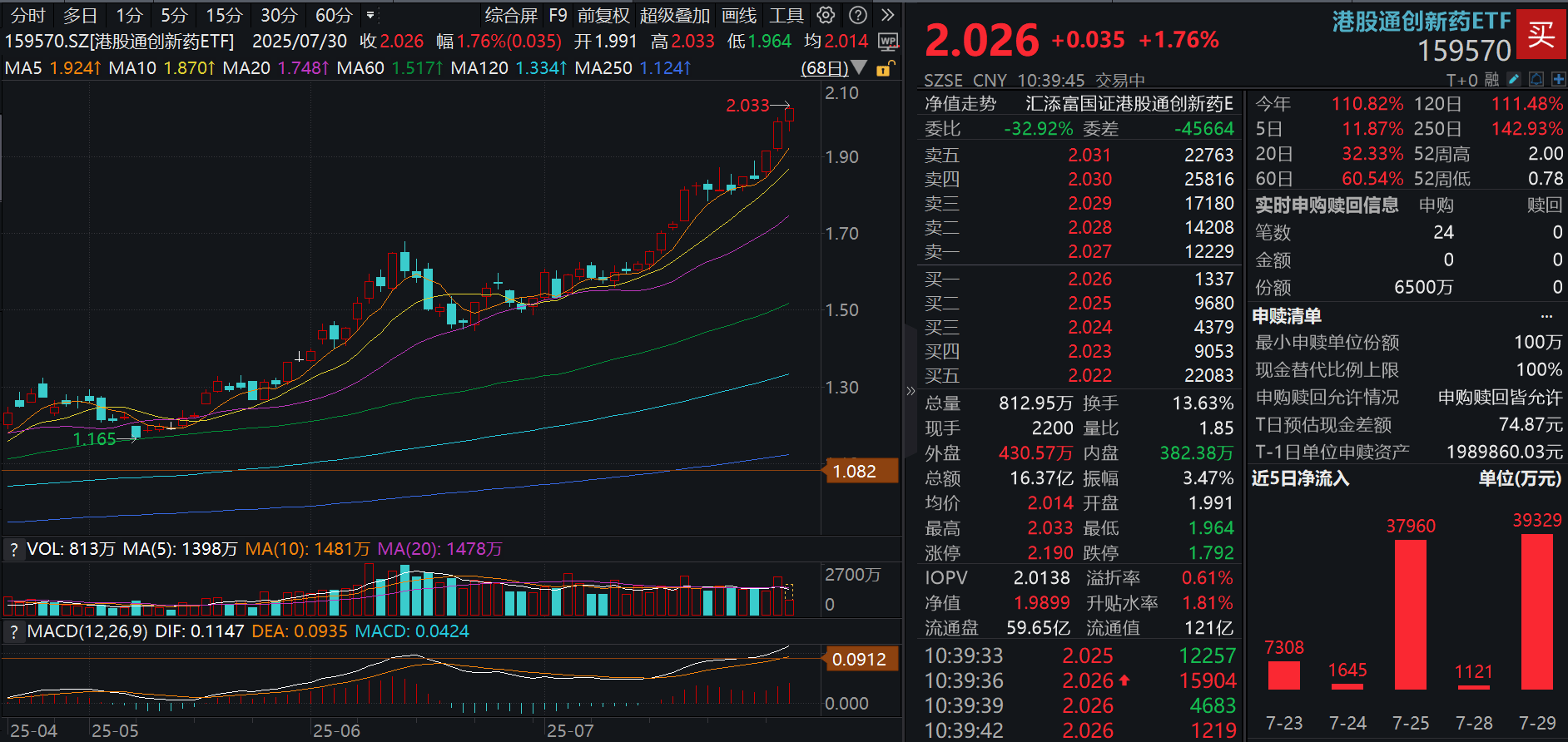
港药再度飘红!可T+0交易的港股通创新药ETF(159570)涨2%再创新高!昨日狂揽净申购近4亿元!
Sou Hu Cai Jing· 2025-07-30 02:59
Group 1 - The core viewpoint of the news highlights the strong performance of the Hong Kong Stock Connect Innovative Drug ETF (159570), which has seen significant inflows and a record scale of over 11.8 billion yuan [1][3] - The ETF's trading volume exceeded 1.6 billion yuan in a single day, with a net inflow of over 390 million yuan yesterday and an additional 145 million yuan during the day [1] - The ETF's underlying index consists of leading innovative drug companies, with significant gains observed in stocks such as Kanglong Chemical, Innovent Biologics, and WuXi AppTec [3][4] Group 2 - Innovent Biologics' dual-target PD-1/IL-2 therapy IBI363 has received approval for two clinical trials, one of which will advance to frontline treatment for lung cancer, indicating strong potential in the oncology space [3] - The recent ASCO conference showcased promising survival data for IBI363 in colorectal cancer and non-small cell lung cancer, generating positive expectations within the industry [3] - The eleventh batch of drug procurement has been initiated, emphasizing the encouragement of innovation and the establishment of transparent selection rules for drug procurement [5][6] Group 3 - The innovative drug sector is viewed as a key investment theme, with expectations for continued growth and performance in the second quarter [5] - The new procurement rules aim to protect innovative drugs by excluding them from collective procurement during the negotiation period, thereby fostering a more favorable environment for innovation [6] - The market is anticipated to experience a rotation, with undervalued assets likely to see a new round of valuation increases, particularly in the context of AI healthcare opportunities [6][7]

中国创新药:出海黄金时代,游到海水变蓝
2025-07-30 02:32
Summary of Key Points from the Conference Call Industry Overview - The Chinese innovative pharmaceutical industry is experiencing a significant enhancement in strength, with its share of global first-in-class drugs increasing to 19% [7] - Multinational corporations (MNCs) are facing a severe patent cliff, with major companies like Merck, AbbVie, and BMS having over 60%, 58%, and 69% of their 2024 revenues coming from drugs facing patent expiration within the next five years [8][9] - MNCs are actively seeking business development (BD) transactions to address these challenges, with strong cash reserves available for such activities [10] Business Development Trends - The trend of Chinese innovative drugs going global is robust, driven by the strengthening capabilities of Chinese companies and the impending patent cliffs faced by MNCs [2] - MNCs are expected to engage in more BD transactions, particularly in the second half of 2025 and into 2026, as they seek to replenish their pipelines [2] Oncology Sector Insights - The oncology field is shifting from PD-1 combined with chemotherapy to next-generation immuno-oncology (IO) and antibody-drug conjugates (ADC) [3] - Potential MNC buyers in this space include AstraZeneca, Pfizer, and Merck, all of which are looking to enhance their portfolios with next-generation IO and ADC assets [3] Metabolic Disease Developments - The metabolic field is evolving from merely focusing on weight loss to comprehensive metabolic management, including fat reduction and muscle preservation [4][5] - Companies like Novo Nordisk and AstraZeneca are exploring oral medications and multi-target approaches in this area [4] Immune and Inflammatory Disease Innovations - New directions in the immune and inflammation sector include novel targets and engineering innovations, with significant investments from companies like AbbVie and Sanofi [6] - Emerging targets such as TL1a are attracting substantial investments, indicating a strong interest in this area [20] Market Position of Chinese Innovative Drugs - Chinese innovative drug companies have made significant strides in global markets, with improved clinical data quality and increased academic recognition [7] - The presence of Chinese companies in the oncology sector is growing, with several projects in advanced stages of development [14] MNC Strategies for BD Transactions - MNCs are focusing on four main strategies for BD transactions: consolidating core areas, entering new fields, exploring opportunities, and investigating new technologies [11] - The willingness of MNCs to invest in promising assets at the preclinical stage is evident, particularly in high-potential areas like TL1a [20] ADC and TCE Technology Developments - The ADC field is characterized by a tiered approach, with MNCs diversifying their portfolios across various targets [15] - T-cell engagers (TCE) are being developed for blood cancers and autoimmune diseases, with ongoing clinical trials showing promising results [16] Conclusion - The ongoing trends in the Chinese pharmaceutical industry, coupled with the challenges faced by MNCs, are creating a fertile ground for increased collaboration and investment opportunities in the global market [29]




最新规模首次突破160亿元,港股创新药ETF(513120)年内净值上涨105.37%,收益已翻倍
Xin Lang Cai Jing· 2025-07-30 02:05
Group 1 - The Hong Kong Innovative Drug ETF (513120) reached a record size of 16.12 billion yuan as of July 29, 2025, with a year-to-date growth of 111.29%, making it the top-performing pharmaceutical ETF in Hong Kong [1] - The CSI Hong Kong Innovative Drug Index (931787) surged by 3.85% on July 29, 2025, with notable increases in constituent stocks such as WuXi AppTec (02359) up 10.76% and Innovent Biologics (01801) up 8.77% [1] - The ETF's liquidity was strong, with a turnover rate of 74.62% and a total trading volume of 11.64 billion yuan on July 29, 2025, leading the market in pharmaceutical ETFs [1] Group 2 - The CSI Hong Kong Innovative Drug Index tracks up to 50 listed companies involved in innovative drug research and development, with a significant focus on biopharmaceuticals and chemical pharmaceuticals, which together account for 92.5% of the index [2] - As of June 30, 2025, the top ten weighted stocks in the index accounted for 67.94%, including companies like Innovent Biologics (01801) and WuXi Biologics (02269) [2] Group 3 - In the first half of 2025, global pharmaceutical transactions reached 456, a 32% year-on-year increase, with total upfront payments soaring by 136% to 11.8 billion USD [3] - Chinese companies contributed nearly 50% of the total transaction value and over 30% of the transaction volume in the global innovative drug market [3] - On July 28, 2025, Heng Rui Medicine announced a deal with GSK for the global exclusive rights to the HRS-9821 project, with an upfront payment of 500 million USD and potential milestone payments totaling around 12 billion USD [3] Group 4 - On July 25, 2025, the National Healthcare Security Administration held a meeting to discuss new policies supporting innovative drugs and medical devices, aiming to accelerate the clinical application of high-level technological innovations [4] - China’s innovative drug assets are gaining global recognition, with increasing business development (BD) licensing amounts and numbers, indicating a growing global influence [4] - The Hong Kong Innovative Drug ETF (513120) supports T+0 trading, allowing investors to trade multiple times within a trading day, enhancing liquidity and capital efficiency [4]

医保基金数据跟踪:2025H1医保基金结余较2024H1有所好转
Ping An Securities· 2025-07-30 02:02
Investment Rating - The industry investment rating is "Outperform the Market" (预计6个月内,行业指数表现强于沪深300指数5%以上) [25] Core Insights - The overall situation of the medical insurance fund has improved in the first half of 2025, with total income of 14,786.17 billion yuan, a year-on-year increase of 6.5%, and total expenditure of 11,776.26 billion yuan, a year-on-year increase of 0.35% [2][5] - The surplus of the medical insurance fund in the first half of 2025 reached 3,009.91 billion yuan, a year-on-year increase of 40.09%, indicating a better performance compared to the first half of 2024 [9] - The growth rate of employee insurance income exceeded that of expenditure, while the expenditure for urban and rural residents' insurance contracted [2][18] Summary by Sections Medical Insurance Fund Performance - In the first half of 2025, the medical insurance fund maintained positive growth, with income exceeding expenditure in all months except May [5] - The monthly income from January to June 2025 was 3,143.12, 2,321.31, 2,681.49, 2,156.11, 1,993.28, and 2,490.86 billion yuan respectively, with year-on-year growth rates of 10.37%, 5.72%, 0.35%, 10.02%, 3.23%, and 9.34% [5] - The total surplus for the first half of 2025 was 3,009.91 billion yuan, with a surplus rate of 20.36%, an increase of 4.88 percentage points compared to the same period in 2024 [9] Employee and Resident Insurance Analysis - Employee insurance income for the first half of 2025 was 9,003.81 billion yuan, with a year-on-year growth of 5.95%, while expenditure was 6,642.51 billion yuan, growing by 4.38% [2][18] - Urban and rural residents' insurance income was 5,782.36 billion yuan, a year-on-year increase of 7.36%, but expenditure decreased by 4.43% to 5,133.76 billion yuan [18] Investment Recommendations - The report suggests focusing on innovative pharmaceutical companies with rich pipeline layouts, such as Heng Rui Medicine, BeiGene, and China National Pharmaceutical Group [3][23] - It also highlights companies with significant single-product potential and those leading in advanced technology platforms [3][23] - In the CXO sector, companies like WuXi AppTec and Zai Lab are recommended, along with quality medical device companies that have been undervalued due to previous price pressures [3][23]
多发性硬化:百亿美金市场,BTKi发展前景广阔
KAIYUAN SECURITIES· 2025-07-30 01:46
Investment Rating - The investment rating for the biotechnology industry is "Positive" (maintained) [1] Core Insights - The global stock of multiple sclerosis (MS) patients is significant, with the market size exceeding $20 billion, primarily focused on relapsing forms of MS (RMS) [6][9] - BTK inhibitors are expected to fill the treatment gap in primary progressive MS (PPMS) and non-relapsing secondary progressive MS (nrSPMS) [7][9] - The anticipated release of clinical data for BTK inhibitors in the second half of 2025 is expected to enhance the attractiveness of the sector [9] Summary by Sections 1. Multiple Sclerosis Overview - MS is an immune-mediated inflammatory demyelinating disease of the central nervous system, characterized by "spatial" and "temporal" multiplicity [5][27] - The global and Chinese stock of MS patients is projected to reach 3.71 million and 60,000 respectively by 2030, with a CAGR of approximately 2.7% and 2.1% from 2025 to 2030 [19][22] 2. Market Size and Product Landscape - The global MS market is approximately $20 billion, with a focus on RMS treatments [6][40] - Existing products include monoclonal antibodies and oral therapies, with CD20 monoclonal antibodies expected to account for over 60% of sales by 2024 [6][46] 3. BTK Inhibitors and Clinical Development - BTK inhibitors are positioned to address unmet needs in the treatment of PPMS and nrSPMS, with several candidates in late-stage clinical trials [7][51] - Tolebrutinib and Fenebrutinib are expected to release pivotal clinical data in the second half of 2025, which could significantly impact their market potential [8][51] 4. Investment Recommendations - The ongoing clinical developments and the large patient base present significant investment opportunities in companies like 诺诚健华, 翰森制药, 云顶新耀, 恒瑞医药, and 百济神州-U [9]
创新药行业景气度上行,关注创新药ETF
Mei Ri Jing Ji Xin Wen· 2025-07-30 01:27
Group 1 - The pharmaceutical sector is experiencing a positive trend, with the innovative drug ETF (517110) rising by 4.26% and the biopharmaceutical ETF (512290) increasing by 2.72% [1] - Heng Rui Medicine has reached a license-out cooperation agreement with GSK worth over $10 billion, which includes an upfront payment of $500 million and potential milestone payments totaling approximately $12 billion [1] - The strong performance of CXO leader WuXi AppTec, which revised its 2025 half-year performance guidance upwards, reflects the resilience of the innovative drug industry and boosts market confidence in the sector [1] Group 2 - The government has introduced multiple policies to optimize drug procurement and support innovative drugs, indicating a favorable policy environment for the pharmaceutical industry [2] - The newly issued Sci-Tech Innovation Drug ETF (589723) aims to track the Shanghai Stock Exchange Sci-Tech Innovation Board Innovative Drug Index, which has shown stronger rebound potential compared to the broader market [2]
创新药行业景气度上行,关注创新药ETF(517110)
Mei Ri Jing Ji Xin Wen· 2025-07-30 01:15
Group 1 - The pharmaceutical sector is experiencing a positive trend, with the innovative drug ETF (517110) rising by 4.26% and the biopharmaceutical ETF (512290) increasing by 2.72% [1] - Heng Rui Medicine has reached a license-out cooperation with GSK worth over $10 billion, with an initial payment of $500 million and potential milestone payments totaling approximately $12 billion [1] - The strong performance of CXO leader WuXi AppTec, which revised its 2025 half-year performance guidance upwards, reflects the resilience of the innovative drug industry and boosts market confidence in the sector [1] Group 2 - The government has introduced multiple policies to optimize drug procurement and support innovative drugs, indicating a favorable policy environment for the pharmaceutical industry [2] - The newly issued Sci-Tech Innovation Drug ETF (589723) aims to track the Shanghai Stock Exchange Sci-Tech Innovation Board Innovative Drug Index, which has shown stronger rebound potential compared to the broader market [2]
南向资金今年以来净流入金额创历史新高
Zhong Guo Zheng Quan Bao· 2025-07-29 21:07
Core Viewpoint - Southbound capital has significantly increased its investment in the Hong Kong stock market this year, leading to a historical net inflow of over 840 billion HKD, surpassing previous records and contributing to a strong performance in the market [1][2]. Group 1: Southbound Capital Inflows - As of July 29, 2023, southbound capital has recorded a cumulative net inflow of 8420.02 billion HKD, marking a historical high for the year and more than double the inflow of the same period in 2024 [1][2]. - The daily net inflow peaked on April 9, 2023, with 355.86 billion HKD, setting a record for single-day inflows [1]. - In 135 trading days this year, there were net inflow days on 114 occasions, accounting for over 80% of the trading days [1]. Group 2: Market Performance - The Hang Seng Index has risen over 27% year-to-date, while the Hang Seng Technology Index has increased by over 26% [1][3]. - Major stocks with market capitalizations exceeding 1 trillion HKD have all seen gains, with Xiaomi Group-W up over 60% and Tencent Holdings up over 34% [1][4]. - The Hong Kong stock market has outperformed major global markets, with the Hang Seng Index, Hang Seng China Enterprises Index, and Hang Seng Technology Index showing respective increases of 27.24%, 25.46%, and 26.33% [3]. Group 3: Sector and Stock Performance - Southbound capital has heavily invested in the financial, information technology, and consumer discretionary sectors, with holdings valued at 14517.43 billion HKD, 11115.84 billion HKD, and 7175.67 billion HKD respectively [2][3]. - Notable individual stock holdings include Tencent Holdings at over 5400 billion HKD, and other significant investments in China Mobile, Xiaomi Group-W, and Alibaba-W, each exceeding 2000 billion HKD [2][3]. Group 4: Valuation and Future Outlook - The rolling P/E ratio of the Hang Seng Index has increased to 10.49 times, up from 8.96 times at the beginning of the year, indicating a rise in market valuation [5][6]. - Analysts predict that southbound capital inflows could exceed 1 trillion HKD for the year, although the pace may slow in the second half [6][7]. - The overall market sentiment remains positive, with expectations of continued upward movement supported by improved fundamentals and ongoing capital inflows [6][7].




大涨近3%!恒生医疗ETF(513060)成交额突破30亿!药明康德业绩引爆创新药板块
Xin Lang Cai Jing· 2025-07-29 06:36
Core Viewpoint - The pharmaceutical sector continues to strengthen, particularly in innovative drug development, with notable gains in companies like WuXi AppTec and others, reflecting a robust demand for CRO/CDMO services driven by global innovation in drug research and development [1][2][3][4][5]. Group 1: Company Performance - WuXi AppTec reported a revenue of 20.8 billion RMB for the first half of the year, representing a year-on-year increase of 20.6%, with a non-GAAP net profit of 5.58 billion RMB, up 26.5% [2]. - The TIDES business (oligonucleotides and peptides) achieved a revenue of 5.03 billion RMB, showing a remarkable growth of 141.6% year-on-year, with a backlog of orders increasing by 48.8% [2][3]. - The company has a total order backlog of 56.69 billion RMB, reflecting a growth of 37.2%, indicating strong future growth potential [2]. Group 2: Industry Trends - The global CRO/CDMO market is expected to maintain double-digit growth due to the increasing demand for innovative drug development and the rising outsourcing penetration rate [2][3]. - Revolutionary technologies such as ADC, cell and gene therapy, and mRNA vaccines are driving rapid growth in specialized fields, creating a blue ocean market for CRO/CDMO companies [3][4]. - The industry is experiencing accelerated consolidation, with leading companies benefiting from their comprehensive service capabilities and global network, enhancing their competitive advantages [4][5]. Group 3: Investment Opportunities - The BoShi CSI Pharmaceutical 50 ETF provides investors with a convenient tool to capture the growth of leading companies in the Chinese pharmaceutical industry, particularly in the CRO sector [4][5]. - The Hang Seng Medical ETF is positioned as an effective tool for investing in the Hong Kong medical sector, benefiting from policy optimizations and technological advancements [6].
利好突袭!刚刚,全线爆发!
券商中国· 2025-07-29 05:51
Core Viewpoint - The innovative drug sector is experiencing a significant surge driven by strong earnings, overseas orders, and favorable policies [2][3][6]. Group 1: Market Performance - On July 29, both A-shares and Hong Kong stocks in the innovative drug sector saw substantial gains, with multiple stocks rising over 10% [2][4][5]. - Notable performers included Yaoshan Technology, Tigermed, and WuXi Biologics, all of which saw significant increases [4]. Group 2: Key Drivers - **Earnings Growth**: WuXi Biologics reported a revenue of 20.799 billion yuan for the first half of 2025, a year-on-year increase of 20.64%, and a net profit of 8.561 billion yuan, up 101.92% year-on-year. The company raised its full-year revenue forecast to between 42.5 billion and 43.5 billion yuan [6]. - **International Expansion**: Heng Rui Medicine announced a partnership with GlaxoSmithKline (GSK), which includes a $500 million upfront payment and potential milestone payments totaling around $12 billion for 12 projects in respiratory diseases, oncology, and autoimmune diseases [6]. - **Policy Support**: The National Healthcare Security Administration held discussions to support the high-quality development of innovative drugs, emphasizing the use of healthcare data to support drug research and development [7][8]. Group 3: Future Outlook - Analysts suggest that the innovative drug sector is in a phase of dual support from policy and fundamentals, indicating a potential for value re-evaluation [10]. - The current valuation of the innovative drug sector remains attractive compared to major pharmaceutical companies in the U.S., with both domestic and foreign investments expected to increase [11][12]. - The sector is seen as a key investment theme for the year, with a focus on high-quality companies and emerging sub-sectors such as CRO&CDMO and specialty raw materials [12][13].