
铠侠

Search documents
SK海力士研究5bit闪存
半导体行业观察· 2026-01-16 01:48
Core Viewpoint - SK Hynix has showcased its latest 5-bit single-cell NAND flash technology at the 2025 IEDM conference, which improves speed and durability by splitting 3D NAND cells and reducing the required voltage states by about two-thirds [1]. Group 1: Technology Overview - The new 4D 2.0 technology allows for bypassing voltage state barriers, avoiding the simple increase of bits beyond 4-level (QLC) in NAND cells [1]. - NAND cells store charge and read it by measuring the threshold voltage of the cell, with the number of voltage states doubling with each additional bit [1]. - The 5-bit PLC (Penta-Level Cell) technology can achieve 32 states with 31 threshold voltages, which is an advancement over existing technologies [2]. Group 2: Commercial Viability - Currently, QLC 3D NAND flash is commercially produced, while PLC flash has not yet reached commercial production due to low read reliability and durability [3]. - PLC technology is attractive as it can increase NAND chip capacity by 25% compared to QLC technology without necessarily increasing the number of stacking layers [3]. - SK Hynix aims to effectively split NAND cells into two independent parts, each with fewer voltage states, to enhance performance [3]. Group 3: Manufacturing Process - Achieving the PLC technology requires additional semiconductor processing steps, such as splitting elliptical cells and adding connections to each half [6]. - Each half-cell has six voltage states, leading to a total of 36 states, which meets the requirements for PLC flash [6]. - The simultaneous reading of both half-cells allows for a 20-fold increase in reading speed compared to non-MSC PLC flash [7]. Group 4: Future Prospects - If an MSC half-cell can achieve eight voltage states, the entire cell would have 64 states, sufficient for a 6-bit HLC (Hexa-Level Cell) requirement, potentially offering higher capacity than QLC chips [8].


99%计算闲置?推理时代,存力比算力香
3 6 Ke· 2026-01-14 12:12
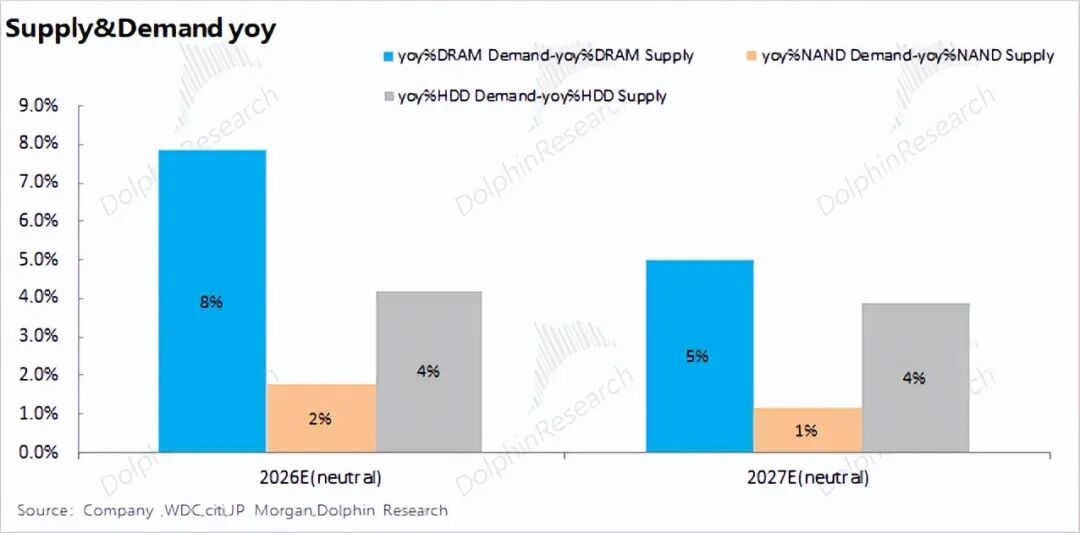
Core Insights - Huang Renxun's speech at CES 2026 has reignited market enthusiasm for storage, particularly with the new Rubin architecture requiring more DDR and NAND compared to the previous Blackwell architecture, leading to a rise in storage stock prices [1] - The market focus has shifted from HBM to traditional storage areas like DDR and NAND, with supply-demand dynamics driving a comprehensive increase in storage prices [1] Group 1: DRAM Market - The supply-demand imbalance for DRAM (including HBM and DDR) is expected to persist until 2027, with demand growth outpacing supply growth during 2026-2027 [2][5] - DRAM production expansion is challenging due to the need for new production lines, leading major manufacturers to focus capital expenditures on DRAM [4] - The demand for DRAM in AI servers is expected to create a significant supply gap by 2027, with a projected demand increase of 222% in 2026 and 80% in 2027 [20][21] Group 2: NAND Market - NAND prices have nearly doubled since the beginning of 2025, driven by supply constraints and increased demand from AI applications [26][28] - The capital expenditure for NAND is expected to rise modestly, with a projected increase to $18.3 billion by 2027, reflecting a compound growth rate of only 6% [30] - The supply-demand gap for NAND is anticipated to remain at 5-6% during 2026-2027, as demand continues to outstrip supply [45] Group 3: HDD Market - HDDs are primarily used for cold storage in AI data centers, with their cost advantage making them a viable option despite slower performance compared to SSDs [48][51] - The supply of Nearline HDDs is expected to grow at 29% in 2026 and 19% in 2027, while demand is projected to increase by 33% and 23% respectively, indicating a tightening supply-demand situation [55]


AI需求推动-NAND与SSD供不应求有望持续
2026-01-13 01:10
Summary of Conference Call Records Industry Overview - The conference call discusses the NAND and SSD market, highlighting the impact of AI demand on storage needs, leading to a sustained supply-demand imbalance in the industry. The shift in data storage structure is driven by AI applications, particularly through RAG technology and KV caching, which significantly increase the demand for active data storage [1][2]. Key Points Market Dynamics - AI-driven storage structure transformation is expected to enhance the demand for active data storage, evolving from a traditional 2:3:5 hot-warm-cold ratio to a 3:7 ratio [1]. - SSDs outperform HDDs in high read/write speeds and low power consumption, making them more suitable for AI data centers. Enterprise NVMe SSDs can achieve continuous read speeds of up to 14,000 MB/s, significantly higher than HDDs [1][5]. - The global NAND and SSD market is anticipated to enter a prolonged boom cycle, with supply concentrated among major players like Samsung and Micron, who are focusing capital expenditures on HBM technology, limiting NAND investments [1][6][7]. Future Projections - Although NAND industry capital expenditures are expected to rebound in 2026 compared to 2023, they will remain below levels seen in 2020-2022. AI applications are projected to drive rapid growth in SSD usage, with global flash memory chip shipments expected to reach around 1,000 EB by 2025 [1][8]. - The domestic market is seeing accelerated progress in the localization of enterprise SSDs and NAND, enhancing the competitiveness of local brands [1][3]. Investment Opportunities - The storage industry presents significant investment opportunities in 2026, driven by AI demand. Key recommended sectors include semiconductor equipment, chip design, storage testing, and storage module manufacturers [2][9][10]. - Notable companies include: - **North Huachuang**: Achieved breakthroughs in high-end logic and storage chips, with advanced equipment in mass production [2][11]. - **Jiangbolong**: A leading storage module manufacturer, has launched innovative enterprise memory products and self-developed eMMC controller chips [2][13]. - **Zhongwei Company**: Focused on plasma etching equipment, showing strong growth in revenue and product advancements [12]. Risks to Monitor - Potential risks include: - AI applications not meeting expectations - Slower-than-expected technological advancements - Delays in domestic production progress These factors could impact industry growth and require strategic adjustments [14].
国产存储芯片,发展到现在,全球份额到底有多高了?
Xin Lang Cai Jing· 2026-01-12 19:15
众所周知,最近一年多以来,整个存储芯片市场,都是大涨特涨。 再说NAND闪存这一方面,国内最强的是长江存储,其市场格局如下。 这个是按照收入来展示的,长江存储在2025三季度时,其营收大约在22亿美元左右,如果放到全球来 看,大约占比是11%。 像三星、SK海力士、美光等厂商,真的是赚疯了,比如三星,按照机构的数据,2025年四季度三星存 储部门的收入高达37.4万亿韩元(259亿美元),创下了历史纪录。 也正因为存储芯片这么涨,所以大家都说,国产存储芯片厂商,也碰到了最好的时机,赚大钱的机会来 了。 那么问题就来了,目前国产存储芯片厂商,到底有多厉害,能够在这一波大涨之中,赚到大钱么? 目前整个存储芯片就两种主要品牌,一种是DRAM内存,一种是NAND闪存,这两种占了所有存储芯片 的95%,其它的相对而言,占比低,也没那么重要。 先说DRAM内存这一方面,国内最强的厂商是长鑫,而全球市场的格局,如下图所示。 这个是截止至2025年三季度的数据,可以看到长鑫存储的全球份额大约在5%左右,排在第四名,而前 面三名是SK海力士,三星、美光,这三家的份额为34%、33%、26%,合计高达93%。 所以国产DRAM内 ...
资讯日报:美国职位空缺和ADP报告显示就业持续降温-20260108
Guoxin Securities Hongkong· 2026-01-08 12:54
Market Overview - The U.S. job openings fell to the lowest level in over a year, indicating a cooling labor market[11] - The ADP report showed moderate growth in private sector employment for December, with labor demand remaining weak[11] - The S&P 500 index's expected price-to-earnings ratio is currently around 22 times, down from 23 times in November but still above the five-year average of 19 times[12] U.S. Stock Market Performance - On Wednesday, the S&P 500 index closed down, primarily due to weakness in financial stocks like JPMorgan and Blackstone[2] - The Nasdaq index saw a slight increase, driven by gains in Nvidia and Alphabet[2] - Major tech stocks mostly rose, with Google A up 2.43% and Microsoft up 1.04%, while Tesla and Apple saw declines of 0.36% and 0.77%, respectively[11] Hong Kong Stock Market Performance - The Hang Seng Index closed at 26,459, down 0.94% for the day, but up 3.23% year-to-date[3] - Technology stocks faced significant declines, with Alibaba down over 3% and Kuaishou down over 2%[9] - The automotive sector also struggled, with NIO dropping over 3% and several other manufacturers down more than 2% due to tightening subsidies and a forecasted 7% decline in China's auto market sales for 2026[9] Sector-Specific Insights - Oil stocks collectively fell, with Kunlun Energy and CNOOC down over 3% amid concerns over increased supply from Venezuela[9] - Pharmaceutical stocks performed well, particularly CRO and CDMO-related companies, with notable gains for clients like Kelaiying and Tigermed, rising 8.92% and 8.88% respectively[9] - The paper industry saw gains, with Nine Dragons Paper up 8.97% due to supply cuts and price increases announced by major companies[9]
中邮证券:英伟达(NVDA.US)Vera Rubin重构AI存储层级 NAND有望成为通胀品
智通财经网· 2026-01-08 08:13
Core Insights - Nvidia's new AI supercomputing platform, Vera Rubin, has officially entered full production, aiming to address the "memory wall" issue by restructuring the HBM-DRAM-NAND storage architecture [1][2] - The platform features significant upgrades, including the integration of HBM4 memory, which enhances bandwidth and processing capabilities, potentially leading to improved profit margins for manufacturers [1][3] Group 1: Storage Architecture - Vera Rubin redefines the storage pyramid by introducing a new memory architecture that significantly increases the processing capacity of context memory, allowing for a fivefold increase in token processing per second [2] - The integration of BlueField-4 processors within the Vera Rubin platform is designed to manage KVCache effectively, enhancing overall system performance [5] Group 2: HBM and DRAM Upgrades - The Rubin GPU is equipped with HBM4, which has doubled the interface width compared to HBM3e, achieving a bandwidth of 22TB/s, nearly tripling that of the previous generation [3] - Vera CPU has been upgraded to LPDDR5X, providing a high bandwidth of 1.2TB/s while maintaining low power consumption, which supports efficient multi-model execution and reduces data movement costs [4] Group 3: NAND Market Outlook - The introduction of the BlueField-4 driven context memory storage platform is expected to correlate linearly with GPU quantities, indicating a potential inflationary trend in NAND prices due to rising demand from cloud service providers and AI applications [5] - The industry anticipates a double-digit percentage increase in NAND prices throughout 2026, driven by the growing needs of cloud services and AI applications [5] Group 4: Investment Recommendations - The report suggests focusing on key players in the storage supply chain, including major overseas companies like SK Hynix, Samsung, Micron, SanDisk, and Kioxia, as well as domestic firms such as Shannon Semiconductor, Demingli, Zhaoyi Innovation, Purun Co., and Tongyou Technology [6]
英伟达VeraRubin重构AI存储层级,NAND有望成为通胀品
China Post Securities· 2026-01-08 04:54
Industry Investment Rating - The industry investment rating is maintained at "Outperform the Market" [2] Core Viewpoints - The report highlights the significant advancements in storage architecture driven by NVIDIA's Vera Rubin platform, which aims to address the "memory wall" issue in AI applications. The new GPU architecture shows substantial improvements in processing power and memory bandwidth [5][6] - The storage industry is expected to experience a narrative upgrade, with a focus on key players in both overseas and domestic markets, including major companies like SK Hynix, Samsung, and Micron, as well as domestic firms like Shannon Semiconductor and Zhaoyi Innovation [8] Summary by Relevant Sections Industry Basic Situation - The closing index level is 5469.82, with a 52-week high of 5841.52 and a low of 3966.07 [2] Industry Relative Index Performance - The relative performance of the computer industry compared to the CSI 300 index shows fluctuations, with a peak increase of 40% observed from January 2025 to January 2026 [4] Recent Research Reports - The report discusses NVIDIA's Vera Rubin platform, which has entered full production and is expected to significantly enhance AI computing capabilities. The new GPU architecture features a processing power of 50 PFLOPS for inference and 35 PFLOPS for training, with a memory bandwidth of 22 TB/s [5][6] - The report emphasizes the introduction of a new storage architecture that integrates HBM, DRAM, and NAND technologies, which is crucial for managing the increasing demands of AI applications [6][7] Investment Recommendations - The report suggests focusing on the storage supply chain, recommending both international leaders and domestic companies as potential investment opportunities [8]
内存条涨疯了,国产替代如何破局?
虎嗅APP· 2026-01-08 00:10
Core Viewpoint - The article discusses the significant price increase of memory chips, particularly 32GB memory modules, which have surged from under 800 yuan at the beginning of the year to over 2200 yuan currently, leading to comparisons with gold bars due to their high value [4][5]. Group 1: Price Trends and Market Dynamics - Since Q3 2025, the global memory chip market has experienced an "epic" price surge, with DRAM prices increasing by 171.8% compared to the same period in 2024, significantly outpacing the less than 110% increase in international spot gold prices [12]. - Major storage manufacturers, including Samsung, Micron, and SK Hynix, have reported substantial profit increases due to rising memory prices, with Samsung's operating profit reaching approximately $8.56 billion, a 32.2% year-on-year increase [17]. - Analysts predict that memory prices will continue to rise, with a forecasted additional increase of 20% early next year and sustained price growth potentially lasting until mid-2026 [14][15]. Group 2: Impact on Supply Chain and Consumer Electronics - The rising cost of memory chips is expected to increase the overall costs of smartphones and computers, as memory components account for 10%-20% of the BOM (Bill of Materials) costs [23][24]. - Smartphone and computer manufacturers face three difficult choices in response to rising memory costs: maintain configurations at original prices, reduce configurations while keeping prices stable, or increase prices, which may deter consumers and impact sales [25][26]. Group 3: Supply and Demand Factors - The price increase is attributed to a dynamic interplay between supply and demand, with supply constraints arising from manufacturers' previous production cuts during industry downturns and demand surges driven by applications such as artificial intelligence [28][32]. - The production of memory chips is capital-intensive and has long lead times, making it difficult for supply to quickly respond to sudden increases in demand [37]. Group 4: Market Structure and Competitive Landscape - The global memory market is dominated by manufacturers from the US, Japan, and South Korea, with Samsung, SK Hynix, and Micron holding over 93% of the DRAM market share [53]. - Chinese companies like Changxin Storage and Yangtze Memory Technologies are emerging but still lag significantly behind leading firms, particularly in high-bandwidth memory (HBM), where 99% of the market is controlled by the top three companies [57]. Group 5: Geopolitical and Technological Challenges - The Chinese memory chip industry faces significant challenges, including geopolitical tensions and technology barriers, which hinder its ability to compete effectively in the global market [64][66]. - The recent price surge presents both challenges and opportunities for Chinese companies to accelerate technological advancements and improve efficiency, while also highlighting the need for a comprehensive strategy to overcome systemic issues in the industry [68][69].

研报 | MLC NAND Flash转向利基型产品,大厂淡出供应引发供应链重组
TrendForce集邦· 2026-01-07 09:01
Core Insights - The article highlights a significant reduction in global MLC NAND Flash production capacity, projected to decrease by 41.7% in 2026 due to major manufacturers exiting or scaling back production [2][4]. - Samsung, the largest supplier, announced the end of MLC NAND Flash production, with the last shipment scheduled for June 2026, leading to a supply shortage and increased prices [4]. - Demand for MLC NAND Flash remains stable, primarily driven by industrial control, automotive electronics, medical devices, and networking, although long-term growth potential is limited [4]. Supply and Demand Dynamics - The supply of MLC NAND Flash is contracting significantly, with Samsung's exit being a major factor. Other manufacturers like Kioxia, SK Hynix, and Micron are focusing on existing customer needs rather than expanding production [4]. - The market has seen a noticeable increase in demand for MLC NAND Flash since Q1 2025, resulting in price hikes due to supply shortages [4]. - The long-term supply chain for MLC NAND Flash is disrupted, creating opportunities for companies like Macronix, which is shifting focus from NOR Flash to MLC NAND Flash to meet niche demands [5]. Market Implications - The contraction in MLC NAND Flash supply is expected to lead to a more concentrated supply chain, which may alleviate previous price pressures in the NOR Flash market as Macronix reduces its NOR Flash capacity [5]. - The overall NAND Flash market may experience a reversal in sentiment if certain applications accelerate the adoption of enhanced TLC solutions, potentially putting indirect pressure on MLC product prices [4].
大摩调研:内存价格飙升,安卓和PC都遇冲击,但苹果今年不涨价
Hua Er Jie Jian Wen· 2026-01-07 05:38
Core Insights - A "cost storm" in the hardware industry is being driven by a surge in memory prices, with DRAM contract prices expected to rise by 40-70% and NAND prices by 30-35% in Q1 2026, significantly exceeding previous forecasts [1][2] - Most OEM manufacturers, except Apple, are expected to raise prices substantially in the first half of 2026, potentially leading to a decline in shipments of Android smartphones and Windows PCs throughout the year [1][3] - Apple has locked in favorable memory prices and plans to maintain product pricing, which may allow it to gain market share in the iPhone and Mac segments in 2026 [1][4] Memory Price Surge - TrendForce predicts DRAM contract prices will increase by 40-70% in Q1 2026, compared to an earlier estimate of 15-23%, while NAND prices are expected to rise by 30-35%, up from 15-25% [2] OEM Manufacturer Strategies - The anticipated price increases are prompting customers to place orders early, leading to strong performance in Q4 2025 and Q1 2026, but demand is expected to weaken in the second half of 2026 [3] - Server OEMs are likely to see a 5% increase in general server shipments in Q1 2026, contrary to the typical seasonal decline of 10-15% [3] - Dell and HP may initiate significant layoffs to protect operating margins due to rising cost pressures [8] Apple’s Market Position - Apple is maintaining stable product prices despite rising memory costs, which is expected to help it achieve growth in iPhone and Mac shipments in 2026 [4][5] - Apple plans to launch a low-cost MacBook priced at $599 in the first half of 2026, which could further enhance its market share in the PC segment [5] HDD Supply Crisis - The HDD supply shortage is worsening, with a projected shortfall of 200EB over the next 12 months, up from a previous estimate of 100-150EB [6] - HDD manufacturers are reallocating production capacity from consumer-grade to cloud storage applications to meet increasing demand [7] AI Server Market Dynamics - The demand for AI servers is strong, but profit margins remain low, with major OEMs facing ongoing price competition [10]
