
泸州老窖

Search documents
2026年食品饮料行业投资策略:黎明前夕,曙光将至
Shenwan Hongyuan Securities· 2025-11-17 10:12
Summary of Key Points Group 1: Overall Industry Analysis - The report indicates a systemic recovery opportunity for the food and beverage industry in 2026 after a five-year adjustment period from 2021 to 2025, with key external indicators being the Consumer Price Index (CPI) and a focus on cyclical attributes in the liquor and catering supply chain [4][19]. - The liquor sector is expected to see a fundamental turning point in Q3 2026, following a significant decline in sales and prices in Q3 2025, with a projected stabilization and recovery in prices as inventory clears and demand rebounds [4][7][19]. - The report emphasizes that if the fundamentals recover as anticipated, a dual boost in valuation and performance is expected by the end of 2026 and into 2027, marking a strategic allocation period for quality companies [4][7][19]. Group 2: Liquor Investment Strategy - The liquor sector has experienced a significant decline in sales, with Q3 2025 showing a 50% year-on-year drop compared to Q3 2023, and high-end liquor prices continuing to fall as the market seeks a balance between volume and price [4][7][8]. - Key recommended companies in the liquor sector include Luzhou Laojiao, Shanxi Fenjiu, Kweichow Moutai, and Wuliangye, with a focus on strategic positioning for quality firms as the market stabilizes [4][7][8]. - Historical performance analysis from 2012 to 2015 suggests that stock price turning points often precede fundamental turning points, indicating a potential recovery in Q3 2026 [4][7][23]. Group 3: Consumer Goods Investment Strategy - The report identifies systemic opportunities in the consumer goods sector, with CPI as a core observation indicator, predicting gradual improvement in food CPI due to structural demand changes and a shift from price competition to quality competition among companies [4][19]. - Recommended companies in the consumer goods sector include Yili Group, Qingdao Beer, Anjuke Food, and Tianwei Food, with a focus on firms that possess pricing power and are positioned for systematic recovery if CPI continues to improve [4][19]. - The report highlights that if CPI improves consistently, leading companies in various sub-sectors will also experience systematic recovery [4][19].



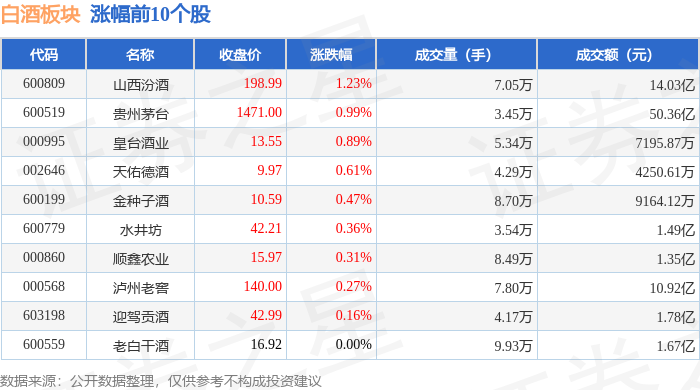
白酒板块11月17日涨0.58%,山西汾酒领涨,主力资金净流出1.06亿元
Zheng Xing Xing Ye Ri Bao· 2025-11-17 08:49
Core Viewpoint - The liquor sector experienced a slight increase of 0.58% on November 17, with Shanxi Fenjiu leading the gains, while the overall market indices showed a decline [1] Group 1: Market Performance - The Shanghai Composite Index closed at 3972.03, down 0.46%, and the Shenzhen Component Index closed at 13202.0, down 0.11% [1] - Shanxi Fenjiu's stock price rose by 1.23% to 198.99, while Kweichow Moutai increased by 0.99% to 1471.00 [1] Group 2: Liquor Stocks Performance - The following liquor stocks showed notable performance: - Qingdao Wenzhou rose by 0.89% to 13.55 - Tianyoude Liquor increased by 0.61% to 9.97 - Water Well Tavern rose by 0.36% to 42.21 [1] - Conversely, some stocks experienced declines, such as: - Yanghe Co. fell by 2.03% to 68.46 - Quanhui Liquor decreased by 1.27% to 20.91 [2] Group 3: Capital Flow - The liquor sector saw a net outflow of 1.06 billion from main funds and 1.45 billion from speculative funds, while retail investors contributed a net inflow of 2.52 billion [2] - Specific capital flows for key stocks included: - Kweichow Moutai had a net inflow of 134 million from main funds but a net outflow of 1.33 billion from speculative funds [3] - Luzhou Laojiao saw a net inflow of 26.95 million from main funds but a net outflow of 59.68 million from retail investors [3]


白酒能抄底吗
新财富· 2025-11-17 08:04
Core Viewpoint - The article discusses the significant decline in the Chinese liquor industry, particularly focusing on the performance of major brands like Moutai and Wuliangye, highlighting the challenges and potential investment opportunities within the sector [4][11][12]. Industry Overview - As of Q3 2025, the liquor industry experienced a revenue decline of 6%, with a more pronounced drop of 13% when excluding Moutai. Net profit also fell by 7%, with a 18% decline when excluding Moutai [4]. - The industry is entering its first year of performance decline since the peak in July 2021, with Q3 2025 showing a 19% revenue drop and a 22% net profit decline [4][5]. Company Performance - Moutai's revenue growth was 15.71% in 2024, but it dropped to 0.56% in Q3 2025. In contrast, Wuliangye's revenue growth fell sharply to -52.66% in Q3 2025 [5]. - The financial data indicates that the liquor industry is undergoing a significant "performance washout," marking a shift from growth to a more cyclical and dividend-focused investment approach [11][12]. Market Sentiment - Despite the poor performance of Wuliangye's Q3 report, the stock price did not react negatively, suggesting that the market still favors the liquor sector, viewing the report as a sign of proactive adjustments by companies [6]. - Investors are increasingly looking at the liquor sector as a "valuation pit" with high safety margins, especially after a prolonged period of declining valuations [7]. Pricing and Inventory Dynamics - The article notes that the pricing of high-end liquor products has been under pressure, with Moutai's price dropping by approximately 600 yuan annually for two consecutive years [19]. - Inventory levels are not significantly rising, but the structure and distribution of inventory are concerning, as sluggish sales hinder effective turnover [16][17]. Future Outlook - The industry is expected to remain in a downward cycle, with no clear bottom in sight. The resilience of distribution channels is still present, but the adjustment period may be longer than anticipated [22][23]. - The overall market is experiencing a downward shift in price bands, with the main consumption range moving downwards, indicating a contraction in market size [23].

食品饮料行业周报:CPI催化预期,底部价值凸显-20251117



Haitong Securities International· 2025-11-17 07:10
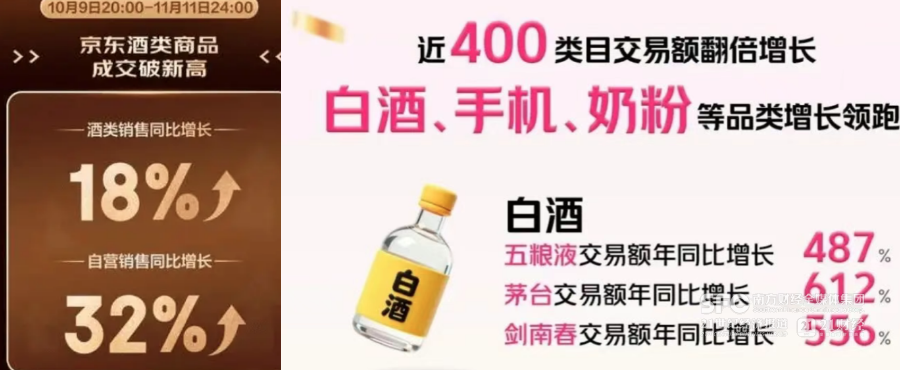
Investment Rating - Investment advice indicates a sector recovery catalyzed by recent CPI data, focusing on growth and supply-demand inflection points [5][16]. Core Views - The report emphasizes the importance of consumer goods growth, particularly in beverages, snacks, and food ingredients, while also highlighting structural opportunities in the baijiu sector [5][16]. - CPI data shows a positive trend with October CPI year-on-year at +0.2% and core CPI at +1.2%, indicating a recovery in domestic demand [6][16]. - The baijiu industry is undergoing accelerated clearing, with expectations for improved sales and inventory adjustments leading into 2026 [7][16]. - Consumer goods are expected to benefit from stabilization and recovery, with a focus on low valuation and high dividend stocks [8][16]. Summary by Sections Investment Recommendations - Recommended baijiu stocks include Shanxi Xinghuacun Fen Wine Factory, Gujing Distillery, and stable targets like Kweichow Moutai and Wuliangye [5][16]. - Beverage growth is highlighted with recommendations for Eastroc Beverage and Nongfu Spring, alongside low valuation stocks like China Foods and Tingyi [5][16]. - Snack and food ingredient stocks recommended include Bailong Chuangyuan, Yankershop Food, and Three Squirrels [5][16]. - Beer recommendations include Yanjing Brewery and Tsingtao Brewery, while condiment stocks like Haitian Flavoring & Food are also suggested [5][16]. Baijiu Sector Insights - The baijiu sector is experiencing a significant adjustment, with industry destocking still in progress and a focus on promotional sales for 2026 [7][16]. - Recent sales data from JD.com shows a +18% year-on-year increase in liquor sales during the Double 11 shopping festival, indicating a positive market response [7][16]. Consumer Goods Outlook - Consumer goods are expected to see growth as the mainline, with structural differentiation evident in beverages, snacks, and health products [8][16]. - The report notes that companies with product innovation and channel expansion will have growth advantages, particularly in the context of recent service and non-food price recoveries [8][16].
头部酒企加速出海!食品ETF(515710)盘中下挫!机构:白酒去库存阶段景气回升在望
Xin Lang Ji Jin· 2025-11-17 06:32
Group 1 - The food ETF (515710) showed weak performance with a decline of 0.32% and a trading volume of 54.66 million yuan as of November 17 [1] - Leading stocks in the food sector included Tianwei Food, Lianhua Holdings, and Kweichow Moutai, with increases of 2.06%, 1.37%, and 0.65% respectively [1] - Conversely, Dongpeng Beverage, Yunnan Energy Investment, and Yanghe Distillery experienced declines of 3.02%, 2.34%, and 2.33% respectively [1] Group 2 - The white liquor industry is undergoing a destocking phase, with expectations of recovery in demand and economic revival by Q4 2025 [2] - The trend towards healthier snacks is evident, with categories like konjac continuing to benefit, and leading companies are expected to gain from this trend [2] - The dairy product demand is gradually recovering, with raw milk prices potentially stabilizing [2] Group 3 - The food ETF and its linked funds passively track a segmented food index, with the top ten weighted stocks including Kweichow Moutai, Wuliangye, and Yili [2]


行业点评报告:10月社零增速延续回落,部分消费结构性回暖
KAIYUAN SECURITIES· 2025-11-17 06:12
Investment Rating - The industry investment rating is "Positive" (maintained) [1] Core Viewpoints - The report indicates that while the overall retail sales growth has declined, there is a marginal improvement in food and beverage consumption driven by holiday spending. The expectation is for more fiscal policies to support domestic demand recovery [4][5] - The white liquor sector is nearing a bottoming phase, suggesting it is a good time for gradual investment. Recommended stocks include Kweichow Moutai, Luzhou Laojiao, Shanxi Fenjiu, Shede Liquor, and Yanghe Brewery [4] - In the mass consumer goods sector, there is a focus on growth through new channels, products, and markets, with key companies to watch being Weilong Delicious, Ximai Food, Yanjinpuzi, and Bairun Co [4] Summary by Sections Retail Sales Performance - In October 2025, the total retail sales of consumer goods increased by 2.9% year-on-year, with a month-on-month decline of 0.1 percentage points. The food, beverage, tobacco, and catering sectors showed marginal recovery due to holiday consumption [5][8] - Specific growth rates for October 2025 include: grain and oil food at +9.1%, beverages at +7.1%, and tobacco at +4.1%, indicating a positive trend in essential consumption [5][10][11] Quarterly Outlook - The report anticipates a continued decline in retail sales growth for Q4 2025, but expects marginal improvements in food and beverage consumption. The October retail sales growth decreased by 0.6 percentage points compared to Q3 2025, primarily due to weaker subsidy effects and high base comparisons [5][6] Industry Observations - The white liquor industry is still in a bottoming phase, with structural differentiation in consumption patterns. While high-end gifting remains stable, business consumption is lagging [6] - The snack food sector shows resilience, benefiting from high-frequency demand and holiday consumption, with leading companies enhancing competitiveness through innovation and channel expansion [6]
双十一电商酒水集体大涨;10月烟酒消费增长4%|观酒周报
2 1 Shi Ji Jing Ji Bao Dao· 2025-11-17 00:49
Industry Overview - The "Double Eleven" shopping festival has shown significant growth in the liquor category, with major brands like Moutai, Wuliangye, and Luzhou Laojiao leading the sales surge across platforms such as Tmall, JD, Meituan, and Douyin [1][3] - JD's report indicates that liquor sales from October 9 to November 11 increased by 18% year-on-year, with self-operated liquor sales rising by 32% [3] - Meituan's report highlights that the white liquor category saw exceptional growth, with Wuliangye's transaction amount increasing by 487% and Moutai's by 612% year-on-year [3] Sales Performance - The overall retail sales of tobacco and liquor products in October grew by 4.1% year-on-year, contributing to a 4% increase from January to October [4] - In the first three quarters of 2025, the export volume of liquor increased by 31%, while the total export value reached $1.47 billion, marking a 7.9% increase [5][6] Brand Performance - Top-selling liquor brands during the Double Eleven included Jian Nan Chun, Moutai, Guojiao 1573, and others, with Jian Nan Chun ranking first in Tmall's white liquor sales [3] - The export of beer reached $410 million, with a year-on-year growth of 17.2%, while wine exports saw a remarkable increase of 137% in value [5][6] Company Developments - Qingdao Beer announced its commitment to a diversified strategy despite the termination of its acquisition of a yellow wine company, indicating ongoing interest in non-beer business opportunities [8] - The company also integrated the Qingdao Beverage Group into its operations, focusing on business synergies and potential future listings [8] Regulatory and Market Challenges - Various liquor companies are enhancing measures to combat counterfeit products, with brands like Niulanshan and Xijiu implementing new anti-counterfeiting technologies [7] - Zhenjiu has temporarily halted recruitment in several provinces to ensure market stability, indicating proactive measures to manage distribution channels [12] Management Changes - Diageo appointed Dave Lewis as the new CEO, effective January 1, 2026, bringing extensive experience in marketing and brand management [15] - The establishment of the Fuyang City Wine Association saw the election of Jia Guangming as president, reflecting ongoing leadership changes within the industry [16]
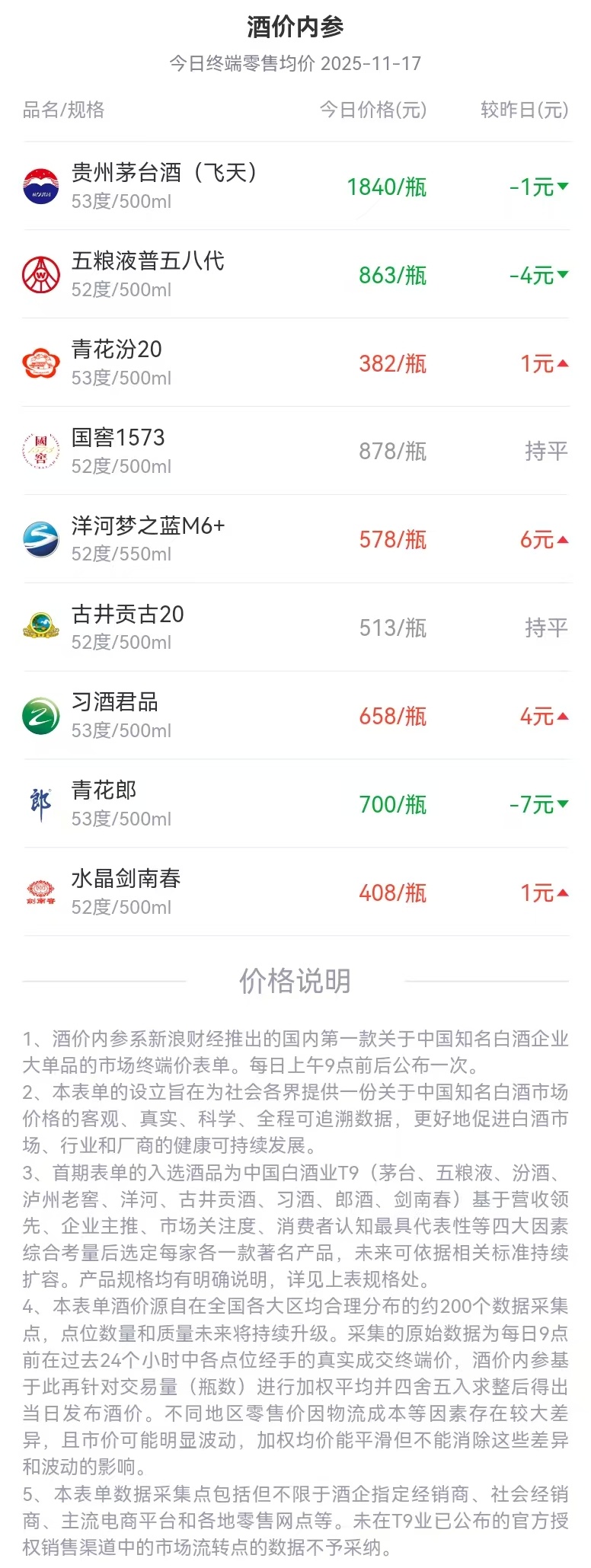
酒价内参11月17日价格发布 整体价格稳定飞天微跌1元
Xin Lang Cai Jing· 2025-11-17 00:31
Core Insights - The overall retail price of major products in the Chinese liquor industry remains stable, with some brands experiencing price increases [1] Price Changes - Yanghe Dream Blue M6+ saw a price increase of 6 yuan per bottle, marking its third consecutive day of price rise [1] - Xijiu Junpin increased by 4 yuan per bottle, continuing its second day of growth [1] - Qinghua Fen 20 and Shuijing Jian'nanchun both experienced a slight increase of 1 yuan per bottle [1] - Guizhou Moutai Feitian's price decreased slightly by 1 yuan per bottle [1] Price Table Summary - Guizhou Moutai Feitian (53°/500ml) priced at 1840 yuan, down by 1 yuan [3] - Wuliangye Pu Wu 8th generation (52°/500ml) priced at 863 yuan, down by 470 yuan [3] - Qinghua Fen 20 (53°/500ml) priced at 382 yuan, up by 1 yuan [3] - Guojiao 1573 (52°/500ml) priced at 878 yuan, unchanged [3] - Yanghe Dream Blue M6+ (52°/550ml) priced at 578 yuan [3] - Xijiu Junpin (52°/500ml) priced at 658 yuan [3]
从三季报看中国经济:新消费潜力迸发
Jing Ji Ri Bao· 2025-11-17 00:03
Core Viewpoint - The third-quarter reports of listed companies reflect the resilience and vitality of China's consumer market, indicating a structural adjustment period in the consumption sector with both challenges and opportunities [1] Overall Recovery - The consumer sector shows a steady recovery overall, but there is uneven performance across different segments. Essential consumption remains stable, while discretionary consumption is experiencing a divide [2] - Essential consumption sectors like food and beverages are performing well due to their necessity, with leading companies showing stable revenue and profit growth [2] - The liquor industry, representing traditional high-end consumption, is under pressure, with major companies like Wuliangye and Luzhou Laojiao reporting significant declines in revenue and profit [2] - In contrast, the new energy vehicle industry is thriving, benefiting from policy support and product upgrades, becoming a key growth driver in the consumer sector [2] Channel Transformation - Traditional retail companies are accelerating their online transformation, integrating online and offline channels to capture market changes, with those embracing digitalization seeing growth [3] Cost Pressures - Global commodity prices remain high, putting pressure on raw material and logistics costs, which challenges the gross margins of mid-to-low-end consumer companies [4] - Companies that optimize product structures and improve supply chain efficiency are demonstrating stronger profitability and market competitiveness [4] Structural Highlights - A number of structural highlights are emerging, driving high-quality development in consumer-related listed companies through innovation in technology, business models, and consumer scenarios [5] - In the smart home sector, companies like Ecovacs and Haier are experiencing significant profit growth, with Ecovacs reporting a 131% increase in net profit [5] - The traditional consumption sector is exploring new business models, with companies like Kweichow Moutai and Mercury Home Textiles achieving double-digit growth through innovative product offerings [6] New Consumption Scenarios - Companies are actively transforming to capture new consumption trends, with firms like Golden Dragon Fish and Miaokelando reporting substantial profit increases due to cost improvements and channel optimization [8] - The consumer market is becoming increasingly segmented, with new brands focusing on specific demographics and scenarios, such as new-style tea drinks and pet economy products [8] - Domestic brands are gaining market share and showing strong performance in sectors like sportswear and beauty products, driven by cultural confidence and supply chain advantages [8] Market Dynamics - The consumer market is undergoing structural upgrades, with recovery being uneven due to factors like income expectations and regional disparities [9] - Companies with strong brand barriers and unique market advantages are favored by capital, while those embracing new trends and product iterations can still find growth opportunities [9] - The competition is shifting from traditional versus new consumption to the operational efficiency and strategic vision of different companies within the same industry [9] High-Quality Development - The recovery trend in China's consumer market is moving from total growth to structural optimization, with companies encouraged to focus on high-quality development through innovation [10]



新消费潜力迸发
Jing Ji Ri Bao· 2025-11-16 21:52
Core Insights - The third-quarter reports of listed companies reflect the resilience and vitality of China's consumer market, indicating a structural adjustment period with both challenges and opportunities [1] Overall Recovery - The consumer sector shows a steady recovery overall, but there is uneven performance across different segments. Essential consumption remains stable, while discretionary consumption is experiencing a divide [2] - Essential consumption sectors like food and beverages are performing well due to their necessity, with leading companies showing stable revenue and profit growth. For instance, Wuliangye reported a 52.66% year-on-year decline in Q3 revenue to 8.174 billion yuan, and a 65.62% drop in net profit to 2.019 billion yuan [2] - In contrast, the new energy vehicle industry is thriving, benefiting from policy support and product upgrades, becoming a key growth driver in the consumer sector [2] Channel Transformation - Traditional retail companies are accelerating their online transformation, integrating online and offline channels. Companies that embrace digitalization are capturing the benefits of this channel transformation [3] Cost Pressures - Global commodity prices remain high, putting pressure on raw material and logistics costs, which challenges the gross margins of mid-to-low-end consumer companies. Companies that optimize product structures and improve supply chain efficiency are showing stronger profitability [4] Structural Highlights - A number of structural highlights are emerging, driving high-quality development in consumer-related listed companies through innovation in technology, business models, and consumer scenarios [5] - In the smart home sector, companies like Ecovacs and Haier are experiencing significant profit growth, with Ecovacs reporting a 131% year-on-year increase in net profit [5] Innovation in Business Models - Traditional consumption sectors are exploring new business models, with companies like Kweichow Moutai and Water Mercury Home Textiles achieving double-digit growth through innovative product offerings and marketing strategies [6] New Consumption Scenarios - Companies are actively transforming to capture new consumption trends, with firms like Golden Dragon Fish and Miaokelando reporting significant profit increases due to cost improvements and channel optimization [8] - The rise of domestic brands is notable, with many achieving excellent performance in revenue growth and market share, particularly in sectors like sportswear and beauty products [8] Market Dynamics - The consumer market is undergoing structural upgrades, with disparities in recovery driven by factors such as income expectations and consumer confidence. Companies with strong brand barriers and unique market advantages are favored by capital [9] - The competition is intensifying among quality sectors, with a focus on operational efficiency and strategic vision. Companies that adapt to new trends and innovate their product offerings are likely to find growth opportunities [10]