中国中铁

Search documents
房地产风向标系列:人民城市建设:新型城镇化与城市更新
Tianfeng Securities· 2025-07-15 09:15
Group 1 - The report outlines the evolution of urban development in China, transitioning from population control in the 1960s to a focus on quality improvement and the concept of "People's City" by 2015 [1][12][14] - The new urbanization strategy emphasizes a people-centered approach, regional coordination, and urban renewal as key components for high-quality development [2][28] - The report highlights the importance of urban renewal in reshaping urban functions, enhancing living quality, and preserving historical culture, marking a shift from expansion to upgrading existing urban areas [3][35] Group 2 - The urban renewal policy has evolved from addressing basic living conditions to creating "livable, resilient, and smart cities," indicating a shift towards sustainable and multi-dimensional urban renewal mechanisms [3][42] - The report suggests that urban renewal will focus on upgrading old residential areas, improving infrastructure, and enhancing cultural heritage protection, aligning with the broader goals of urban modernization [4][34] - The investment landscape for urban renewal includes sectors such as interior design, building materials, underground utilities, elevators, urban planning, and smart city technologies [4][28]
建筑建材双周报(2025年第12期):“反内卷”与城市更新共振,建筑建材供需格局有望改善-20250715
Guoxin Securities· 2025-07-15 05:14
Investment Rating - The report maintains an "Outperform" rating for the construction materials sector, indicating expected performance above the market index by over 10% [4][70]. Core Views - The construction materials sector is expected to benefit from a shift towards healthy competition driven by technological innovation and quality, as highlighted by a recent initiative from the State-owned Assets Supervision and Administration Commission and the All-China Federation of Industry and Commerce [1]. - The demand side is anticipated to see a release of new demand due to urban renewal, leading to a marginal improvement in the supply-demand balance in the construction materials industry [1]. Summary by Sections Cement - National cement prices decreased by 0.4% week-on-week, with specific regions like Anhui, Hubei, and Shaanxi seeing declines of 10-20 CNY per ton. Despite seasonal demand weakness, major enterprises maintained an average shipment rate of 43% [2][20]. - Future price trends are expected to show slight fluctuations due to planned price increases in regions like Ningxia and the Yangtze River Delta, although demand remains subdued [2][20]. Glass - The domestic float glass market saw stable prices with minor increases, driven by some replenishment demand from downstream sectors. However, supply-demand contradictions persist, and manufacturers are focused on sales [2][34]. - The photovoltaic glass market is under pressure, with low operating rates among downstream component manufacturers leading to cautious purchasing behavior [2][37]. Fiberglass - The price of domestic non-alkali roving remained stable, with the average price for 2400tex winding direct yarn at 3,300-3,700 CNY per ton, unchanged from the previous week [2][40]. - Electronic yarn prices are expected to rise due to tight supply-demand conditions, with G75 electronic yarn quoted at 8,800-9,200 CNY per ton [2][40]. Investment Recommendations - The report suggests focusing on resilient consumer building material leaders, particularly those benefiting from second-hand housing and stock renovation demand, recommending companies like Sanke Tree, Beixin Building Materials, and others [3]. - For the cement and fiberglass sectors, companies like Conch Cement and China Jushi are highlighted for their potential recovery in performance [3]. - In the construction sector, firms such as China Railway Construction and China State Construction Engineering are recommended due to their improving asset quality amid a challenging environment [3].
上半年成交破千亿后,北京土拍节奏又乱了
Sou Hu Cai Jing· 2025-07-15 04:30
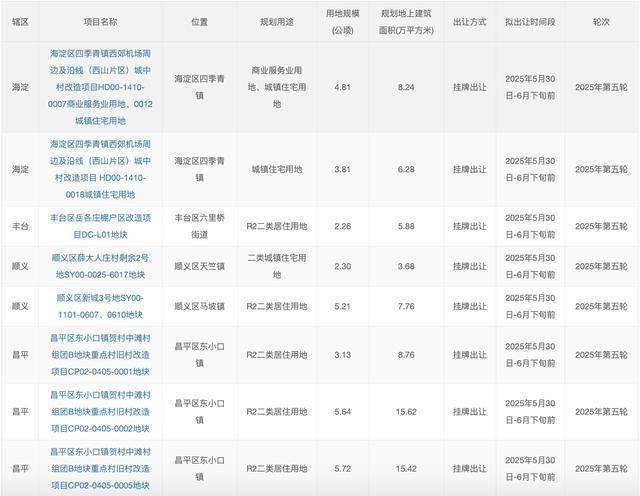
Core Viewpoint - Beijing's land market has experienced a sudden slowdown after a series of high-quality land sales in June, with only a few transactions expected to occur at the base price in July [1][4]. Group 1: Land Supply and Transactions - In July, only two land parcels are expected to be sold at the base price: the Zhongjian Fangcheng land in Yanqing and the Changping land [1]. - The land supply list, which was regularly updated at the end of each month, has not been updated since the fifth round [1][4]. - A total of 22 residential land parcels were sold in Beijing in the first half of the year, amounting to 100.56 billion yuan, with a residential building area of approximately 2.17 million square meters, remaining stable compared to the previous year [18][19]. Group 2: Upcoming Land Projects - The upcoming land projects include several residential and commercial parcels in various districts, with a focus on areas with strong market demand and well-developed infrastructure [4][19]. - Specific projects include: - In Haidian District, two parcels for residential use with a total area of 8.62 hectares and a planned building area of 145,200 square meters [8]. - In Fengtai District, a parcel for residential use with an area of 2.26 hectares and a planned building area of 58,800 square meters [11]. - In Changping District, three parcels for residential use with a total area of 14.49 hectares and a planned building area of 398,000 square meters [13]. - In Shunyi District, two parcels for residential use with a total area of 5.1 hectares and a planned building area of 77,600 square meters [17]. Group 3: Market Trends and Pricing - The average premium for land parcels has been low, with 13 parcels sold at the base price and only 7 parcels achieving a premium of over 10% [19]. - The total transaction amount for land in the first half of the year showed a significant increase of approximately 37.3% compared to the same period last year [19].

中国资产重估,首选低PB策略
Huafu Securities· 2025-07-14 11:34
Long-term Logic - The global restructuring and economic transformation in China are highlighted as key drivers for investment strategies, with a shift from a US-dominated global division of labor to a more balanced approach favoring China [2][11]. - China's economy is transitioning from high-speed growth to high-quality development, with a notable decline in real estate and infrastructure investment, leading to improved cash flow and asset quality [12][16]. Mid-term Logic - The current economic cycle is at a low point, with weak demand and low inflation suppressing corporate investment, prompting companies to reduce capital expenditures [17][21]. - As companies focus on asset quality and cash flow, the market is expected to shift its valuation anchor from earnings to net assets, making price-to-book (PB) ratios more relevant [17][21]. Short-term Catalysts - External factors, such as the US's reverse globalization policies, are creating favorable conditions for Chinese assets, with a passive appreciation of the RMB and increased capital inflow [22][28]. - Domestic policies emphasizing "de-involution" are leading to expectations of capacity reduction in traditional industries, further supporting asset revaluation [28]. Industry Selection - The report identifies Hong Kong's financial, real estate, construction, and energy sectors as having better value propositions, with many industries exhibiting low PB ratios [6][37]. - Specific stocks with PB ratios below 2 and market capitalizations above 500 billion yuan are highlighted, indicating potential investment opportunities in these sectors [40][41].
招商蛇口21.5亿竞得深圳新单价地王 楼面价达8.4万元/平
news flash· 2025-07-14 08:42
深圳前海桂湾片区一宗住宅用地于7月14日完成出让,该地块建筑面积25600平方米,挂牌起始价11.58 亿元,吸引了包括中铁、 保利置业、中建壹品、华发、绿城、金茂、越秀、建发、中海、招商、 华润 等在内的12家 房企参与。该地块经过158轮报价后,最终由 招商蛇口以21.55亿元的价格摘得,溢价率 86.1%,成交楼面价约8.4万元/平方米。该成交楼面价刷新了深圳涉宅用地成交楼面价TOP1位置,成为 深圳新的单价地王。(记者 李洁) ...

港股基建股异动拉升,中国中车(01766.HK)涨近9%,时代电气(03898.HK)涨超5.5%,中国中冶(01618.HK)、中国中铁(00390.HK)、中国铁建(01186.HK)、中国交通建设(01800.HK)等多股均涨超2%。
news flash· 2025-07-14 02:24
Group 1 - Infrastructure stocks in Hong Kong experienced significant upward movement, with China CRRC (01766.HK) rising nearly 9% [1] - Times Electric (03898.HK) saw an increase of over 5.5% [1] - Other companies such as China Metallurgical Group (01618.HK), China Railway (00390.HK), China Railway Construction (01186.HK), and China Communications Construction (01800.HK) also reported gains exceeding 2% [1]




建筑企业联合倡议反内卷,企业盈利有望改善,建议关注低估值高股息标的
Guotou Securities· 2025-07-14 02:04
2025 年 07 月 14 日 建筑 建筑企业联合倡议反内卷,企业盈利有 望改善,建议关注低估值高股息标的 | 投资评级 | 领先大市-B | | --- | --- | | | 维持评级 | | 行业表现 | | | | | --- | --- | --- | --- | | 39% | 建筑 | 沪深300 | | | 29% | | | | | 19% | | | | | 9% | | | | | -1% | | | | | -11% | | | | | 2024-07 | 2024-11 | 2025-03 | 2025-07 | | 资料来源:Wind 资讯 | | | | | 升幅% | 1M | 3M | 12M | | 相对收益 | 0.8 | 2.0 | 4.7 | | 相对收益 | 0.8 | 2.0 | 4.7 | | --- | --- | --- | --- | | 绝对收益 | 3.9 | 9.1 | 20.5 | | | 董文静 | | 分析师 | SAC 执业证书编号:S1450522030004 dongwj@essence.com.cn 陈依凡 分析师 SAC 执业证书编 ...
当前为何要重视“类银行”建筑央企投资机会?
GOLDEN SUN SECURITIES· 2025-07-13 15:09
Investment Rating - The report maintains a "Buy" rating for major construction enterprises, indicating a significant demand for rebound in the construction sector compared to the banking sector [8][31]. Core Insights - The domestic construction industry has evolved into a model with financial attributes similar to banks, where construction companies provide financing to clients, thus resembling "shadow banks" [1][14]. - The construction sector has lagged behind the banking sector in terms of stock performance, with a 76.1% increase in the banking sector since December 20, 2023, compared to only 13.5% in the construction sector, indicating a clear need for catch-up [2][15]. - The dividend yield of leading construction state-owned enterprises (SOEs) is attractive, with several companies offering yields above 3% in A-shares and over 5% in H-shares, making them appealing for long-term investors [3][22]. Summary by Sections Section 1: Industry Overview - The construction industry operates with a business model that has financial characteristics, requiring companies to provide upfront financing to secure projects, which has led to a high-leverage, asset-heavy structure [1][14]. - Major assets of construction firms include cash and receivables, which are akin to financial assets, while liabilities are primarily operational debts, similar to bank deposits [1][14]. Section 2: Market Performance - The construction sector's performance has been hindered by concerns over slow repayments from government and real estate developers, but these pessimistic expectations are now largely priced in, suggesting a potential for valuation recovery [2][15]. - The report highlights that the construction sector's valuation has been stabilizing, indicating a potential for upward movement as market conditions improve [2][15]. Section 3: Dividend Appeal - A-shares of leading construction SOEs show a competitive dividend yield, with companies like China Railway, China Railway Construction, and China Communications Construction yielding over 3% [3][22]. - In H-shares, the average dividend yield for construction SOEs matches that of leading banks, reflecting strong investment attractiveness [3][22]. Section 4: Policy Impact - Upcoming policies are expected to accelerate infrastructure project implementation, which, combined with a low base effect, may lead to improved revenue and performance for construction SOEs in the latter half of the year [4][26]. - The report anticipates that fiscal policies will be enhanced, with an increase in the issuance of special bonds and other financing tools to support infrastructure development [4][26]. Section 5: Competitive Landscape - The construction industry is witnessing a push against "involution" or excessive competition, with major players advocating for a focus on sustainable growth and innovation rather than aggressive expansion [7][30]. - This initiative aims to improve project profitability and stabilize the competitive environment within the industry [7][30]. Section 6: Investment Recommendations - The report recommends investing in undervalued construction SOEs, highlighting companies such as China Energy Engineering, China State Construction, and China Communications Construction as key targets for investment [8][31]. - The expected recovery in earnings and the attractive dividend yields position these companies favorably for long-term investment [8][31].





建筑装饰行业跟踪周报:城市更新、重点工程项目关注度提升-20250713
Soochow Securities· 2025-07-13 15:08
Investment Rating - The report maintains an "Overweight" rating for the construction and decoration industry [1] Core Viewpoints - The issuance of new special bonds by various regions increased by 44.7% year-on-year in the first half of the year, with an issuance progress of 49.1%, indicating a faster pace compared to 2024 but slower than 2022 and 2023. The focus is on supporting infrastructure investment in the second half of the year [2][11] - The construction business activity index for June was 52.8%, up 1.8 percentage points from the previous month, indicating a recovery in the industry. The civil engineering business activity index has remained above 55.0% for three consecutive months, reflecting an acceleration in construction projects [2][11] - There is an increasing focus on urban renewal and major infrastructure investment projects, with the completion of the 800 billion yuan "two重" construction project list expected to accelerate the implementation of key projects and physical workload [2][11] - The report suggests focusing on state-owned enterprises and local state-owned enterprises with low valuations and stable performance, recommending companies such as China Communications Construction, China Electric Power Construction, and China Railway [2][11] Summary by Sections Industry Dynamics - The report highlights that the Ministry of Housing and Urban-Rural Development is accelerating the renovation of old urban residential areas, with over 50% of construction rates reported in several provinces by June. A total of 180 billion yuan has been allocated for the renovation of 120,000 old elevators [14] - The National Development and Reform Commission emphasizes a balanced approach to infrastructure investment, ensuring the completion of major projects while planning for future initiatives [15] International Expansion - In the first five months of 2025, China's overseas contracting projects saw a 5.4% increase in revenue and a 13% increase in new contracts. Notably, contracts signed in Belt and Road Initiative countries reached 84.93 billion USD, a 20.7% increase year-on-year [3][12] - The report suggests focusing on international engineering sectors, recommending companies such as China Materials International and Shanghai Port Construction [3][12] Demand Structure - There are promising investment opportunities in specialized manufacturing engineering sectors, energy conservation, and new energy-related infrastructure. Companies with relevant transformation layouts are expected to benefit, such as Honglu Steel Structure and Huayang International [3][12]
申万宏源建筑周报:适度不过度超前推进现代基础设施体系,总量投资趋于平稳-20250713
Shenwan Hongyuan Securities· 2025-07-13 05:41
Investment Rating - The industry investment rating is "Positive" [1] Core Viewpoints - The report indicates that the total investment in the industry is expected to stabilize, with a focus on advancing modern infrastructure systems without excessive preemption [1][3] - The National Development and Reform Commission (NDRC) has stated that all 102 major projects outlined in the "14th Five-Year Plan" are expected to be completed by the end of the year [11] - The report highlights that regional investments are likely to gain significant elasticity as national strategic layouts deepen [3] Industry Performance - The construction industry saw a weekly increase of 2.59%, outperforming major indices such as the Shanghai Composite Index (+1.09%) and the Shenzhen Component Index (+1.78%) [4][6] - The best-performing sub-industries for the week were Ecological Landscaping (+5.49%), International Engineering (+5.34%), and Design Consulting (+4.20%) [6][9] - Year-to-date, the top three sub-industries are Ecological Landscaping (+27.48%), Decorative Curtain Walls (+15.98%), and Design Consulting (+15.74%) [6][9] Key Company Developments - Anhui Construction won contracts for the S27 Hohhot to Ordos Expressway and G4212 Hefei to Anqing Expressway, totaling 8.085 billion yuan, which represents 8.38% of its 2024 revenue [13] - Zhejiang Communications won a contract for the G2531 Hangzhou to Shangrao Expressway, valued at 4.222 billion yuan, accounting for 8.84% of its 2024 revenue [13] - The report recommends low-valuation state-owned enterprises such as China Chemical, China Railway, and China Railway Construction, while also highlighting private companies like Zhite New Materials and Honglu Steel Structure [3][11]