
平安银行

Search documents
平安公司债ETF:你的未来你做主
Sou Hu Cai Jing· 2025-10-22 05:54
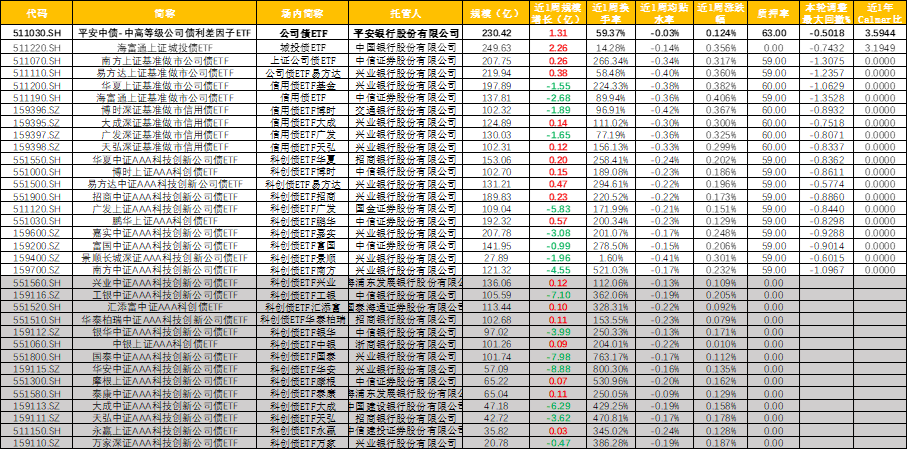
Core Insights - The total scale of credit bond ETFs is 476.9 billion yuan, with a daily decrease of 500 million yuan, indicating a trend of capital outflow from credit bond ETFs [1] - The Ping An Company Bond ETF (511030) has seen a contrary growth of 131 million yuan, attributed to its short duration of 1.95 years, static high yield of 1.97%, and minimal discount of -0.03% [1] - The average yield of credit bond ETFs is 1.92%, with a median discount rate of -13.5 basis points [1] Liquidity - The overall transaction amount reached 194.3 billion yuan, with an average single transaction amount of 4.88 million yuan [1] - The median turnover rate stands at 46.7%, reflecting active trading in the market [1] Valuation - The median yield is reported at 1.92%, while the median discount rate is -13.5 basis points, with the benchmark market-making ETF at -26.6 basis points [1] - The Ping An Company Bond ETF has the best performance in terms of drawdown control since the bond market adjustment, with a year-to-date drawdown of only -0.50% [1] Competitive Positioning - The Ping An Company Bond ETF differentiates itself from other credit bond ETFs through its unique positioning, which includes a shorter duration and lower drawdown, providing a competitive edge in the current market environment [1]

监管新信号!多家银行被罚
Jing Ji Wang· 2025-10-22 02:21
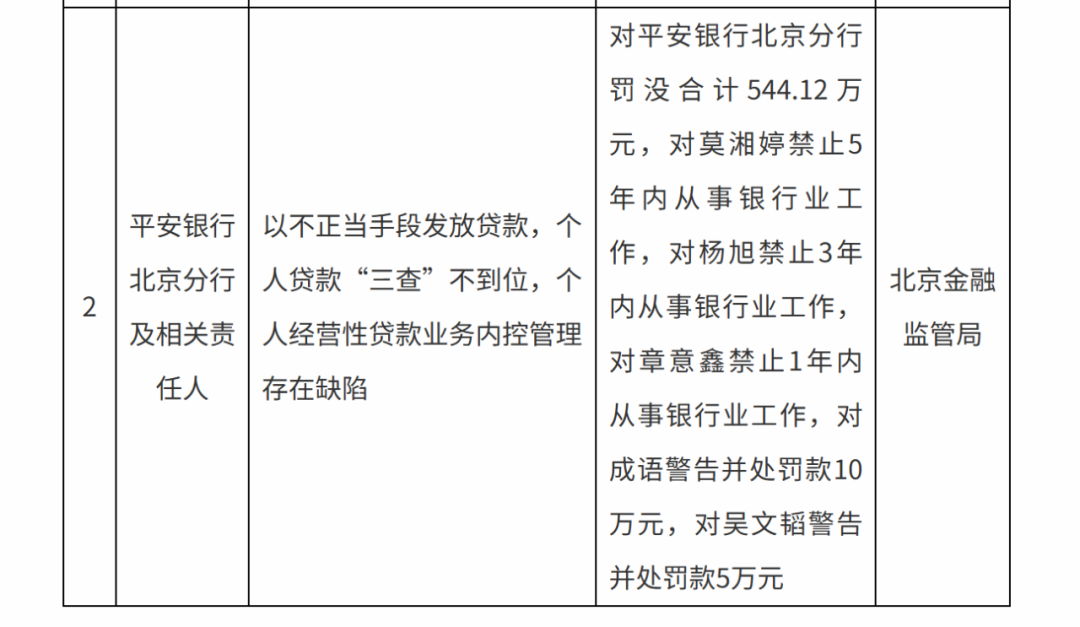
Core Viewpoint - Recent regulatory actions against multiple banks highlight a stringent regulatory environment, emphasizing the need for improved pre-loan audits and monitoring of fund flows to ensure compliance and promote standardized business practices [1][3]. Regulatory Actions - The Beijing Regulatory Bureau of the National Financial Supervision Administration disclosed penalties against Ping An Bank's Beijing branch for improper loan issuance and inadequate internal controls in personal loans, resulting in fines totaling 5.44 million yuan [2]. - Agricultural Bank of China’s Honghe branch was fined 300,000 yuan for ineffective control over loan fund flows, while its Beijing branch faced penalties for six violations related to loan monitoring and management [1][2]. - Zhejiang Zhuji United Village Bank was fined 550,000 yuan for imprudent management of personal business loans and misuse of loan funds [1]. Industry Implications - The penalties reflect a broader trend of regulatory bodies holding both institutions and individual responsible parties accountable, indicating a "double penalty" system becoming standard practice [2]. - Experts suggest that the observed credit irregularities point to deficiencies in risk control and compliance management within financial institutions, which could lead to funds being misallocated to restricted sectors like real estate [3]. - Recommendations for improvement include enhancing pre-loan audits, monitoring fund flows, and establishing a comprehensive penalty mechanism to foster compliance and mitigate financial risks [3].


利率专题:一文全览同业存单
Tianfeng Securities· 2025-10-22 01:12
1. Report Industry Investment Rating No information provided on the industry investment rating in the given content. 2. Core Viewpoints of the Report - The report focuses on the supply, demand, and pricing of inter - bank certificates of deposit (CDs), analyzes the core factors affecting their supply and demand, and discusses the supply pressure of CDs within the year. It points out that since 2025, there have been some "unusual" phenomena in CDs, and the market's concerns about CDs have resurfaced, mainly due to the potential supply pressure from the maturity of high - interest fixed - term deposits in the fourth quarter and the possible weakening of demand - side stability [11]. - Considering the central bank's current intention to support the market, the ongoing repair of real - economy credit demand, and the stable supply rhythm of government bonds, the pressure for CDs to be issued at higher prices in the fourth quarter may be relatively controllable, but there may be some stage fluctuations. The main fluctuation range of 1 - year CDs is expected to remain between 1.6% - 1.7% [5]. 3. Summary by Relevant Catalogs 3.1 Development History: The Appeal and Boundary of Active Liabilities - **2013 - 2017: Rapid Expansion after Formal Start** - In December 2013, the issuance of the "Interim Measures for the Administration of Inter - bank Certificates of Deposit" marked the formal start of the development of inter - bank CDs. From 2014 to 2017, the issuance scale increased from nearly 1 trillion yuan in 2014 to nearly 20 trillion yuan in 2017, mainly issued by small and medium - sized banks such as city commercial banks and joint - stock banks [12]. - The rapid expansion was driven by the inherent advantages of CDs as an active liability tool, the "disintermediation of deposits", the trend of interest rate liberalization, and the change in the central bank's base - money injection method [14][21]. - **2017 - 2023: Stable Development under Regulatory Constraints** - Since 2017, a series of regulatory measures have been introduced to guide the financial system to return to its origin, improve the quality and efficiency of serving the real economy, and strengthen risk prevention and control. The issuance growth of inter - bank CDs has flattened out [23]. - In terms of structure, inter - bank CDs have become the fourth - largest variety in the inter - bank market. The issuance scale of large state - owned banks has increased slightly year by year, and the proportion of 1 - year - term varieties has increased significantly since 2018 [27][28]. - **Since 2023: The Issuance Scale Rises Again** - In 2023, the annual issuance scale exceeded 25 trillion yuan, with state - owned banks accounting for 26%. In 2024, the scale exceeded 30 trillion yuan, and the proportion of state - owned banks reached 28%. This was mainly affected by the downward trend of CD issuance costs, the expansion of the deposit - loan gap, and the concentrated issuance of government bonds [32]. 3.2 Supply Willingness and Rhythm - **Liquidity Gap Management on the Liability Side** - During periods of high capital demand, such as large - scale bank credit issuance and concentrated government bond supply, the net financing scale of CDs usually increases, showing certain seasonal patterns and being affected by policies [47]. - Weak deposit growth on the liability side requires CDs to supplement liabilities, which is more of a trend change and closely related to regulatory norms [50]. - To cope with foreseeable liquidity consumption within the month and avoid large fluctuations in funds to lock in lower issuance costs, CD supply shows certain regularities within the month, usually concentrating in the first three weeks [50]. - **Cost Considerations on the Liability Side** - The demand for CD issuance is affected by the central bank's medium - and long - term liquidity injection. If banks can obtain lower - cost funds from the central bank, their willingness to issue CDs will decrease [54]. - Banks will adjust the maturity structure of CD issuance based on cost considerations. In a loose liquidity environment, they tend to lengthen the maturity of CD issuance to lock in lower financing costs [56]. - From the perspective of asset returns, if the demand for real - economy loans is expected to be strong and the asset - liability spread is expected to widen, banks tend to increase the issuance scale of CDs to reserve liability sources in advance [62]. - **Constraints of Regulatory Indicators** - Issuing inter - bank CDs helps improve liquidity regulatory indicators, especially the liquidity coverage ratio (LCR), net stable funding ratio (NSFR), and liquidity matching ratio (LMR) [65]. - Different maturities of CDs have different conversion coefficients in regulatory indicators. Long - term CDs usually have a positive impact on improving these indicators, while short - term CDs may not [66]. - **Issuance Characteristics under the Management of Filing Quotas** - The issuance of inter - bank CDs adopts a filing system, and the filing quota is managed on a balance basis. The balance of inter - bank CDs at any time within the year shall not exceed the annual filing quota [72]. - There is a negative correlation between the utilization progress of CD filing quotas and the deposit ratio. Banks with strong deposit - attracting ability and high deposit ratios have lower demands for issuing CDs [73]. 3.3 Demand Side: Who Are the Main Allocation Forces? - **Commercial Banks** - Commercial banks' allocation of CDs is a process of seeking a dynamic balance between risk and return under the constraints of regulatory frameworks and market environments. Different banks have different allocation logics due to differences in liability costs, credit issuance, and regulatory indicators [84][86]. - Rural commercial banks and large banks are the main buyers of CDs. Rural commercial banks' allocation logic has changed since 2023, from a "seesaw" relationship with credit issuance to focusing more on the allocation value of CDs in an "asset shortage" situation [88][89]. - Large banks' weak credit issuance demand in recent years has increased their demand for allocating CDs, and they show a characteristic of increasing net purchases at the end of the month [98]. - **Bank Wealth Management** - Bank wealth management shows a distinct right - hand trading characteristic in investing in CDs and is also affected by factors such as liability - side stability, regulatory requirements, and monetary policy. In recent years, the expansion of the liability side has increased its demand for CD allocation [102]. - Current - management wealth management products are the main force in CD allocation, preferring short - term CDs due to regulatory restrictions on the average remaining maturity of product investment portfolios [102]. - **Money Market Funds** - Compared with the right - hand trading of wealth management products, the peak of net purchases by money market funds usually coincides with the inflection point of CD interest rates, which may drive the inflection point of CD prices to some extent [4]. 3.4 How Are CDs Priced? - **Theoretical Pricing Benchmark of CDs** - Policy interest rates (MLF/OMO + 30BP) form the theoretical upper limit of CD pricing, while SHIBOR, DR interest rates, deposit interest rates, and R001 form the theoretical lower limit. This pricing system anchors CD interest rates by affecting supply and demand [5]. - **Core Factors Affecting CD Supply and Demand** - In the short term, CD interest rates are affected by supply and demand forces, including the liability - side capital gap, liability costs, asset returns, regulatory regulations and assessments, and the institutional behavior of allocation forces [5]. - **Outlook on the Supply Pressure of CDs within the Year** - Considering the central bank's support intention, the ongoing repair of real - economy credit demand, and the stable supply rhythm of government bonds, the pressure for CDs to be issued at higher prices in the fourth quarter may be relatively controllable, but there may be some stage fluctuations. The main fluctuation range of 1 - year CDs is expected to remain between 1.6% - 1.7% [5].
银行聚焦信用卡与储蓄卡发力“双11”!
Zheng Quan Ri Bao· 2025-10-22 00:17
Core Insights - The article highlights the increasing competition among banks during the "Double 11" shopping festival, focusing on credit and debit card promotions to stimulate consumer spending and capture market share [1][4]. Group 1: Credit Card Promotions - Banks are launching various promotional activities for credit cards, including "discounts for spending" and "interest-free installment plans" to meet consumer shopping needs [2][3]. - For instance, Ping An Bank's credit card offers significant discounts on major e-commerce platforms, integrating national subsidies with credit card benefits to enhance consumer incentives [2][3]. Group 2: Debit Card Promotions - Several banks are promoting debit cards with cashback offers and exclusive discount coupons, linking online and offline services to provide comprehensive benefits [3][4]. - China Bank, in collaboration with Alipay, has introduced a "daily discount" campaign during the "Double 11" period, allowing users to enjoy random discounts based on their spending [3]. Group 3: Market Dynamics and Strategy - The focus on credit and debit cards during "Double 11" aligns with banks' goals to stimulate consumer spending and enhance transaction volumes, thereby increasing fee-based income [4][5]. - This strategy not only aims to activate dormant accounts but also to gather extensive consumer data for future targeted marketing [4][5]. Group 4: Consumer and Market Impact - The promotional activities are expected to lower shopping costs for consumers while potentially increasing the risk of overspending due to the convenience of credit [5]. - The combination of bank payment incentives and e-commerce promotions is anticipated to amplify the overall consumption scale during the festival, injecting vitality into the real economy [5]. Group 5: Future Considerations - The challenge for banks lies in converting the influx of new users during "Double 11" into long-term customers, moving from "traffic" to "retention" [5]. - Recommendations for banks include optimizing services, integrating new consumer trends, and enhancing digital marketing strategies to improve user experience and brand loyalty [6].
海南矿业股份有限公司关于控股股东股份解除质押及再质押的公告
Shang Hai Zheng Quan Bao· 2025-10-21 19:29
证券代码:601969 证券简称:海南矿业 公告编号:2025-119 海南矿业股份有限公司 关于控股股东股份解除质押及再质押的公告 本公司董事会及全体董事保证本公告内容不存在任何虚假记载、误导性陈述或者重大遗漏,并对其内容 的真实性、准确性和完整性承担法律责任。 重要内容提示: ● 截至本公告日,海南矿业股份有限公司(以下简称"公司")控股股东上海复星高科技(集团)有限公 司(以下简称"复星高科")持有公司股份949,056,507股,占公司股份总数的47.49%;本次解除质押并再 质押后,累计质押公司股份(含本次)700,000,000股,占其所持公司股份数的73.76%,占公司股份总 数的35.03%。 公司于2025年10月21日收到复星高科关于股份解除质押及再质押的通知,具体事项如下: 一、上市公司股份解除质押 复星高科于2025年10月20日将质押给平安银行股份有限公司的公司股份解除质押,情况如下: ■ 二、上市公司股份质押 2025年10月20日,复星高科将其所持有本公司的部分股份质押给平安银行股份有限公司深圳分行(以下 简称"平安银行深圳分行"),并已在中国证券登记结算公司上海分公司办理完成质 ...

银行聚焦信用卡与储蓄卡发力“双11”
Zheng Quan Ri Bao· 2025-10-21 16:39
Core Viewpoint - The banking sector is leveraging the "Double 11" shopping festival to enhance credit and debit card promotions, aiming to stimulate consumer spending and capture market share in response to rising consumer demand [1][4]. Group 1: Credit Card Promotions - Banks are focusing on credit card marketing during "Double 11," offering payment discounts, installment benefits, and reward points to meet consumer shopping needs [2]. - Specific promotions include "direct discounts" on designated e-commerce platforms and "interest-free installment" policies for large purchases, effectively alleviating short-term payment pressures [2]. - For instance, Ping An Bank's credit card campaign emphasizes "three savings," covering major platforms and integrating national subsidies with credit card installment offers to maximize consumer benefits [2]. Group 2: Debit Card Promotions - Debit card promotions are highlighted by cashback offers and exclusive discount coupons, with some banks linking online and offline services to create integrated discounts [3]. - An example includes Bank of China’s collaboration with Alipay for the "11.11 Daily Discount" campaign, allowing users to enjoy random discounts based on their spending during the promotional period [3]. - Several banks, including Agricultural Bank, Postal Savings Bank, and others, have launched related promotional activities for both credit and debit cards during "Double 11" [3]. Group 3: Market Dynamics and Strategy - The focus on credit and debit cards aligns with consumer demand during peak shopping seasons and supports banks' business development goals [4]. - Credit cards stimulate consumer spending through overdraft features, while debit cards encourage fund accumulation and enhance liquidity [4]. - This strategy not only boosts transaction volumes and fee income for banks but also increases user engagement and market share [5]. Group 4: Long-term Customer Retention - While "Double 11" serves as a significant opportunity for customer acquisition, the challenge remains in converting short-term users into long-term customers [5]. - Recommendations for banks include optimizing services, simplifying payment processes, and offering personalized promotions to enhance user experience [6]. - Additionally, banks should focus on responsible consumption guidance to build a trustworthy brand image [6].
10月24日起!平安银行积存金定投起投金额上调至1100元
Bei Jing Shang Bao· 2025-10-21 12:23
Core Viewpoint - Ping An Bank announced adjustments to its gold accumulation business due to significant fluctuations in domestic gold prices, increasing the minimum investment amount for its fixed investment plan from 900 yuan to 1100 yuan, effective October 24, 2025 [1] Group 1 - Ping An Bank's announcement is a response to recent volatility in gold prices in the domestic market [1] - The adjustment aligns with regulatory requirements related to gold accumulation business [1] - The new minimum investment amount reflects the bank's strategy to adapt to market changes [1]
美元债与汇率2025年四季度策略:波动回归
Ping An Securities· 2025-10-21 10:28
Market Review - US Treasury yields declined overall in Q3, with fluctuations in the yield curve. The decline was driven by weaker non-farm data and the emergence of rate cut expectations, with yields dropping from around 4.4%-4.5% to approximately 4.25% [7][9]. - High-yield Chinese dollar bonds underperformed investment-grade bonds but performed better than US Treasuries, influenced by debt restructuring among real estate companies [9][11]. Interest Rate Strategy - Increased volatility is expected, with stronger certainty in the short end. The government shutdown in October led to minimal disruption in the bond market, maintaining a low volatility environment. However, potential negative factors such as government reopening and tariff negotiations could increase volatility in November [38][39]. - The unemployment rate data in November may be technically affected by the government shutdown, potentially leading to an increase [42][43]. Currency Outlook - The US dollar index is expected to maintain a strong oscillation, projected to range between 95-105 points. External factors are not anticipated to exert significant pressure on the dollar index, which may follow domestic rate cut expectations [46][47]. - The fiscal expansion in Germany is expected to begin in Q4, while France faces a fiscal deadlock and the UK has a fiscal gap to address, which may hinder overall fiscal expansion in Europe [48][53]. Dollar Bond Strategy - Credit spreads are expected to rise initially and then decline, with a recommendation to buy on highs. Focus should be on sectors like brokerages and state-owned enterprises that have shown resilience during tariff shocks [58][69]. - The recent increase in supply of Chinese real estate bonds is attributed to debt restructuring efforts by some developers [62]. Employment and Inflation - Consumer spending in the US showed recovery in Q3, outperforming Q2, with steady growth in service and non-durable goods consumption [18][19]. - Inflationary pressures are anticipated to increase in the coming months, driven by tariff impacts on core goods prices [23][24]. Investment Strategy - The report suggests a focus on stable sectors such as essential consumer goods and brokerages, which have demonstrated resilience during market fluctuations [64][69]. - The strategy emphasizes flexibility in adjusting credit bond investments based on tariff developments, with a recommendation to buy on highs [70].
10月21日动量因子R(480057)指数涨1.72%,成份股瑞达期货(002961)领涨
Sou Hu Cai Jing· 2025-10-21 10:06
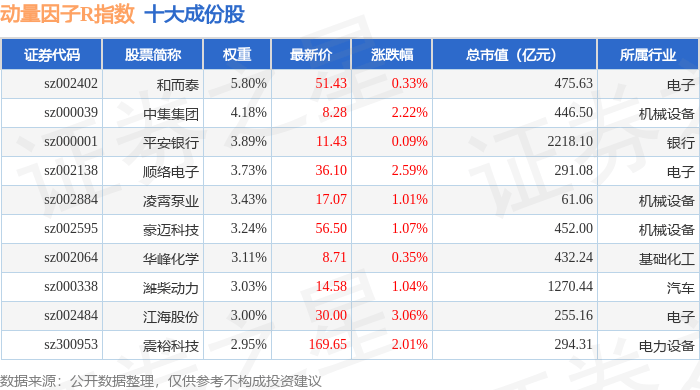
Core Insights - The Momentum Factor R (480057) index closed at 2744.45 points, up 1.72%, with a trading volume of 40.255 billion yuan and a turnover rate of 1.79% [1] - Among the index constituents, 46 stocks rose, with Ruida Futures leading at a 9.98% increase, while 3 stocks fell, with Xinhecheng leading the decline at 0.3% [1] Index Constituents Summary - The top ten constituents of the Momentum Factor R index include: - Heertai (5.80% weight, latest price 51.43, market cap 47.563 billion yuan) in the electronics sector - Zhongjun Group (4.18% weight, latest price 8.28, market cap 44.650 billion yuan) in machinery - Ping An Bank (3.89% weight, latest price 11.43, market cap 221.810 billion yuan) in banking - Shunluo Electronics (3.73% weight, latest price 36.10, market cap 29.108 billion yuan) in electronics - Linggongquan (3.43% weight, latest price 17.07, market cap 6.106 billion yuan) in machinery - Mengmai Technology (3.24% weight, latest price 56.50, market cap 45.200 billion yuan) in machinery - Huafeng Youxue (3.11% weight, latest price 8.71, market cap 43.224 billion yuan) in basic chemicals - Weichai Power (3.03% weight, latest price 14.58, market cap 127.044 billion yuan) in automotive - Jianghai Co. (3.00% weight, latest price 30.00, market cap 25.516 billion yuan) in electronics - Nongyu Technology (2.95% weight, latest price 169.65, market cap 29.431 billion yuan) in power equipment [1] Capital Flow Analysis - The net inflow of main funds into the index constituents totaled 1.292 billion yuan, while retail funds saw a net outflow of 0.592 billion yuan [1] - Specific stock capital flows include: - Dongshan Precision with a net inflow of 94.5 million yuan from main funds - Ding Tai High-Tech with a net inflow of 13.2 million yuan from main funds - Ruida Futures with a net inflow of 11.3 million yuan from main funds [2]

两家股份行同日宣布上调积存金起购金额,最高调整至1200元
Cai Jing Wang· 2025-10-21 09:11
Core Viewpoint - The continuous rise in gold prices has led several banks to adjust their minimum purchase amounts for gold accumulation products, reflecting the market's response to price fluctuations [1][2]. Group 1: Gold Price Trends - As of October 20, COMEX gold futures rose by 3.82%, reaching a record high of $4,374.3 per ounce [1]. - The increase in gold prices has prompted at least seven banks to raise the minimum purchase thresholds for gold accumulation products in the past two weeks [2]. Group 2: Bank Adjustments - Industrial Bank and Ping An Bank announced an increase in their gold accumulation business minimum purchase amounts by 200 yuan, marking the largest adjustment of the year [1]. - Industrial Bank's new minimum purchase amount for gold accumulation is set at 1,200 yuan, while Ping An Bank's is now 1,100 yuan, effective from October 24, 2025 [1]. - Other banks, including Urumqi Bank, Ningbo Bank, and Agricultural Bank, have also raised their minimum purchase amounts, with most banks now setting thresholds around 1,000 yuan [2]. Group 3: Risk Awareness - In light of the volatile gold prices, seven major national banks have issued risk alerts, advising investors to be cautious and to manage their gold asset allocations wisely [3]. - China Construction Bank has issued multiple risk warnings, emphasizing the need for clients to monitor their positions and margin balances closely [3].

