
腾讯

Search documents
上海发力开源体系建设
Guo Ji Jin Rong Bao· 2025-11-11 12:29
Core Viewpoint - The Shanghai government has approved a plan to strengthen the open-source ecosystem, aiming to accelerate innovation, attract global talent, and cultivate leading enterprises in the open-source field, positioning Shanghai as a leader in technology and industry transformation [1][6]. Group 1: Open Source Ecosystem Development - The plan outlines a core path for building the open-source ecosystem in Shanghai, focusing on encouraging enterprises and research institutions to share innovation results, particularly in foundational and industrial software [2]. - The initiative aims to transition from a "usage ecosystem" to a "dominant ecosystem" by fostering original open-source projects with international influence [2]. - The strategy includes creating high-quality open-source communities and an incentive system for developers to attract global talent to Shanghai [2]. Group 2: AI and Open Source Models - The open-source model in the AI sector has seen significant growth, with major companies like Alibaba and Tencent releasing multiple open-source models in July 2023 [3]. - The MiniMax-M2 model has achieved a top-five ranking globally in the Artificial Analysis evaluation, showcasing China's competitive edge in AI open-source technology with a cost-effective solution [3]. - SenseNova-SI series models have outperformed international closed-source models, indicating a shift in China's AI landscape from "technology catching up" to "ecosystem leadership" [4]. Group 3: Challenges and Opportunities - The open-source model allows small and medium enterprises to leverage existing models, significantly lowering the technical entry barrier [5]. - Experts highlight the need for a shift from a "model-centric" to a "data-centric" approach in AI, emphasizing the importance of high-quality data infrastructure [5]. - The Shanghai plan aims to address the challenges of open-source development by enhancing technological innovation and talent aggregation while ensuring data security and value release [6].


2026年传媒年度策略:十五五启幕AI赋能媒介与内容新叙事
Huaxin Securities· 2025-11-11 12:02
Group 1 - The report emphasizes the transition into the AI era, highlighting the need for media and content industries to adapt to new user demands and leverage AI for growth opportunities [3][4][5] - The cultural media sector is positioned for growth due to two main variables: the initiation of the 14th Five-Year Plan and the empowerment of AI technology, which is shifting from market-driven to policy-driven [4][7] - State-owned enterprises are expected to play a crucial role in the cultural media sector, with companies like Oriental Pearl and Mango TV being highlighted as key players benefiting from AI integration [6][11] Group 2 - The report outlines the performance of the cinema sector, noting that while 2025 saw some challenges, the upcoming 2026 year is expected to bring new content supply and potential growth [30][31] - The digital marketing and e-commerce sectors are experiencing a transformation driven by AI, with significant growth projected in the smart marketing space, expected to reach 1.49 trillion yuan by 2026 [55] - The gaming industry is highlighted as needing to focus on high-quality content production, with companies like miHoYo and Lilith Games being noted for their successful titles, indicating a shift towards content-driven gaming experiences [58][59] Group 3 - The report discusses the importance of long and short video platforms, with significant user engagement noted, particularly in the short video segment, which has reached 1.129 billion monthly active users [36][37] - The audio content market is projected to grow significantly, with the long audio market expected to reach 649.77 billion yuan by 2026, indicating a shift in consumer preferences towards immersive audio experiences [40] - Companies like Bilibili and Xiaohongshu are expanding into audio content, which is expected to drive new user engagement and revenue streams [40][42] Group 4 - The report identifies key companies to watch in the cultural media sector, including state-owned enterprises and digital marketing firms, emphasizing their strategic importance in the evolving landscape [11][12] - The cinema sector is expected to see a rebound in 2026, with new film releases anticipated to drive box office performance, particularly following a low base effect from 2025 [30][31] - The gaming sector is under pressure to innovate and produce high-quality content, with a focus on new product launches and the integration of AI technologies to enhance user experiences [58][59]


10月AI月报:全球AI下载4.9亿,豆包下载量上涨
Tai Mei Ti A P P· 2025-11-11 09:33
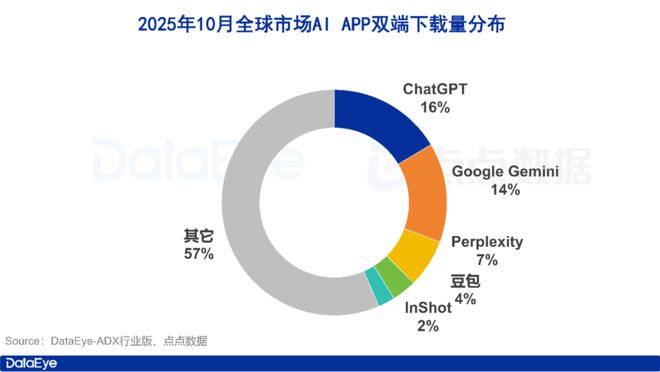
Core Insights - In October, downloads for ChatGPT and Google Gemini declined, while the overseas version of Doubao, renamed "Dola," saw a significant increase in downloads [1][3] - The AI application industry is experiencing notable changes and trends, with a focus on download volumes and advertising material [1] Group 1: Overall Market Data - In October 2025, the estimated total downloads for AI apps across Apple App Store and Google Play reached 490 million, a decrease of 2.7% from September [3] - The top five AI applications, including ChatGPT and Google Gemini, accounted for 43% of global downloads, with slight declines in their respective shares [3] - In the mainland market, Apple App Store downloads for AI apps totaled approximately 30.59 million, down 20.8% from September [7] Group 2: Top AI Apps Download Changes - Globally, ChatGPT and Google Gemini led the market, with daily downloads stabilizing around 2.6 million and 3.2 million, respectively, before declining to about 2 million by the end of October [11] - Perplexity saw an increase in downloads, rising from approximately 630,000 to a peak of 1.36 million, although it experienced a drop towards the end of the month [11] - In the mainland market, Doubao maintained a leading position with stable daily downloads around 200,000, while other apps like Jimeng AI showed significant fluctuations [14] Group 3: Advertising Material Distribution - In October, the mainland market saw a total of 1.195 million advertising materials for AI products, a decrease of 15.3% from September [18] - Tencent Yuanbao and Quark led the material distribution, accounting for 39% and 35% of the total, respectively [18] - Doubao, Kuaishou, and Wen Xiaoyan followed, with Doubao's material volume significantly higher than the others [23] Group 4: Download Rankings - In the global market, ChatGPT retained the top position with 79.99 million downloads, a decline of 6.1%, while Google Gemini followed with 69.39 million, down 8.7% [27] - Perplexity and Doubao ranked third and fourth, with downloads of 33.72 million and 17.13 million, respectively, showing significant growth for Perplexity [27] - In the mainland market, Doubao led with 6.44 million downloads, a 4.1% increase, while Jiemeng AI and Tencent Yuanbao followed with 4.95 million and 4.03 million downloads, respectively [31] Group 5: Advertising Material Rankings - Tencent Yuanbao topped the advertising material rankings with 468,089 materials, although this represented a 20.1% decrease from September [35] - Quark and Doubao followed with 418,534 and 112,020 materials, respectively, both also experiencing declines [35] - Kuaishou and Wen Xiaoyan advanced in the rankings, with significant increases in their material volumes [35]
超5万亿,史诗级买入
Ge Long Hui· 2025-11-11 09:17
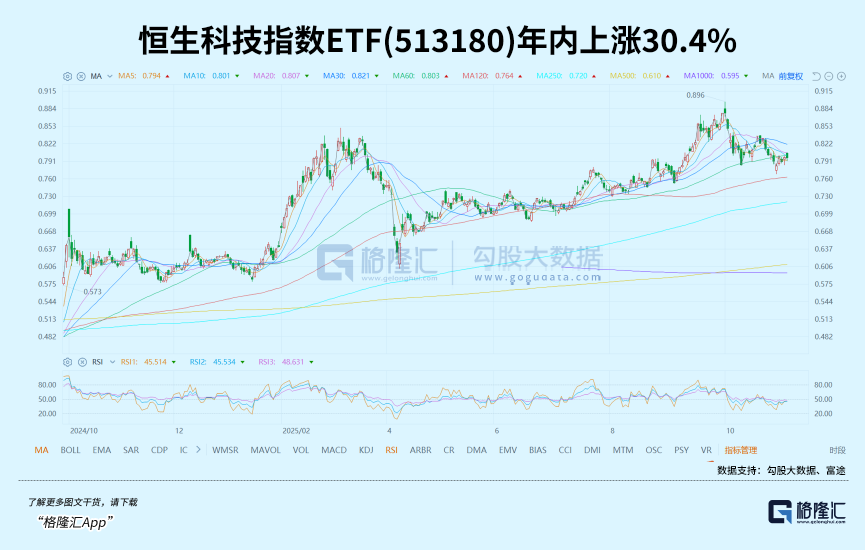
Group 1 - The core point of the article highlights that southbound funds have achieved a net purchase of over 1.3 trillion HKD this year, with cumulative net inflows surpassing 5 trillion HKD since the launch of the Stock Connect program [1][14]. - The technology sector remains a key area for capital inflows in the Hong Kong stock market, with the Hang Seng Technology Index ETF rising by 30.4% this year and the Hong Kong Stock Connect Technology ETF gaining 44.19% [2][4]. - Despite the market being in a correction phase, multiple positive signals, including domestic economic plans and easing international relations, are expected to inject new momentum into the Hong Kong market [4][30]. Group 2 - The Hang Seng Technology Index has corrected over 10% from its peak this year, but the current macro environment is less uncertain compared to previous months, suggesting a lower probability of extreme corrections [6][8]. - Analysts predict that major internet companies will maintain revenue growth rates between 10% and 15%, with ongoing cost reduction strategies improving profit margins [9][10]. - The valuation of the Hong Kong technology sector remains attractive, with the Hang Seng Technology Index ETF's PE ratio at 23.09, significantly lower than the Nasdaq's 42.5 [11][12]. Group 3 - The inflow of long-term capital, primarily from insurance and public funds, is expected to continue, with projections of an additional 1.54 trillion HKD in southbound funds by the end of next year [17][18]. - The sustained inflow of these long-term funds is improving market structure and pushing the Hong Kong stock market towards a fundamental-driven valuation [18][20]. - Foreign capital has shown a net inflow trend since 2025, particularly in the technology sector, indicating a strong interest in core assets [19][20]. Group 4 - The rise of AI technology has made core AI assets highly sought after globally, with major tech companies in Hong Kong becoming essential market players [22][24]. - These tech giants are capable of achieving high-quality revenue and profit growth, supported by strong competitive advantages and robust ecosystems [25][28]. - The article emphasizes that Hong Kong's tech giants are well-positioned in the AI revolution, possessing the necessary data and capital to drive innovation and growth [26][27]. Group 5 - Despite recent market volatility, the direction of AI industry development remains unchanged, with positive factors influencing technology company valuations [30][31]. - Investors are encouraged to focus on market changes to capture turning points and new opportunities, particularly in core AI technology companies and related ETFs [31][32]. - The Hang Seng Technology Index ETF and the Hong Kong Stock Connect Technology ETF are highlighted as key investment vehicles, with significant assets under management and a focus on leading tech firms [32][33].
大厂“爱”上车,“野蛮人”还是“送水人”?
3 6 Ke· 2025-11-11 07:52
Core Insights - The article highlights the aggressive entry of major internet companies into the automotive industry, particularly in the electric vehicle (EV) sector, as they seek to capitalize on the growing market opportunities presented by the shift towards new energy and smart vehicles [1][7][12] Group 1: Market Dynamics - Aion UT Super, a new energy vehicle, has topped JD.com's sales rankings during the Double Eleven shopping festival, showcasing the potential of low-cost EVs with battery rental options [1] - Major internet firms like Alibaba, Tencent, and Baidu are expanding their presence in the automotive sector, focusing on various aspects such as production, sales, maintenance, and mobility services [1][7] - The penetration rate of new energy vehicles in China reached 58.7% by October 2025, a significant increase from 20% three years prior, indicating a shift from niche to mainstream adoption [7] Group 2: Strategic Collaborations - Alibaba's strategic partnership with Shanzi Gaoke aims to explore new retail models for smart vehicle customization, with the first project, the V17 model, already in testing [4][6] - Alibaba has been investing in the automotive sector since 2014, establishing a comprehensive O2O service model for car sales, and has made significant investments in companies like Xpeng Motors and partnerships with SAIC [6][12] Group 3: Technological Integration - The automotive industry is transitioning from mechanical products to smart terminals, with AI, big data, and cloud computing being core strengths of internet companies, facilitating cross-industry collaborations [9][10] - Baidu's autonomous driving service, "Luobo Kuaipao," has completed over 17 million rides globally, demonstrating the potential of turning vehicles into "mobile smart spaces" [9] - Meituan's self-developed delivery vehicle, equipped with L4-level autonomous driving capabilities, enhances delivery efficiency while collecting valuable real-world data for technology iteration [9] Group 4: Ecosystem Development - Internet companies are seeking a second growth curve as traditional business growth slows, with the automotive industry's smart transformation providing a new direction for expansion [12] - JD.com focuses on leveraging its retail and logistics strengths to enhance car sales and usage, while Alibaba aims to integrate automotive services into a broader lifestyle ecosystem [12][13] - The competition among internet giants in the automotive ecosystem is not about replacing traditional automakers but rather reshaping the industry's value distribution and encouraging a shift towards an ecosystem mindset [13]



恒指微跌0.20%,百度集团-SW上涨3.34%
Mei Ri Jing Ji Xin Wen· 2025-11-11 05:05
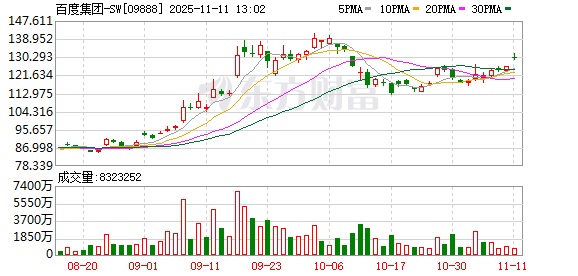
Group 1 - The Hang Seng Index slightly declined by 0.20% to 26,595.97 points, with the Hang Seng Tech Index down 0.25% and the Hang Seng China Enterprises Index down 0.32%, while the market's half-day turnover was HKD 118.31 billion [1] - Notable stock movements included Xpeng Motors rising by 15.11%, Baidu Group increasing by 3.34%, and Kingdee International up by 1.61%. Conversely, Tencent Music fell by 2.35%, Alibaba by 2.33%, and JD Group by 2.09% [1] - Guotai Junan Securities reported that after a prolonged adjustment, the valuation of the Hong Kong internet sector has entered an attractive range, with the latest PE ratio of the Hang Seng Internet Technology Index at 21.73 times, which is at the 16.67% historical low over the past decade [1] Group 2 - The core narrative of the Hong Kong internet sector is undergoing a fundamental shift from user growth and business models to a new growth curve driven by "AI empowerment" [1] - Recent industry developments, such as Alibaba's establishment of a "Robotics and Embodied AI Group" and Tencent's mixed Yuan image model ranking first in global blind tests, indicate that AI is moving from concept to practical application, potentially reshaping the market value of internet giants [2] - The Hang Seng Internet ETF (513330) supports T+0 trading and focuses on the platform economy, covering major internet leaders like Alibaba, JD, Tencent, Meituan, Kuaishou, and Baidu, making it a good tool for investors to allocate to AI application and "AI + Internet" core assets [2]

恒指微跌0.20% 百度集团-SW上涨3.34%
Mei Ri Jing Ji Xin Wen· 2025-11-11 05:01
Market Overview - The Hang Seng Index slightly declined by 0.20% to 26,595.97 points, while the Hang Seng Tech Index fell by 0.25% and the Hang Seng China Enterprises Index decreased by 0.32%. The market's half-day trading volume was HKD 118.31 billion [2]. Company Performance - Xpeng Motors (XPEV) saw a significant increase of 15.11%, while Baidu (BIDU) rose by 3.34% and Kingdee International (0268.HK) increased by 1.61%. Conversely, Tencent Music (TME) dropped by 2.35%, Alibaba (BABA) fell by 2.33%, and JD.com (JD) decreased by 2.09%. Tsinghua Tongfang (Tengsheng Bo Pharmaceutical) rose by 1.65% after presenting breakthrough data at the 2025 AASLD conference [2]. Industry Insights - Guotai Junan Securities reported that the valuation of the Hong Kong internet sector has become highly attractive after a prolonged adjustment. The latest price-to-earnings (PE) ratio for the Hang Seng Internet Technology Index is 21.73, placing it at the 16.67% historical low over the past decade, indicating that the sector is undervalued [3]. - A fundamental shift in the core narrative of the Hong Kong internet sector is occurring, moving from a focus on user growth and business models to the new growth curve brought by "AI empowerment." Recent developments, such as Alibaba's establishment of a "Robotics and Embodied AI Group" and Tencent's mixed-image model achieving first place in global blind tests, demonstrate that AI is transitioning from concept to practical application, potentially reshaping the market value of internet giants [3]. - The Hang Seng Internet ETF (513330) supports T+0 trading and focuses on the platform economy, including major internet leaders like Alibaba, JD.com, Tencent, Meituan, Kuaishou, and Baidu. With a DeepSeek content ratio of 86%, it possesses dual attributes of "new consumption + new technology," making it a suitable tool for investors looking to allocate resources to AI applications and "AI + internet" core assets [3].
高开低走!恒指午间收跌0.2%,煤炭股回调,影视股继续活跃,小鹏汽车飙涨超15%
Ge Long Hui· 2025-11-11 04:07
Market Performance - The Hong Kong stock market showed a high open but low close trend in the morning session, with the Hang Seng Index down by 0.2%, the Hang Seng China Enterprises Index down by 0.32%, and the Hang Seng Tech Index down by 0.25%, failing to maintain the strong performance from the previous day [1] Sector Performance - Major technology stocks experienced a decline, with Alibaba, JD.com, and Meituan each dropping over 2%, while Tencent fell nearly 1% [1] - The coal sector collectively retreated, and semiconductor chip stocks, Chinese brokerage stocks, home appliance stocks, and military industry stocks also faced pressure [1] Film and Entertainment Sector - Several major IP films are set to be released soon, with the annual box office expected to reach 50 billion yuan, leading to continued activity in the film and entertainment stocks [1] - Maoyan Entertainment recorded a seven-day rising trend in its stock price [1] Banking and Real Estate Sector - Most banking stocks, real estate stocks, and airline stocks saw an increase [1] Automotive Sector - XPeng Motors surged over 15%, and the new generation humanoid robot IRON has garnered significant attention, receiving strong endorsements from several leading institutions [1]
2026年宏观与政策展望:万里豁晴川
citic securities· 2025-11-11 03:46
Market Overview - Chinese market rebounded on Monday, with October CPI rising, significantly boosting consumer stocks[3] - European stock markets closed strongly, with optimism over the potential end of the US government shutdown enhancing market sentiment[3] - US stock indices saw substantial gains, led by technology stocks, with the Nasdaq rising 2.3%[9] Economic Indicators - US Senate made progress on a bill to end the federal government shutdown, which is expected to restore data releases and strengthen market expectations for a Fed rate cut in December[4] - October CPI in the US showed a slowdown in the price increase of durable and personal goods for the first time in three months[6] Commodity and Forex Markets - Gold prices surged nearly 3%, reaching a two-week high, supported by positive market sentiment[4] - Oil prices also increased, with NY crude oil rising 0.64% to $60.13 per barrel[24] Fixed Income Market - US Treasury yields rose ahead of the holiday, with a strong demand for a $58 billion 3-year Treasury auction, exceeding expectations[5] - Asian bond markets showed slow trading but maintained a resilient sentiment, with bond spreads narrowing by 1-3 basis points[28] Stock Performance - Hong Kong's Hang Seng Index rose 1.55%, driven by large tech stocks and a rebound in consumer sectors[10] - A-shares showed mixed results, with the Shanghai Composite Index up 0.53% and strong performances in consumer stocks like Shanxi Fenjiu, which rose 6%[14] Global Market Trends - The KOSPI index in South Korea surged 3.0%, reflecting a broad recovery in the Asia-Pacific region[18] - The MSCI Asia Emerging Markets Index (excluding China) showed positive movement, indicating a favorable outlook for the region[20]
小鹏IRON点燃机器人主题,多家机构认为小鹏汽车估值逻辑有望重构
Mei Ri Jing Ji Xin Wen· 2025-11-11 03:07
Core Viewpoint - The recent performance of Hong Kong stocks shows mixed results, with a notable rise in shares of XPeng Motors following the announcement of their new AI-driven products, including the IRON robot and flying car, which may enhance market confidence in domestic technology [1][2]. Group 1: Market Performance - The three major indices in Hong Kong opened high but experienced a decline, with tech stocks showing mixed results and some automotive stocks gaining strength [1]. - The Hang Seng Technology Index ETF (513180) followed the index's downward trend, with leading stocks like Alibaba and JD.com declining, while XPeng Motors and Baidu saw gains, with XPeng rising over 15% at one point [1]. - The Hong Kong Stock Connect Automotive ETF (159323) rose against the trend, driven by XPeng's strong performance, gaining over 2.5% [1]. Group 2: Product Launch and Innovation - XPeng Motors recently unveiled four significant applications at the 2025 XPeng Technology Day, including the second-generation VLA model, Robotaxi, the new IRON humanoid robot, and a flying car [1]. - The IRON robot attracted widespread attention due to its fluid movements and advanced AI capabilities, with the CEO demonstrating its mechanical structure to address authenticity concerns [1]. Group 3: Investment Insights - According to Shenwan Hongyuan, the IRON robot's humanoid design highlights China's leading position in robotics technology, suggesting that XPeng Motors and its supply chain could be undervalued [2]. - Changjiang Securities noted that XPeng's valuation has primarily focused on its automotive business, with AI applications like Robotaxi and flying cars not yet reflected in its valuation, indicating potential for significant valuation growth compared to Tesla [2].
